
GET IN TOUCH
Ask For Sample?
How Does a Cationic Polymer Pool Clarifier Work?
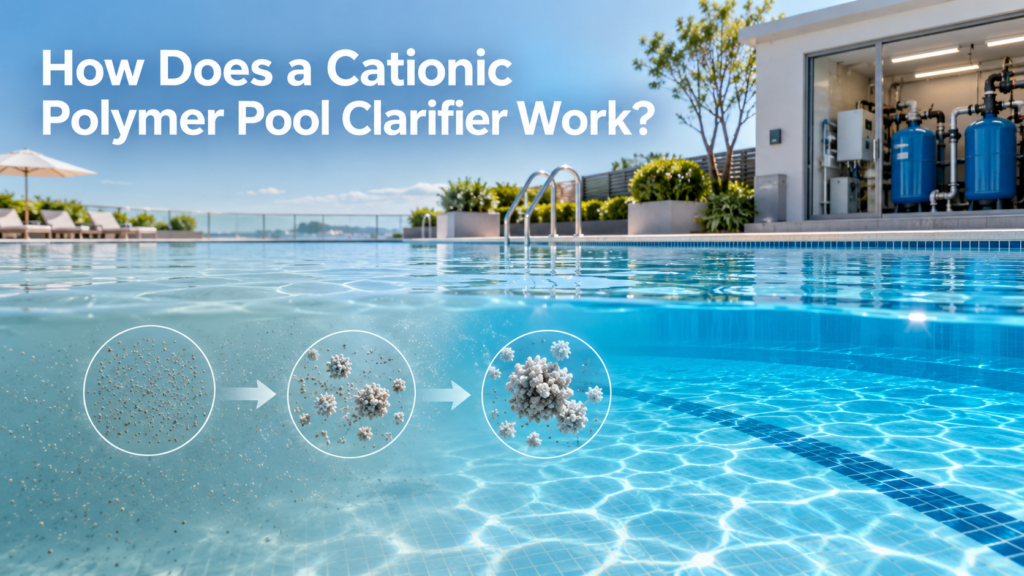
A swimming pool can have acceptable chlorine and pH readings yet still look slightly dull, hazy, or cloudy. That seems unfair, doesn’t it? The basic chemistry may be under control, but thousands of tiny suspended particles can remain in the water.
Many of these particles are too small for the pool filter to capture efficiently. They pass through the filter media, return to the pool, and continue scattering light. The water may be sanitary, but it does not have that bright, polished appearance swimmers expect.
A cationic polymer pool clarifier helps solve this problem by changing how those particles behave. It does not simply “clear” the water by magic. It brings fine particles together, creating larger clusters that the filtration system can remove more easily.
That sounds simple. The chemistry behind it, however, is rather clever.
First, Why Do Fine Particles Stay Suspended?
Cloudy pool water contains many kinds of microscopic material, including:
- Dust and airborne dirt
- Pollen and plant debris
- Dead algae
- Sunscreen and cosmetic residues
- Body oils and perspiration
- Fine mineral particles
- Organic matter introduced by swimmers
- Debris washed into the pool after rain
- Very small particles created during chemical treatment
Some particles settle naturally. Others remain suspended for hours or even days.
Their small size is part of the problem. A particle may be only a few microns across, making it difficult for a sand filter—and sometimes even a cartridge or diatomaceous earth filter—to retain it during a normal filtration cycle.
Size is not the whole story, though.
Many suspended particles in pool water carry a weak negative surface charge. When two particles with similar negative charges approach each other, they repel. The effect is a little like trying to push the same poles of two magnets together.
The particles may collide as the water circulates, but they do not readily stick. Instead, they separate again and continue floating.
This condition is known as colloidal stability. It is one reason why a pool can remain cloudy even while the pump and filter are running properly.
What Does “Cationic Polymer” Mean?
Let’s break the term into two parts.
“Cationic” means that the material carries positive electrical charges.
A “polymer” is a large molecule made from many repeating chemical units joined together in a chain. Depending on its design, that chain may be linear, branched, short, or long. It may also carry positive charges at many points along its structure.
Put those ideas together and you have a long, positively charged molecule.
Common cationic pool clarifiers may be based on water-soluble polymers such as polyDADMAC, also known by the CAS number 26062-79-3. Commercial formulations can differ in concentration, molecular weight, charge density, color, viscosity, and intended dosage, so two products that appear similar may not perform in exactly the same way.
When a correctly formulated cationic polymer is added to pool water, its positive charge is attracted to negatively charged suspended matter.
That attraction begins the clarification process.
Step One: The Polymer Disperses Through the Pool
A liquid clarifier is normally added while the circulation system is operating. Water movement distributes the product across the pool and brings polymer molecules into contact with suspended particles.
Good circulation matters here. If the product remains concentrated in one small area, its distribution may be uneven. Some particles may receive too much polymer while others receive very little.
Once dispersed, the positively charged sites along the polymer chain begin interacting with negatively charged particle surfaces.
Imagine a long strip of hook-and-loop fastener drifting through the water. One part touches a fine particle and attaches to it. Another section remains available to contact a second particle.
The actual interaction is electrochemical rather than mechanical, of course, but the comparison helps explain what happens next.
Step Two: Opposing Charges Attract
Many particles responsible for haze carry a negative surface charge. The cationic polymer carries positive charges. Opposite charges attract, allowing the polymer to adsorb onto the surface of the suspended material.
This interaction reduces the electrical repulsion that has been keeping neighboring particles apart.
The effect is commonly described as charge neutralization. Yet complete neutralization is not always necessary. The polymer may create positively charged “patches” on a mostly negative particle surface. Those patches can attract negative areas on nearby particles.
This process is called electrostatic patching.
The particles are no longer as stable as separate microscopic units. They can approach one another, make contact, and remain together.
This is the first real change the pool operator may not see—but it matters enormously.
Step Three: Polymer Chains Bridge Between Particles
Charge attraction brings the polymer and particles together. The physical shape of the polymer adds another useful mechanism: polymer bridging.
A section of the polymer chain attaches to one particle while other parts extend into the surrounding water. Those free sections can attach to additional particles.
One particle becomes two. Two become several. Gradually, a loose cluster begins to form.
These clusters are often called microflocs or aggregates. They are larger than the original contaminants but may still be difficult to see with the naked eye.
The mechanism can be pictured like this:
Fine individual particles → destabilized particles → small particle clusters → larger filterable aggregates
The polymer is acting as a molecular connector. Rather than removing contamination by itself, it reorganizes tiny pieces of contamination into a form the filtration system can handle.
That distinction is important. A clarifier supports filtration; it does not replace it.
Step Four: The Filter Captures the Larger Aggregates
As the pool water passes through the filter, the newly formed particle clusters encounter the filter media.
Because the clusters are larger than the original particles, they have a greater chance of being retained by:
- Sand filter beds
- Glass filter media
- Cartridge filter surfaces
- Diatomaceous earth filter coatings
The filtered water then returns to the pool with fewer suspended particles.
Clarification therefore depends on two connected processes:
- The clarifier changes the size and surface behavior of fine particles.
- The filtration system physically removes the resulting aggregates.
If the pump is not running, the filter is overloaded, or the filter media is in poor condition, adding more clarifier may accomplish very little. The chemistry and equipment need to work as a team.
Why Does the Water Look Clearer?
Cloudiness is closely related to light scattering.
Tiny suspended particles interrupt the path of light as it travels through the pool. Instead of passing cleanly through the water, light is scattered in different directions. The pool then appears milky, flat, or hazy.
After clarification and filtration remove a large share of those particles, less light is scattered. The water begins to look brighter and more transparent. Floor markings become easier to see, colors appear sharper, and the pool gains that clean blue sparkle associated with professional maintenance.
This improvement is not merely cosmetic.
In commercial pools, operators need to maintain clear visibility through the water. Lifeguards and staff should be able to see the pool floor and identify a swimmer in difficulty. Poor clarity can hide hazards, interfere with supervision, and damage guests’ confidence in the facility.
Clear water looks inviting, yes—but it also supports safer pool operation.
Is a Cationic Clarifier the Same as a Flocculant?
The two products are related, but they are not always used in the same way.
A clarifier generally creates smaller aggregates that remain suspended long enough to travel through the circulation system and reach the filter. It is often used at a relatively low dose for mild cloudiness, routine water polishing, or gradual improvement.
A pool flocculant usually creates larger and heavier flocs. These may settle on the pool floor, after which they are removed by vacuuming to waste. Flocculation is often reserved for severe cloudiness or situations requiring a more intensive cleanup.
The practical distinction can be summarized as follows:
| Feature | Cationic Pool Clarifier | Pool Flocculant |
|---|---|---|
| Main purpose | Improve filter capture | Create heavy, settling flocs |
| Typical particle behavior | Aggregates circulate to the filter | Flocs settle toward the floor |
| Filtration | Usually remains running | May be stopped during settling |
| Removal method | Filter, then backwash or clean | Vacuum to waste |
| Common use | Mild haze and routine polishing | Severe cloudiness or rapid cleanup |
| Downtime | Usually limited | Often requires more operator attention |
Product chemistry varies, so the label directions should always take priority. A concentrated polymer sold as a clarifier should not automatically be used as a settling flocculant.
Why Positive Charge Alone Is Not Enough?
It may be tempting to assume that a product with the highest possible positive charge must be the strongest clarifier. Pool water treatment is not quite that straightforward.
Performance also depends on:
- Polymer molecular weight
- Charge density
- Chain structure
- Product concentration
- Water pH
- Water temperature
- Particle type and concentration
- Mixing conditions
- Contact time
- Filter design and operating condition
A polymer with very high charge density may adsorb rapidly, but a different molecular structure could provide better bridging. A long chain may connect more particles, yet it must still disperse properly through the water.
The ideal clarifier formulation balances these properties.
This is why manufacturers evaluate products through jar testing, filtration testing, stability checks, and real-water trials. A chemical name tells part of the story. The final formulation and operating dose tell the rest.
Can You Add Too Much Pool Clarifier?
Yes. More clarifier does not always produce clearer water.
At the correct dose, polymer molecules destabilize and connect suspended particles. At an excessive dose, the particle surfaces may become fully covered by polymer. They can develop a net positive charge and begin repelling one another again.
This is sometimes called charge reversal or particle restabilization.
Overdosing can also produce:
- Persistent or renewed cloudiness
- Sticky deposits on filter media
- Short filter cycles
- Increased filter pressure
- Cartridge fouling
- Residue on pool surfaces
- Greater cleaning and backwashing demand
Think of it like adding glue to paper. A small, controlled amount joins the pieces. Pouring an entire bucket over them creates a different problem.
The proper dosage should be based on the product concentration, pool volume, water condition, and manufacturer’s directions. Operators handling a concentrated raw material or private-label formulation should confirm the recommended active-polymer dose rather than copying instructions from an unrelated retail product.
What Conditions Help a Cationic Clarifier Perform Well?
A clarifier works most reliably after the main water balance and equipment issues have been checked.
Balanced pH
Extreme pH conditions can affect particle charge, polymer behavior, sanitizer performance, and swimmer comfort. Correct the pH before treating persistent haze.
Effective Circulation
The polymer must contact particles throughout the pool. Poor circulation may leave dead zones untreated and delay clarification.
A Clean, Working Filter
A damaged, channeled, clogged, or undersized filter cannot remove aggregates efficiently. Check the pressure gauge and inspect the filter before blaming the clarifier.
Correct Sanitizer Level
A clarifier gathers particles, but it does not provide primary disinfection. If algae or microbial growth is active, address the sanitation problem first.
Accurate Pool Volume
Dosage calculations are only as accurate as the pool volume. A major estimation error can lead to underdosing or overdosing.
Adequate Filtration Time
Particle aggregation starts in the water, but removal happens at the filter. The system needs enough circulation time to process the pool volume.
Small adjustments often matter more than dramatic chemical additions. Pool water has a way of rewarding patience.
What a Cationic Clarifier Cannot Fix?
A pool clarifier is useful, but it is not a cure for every cloudy-water problem.
It cannot compensate for:
- Active algae growth
- Very low sanitizer levels
- Incorrect pH or alkalinity
- Calcium precipitation
- A damaged filter
- Insufficient circulation
- Excessive filter loading
- Poor maintenance routines
- Major contamination after a serious incident
- Incorrect chemical additions
For example, white cloudiness caused by calcium carbonate precipitation may require correction of pH, alkalinity, calcium hardness, or water temperature conditions. Adding clarifier without addressing the cause may give disappointing results.
Likewise, green or dull water with slippery surfaces may indicate algae. A clarifier can help collect dead algae after treatment, but it should not be presented as an algaecide unless the formulation has been specifically designed, tested, and legally approved for that use.
Diagnosis should come before dosage.
How Long Does Clarification Take?
The visible response depends on the severity of the haze, product dose, circulation rate, filter type, and water chemistry.
Some pools show improvement within several hours. Others may require a full filtration cycle or overnight operation. Heavily loaded commercial pools can take longer because new contaminants continue entering the water.
A sensible treatment sequence is:
- Test the water.
- Correct major balance or sanitation problems.
- Inspect circulation and filtration.
- Calculate the pool volume.
- Add the measured clarifier dose.
- Maintain circulation according to the product directions.
- Monitor filter pressure and water clarity.
- Backwash or clean the filter when required.
Repeated additions made too quickly can create an overdose before the first treatment has had time to work. Give the system time to respond.
Are Cationic Clarifiers Compatible with Pool Filters?
Many cationic polymer clarifiers can be used with sand, glass-media, cartridge, and diatomaceous earth filters. However, suitability depends on the particular formulation and dose.
Sand filters often benefit noticeably because they can struggle with the finest suspended particles. Once those particles form larger aggregates, the filter bed can retain them more effectively.
Cartridge filters may produce very clear water, but excessive polymer can coat the cartridge and shorten the cleaning interval. Careful dosage is essential.
Diatomaceous earth filters already remove very fine particles. A clarifier may still assist under certain conditions, though operators should avoid unnecessary treatment and watch filter pressure closely.
No matter which filter is installed, the clarifier should support normal operation—not force the equipment to process an avoidable chemical overload.
Why Are Cationic Polymers Used in Professional Pool Care?
Professional operators value consistency. Hotel guests, homeowners, swimmers, and facility managers rarely care why the water looks cloudy. They simply expect it to look clean.
A well-formulated cationic polymer clarifier can offer several practical benefits:
- Improved removal of fine suspended matter
- Brighter, more polished water
- Better support for existing filtration
- Faster recovery after heavy swimmer use
- Help managing dust, pollen, and fine debris
- Low-dose routine maintenance
- Compatibility with automated or manual treatment programs
- Flexible packaging for commercial and private-label markets
Routine use does not mean constant overfeeding. A professional treatment program should respond to actual water conditions, seasonal contamination, swimmer load, and filter performance.
During pollen season, after a dust storm, or following a busy weekend at a resort, the need may rise. During quiet periods, the same dose may be unnecessary.
Formulation Matters in Private-Label Clarifiers
A private-label pool clarifier is more than a colored liquid placed in a branded bottle.
Buyers should consider:
- Active polymer concentration
- Raw material identity
- Molecular characteristics
- Viscosity
- Appearance and color
- Product stability
- Recommended dosage
- Packaging compatibility
- Storage temperature
- Shelf-life expectations
- Label claims and local regulations
A common commercial concept may use polyDADMAC at a specified active concentration, such as a 10% formulation. The liquid may be supplied colorless or adjusted to blue when the colorant is compatible with the formula and target market.
Packaging may include 1 L bottles, 5 L containers, or 25 L jerry cans. Yet the package should match the product viscosity, shipping conditions, customer handling needs, and local labeling rules.
A dependable supplier should provide supporting documents such as a specification sheet, certificate of analysis, and safety data sheet. Batch consistency matters too. If polymer concentration or viscosity changes significantly between shipments, dosing performance may also change.
The Real Job of a Clarifier
A cationic polymer pool clarifier performs a precise supporting role.
It does not disinfect the water. It does not repair broken equipment. It does not make poor water balance irrelevant.
Instead, it solves a specific physical problem: fine particles are too small and too stable for the filter to remove efficiently.
The positively charged polymer adsorbs onto negatively charged particles. It reduces repulsion, creates charged patches, and bridges particles together. The resulting aggregates become easier for the pool filter to capture.
That is the whole process in one sentence:
A cationic polymer turns hard-to-filter microscopic particles into larger, filterable clusters.
Simple on the surface; smart at the molecular level.
When the product is correctly formulated, accurately dosed, and paired with effective circulation and filtration, it can restore the bright, polished clarity that makes a pool look professionally maintained.
Frequently Asked Questions
1. Does a cationic polymer pool clarifier kill algae?
Not necessarily. A standard cationic pool clarifier helps collect fine suspended particles, including dead algae, so the filter can remove them. It should not be treated as an algaecide unless the specific formulation is approved and labeled for algae control.
2. How much cationic pool clarifier should I add?
Use the dosage stated by the product manufacturer and calculate it from the actual pool volume. The correct amount depends on active polymer concentration, water condition, and treatment purpose. Avoid adding extra product simply because the water has not cleared immediately.
3. Can a polyDADMAC pool clarifier be used with a sand filter?
Many polyDADMAC-based pool clarifiers are suitable for sand filtration. They gather very fine particles into larger aggregates that the sand bed can retain more readily. Follow the supplier’s directions and backwash when filter pressure indicates that cleaning is needed.
4. Why is my pool still cloudy after adding clarifier?
Possible causes include insufficient filtration time, incorrect dosage, active algae, unbalanced water, poor circulation, calcium precipitation, or a dirty or damaged filter. Check the underlying cause before adding a second dose.
5. What is the difference between charge neutralization and polymer bridging?
Charge neutralization reduces the electrical repulsion that keeps fine particles separated. Polymer bridging occurs when one polymer chain attaches to several particles and connects them into a larger aggregate. A cationic polymer clarifier may use both mechanisms during pool water clarification.