
GET IN TOUCH
Ask For Sample?
Why Pool Service Companies Use Clarifiers in Routine Maintenance?
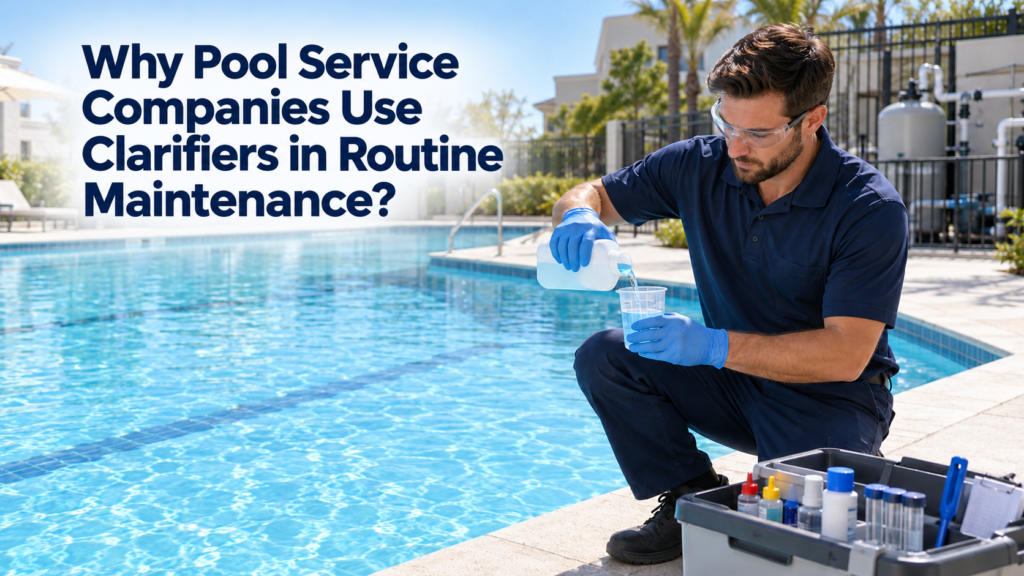
A pool can pass its basic water tests and still look a little tired. Chlorine may be within the target range. The pH may be steady. The circulation system may be running as expected. Yet, when sunlight crosses the water, a faint haze appears.
For a homeowner, that may seem like a minor cosmetic issue. For a pool service company, it is a sign worth reading.
Professional maintenance is not only about keeping water sanitary. It is also about keeping the pool clear, inviting, and easy to manage between scheduled visits. That is one reason many service teams include a pool clarifier in their routine maintenance program.
A clarifier helps the filter capture very small suspended particles that might otherwise remain in the water. It does not replace chlorine, correct poor circulation, or repair a damaged filter. Used at the right time and at the right dose, however, it can support the whole treatment system—and give the water that clean, polished appearance clients notice at once.
So why do experienced technicians keep clarifier on the service truck? The answer is less about a quick cosmetic trick and more about control, consistency, and fewer surprises.
Clear Water Is Part of the Service Promise
Pool owners rarely judge a maintenance visit by laboratory numbers alone. They look across the pool. Can they see the floor drains clearly? Does the water sparkle, or does it seem flat? Is there a soft haze near the lights?
Those visual details shape their view of the entire service.
This creates a practical challenge for pool companies. A technician may balance the water perfectly, brush the walls, empty the baskets, and inspect the equipment. If fine particles remain suspended, the client may still think something is wrong.
That reaction is understandable. Clear water suggests care and control. Cloudy water raises questions—even when the cause is temporary and the disinfectant level is correct.
Routine use of a suitable clarifier can help service companies maintain a more consistent visual result. It gives the filtration system support when the pool is dealing with dust, pollen, body oils, sunscreen residue, or other small contaminants.
The goal is not to hide a problem. It is to help a sound system perform more effectively.
The Tiny-Particle Problem Filters Cannot Always Solve Quickly
Pool filters do most of the heavy work. They remove leaves, hair, insects, dirt, and many suspended solids as water passes through the system. Still, not every particle is easy to catch.
Some particles are extremely small. Others carry similar electrical charges and tend to remain separate, almost as if they are politely refusing to sit together. Because they stay dispersed, they may pass through the filter or circulate for a long time before being removed.
This is where a polymer pool clarifier can help.
Many clarifiers contain charged polymer chains. These polymers attract fine suspended matter and connect small particles into larger clusters. The clusters remain light enough to travel through the circulation system, but they become easier for the filter media to retain.
Think of loose flour floating in air. Each speck is hard to control. Add enough moisture, and the specks begin to gather into heavier groups. A clarifier works differently at the chemical level, of course, but the practical idea is similar: small, elusive matter becomes a more manageable target.
The filter still removes the particles. The clarifier simply helps prepare them for capture.
Why Clarifier Fits Routine Maintenance So Well?
Emergency treatments attract attention, but steady maintenance is what keeps a pool dependable. Pool service companies work on schedules—often weekly—and the water must remain presentable after the technician leaves.
A carefully selected maintenance dose can support that interval in several ways.
It manages the fine debris that arrives every day
Even a covered or lightly used pool receives airborne material. Wind brings dust. Trees release pollen. Landscaping work sends fine soil into the air. Swimmers add skin particles, cosmetics, fabric fibers, and sunscreen.
Much of this material is too small to sink quickly. Some of it stays suspended and gradually dulls the water. Clarifier helps the filter collect more of that fine load before it becomes an obvious haze.
It improves visual consistency between service visits
Service companies cannot stand beside every pool all week. Weather changes. Guests arrive. A lawn crew works nearby. A windy afternoon fills the surface with debris.
No chemical can guarantee perfect water under every condition. Still, a well-planned clarifier program can provide a useful margin. The filter receives particles in a form it can handle more readily, which may help the pool retain its polished look for longer.
It supports filtration without shutting the pool down
Routine clarifiers are commonly designed to work while the circulation system operates. The treated particles move toward the filter rather than settling as a heavy layer on the pool floor. That makes them suitable for ongoing maintenance when the operator wants to improve clarity without using a more disruptive recovery process.
This point matters for hotels, apartment pools, health clubs, and other busy facilities. Closing a pool, allowing material to settle, and vacuuming it to waste may not be practical during normal operations.
It can reduce repeat complaints about slightly dull water
A small clarity issue can create a surprising amount of back-and-forth. A client sends a photo. A technician makes an extra visit. Someone checks the chlorine again, though sanitation was never the main issue.
When fine suspended matter is the true cause, clarifier can help prevent this cycle. That may reduce avoidable callbacks and protect the service company’s time. More importantly, it reassures the client that the pool is being watched with a professional eye.
Clarifier Is a Supporting Player, Not the Whole Team
Here is the point that deserves emphasis: clarifier cannot rescue a poorly maintained pool by itself.
If the sanitizer is too low, algae may grow. If the pH is far outside the recommended range, treatment performance and swimmer comfort can suffer. If the pump barely moves water, the clarifier cannot carry particles efficiently to the filter. If the filter is dirty, damaged, undersized, or channeling, particle capture will remain weak.
Before adding clarifier, a service technician should consider the whole system:
- Is the water chemistry within the appropriate operating range?
- Is the sanitizer holding as expected?
- Is circulation reaching the whole pool?
- Is the filter clean and functioning correctly?
- Has the recent bather load changed?
- Did rain, wind, construction dust, or landscaping add an unusual particle load?
- Is early algae growth a possible cause of the haze?
This diagnosis matters. A clarifier can help with suspended particles, but it cannot sanitize unsafe water or replace mechanical repair.
Treating every cloudy pool with more polymer is a bit like turning up the radio when the car makes a strange noise. The symptom may feel less obvious for a moment, but the cause remains.
Professional service starts with the cause.
Why More Clarifier Is Usually Not Better?
Clarifiers work at low use levels compared with many pool treatments. That can tempt an operator to pour in extra product when the water does not clear immediately. More must work faster, right?
Not necessarily.
An overdose may create poor particle bridging, leave the water looking hazy, or place an unnecessary load on the filter. Depending on the formula and pool conditions, excess polymer may also contribute to sticky residue or rapid pressure rise.
Good technicians measure. They calculate pool volume, follow the product label, note whether the dose is for routine maintenance or corrective treatment, and allow enough circulation time for the product to work.
They also check the filter afterward and clean or backwash it when the pressure and manufacturer’s instructions indicate that service is needed.
The right amount often looks almost uneventful. That is a good thing. Routine maintenance should be calm, repeatable, and easy to document.
Routine Clarifier Versus Flocculant: Similar Goal, Different Job
Clarifier and flocculant are sometimes treated as interchangeable terms, but pool professionals usually use them in different ways.
A routine clarifier helps fine particles form filterable clusters. The circulation system stays on, and the filter removes the combined matter over time. This makes clarifier well suited to mild haze, recurring fine debris, or regular clarity support.
A pool flocculant is generally used for more severe cloudiness. It encourages particles to form larger, heavier masses that settle to the floor. The settled material then needs to be vacuumed—often to waste—without sending it back through the filter.
That process may require downtime, careful valve settings, enough water for vacuuming and refilling, and more technician labor. It can be very useful in the right situation, but it is not usually the first choice for ordinary weekly upkeep.
In simple terms: clarifier works with the filter; flocculant is commonly used for a settle-and-remove procedure. Product labels differ, so the instructions for the specific formula always come first.
Different Pools Create Different Reasons to Use Clarifier
Routine maintenance is never quite as routine as it sounds. Each property has its own pattern.
Residential pools
Home pools may experience irregular use. The water is quiet during the week, then a family gathering adds a sudden load of sunscreen, body oils, food crumbs, and fine debris.
A maintenance clarifier can help the filter catch what remains after the visible mess has been skimmed and the chemistry has been checked.
Hotels and resorts
Hospitality pools are judged constantly. Guests see the water from balconies, restaurant terraces, and lobby windows. Underwater lighting can reveal particles that are almost invisible during the day.
Clarifier can help maintain the bright, polished appearance expected from a well-run property, especially when bather load changes from one day to the next.
Community and apartment pools
These pools often face heavy use, limited recovery time, and frequent introductions of cosmetics and organic matter.
A measured clarifier program may support filtration during normal operation, but it must sit within a wider plan that includes testing, turnover, filter care, and local operating requirements.
Outdoor pools near dust, pollen, or landscaping
Some pools seem to collect the neighborhood. Dry soil, plant fragments, pollen, and mower dust arrive almost daily.
Skimming removes the larger pieces; clarifier can assist with the fraction too small to see individually.
Indoor pools
Indoor pools avoid much of the windblown debris found outdoors, but they still receive fibers, body-care products, and fine organic matter from bathers.
Because the surrounding air and lighting can make haze noticeable, visual clarity remains an important operating signal.
The Service Visit: Where Clarifier Belongs in the Process
Clarifier should not be the first bottle opened at every stop. A sensible service sequence gives the technician enough information to decide whether it is needed.
A typical visit may include:
- Inspecting the water, surfaces, equipment, and surrounding area.
- Testing sanitizer, pH, and other parameters required by the service plan.
- Emptying baskets and removing visible debris.
- Checking circulation, return flow, and filter condition.
- Brushing and vacuuming where needed.
- Correcting water balance or sanitation issues according to the pool’s needs.
- Adding a measured clarifier dose only when the treatment plan and product directions support it.
- Recording the dose, water condition, filter pressure, and any follow-up action.
Documentation is not glamorous, but it is powerful. When technicians record what they see and what they add, the company can identify patterns.
Perhaps one property becomes hazy after every weekend. Perhaps another needs filter cleaning more often during pollen season. Perhaps the existing clarifier dose is higher than necessary.
That history turns routine service into informed service.
What Pool Companies Look for in a Routine Clarifier?
A service product must do more than work in a perfect test jar. It must also fit real routes, real weather, and real operating systems.
Pool companies often value:
- Consistent performance at a low, measurable dose
- Compatibility with common pool filtration systems when used as directed
- Clear instructions for maintenance and corrective dosing
- Easy handling and pouring
- Stable quality from batch to batch
- Packaging suited to route work or commercial facilities
- Technical documents, including a current safety data sheet
- Private-label and package-size choices for distributors or service brands
Polymer chemistry also matters. A cationic polymer carries positive charges that can attract many negatively charged suspended particles. Yet the finished formula, polymer concentration, molecular characteristics, water chemistry, and dose all influence field performance.
A raw-material name alone does not tell the whole story.
For that reason, buyers should assess the finished product, not just the headline ingredient. Small field trials under normal operating conditions are often more useful than broad promises.
Seasonal Maintenance Makes Clarifier Even More Relevant
Pools do not receive the same particle load throughout the year.
Spring may bring pollen and windblown plant material. Summer brings sunscreen, higher bather loads, and more frequent top-ups. Storm season can wash dust and organic debris into outdoor pools. In autumn, dry leaves break into fragments that are much smaller than the pieces caught by a skimmer.
Service companies can adjust their approach as these conditions change. That does not always mean increasing the dose.
It may mean checking baskets more often, extending filtration, cleaning the filter, improving circulation, or using clarifier only after a known high-load event.
The product is one control among several. Experienced technicians know when to use it—and when the pool needs something else.
A Small Dose Can Carry a Large Business Benefit
The chemistry explains how clarifier works. The service model explains why companies keep using it.
Clearer water supports client confidence. A more stable appearance between visits can reduce unnecessary concern. Better capture of fine matter can help the filtration system do the job it was built to do. A repeatable dose is also easy to include in a documented maintenance program.
There is a quieter benefit too.
When a technician can explain why the water looked dull, what was checked, and why a clarifier was—or was not—used, the service feels more professional. The client is no longer watching someone pour chemicals into a pool. They are seeing a trained person manage a system.
That distinction matters.
The Bottom Line
Pool service companies use clarifiers in routine maintenance because fine suspended particles are a normal part of pool operation. Filters may struggle to capture those particles quickly when they remain dispersed.
A correctly dosed clarifier gathers them into larger, filterable clusters, helping the pool retain a cleaner and brighter appearance.
Still, clarifier is not a cure-all. It works best when sanitation, water balance, circulation, and filtration are already under control. The technician must identify the cause of poor clarity, follow the product label, avoid overdosing, and monitor the filter afterward.
Used with that level of care, clarifier becomes more than a bottle on the truck. It becomes a practical part of consistent service—quietly helping the water look as well maintained as it truly is.
Frequently Asked Questions
1. Can a pool clarifier be used during weekly pool maintenance?
Yes, if the product label allows routine dosing and the pool has a genuine need for clarity support. The technician should calculate the pool volume, measure the correct dose, and confirm that circulation and filtration are working properly.
2. Does pool clarifier replace chlorine or other sanitizers?
No. Clarifier helps the filter remove suspended particles; it does not provide the sanitation required to control harmful microorganisms. Sanitizer levels and water balance must still be maintained according to applicable guidance.
3. How long does a pool clarifier take to clear cloudy water?
The time varies with the product, particle load, circulation rate, filter condition, and cause of the cloudiness. Mild haze may improve after continued filtration, while persistent cloudiness needs further diagnosis rather than repeated dosing.
4. Can too much polymer pool clarifier make water cloudy?
Yes. Overdosing can interfere with effective particle grouping and may add load to the filter. Always follow the stated maintenance or corrective dose instead of assuming that more product will work faster.
5. Should a pool filter run after adding a routine clarifier?
Most routine clarifiers are designed to work with circulating water so the treated particles reach the filter. Follow the specific product label, then monitor filter pressure and clean or backwash the filter when required.