
GET IN TOUCH
Ask For Sample?
How Do Fine Particles Escape Swimming Pool Filters?
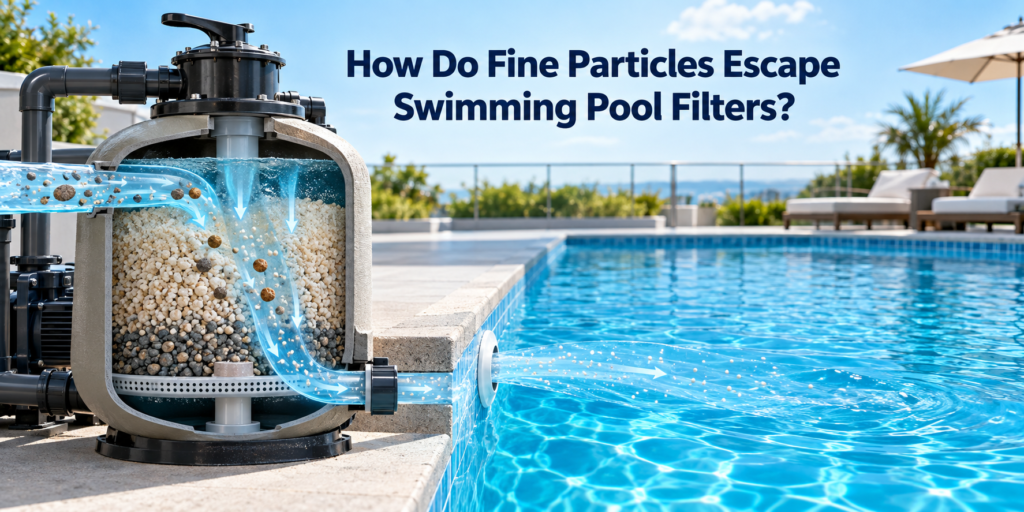
A swimming pool filter can run for hours, the sanitizer level can look normal, and the water may still carry a faint haze. It is frustrating—especially when the equipment seems to be doing everything it should.
So, what is happening?
The short answer is simple: some suspended particles are too small, too stable, or moving too quickly to be captured by the filter. They travel through the filter media and return to the pool with the clean-water flow. Others are caught at first but later break free because of pressure changes, damaged components, poor maintenance, or an unsuitable filtration rate.
This does not always mean the filter is defective. Often, it means the particles and the filter are working on very different physical scales.
Understanding that gap helps pool operators solve recurring cloudy water without endlessly adding chlorine, backwashing the filter, or replacing equipment that may still be perfectly serviceable.
A Pool Filter Is a Barrier, Not a Solid Wall
It is tempting to picture a filter as a solid screen that blocks everything except water. In reality, filtration media contain countless passages through which water must move.
Those passages are essential. If the media were completely solid, water could not pass through the system.
As pool water travels through sand, diatomaceous earth, or a cartridge element, suspended material may be captured in several ways:
- A particle may be too large to pass through an opening.
- It may collide with the filter media and remain attached.
- It may settle within a deeper part of the filter bed.
- It may become trapped between previously collected particles.
- It may be attracted to the surface of the media through electrical or chemical forces.
Filtration is therefore more complex than simple sieving. Particle size matters, but shape, surface charge, water velocity, filter condition, and particle concentration matter too.
A small particle can sometimes be captured successfully. A larger one can occasionally squeeze through, deform, or follow a channel around the media. That is why two pools fitted with similar filters may show very different clarity.
Just How Small Are These Particles?
Many contaminants that enter a swimming pool are large enough to see and easy to remove. Leaves, insects, hair, and larger pieces of dirt are collected by skimmer baskets, pump baskets, or filter media.
The particles responsible for persistent haze are much smaller. They may include:
- Fine dust and soil
- Pollen fragments
- Dead algae
- Tiny pieces of organic matter
- Skin-care product residues
- Body oils dispersed into small droplets
- Insoluble mineral deposits
- Partially oxidized contaminants
- Fine debris introduced during heavy bather use
- Precipitates formed by unbalanced water chemistry
A micrometre, commonly written as a micron or μm, is one-millionth of a metre. For comparison, a human hair may be roughly 50 to 100 microns wide, although its actual diameter varies.
A suspended particle measuring only a few microns cannot usually be seen as an individual object. Yet thousands or millions of such particles can scatter light. Together, they make the water look dull, milky, or slightly cloudy.
That is the tricky part. The pool may contain no obvious debris, but the water can still lose its sparkle.
Different Filters Have Different Capture Capabilities
Pool filters are not identical. Each type uses a different medium and has a practical particle-capture range.
Exact performance depends on the product design, media condition, flow rate, installation, and maintenance history. Manufacturer specifications should always take priority. Still, the following general comparison helps explain why very fine particles may remain suspended.
| Filter type | Typical filtration behaviour | Why fine particles may pass |
|---|---|---|
| Sand filter | Water moves through a bed of graded filter media | Very small particles may travel through spaces between media grains |
| Cartridge filter | Water passes through pleated fabric or synthetic media | Particles smaller than the effective pores may pass through; damaged pleats can worsen the problem |
| Diatomaceous earth filter | Water passes through a fine coating of diatomaceous earth | Missing, uneven, or disturbed coating may create paths for particles |
| Glass or other engineered media | Performance depends on media size, shape, condition, and installation | Incorrect media grading, poor bed depth, or channel formation can reduce capture |
This table is not a promise of exact micron removal. Real-world performance rarely fits into one neat number.
A filter’s nominal rating may describe the size of particles it captures under certain conditions. An absolute rating, where provided, generally represents a more definite removal threshold. Pool filters, however, are often discussed through practical ranges rather than laboratory-perfect cutoffs.
The Particle Is Smaller Than the Effective Passage
The most direct explanation is that the particle is smaller than the passage available through the filtration media.
In a sand filter, water moves through spaces between individual grains. The path is not straight. It twists and narrows as water travels deeper into the bed. Larger debris becomes trapped, while some finer material follows the water through these connected spaces.
A cartridge works differently, but the basic limitation remains. Water must pass through the porous material. If a particle is small enough—and if it does not attach to a fibre—it can pass with the water.
Think of carrying sand through a kitchen strainer. Large grains stay behind, while flour-like dust may slip through. Pool filtration happens on a far smaller scale, but the principle is familiar.
There is an interesting contradiction here: a slightly loaded filter may sometimes remove fine particles better than a freshly cleaned one. The collected material narrows some passages and forms an additional filtration layer. As the filter becomes too dirty, however, pressure rises and flow suffers.
A little captured debris may help. Too much causes trouble.
Surface Charge Can Keep Fine Particles Apart
Size is only part of the story.
Many tiny particles in pool water carry an electrical surface charge. Particles with similar charges repel each other, rather like two matching poles of a magnet. This repulsion helps keep them separate and suspended.
Individually, the particles may remain too small for the filter to catch effectively. They circulate through the pool, enter the filter, pass through the media, and return through the inlets.
They may repeat this journey many times.
Because the particles stay dispersed, they do not readily settle on the floor or combine into filterable clusters. The water may therefore remain hazy even after long filtration cycles.
This is where a cationic polymer pool clarifier can help. “Cationic” means the polymer carries positive charges. Many suspended particles have negatively charged surfaces. The polymer can reduce this charge-based repulsion and connect several particles into larger groups.
These larger aggregates are easier for the filter to capture.
The clarifier does not magically remove contaminants by itself. It changes how the particles behave so the existing filtration system can remove them more effectively.
Water Flow Can Carry Particles Through the Media
Flow rate has a major effect on filtration.
When water moves too quickly, fine particles have less time to collide with and attach to the filter media. Strong hydraulic forces may also push weakly retained material deeper into the bed or completely through it.
Imagine trying to catch floating dust with a slightly sticky cloth. Move the cloth slowly, and more dust may adhere. Sweep it through the air at high speed, and some particles follow the moving air around or through it.
A similar interaction occurs inside a pool filter.
Excessive flow can result from:
- An oversized circulation pump
- Incorrect valve settings
- Plumbing changes
- A filter that is too small for the circulation system
- Operating several water features at once
- A control system configured without considering the filter’s rated flow
- A replacement pump that delivers more water than the original unit
Higher flow is not automatically better. It may improve water turnover on paper, but filtration quality can decline if water passes through the media too aggressively.
Pool operators should compare the actual flow with the filter manufacturer’s recommended operating range. The filter area, pump curve, plumbing resistance, and pressure readings should be considered as one system.
Channeling Gives Water an Easy Way Through
Water tends to follow the path of least resistance. If a sand bed becomes uneven, compacted, cracked, or partially displaced, water may form preferential channels.
Instead of spreading evenly through the full filter bed, part of the flow rushes through these easier routes. Fine debris travels with it.
Channeling may be associated with:
- Incomplete or ineffective backwashing
- Incorrect sand grade
- Insufficient media depth
- Calcification or clumping within the bed
- Long periods without media inspection
- Sudden hydraulic changes
- Improper filling of the filter
- Damaged internal components
The pressure gauge may not always reveal the full problem. Water can continue moving through the filter, yet only part of the media is doing useful work.
A filter can therefore appear operational while providing disappointing clarity. It is running, yes—but not necessarily filtering evenly.
A Dirty Filter Is Not Always a Better Filter
As mentioned earlier, a modest layer of captured debris can improve fine-particle retention. Pool professionals sometimes observe that water polishes more effectively after a filter has been operating for a while.
But there is a limit.
When the filter becomes excessively loaded, several problems may occur:
- Filter pressure increases.
- Circulation decreases.
- Debris may be driven deeper into the media.
- Water may form channels around heavily blocked areas.
- Weakly attached particles may break loose.
- The filter may no longer process enough pool water to maintain clarity.
Frequent cleaning can create problems too. Backwashing a sand filter whenever the pressure moves slightly may prevent the filter bed from developing that useful, lightly seasoned layer.
Cleaning should normally be based on pressure rise, system performance, and manufacturer instructions—not habit alone.
A commonly used approach is to record the clean starting pressure after proper cleaning or backwashing. The operator can then monitor how much the pressure rises during service. The equipment manufacturer’s guidance should determine the correct cleaning point.
Filter Damage Can Return Debris to the Pool
Sometimes fine particles escape because the filtration barrier is physically damaged.
In a sand filter, cracked laterals or other damaged internal parts can allow filter media and contaminants to enter the return line. If sand appears beneath the pool return fittings, internal damage should be investigated. Be careful, though: material on the pool floor may also be ordinary dirt or dead algae rather than filter sand.
In a cartridge filter, possible problems include:
- Torn pleats
- Cracked end caps
- A deformed cartridge
- Incorrect installation
- A missing or damaged seal
- A cartridge that does not fit the housing correctly
In a diatomaceous earth filter, damaged grids, torn fabric, manifold cracks, or an incomplete coating can create bypass routes.
A filter housing seal, valve gasket, or multiport valve can also contribute to bypass. Water may avoid the intended filtration path and carry suspended material back to the pool.
When the water remains cloudy despite correct chemistry and adequate circulation, physical inspection is worth the effort. Sometimes the cause is not chemistry at all. It is a small crack hiding inside the equipment.
Backwashing Can Temporarily Release Fine Material
Backwashing reverses the flow through a filter to remove trapped contaminants. It is necessary maintenance, but it also disturbs the filter bed.
After backwashing, the media may need time to settle. Loose material may remain inside the plumbing or above the media bed. If the filter is returned directly to normal service without an appropriate rinse cycle, some of this material can enter the pool.
This is why many multiport valve systems include a rinse setting. The rinse cycle helps settle the bed and directs remaining debris to waste before normal filtration resumes.
Operators should follow the equipment instructions because valve designs and procedures vary. The pump should normally be switched off before changing the multiport valve position. Moving the valve while water is flowing can damage the gasket or internal mechanism.
A rushed backwash may solve one problem and quietly create another.
Poor Water Chemistry Can Create New Fine Particles
A filter may capture existing debris while the pool water keeps producing fresh particles.
High pH, excessive calcium hardness, sharp temperature changes, or poor chemical addition practices can encourage mineral precipitation. These fine deposits may create a pale, cloudy appearance.
Adding incompatible concentrated chemicals too close together may also cause local reactions. The resulting precipitate can remain suspended or coat the filter.
Sanitizer problems introduce another route. If algae begin to grow and are later killed, the pool may contain huge quantities of tiny dead cells. The sanitizer has performed part of its job, but the filter still needs to remove the remaining material.
Cloudiness after algae treatment does not necessarily mean the treatment failed. It may mean the filtration stage is unfinished.
Water testing should therefore include more than free chlorine. Depending on the pool and treatment program, operators may need to review:
- Free and combined chlorine
- pH
- Total alkalinity
- Calcium hardness
- Cyanuric acid
- Water temperature
- Sanitizer demand
- Circulation time
- Filter pressure
- Visible signs of scaling or algae
Balanced chemistry and effective filtration support each other. One cannot fully compensate for the other.
Oils and Organic Residues Behave Differently from Dust
Not every pool contaminant is a rigid mineral particle.
Sunscreen, cosmetics, body oils, lotions, and other organic substances may enter the water as very small droplets or films. They can combine with dust and dead cells, producing soft material that behaves differently from dry debris.
Some residues may coat filter media. Others remain dispersed in the water. Heavy bather loads can introduce these contaminants faster than the circulation system removes them.
Commercial pools, hotels, resorts, water parks, and health clubs face this challenge frequently. A pool that looks clear early in the morning may become dull after several busy hours—not because the filter suddenly stopped working, but because the contaminant load changed dramatically.
Oxidation, filtration, suitable cleaning schedules, and controlled clarifier use may all form part of the response. No single chemical should be expected to carry the whole treatment program.
Why Longer Filtration Does Not Always Solve the Problem?
Running the circulation system longer often helps because more water passes through the filter. Yet time alone cannot overcome every filtration limit.
If a particle repeatedly passes through the media, another six hours of circulation may simply give it another six hours of travel.
Longer filtration may also deliver disappointing results when:
- The circulation pattern contains dead zones.
- Return fittings are poorly directed.
- The filter is undersized.
- The pump and filter are mismatched.
- The media is damaged or channelled.
- Particles remain electrically stable and dispersed.
- New contaminants are entering the pool continuously.
- Water chemistry keeps forming fresh precipitates.
The useful question is not only, “How long is the pump running?” It is also, “What happens to the water while the pump is running?”
Good circulation must bring cloudy water to the filter. Good filtration must then retain the particles. Both stages matter.
How a Polymer Pool Clarifier Supports Filtration?
A polymer pool clarifier is designed to help small suspended particles form larger, more filterable aggregates.
Many clarifiers contain water-soluble cationic polymers. When correctly dispersed, the polymer chains can interact with several particles. Charge neutralization reduces repulsion, while polymer bridging connects particles into loose clusters.
A simplified sequence looks like this:
- Fine particles remain dispersed in the pool water.
- The clarifier is added at the recommended dose.
- Polymer chains interact with particle surfaces.
- Small particles form larger aggregates.
- Circulation transports the aggregates to the filter.
- The filter retains more of the suspended material.
- Water clarity gradually improves.
Correct dosage matters. Too little clarifier may not produce enough aggregation. Too much can restabilize particles, coat the filter, raise pressure, or leave the water looking worse.
More product does not mean faster clarity. Pool chemistry has a sense of humour that way.
The formulation should also match the intended filter system and operating conditions. Pool volume, turbidity, bather load, media type, circulation rate, and existing chemical program can all affect performance.
For private-label and professional pool products, clarifier concentration, colour, packaging, label directions, and compatibility testing should be defined carefully. Clear instructions are not a minor detail; they are part of product performance.
Clarifier or Flocculant—Are They the Same?
The terms are sometimes used loosely, but a clarifier and a drop-out flocculant are commonly applied in different ways.
A clarifier generally forms aggregates that remain light enough to circulate toward the filter. The filter then removes them.
A flocculant may form heavier flocs intended to settle on the pool floor. Those deposits are usually vacuumed to waste rather than sent through the filter.
The correct approach depends on the severity of the cloudiness, pool design, filtration system, operating restrictions, and product instructions.
For mild or recurring haze, a properly dosed clarifier may support normal filtration with less interruption. For severe cloudiness, a settling treatment may sometimes be considered, but it can require closing the pool, stopping normal circulation, waiting for sedimentation, and carefully vacuuming the settled material.
Neither product should be added casually. Misuse can create extra labour and prolong the recovery.
A Practical Troubleshooting Sequence
When fine particles appear to be escaping the filter, random chemical additions usually make diagnosis harder. A structured check is more useful.
Start with the water:
- Confirm sanitizer concentration.
- Test pH and other relevant balance parameters.
- Look for signs of algae, scale, or recent chemical precipitation.
- Consider recent rain, dust, construction work, or heavy swimming activity.
Then examine circulation:
- Check whether all skimmers and drains are working.
- Confirm that return fittings promote circulation throughout the pool.
- Identify steps, corners, benches, or shallow zones with little water movement.
- Review the daily filtration period and estimated flow.
Next, inspect the filter:
- Record the pressure.
- Compare it with the clean starting pressure.
- Check the media or cartridge condition.
- Look for channeling, tears, cracks, damaged seals, or internal bypass.
- Confirm that the filter is correctly sized for the pump.
- Verify that backwashing and rinsing are being performed correctly.
Only then should treatment support be considered:
- Select a clarifier suitable for the filtration system.
- Calculate pool volume carefully.
- Follow the stated dosage.
- Distribute the product as directed.
- Allow sufficient circulation and filtration time.
- Monitor filter pressure and clean the filter when required.
This method may feel slower than pouring in another chemical. In practice, it often saves time because it addresses the actual cause.
How to Prevent Fine-Particle Haze from Returning?
Recurring cloudy water is usually a system issue rather than a single event. Prevention requires consistent control of contaminant entry, chemistry, circulation, and filtration.
Useful measures include:
- Maintain sanitizer and pH within the appropriate operating range.
- Clean skimmer and pump baskets before flow becomes restricted.
- Record filter pressure after each proper cleaning.
- Inspect cartridges, grids, laterals, seals, and valves on a planned schedule.
- Avoid excessive backwashing.
- Use only the correct grade and quantity of filter media.
- Review pump speed and filtration flow.
- Improve circulation in dead zones.
- Encourage pre-swim showering in commercial facilities.
- Respond quickly after storms, dust events, or unusually heavy bather use.
- Use clarifier at a controlled dose when fine suspended material exceeds the filter’s practical capture ability.
The goal is not to make the filter catch every microscopic substance. That would be unrealistic. The goal is to help the full treatment system maintain safe, attractive, and consistently clear water.
Clear Water Comes from the Whole System
Fine particles escape swimming pool filters for several connected reasons. They may be smaller than the filter’s effective passages, kept apart by surface charges, carried through by excessive flow, or allowed to bypass damaged or uneven media.
The filter may be only one part of the problem.
Water chemistry can create fresh precipitates. Poor circulation can leave contaminants in quiet areas. Heavy bather loads can overwhelm normal removal capacity. Damaged components can send captured debris straight back to the pool.
A polymer pool clarifier provides a practical link between fine-particle behaviour and mechanical filtration. By helping small particles form larger aggregates, it gives the filter something it has a better chance of retaining.
That is the central point: clearer water does not come from forcing the filter to do the impossible. It comes from helping particles become filterable—and making sure the entire circulation and treatment system is ready to remove them.
Frequently Asked Questions
1. What particle size can a swimming pool filter remove?
The practical capture range depends on the filter type, media, flow rate, condition, and manufacturer’s design. Sand filters generally allow finer material to pass than well-maintained cartridge or diatomaceous earth filters, but real performance varies. Always refer to the equipment specification rather than relying on one universal micron rating.
2. Why is my pool cloudy even though the filter is running all day?
Fine particles may be passing through the filter repeatedly. Poor circulation, damaged media, excessive flow, algae residue, mineral precipitation, or incorrect water chemistry may also be involved. Longer operation helps only when water reaches the filter and the filter can retain the suspended material.
3. Can a pool clarifier help a sand filter catch fine particles?
Yes. A compatible polymer pool clarifier can group very small suspended particles into larger aggregates that a sand filter can retain more easily. Accurate dosing is essential because excessive clarifier may coat the media or increase cloudiness.
4. Can high pump speed cause fine debris to pass through a pool filter?
It can. Excessive water velocity reduces contact time and may push fine or weakly retained particles through the media. The pump flow should stay within the filter manufacturer’s rated operating range.
5. How long does a polymer pool clarifier take to clear cloudy water?
The time varies with turbidity, pool volume, filter condition, circulation, water balance, temperature, and product dosage. Some improvement may appear within several hours, while more difficult cases can require one or more complete filtration cycles. The filter pressure should be monitored because captured aggregates may increase the filter load.