GET IN TOUCH
Ask For Sample?
Why Crystal-Clear Water Matters for Hotels, Resorts, and Commercial Pools?
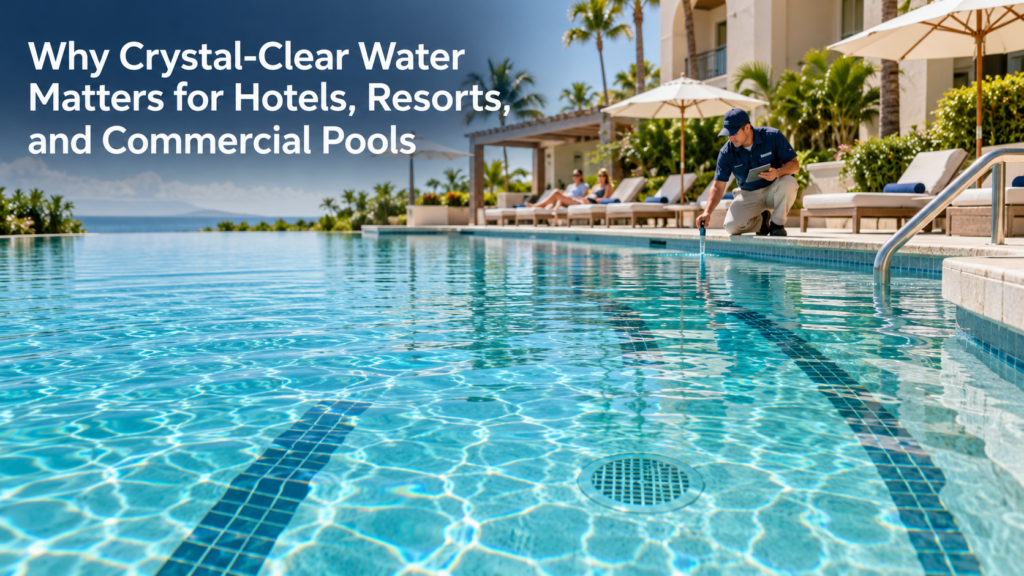
A hotel pool can be chemically balanced and still fail the guest test.
The pH may sit within the target range. The sanitizer reading may look fine. The circulation pump may be running without complaint. Yet if the deep end appears hazy, the water looks flat in photographs, or a guest cannot clearly see the pool floor, confidence drops almost at once.
That reaction is not merely cosmetic. In a hotel, resort, health club, waterpark, apartment complex, or other commercial venue, pool clarity affects safety, guest trust, maintenance decisions, operating costs, and brand reputation. Clear water quietly says, “This facility is being cared for.” Cloudy water says something else—even when the actual cause is a temporary load of fine particles rather than poor sanitation.
For commercial pool operators, then, clarity is not a finishing touch. It is part of the service.
The Pool Is Part of the Guest Experience Before Anyone Swims
Guests often see a pool long before they test it with a toe. It may appear in the hotel’s booking photos, through the lobby windows, beside the breakfast terrace, or in the first video they record after arriving.
That visual moment matters.
Bright, transparent water reflects light across the pool floor and gives the entire area a fresh, open feeling. The surrounding stone looks cleaner. The loungers look more inviting. Even the sky seems bluer in the reflection. Slightly cloudy water does the opposite. It softens the tile pattern, hides depth markings, and makes an otherwise beautiful facility feel tired.
Guests do not usually study turbidity, particle size, or filtration rates. They make a faster judgment: Does this pool look clean enough for me, my children, or my clients?
Fair or not, visual clarity becomes a shortcut for trust.
This is especially important for resorts where the pool is a major selling point. A city hotel may treat its pool as one amenity among many. A family resort, beachfront property, spa hotel, or holiday park often sells the pool experience itself. The water is part of the product, just like the room, the restaurant, and the view.
Clear Water Is a Safety Requirement, Not Just a Pretty Picture
The most important reason for maintaining clear commercial pool water is simple: people must be visible below the surface.
Lifeguards, pool attendants, parents, and other swimmers need to see a person who is in distress. They also need a clear view of steps, ledges, floor markings, drain covers, and changes in depth. Haze reduces contrast, especially when the surface is busy, sunlight is uneven, or many guests are in the water.
The CDC’s Model Aquatic Health Code states that the bottom of an aquatic venue should remain visible while the water is static whenever the venue is open or available for use. It treats failure to see the pool bottom as a condition that may require immediate correction or closure.
That is a useful operational test because it is immediate. You do not need a laboratory report to notice that the main drain or reference tile has disappeared behind a veil of haze.
The CDC also advises swimmers to check whether they can see the drain at the bottom of the deep end. Clear water helps lifeguards and other people notice swimmers underwater who may need assistance.
Of course, local regulations differ. A hotel in the United States, Spain, the UAE, Kenya, or Southeast Asia must follow the rules that apply at its location. Still, the underlying safety principle travels well: if staff cannot see the bottom clearly, the pool should not be treated as ready for normal use.
But Let’s Be Precise: Clear Does Not Automatically Mean Sanitary
Here is the important counterpoint. Water can look brilliant and still have a microbiological or chemical problem.
Clarity cannot replace disinfectant testing, pH control, circulation, filtration, recordkeeping, or professional inspection. Germs are not always visible. Neither are incorrect sanitizer levels, poor turnover, or unsafe chemical handling.
The reverse is also true. Water may have an acceptable sanitizer residual yet look cloudy because it contains very fine suspended particles. Skin oils, cosmetics, dust, pollen, organic debris, early algae growth, precipitated minerals, or fragments left after an oxidation treatment can all affect appearance. Heavy bathing adds another layer: more people bring more material into the water, and the filter must handle it.
So, clear water is one indicator—not the whole report card.
Commercial operators should treat water quality as a connected system:
- Sanitizer helps control harmful microorganisms.
- Correct pH supports swimmer comfort and sanitizer performance.
- Circulation moves treated water through the venue.
- Filtration removes particles from the water.
- Clarification can help the filter capture particles that are otherwise too fine to retain efficiently.
- Routine inspection catches changes before guests do.
When these parts work together, clarity becomes more stable rather than a last-minute rescue job.
First Impressions Now Travel Far Beyond the Pool Deck
A cloudy pool used to disappoint the people standing beside it. Now it can reach thousands of potential guests by lunchtime.
Travelers photograph everything. A dull patch in the deep end, a green tint, or visible floating debris may appear in an online review before the maintenance team knows there is a concern. Smartphone cameras can also exaggerate haze under strong backlighting. What looks merely “not quite right” in person may look far worse on a screen.
The same effect works in a hotel’s favor. A clear pool produces crisp reflections, visible tile lines, and that clean turquoise look guests associate with a well-run resort. It gives the marketing team better raw material without filters doing all the work.
This does not mean operators should chase an artificial, neon-blue appearance. Natural, transparent water is the goal. Guests notice authenticity too.
For properties that depend on social media, wedding photography, travel agents, and online booking platforms, the pool is effectively a public showroom. Water clarity supports the hotel’s visual promise every hour of the day.
Guest Confidence Affects Pool Use—and Perceived Value
Imagine a family arriving after a long journey. The children see the pool and want to swim immediately. One parent looks toward the deep end and hesitates because the floor is difficult to see.
That brief hesitation is valuable information.
Once a guest doubts the water, a technical explanation may not fully restore confidence. Telling them that the sanitizer level is within range may be correct, but it does not remove what their eyes are reporting. They may avoid the pool, ask for a manager, post a photo, or question other parts of the property’s hygiene.
In hospitality, perception and performance are tied together. Guests cannot inspect the pump room, read the chemical log, or evaluate filter media. They see the water. That visible result becomes evidence—rightly or wrongly—of what is happening behind the scenes.
Crystal-clear water can therefore raise the perceived value of the entire facility. It supports the feeling that the room rate, membership fee, or admission price is justified. This matters at luxury resorts, but it matters just as much at community pools, schools, gyms, and apartment complexes. People want to feel that the venue respects them.
Commercial Pools Face a Different Kind of Pressure
A private backyard pool may receive a few swimmers on a warm weekend. A hotel or commercial pool can face sharply changing demand throughout the day.
Breakfast ends, families arrive, sunscreen enters the water, wind carries dust across the deck, and a poolside event starts at sunset. In tropical or desert locations, environmental loads can be especially persistent. An outdoor resort pool near landscaping may collect pollen and fine soil. A rooftop pool may receive airborne city dust. An indoor spa pool can face high bather load in a smaller water volume.
Then there are the operational constraints:
- The pool may need to remain attractive from early morning until late evening.
- Maintenance windows may be short.
- Guests expect minimal disruption.
- Water conditions can change quickly after heavy use or rain.
- Several shifts may share responsibility for testing and treatment.
- A single property may operate a lap pool, children’s pool, spa, and decorative water feature.
This is why commercial clarity management should be preventive and documented. Waiting until the water becomes obviously cloudy usually costs more time, labor, and guest goodwill.
What Actually Makes Commercial Pool Water Cloudy?
Cloudiness is not one problem with one cure. It is a visible symptom with several possible causes.
Fine suspended matter is common. Some particles are so small that they remain dispersed in the water and pass through the filter repeatedly. Individually, they are hard to see. Together, they scatter light and create a pale haze.
An overloaded or poorly maintained filter can also reduce clarity. Dirty media, channeling, an incorrect backwash routine, low flow, air entering the system, or insufficient run time may all matter. If circulation is uneven, some parts of the pool may receive less effective treatment than others.
Water balance deserves attention as well. A change in pH, alkalinity, calcium hardness, or temperature may encourage minerals to precipitate, producing a milky appearance. An early algae problem may begin as a loss of sparkle before the water becomes clearly green. Heavy swimmer use adds body oils, sweat, hair products, and sunscreen; rain and wind bring their own cargo.
And sometimes the cause is human. An incorrect chemical sequence, an excessive dose, poor dilution, or incompatible products may create new haze rather than remove it.
The practical lesson? Diagnose first. Do not add one treatment after another and hope the pool clears. That “more chemical must be better” instinct can turn a small problem into a long night.
Where a Polymer Pool Clarifier Fits?
When water balance, sanitizer, circulation, and filter operation are being managed correctly, a pool clarifier can help remove the fine suspended particles that remain.
A cationic polymer clarifier carries positive charge sites. Many fine contaminants in pool water have a negative surface charge. The polymer helps destabilize and gather these tiny particles into larger clusters. The filter can then retain them more effectively.
Think of loose flour floating through the air. One speck is easy to miss and difficult to catch. Gather many specks into a soft clump, and removal becomes much easier. Pool clarification follows a similar principle, though the chemistry and operating conditions are more controlled.
This makes a clarifier useful for:
- Routine water polishing in busy hotel pools
- Haze after a period of heavy bathing
- Fine debris following weather events
- Dull water that persists despite normal filtration
- Improving the filter’s ability to catch small suspended particles
Eautrix’s Polymer Pool Clarifier is based on PolyDADMAC technology and is designed for both residential and commercial pool systems. It is available as a ready-to-use liquid, with original or blue color options for private-label programs.
A clarifier is not a substitute for sanitizer, and it cannot repair a failed pump or damaged filter. It is one tool within a complete treatment program. Used for the right reason and at the right dose, however, it can make the filtration process far more effective.
Clarifier and Flocculant Are Not Always Interchangeable
People often use the words “clarifier” and “flocculant” as if they mean exactly the same thing. In practice, the treatment approach may be quite different.
A clarifier generally forms smaller particle clusters that can travel through the circulation system and be captured by the operating filter. It suits routine polishing and moderate haze, especially when continuous operation is important.
A flocculant usually creates heavier flocs intended to settle to the floor. The settled material is then vacuumed to waste. This may help with severe cloudiness, but it can require pool closure, settling time, careful vacuuming, and water replacement. It is often more disruptive for a hotel that wants to keep the pool available.
The correct choice depends on the severity of the problem, filtration setup, operating schedule, and local procedure.
Overdosing Can Make a Clear Idea Surprisingly Cloudy
If a little clarifier helps, should a lot work faster? Usually, no.
Polymer performance depends on dose. Too little may not gather enough particles. Too much can restabilize material, leave excess polymer in the water, load the filter, or prolong haze. Results also depend on the type and concentration of the product, pool volume, water condition, and filtration system.
Commercial operators should follow the supplier’s directions, calculate pool volume carefully, and begin with a controlled treatment. If a product is concentrated, the difference between liters and milliliters is not a small detail. Staff should record the time, dose, water readings, pressure changes, and visual result.
More importantly, the operator should ask why clarity was lost. Repeated clarifier dosing may hide a filter or circulation problem for a while, but it will not solve it.
Clear Water Can Reduce Operational Drama
Stable clarity makes daily pool management calmer.
When staff monitor trends and treat the actual cause early, they are less likely to face emergency closures, guest complaints, rushed chemical additions, or repeated backwashing. The maintenance team can work from a plan instead of reacting to a crisis.
Good clarity can also support more efficient filtration. When a suitable clarifier gathers fine particles for filter capture, the water may recover without the disruptive settling and vacuum-to-waste process associated with heavier flocculation. That can save staff time and reduce avoidable water loss, though the result always depends on the pool and the treatment method.
There is a balance here. Backwashing too often wastes water and may prevent some filter beds from performing at their most effective. Waiting too long raises pressure and reduces flow. The right schedule should follow the equipment manufacturer’s guidance and actual pressure readings, not habit alone.
For hotels with several pools, consistency matters as much as chemistry. A simple written standard helps every shift respond in the same way.
A Practical Clarity Routine for Hospitality Facilities
An effective routine does not need to be complicated. It needs to be followed.
Start each operating period with a visual check from several positions around the deck. Can staff clearly see the deepest point, drain covers, steps, and floor markings? Check under the lighting conditions that guests will experience—not only at dawn when the surface is calm.
Next, verify and record the required water parameters according to local rules and the facility’s operating plan. Inspect flow, skimmer action, water level, filter pressure, and visible return circulation. Confirm that chemical feeders and safety systems are working as intended.
During the day, connect clarity changes to events. Was there a sudden bather surge? Strong wind? Rain? A children’s activity? A nearby landscaping job? Context helps the next shift understand what happened.
A useful routine includes:
- A pre-opening bottom-visibility check
- Scheduled sanitizer and pH testing
- Filter-pressure and circulation checks
- Inspection after peak bathing periods
- Accurate chemical dosing records
- A response level for early haze
- Clear authority to restrict access when visibility is unsafe
- A handover note between shifts
The aim is not paperwork for its own sake. It is continuity. Commercial pools rarely fail because nobody cares; they often struggle because information is fragmented.
The World Health Organization similarly recommends managing pool health risks through systematic control and monitoring rather than relying on appearance alone.
Purchasing Decisions Matter Behind the Scenes
For hotel groups, pool service companies, and chemical distributors, reliable water clarity also depends on consistent product supply.
A commercial clarifier should arrive with a clear specification, batch identification, Certificate of Analysis, and current Safety Data Sheet. Packaging must suit the people who handle it. A 1 L bottle may work for retail or small facilities, while 5 L and 25 L packs are often more practical for professional use. Labels should remain legible around wet plant rooms and state the required handling information for the destination market.
Buyers should also consider:
- Active ingredient and concentration
- Recommended dose range
- Appearance and color consistency
- Compatibility guidance
- Storage conditions and shelf life
- Packaging strength and closure quality
- Private-label support
- Batch traceability
- Sample and technical evaluation procedures
A low purchase price can become expensive if concentration varies, packaging leaks, or directions confuse operators. Commercial water care depends on repeatability. The product used in July should behave like the product approved in March.
Eautrix supplies cationic polymer solutions from Langfang, Hebei, China, with formulation, blending, custom packaging, private-label, sample, inspection, and chemical logistics support. Buyers can review the Eautrix product range or request technical information for a commercial pool clarifier program.
The Real Standard Is Confidence You Can See
Crystal-clear water does more than improve the color of a hotel photograph. It helps lifeguards and pool staff see below the surface. It reassures guests. It supports the value of the property and gives the maintenance team visible feedback that the treatment system is working as a whole.
Still, clarity should never be mistaken for proof of disinfection. The strongest commercial pool program combines visual checks with chemical testing, filtration control, circulation, staff training, and documented response procedures.
When all of that work is done well, guests rarely notice the effort. They simply see a clean, inviting pool and feel comfortable stepping in.
And honestly, that quiet confidence is exactly the result a hotel or resort should want.
Frequently Asked Questions
1. Why is crystal-clear water especially important in a hotel swimming pool?
It supports underwater visibility, guest confidence, attractive photography, and the property’s overall image. Cloudy water may also require investigation or temporary closure when staff cannot clearly see the pool bottom.
2. Does clear commercial pool water mean the water is safe to swim in?
Not by itself. Clear water can still contain microorganisms or have incorrect sanitizer and pH levels. Operators must combine visual clarity checks with testing, circulation, filtration, and local health requirements.
3. Can a polymer pool clarifier help after heavy hotel pool use?
Yes, when fine suspended particles are causing haze and the filtration system is operating correctly. A polymer clarifier can gather small particles into larger clusters that the filter can capture more easily. The product must be dosed according to its directions.
4. How often should a commercial pool operator check water clarity?
Clarity should be checked before opening and regularly during operation, especially after peak bathing, rain, wind, treatment changes, or unusual events. The exact inspection schedule must follow local rules and the facility’s operating plan.
5. What should a hotel do if the main drain is no longer visible?
Restrict access according to the facility’s safety procedure, then check water balance, sanitizer, circulation, filtration, bather load, and recent chemical additions. Do not reopen the pool until required visibility and all applicable water-quality conditions have been restored.