
GET IN TOUCH
Ask For Sample?
How Cationic Polymers Help Remove Suspended Particles from Pool Water?
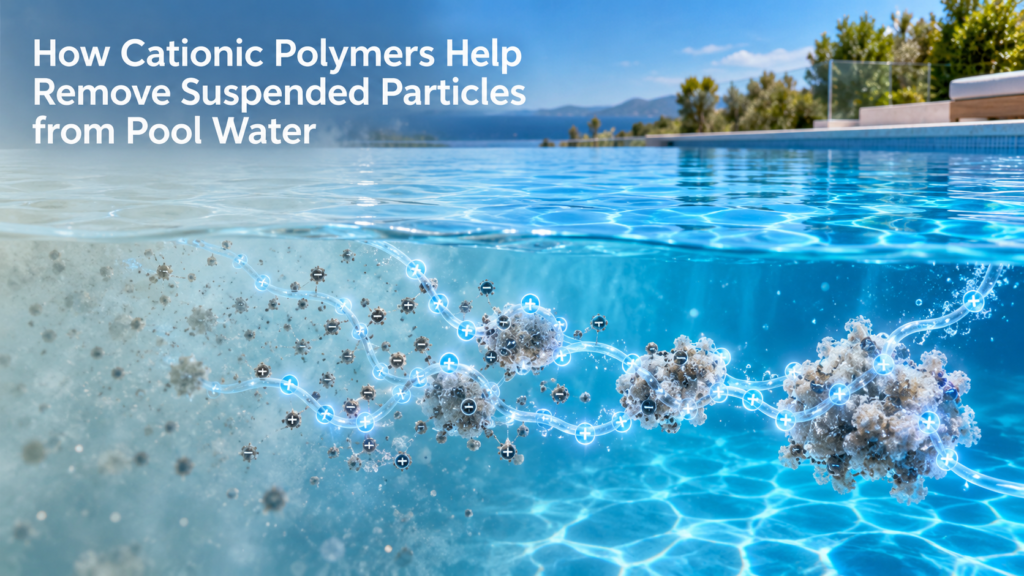
A swimming pool can have the “right” pH, enough sanitizer, and a clean-looking filter—yet still appear dull or cloudy. It is frustrating, especially when the water tests seem to say everything is fine.
The problem may be too small to see clearly.
Pool water often contains countless suspended particles. A single particle may be microscopic, but millions of them scatter light and give the water a hazy, flat, or milky appearance. Many are also too small for a standard pool filter to catch efficiently.
This is where cationic polymers can help. Instead of destroying particles, these positively charged water-treatment polymers gather fine matter into larger clusters. The filter can then retain material that previously passed through it.
It sounds simple. The chemistry behind it is clever—but not mysterious. Let’s look at what happens in the water, why charge matters, and how operators can use polymer clarification without creating a new problem.
First, What Are Suspended Particles in Pool Water?
Suspended particles are tiny pieces of solid or semi-solid material that remain dispersed in water rather than settling quickly. Some are visible in a beam of sunlight. Many are far smaller.
Common sources include:
- Dust, pollen, soil, and windblown debris
- Dead algae and fragments of biological growth
- Skin cells, body oils, cosmetics, and sunscreen residue
- Fine organic matter introduced by swimmers
- Precipitated calcium compounds or other mineral scale
- Debris left after oxidation or algae treatment
- Very fine particles released during construction or nearby landscaping
After a busy weekend, an outdoor pool may receive a surprising mixture of these materials. The sanitizer may control microorganisms, but it does not automatically remove every piece of fine debris. Oxidation can even break organic contamination into smaller fragments before the filter removes them.
That is why sanitized water is not always clear water. Disinfection, oxidation, circulation, and filtration work together, but they do different jobs.
Why Do Tiny Particles Refuse to Settle?
If grit falls into a glass of water, it sinks. Why don’t all suspended particles do the same?
Size is part of the answer. Very small particles settle slowly because their weight is tiny compared with the forces created by water movement. Continuous circulation keeps them moving. Even when the pump stops, microscopic particles may take a very long time to settle.
Electrical charge also matters.
Many fine particles found in pool water carry a negative surface charge. Particles with similar charges repel one another, rather like the matching poles of two magnets. This repulsion helps keep them separated. They remain individually dispersed instead of colliding, sticking together, and forming heavier material.
Water-treatment professionals often describe such a stable dispersion as a colloidal system. In plain language, the particles are small, mobile, and quite good at staying apart.
This creates a filtration problem. A filter can only retain particles above a certain practical size. When the particles remain smaller than that range, they may travel through the filter media and return to the pool. The pump keeps moving water, yet the haze seems to go round and round.
What Is a Cationic Polymer?
A polymer is a long molecule made from repeating chemical units. Picture a molecular chain rather than one small, isolated molecule.
“Cationic” means the polymer carries positive electrical charges. Depending on the chemistry, those charges may be distributed along the polymer chain and remain present across the product’s recommended working conditions.
One polymer commonly associated with pool clarification is PolyDADMAC, also known as poly(diallyldimethylammonium chloride), CAS No. 26062-79-3. Pool clarifier formulations may contain a controlled concentration of this cationic polymer, often with other formulation components selected for product stability, handling, and end use.
The long chain and positive charge give the polymer two useful qualities:
- It can attract many negatively charged suspended particles.
- One chain can interact with more than one particle, helping link them together.
That combination supports coagulation and flocculation. The two words are often used together, although they describe related stages rather than exactly the same event.
Step One: Charge Neutralization Reduces Repulsion
Imagine a room full of people who are all trying to keep their distance. They rarely form groups. Suspended particles behave in a similar way when their surface charges push one another apart.
When the cationic polymer is diluted and dispersed through pool water, its positively charged sites are attracted to negatively charged particle surfaces. The polymer adsorbs onto those surfaces. This reduces the effective charge and weakens the repulsive force between nearby particles.
Once that electrical barrier becomes weaker, collisions are more likely to result in attachment. Small particles can begin forming larger aggregates.
This process is often called charge neutralization or coagulation. It does not mean the pool suddenly fills with large visible clumps. Early aggregates may still be very small. The important change is that the dispersion has become less stable.
Here is the key: the polymer is not making dirt disappear. It is changing how dirt behaves.
Step Two: Polymer Bridging Builds Larger Flocs
A cationic polymer chain can attach to one particle while other parts of the same chain extend into the surrounding water. Those open segments may attach to other particles. A bridge forms.
More collisions follow. More particles become linked. The resulting clusters are called flocs.
You can think of the polymer as a flexible molecular thread that gathers scattered dust into soft bundles. The analogy is not chemically perfect, of course, but it captures the practical result: individual particles become larger groups.
Polymer bridging is especially useful when the product has the right molecular characteristics and is applied at an appropriate dose. Charge density, molecular weight, polymer structure, water chemistry, mixing, and the type of suspended material can all influence performance.
This is why two cationic products may not behave identically even if both are described as polymers. Formulation matters. So does the pool.
Step Three: The Filter Can Finally Do Its Job
Once fine particles form larger flocs, the pool filter has a better chance of retaining them. Water passes through the filter media, while the conditioned particles remain behind.
The exact result depends on the filtration system:
- Sand filters retain particles within the media bed and often benefit from correctly formed, filterable flocs.
- Cartridge filters capture conditioned particles on their pleated surfaces and require cleaning when pressure rises.
- Diatomaceous earth filters already remove very fine matter, but a suitable clarifier may still assist in certain situations when used carefully.
Clarification is therefore a partnership between chemistry and equipment. The polymer prepares the particles; circulation carries them to the filter; the filter removes them from the water.
If circulation is weak, the filter is dirty, the media is channeling, or the return flow creates dead zones, the chemistry cannot compensate forever. A bottle of clarifier is useful, but it is not a repair technician in disguise.
Cationic Polymer Clarifier or Traditional Flocculant?
The terms “clarifier” and “flocculant” are sometimes used loosely in the pool market. In practice, the intended operating method may be different.
A pool clarifier generally forms relatively small, filterable aggregates while the circulation system continues to run. The goal is to help the existing filter remove haze over one or more turnover cycles.
A drop-out flocculant is usually intended to create heavier material that settles on the pool floor. The pump may be stopped after distribution, and the settled debris is then vacuumed to waste rather than sent through the filter.
Both approaches involve particle aggregation, but they are not interchangeable. Using a settling product as though it were a normal filter aid can load or block the filter. Using a mild clarifier when heavy settling is required may not deliver the expected drop-out.
For routine haze caused by fine particles, a purpose-designed Polymer Pool Clarifier can offer a convenient route because it works with ongoing circulation and filtration. The product label should still define the correct application method.
Why Dosage Matters More Than “A Little Extra”?
Pool owners often assume that if one dose is helpful, a larger dose must work faster. With polymers, that logic can backfire.
An appropriate dose allows polymer chains to adsorb onto particles while leaving enough open chain segments for bridging. An excessive dose may coat particle surfaces too completely. Instead of building bridges, the saturated particles can become stable again. This is sometimes called restabilization.
Too much polymer can also create sticky deposits, load the filter, or leave the water looking no better—and sometimes worse. The operator then adds another chemical, which makes diagnosis even harder.
So, yes, “more” can mean “less clear.” Pool chemistry has a sense of humor like that.
Dosage should be based on the formulated product concentration and its instructions, not on the raw polymer’s name alone. A 10% active formulation and a more dilute retail product cannot be dosed as if they were identical. Commercial pools should also follow applicable operating procedures and local regulations.
Good Mixing Is Gentle, Not Violent
The polymer needs to contact suspended particles throughout the pool. Initial distribution therefore matters.
Add the product according to its label—often slowly around the pool perimeter or through an approved feed point while circulation is operating. The objective is even dispersion.
Once aggregates begin forming, excessive shear can break delicate flocs apart. Pool systems are not industrial jar-test machines, and normal circulation is usually part of the intended process. Still, operators should avoid improvising with high-speed mechanical mixing unless the product instructions specifically call for it.
Allow enough filtration time. Cloudiness caused by millions of microscopic particles will not always vanish in ten minutes. Improvement may become visible across several hours or filtration cycles, depending on contamination load, water movement, filter condition, and dosage.
Water Balance Still Comes First
Cationic polymers can improve particle capture, but they do not correct every cause of cloudy water.
Before adding a clarifier, check:
- Free sanitizer level and combined chlorine, where applicable
- pH and total alkalinity
- Calcium hardness and the likelihood of mineral precipitation
- Cyanuric acid in stabilized-chlorine pools
- Filter pressure, flow rate, and cleaning condition
- Circulation time and visible dead zones
- Signs of living algae or a recent algae treatment
High pH or an imbalanced saturation condition can cause calcium carbonate to precipitate, creating a white haze. Active algae growth requires a sanitation and algae-control response. A damaged filter may simply return debris to the pool. In these cases, clarifier alone treats a symptom rather than the cause.
The better sequence is diagnosis first, correction second, and targeted clarification when fine suspended matter remains.
A Clarifier Is Not a Sanitizer—or an Algaecide
This distinction protects both water quality and customer expectations.
A cationic pool clarifier gathers suspended material so the filter can remove it. It does not replace chlorine, bromine, or another approved sanitizer. It should not be expected to provide reliable control of disease-causing microorganisms unless the specific product is separately registered and labeled for that purpose.
Likewise, a dedicated algaecide and a dedicated clarifier are not automatically the same product. Some cationic polymer algaecides may also support water clarity by associating with negatively charged debris. Yet their primary purpose and recommended dose may differ from those of a dedicated clarifier.
Do not combine multiple cationic polymer products casually. Two products that are individually compatible with a pool may still create an excessive total polymer dose when used together. Check their labels, formulation guidance, and treatment intervals.
What Can Affect Cationic Polymer Performance?
Real pool water is more complicated than a beaker of clean laboratory water. Several factors can change how well a cationic polymer works.
Particle type is one. Clay, dead algae, pollen, organic debris, and mineral precipitates do not present identical surfaces. A dose that works well after a dust storm may behave differently after algae treatment.
Particle concentration matters too. Light haze and a pool filled with dead algae represent very different solids loads. Severe contamination may first require vacuuming, backwashing, filter cleaning, or a more intensive treatment route.
Other factors include:
- The polymer’s charge density and molecular weight
- Product concentration and formulation quality
- pH, ionic strength, and dissolved minerals
- Water temperature
- Contact and circulation time
- Existing chemicals in the water
- Filter type and media condition
Anionic products deserve special attention. Because anionic materials carry negative charges, they may interact strongly with cationic polymers. An uncontrolled combination can produce deposits, precipitates, or loss of performance. Compatibility should be confirmed before products are used in the same treatment program.
What Does Successful Clarification Look Like?
The first sign may not be dramatic. The water can begin to look brighter under pool lights. Fine haze decreases. Floor details become sharper, and the main drain becomes easier to see from across the deck.
Filter pressure may rise as the system captures more material. A small increase can indicate that the filter is doing useful work, but operators must stay within the equipment manufacturer’s limits. Backwash or clean the filter when required. Otherwise, retained debris can restrict flow and reduce the very filtration needed to finish the job.
After cleaning, keep monitoring the pool. If the haze returns quickly, ask why. Is new contamination entering the water? Is algae still active? Is the filter media worn or channeling? Is water balance causing precipitation?
Clear water should be the result of a stable treatment system, not a brief cosmetic effect.
When a Cationic Polymer Clarifier Makes Sense?
A polymer clarifier may be helpful when:
- Water balance and sanitizer levels are acceptable, but fine haze remains.
- Dead algae or oxidized organic debris is too fine for efficient filtration.
- Wind, dust, or heavy swimmer use has introduced a high load of small particles.
- The filter is operating correctly but needs help retaining very fine matter.
- A service company wants to restore sparkle without using a settling-and-vacuuming procedure.
It may not be the first response when the pool is green, circulation has failed, calcium is visibly precipitating, or heavy debris is lying on the floor. Those situations require correction of the underlying fault.
And if the water is so cloudy that the pool floor cannot be seen, swimmer safety comes first. Close the pool according to applicable rules until visibility and water quality have been restored.
How Manufacturers Can Build a Better Pool Clarifier Product?
For distributors and private-label brands, the active polymer is only one part of the commercial product.
A useful formulation should provide consistent polymer concentration, good storage stability, easy dilution, controlled appearance, and packaging suited to the target market. Depending on customer preference, a PolyDADMAC-based clarifier may be supplied colorless to pale yellow or formulated with a suitable blue color. Common retail and professional pack sizes include 1 L, 5 L, and 25 L.
Clear instructions matter just as much as attractive packaging. The label should explain dosage, circulation time, filter cleaning, compatibility, storage, and what the product cannot do. This reduces overdosing and prevents the clarifier from being blamed for problems caused by poor filtration or active algae.
For B2B buyers, product evaluation should include:
- Active content or polymer concentration
- Appearance, pH, and viscosity specification
- Batch-to-batch consistency
- Compatibility with planned dyes and packaging
- COA and SDS availability
- Recommended use rate based on the finished formulation
- Private-label and custom-packaging capability
A supplier should also be able to discuss application logic, not merely quote a price per kilogram. The cheapest liquid can become expensive quickly if the concentration is inconsistent or the directions encourage customer complaints.
The Simple Science Behind Clearer Water
Cationic polymers help remove suspended particles by changing particle behavior. Their positive charges reduce the repulsion between negatively charged fine matter. Their long molecular chains can bridge multiple particles, forming larger flocs. Filtration then removes those flocs from circulation.
That is the whole working chain:
Fine particles remain dispersed. The polymer brings them together. The filter takes them out.
No magic, and no substitute for sound pool operation. Water balance, sanitation, circulation, filtration, correct dosing, and timely filter cleaning still carry the load. Yet when microscopic debris keeps slipping through an otherwise functional system, the right cationic polymer clarifier can provide the missing link between cloudy water and a clean, bright finish.
Frequently Asked Questions
1. How do cationic polymers clear cloudy swimming pool water?
Cationic polymers carry positive charges that attract many negatively charged suspended particles. They reduce particle repulsion and bridge fine matter into larger flocs, which the pool filter can capture more easily.
2. Is PolyDADMAC used as a pool water clarifier?
Yes. PolyDADMAC is a cationic polymer used in some pool clarifier formulations. The finished product’s concentration, formulation, and label directions determine the correct pool dosage.
3. Can adding too much cationic polymer make pool water cloudy?
Yes. Overdosing may coat particles, interfere with bridging, overload the filter, or restabilize the suspension. Always dose the finished clarifier according to its label rather than assuming that extra product works faster.
4. Does a cationic polymer pool clarifier kill algae?
A dedicated clarifier should not be treated as an algaecide or sanitizer. It can help filters remove dead algae and fine debris, but active growth requires an appropriate algae-control and sanitation program.
5. How long does a polymer pool clarifier take to work?
Visible improvement may occur after several hours or filtration cycles. Timing depends on particle load, dose, circulation, filter type, media condition, and water balance. Clean or backwash the filter when pressure reaches the equipment manufacturer’s recommended limit.