
GET IN TOUCH
Ask For Sample?
The Role of Coagulation and Flocculation in Swimming Pool Water Treatment
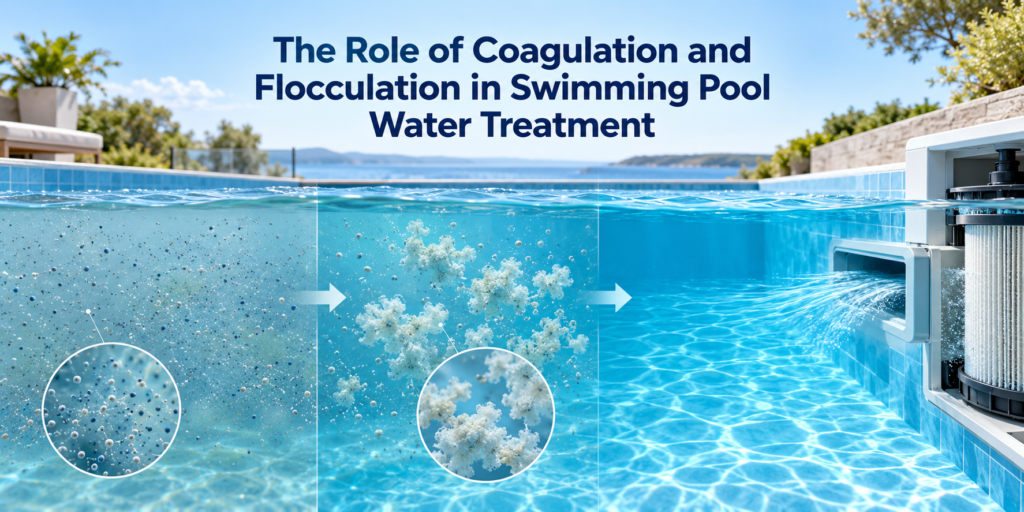
A swimming pool can have the right chlorine reading, a sensible pH, and a pump that seems to be working normally—yet the water still looks dull. Sometimes it is only a faint haze. Sometimes the main drain is hard to see. Either way, the problem often comes down to particles that are too small for the filter to catch efficiently.
That is where coagulation and flocculation earn their place in pool water treatment.
These two processes help tiny suspended contaminants come together so they can be removed by filtration or allowed to settle for vacuuming. They do not replace chlorine, balanced water chemistry, good circulation, or routine filter care. Instead, they fill a gap between chemical sanitation and physical filtration.
The science sounds technical, but the basic idea is surprisingly familiar. Imagine trying to pick up a handful of flour scattered across a wet countertop. Each speck is hard to collect. Gather those specks into larger clumps, though, and removal becomes far easier. Coagulation and flocculation do something similar in pool water.
Why Can Fine Particles Stay Suspended for So Long?
Pool water collects more than leaves and visible debris. It also receives dust, pollen, sunscreen, body oils, dead algae, cosmetic residue, organic matter, and tiny mineral particles. Many of these contaminants are measured in microns and may pass through a filter—or move around it—without being captured.
Their small size is only part of the story.
Fine particles often carry electrical charges on their surfaces. Particles with similar charges repel one another, much like the matching poles of two magnets. That repulsion helps them remain dispersed instead of joining together and settling. Constant circulation then keeps them moving through the pool.
The result is familiar: light strikes thousands of suspended particles and scatters in different directions. The water loses its sparkle. It may appear milky, gray, or slightly green even when no obvious debris is present.
This explains why stronger filtration alone does not always solve cloudy water. A filter cannot reliably retain particles that are smaller than its effective capture range. Running the pump longer may help, but it does not change the electrical behavior or size of those particles.
Coagulation and Flocculation: Similar, but Not the Same
The terms are often used as if they mean the same thing. They are closely linked, yet each describes a different stage.
Coagulation destabilizes fine suspended particles. A coagulant helps reduce or neutralize the electrical forces that keep particles apart. Once that repulsion weakens, the particles can approach one another and form very small clusters called microflocs.
Flocculation follows. During this stage, destabilized particles and microflocs collide, attach, and form larger clusters known as flocs. These larger groups are easier for the pool filter to trap. If a settling treatment is used, they can become heavy enough to fall to the floor, where they are removed by vacuuming to waste.
In simple terms:
- Coagulation makes the particles willing to come together.
- Flocculation helps them grow into removable groups.
- Filtration or vacuuming completes the job.
This distinction matters because different products and treatment methods are designed for different outcomes. A filter-aid clarifier may create small, filterable clusters. A strong settling flocculant may form heavier flocs that must be vacuumed out. Using the wrong approach can turn a manageable haze into a messy maintenance job.
What Happens During Coagulation?
Most fine particles in pool water are negatively charged. A cationic, or positively charged, coagulant is attracted to those surfaces. When the product is distributed through the water, its charged sites interact with suspended matter and reduce the forces keeping the particles separate.
Two common mechanisms may be involved.
The first is charge neutralization. Positive charges from the coagulant balance some of the negative charge on the particles. Repulsion drops, so particle collisions are more likely to result in attachment.
The second is patch coagulation. A cationic polymer adsorbs onto part of a particle surface and creates a localized positive area. That area can attract an uncoated negative area on another particle. The particles then join, rather like two pieces of hook-and-loop fastener finding one another in the water.
This stage can happen quickly. It may not produce large, visible flocs right away, but it changes the condition of the suspension. The particles are no longer quite so comfortable staying apart.
Then Flocculation Builds Something the Filter Can Catch
Once the particles have been destabilized, movement brings them into contact. In a municipal water plant, this stage may take place in a carefully controlled basin with slow mixing. A swimming pool is different. Circulation through return jets, plumbing, and the main body of water supplies the movement.
Polymeric flocculants can assist by creating links between several particles. A long polymer chain attaches to one particle, extends into the water, and connects with another. This is often called polymer bridging.
As collisions continue, microflocs grow into larger structures. The goal is not simply to make the biggest possible floc. The goal is to create flocs with the right strength and size for the chosen removal method.
That detail is easy to miss. Weak flocs may break apart in turbulent plumbing. Oversized or excessive floc can load the filter too quickly. Heavy settling floc may sink as intended, but it can also create trouble if the system cannot vacuum directly to waste.
Good treatment is a controlled process, not a “more chemical, more clarity” contest.
Clarification and Settling Flocculation Follow Different Routes
Pool owners and operators often use the words clarifier and flocculant loosely. In practice, the difference is usually based on how the aggregated particles will be removed.
Filter-Aid Clarification
A pool clarifier gathers very fine particles into moderately larger clusters. These clusters remain suspended long enough to travel through the circulation system and reach the filter. The filter captures them, and routine cleaning or backwashing removes the collected material.
This method is well suited to:
- Mild or moderate haze
- Routine water polishing
- Fine dust and pollen
- Dead algae left after correct sanitation
- Pools that can continue circulating during treatment
A properly selected Polymer Pool Clarifier can support this route by improving the effective removal of fine suspended particles. Eautrix’s product is based on PolyDADMAC technology and is designed for non-foaming pool water clarification.
Settling Flocculation
A pool flocculant is generally used when faster, more forceful clarification is needed. It forms heavier flocs that settle on the pool floor after circulation is stopped. The settled layer is then vacuumed slowly to waste.
This approach may suit:
- Severe cloudiness
- Large amounts of dead algae
- Heavy contamination after a storm
- Situations where normal clarification has not restored visibility
Settling flocculation demands more labor. It may also waste a meaningful amount of water because the settled material should not be sent back through the filter.
Cartridge-filter pools and systems without a vacuum-to-waste setting may not be suitable for this treatment. Always follow the product label and equipment instructions.
The Filter Is Still the Finishing Tool
Coagulation and flocculation prepare contaminants for removal. They do not make the contaminants disappear.
With a clarifier, the filter does the final work. A sand filter may capture aggregated material within the filter bed. A cartridge filter holds it between pleats. A diatomaceous earth filter retains it in the filter coating. Each system has its own pressure limits and cleaning procedure.
As floc accumulates, filter pressure may rise. Flow may slow. The operator may need to backwash, rinse, clean the cartridge, or service the filter sooner than usual. This is often a sign that the process is working—but it should not be ignored.
Here is the key: filtration must be functional before a clarifier is added. A damaged cartridge, channeled sand bed, blocked skimmer, undersized pump, or short circulation cycle will not be cured by more polymer.
If cloudy water returns again and again, inspect the system rather than treating every episode as a chemical shortage.
Water Chemistry Can Help—or Fight—the Process
Coagulation and flocculation depend on chemical interactions, so water conditions matter. Product performance can change with pH, alkalinity, temperature, contaminant load, dissolved solids, and the type of particles present.
Before treating cloudy water, test at least:
- Free available sanitizer
- pH
- Total alkalinity
- Calcium hardness where relevant
- Cyanuric acid in stabilized chlorine pools
For home pools, the CDC recommends maintaining pH from 7.0 to 7.8 and at least 1 ppm chlorine, or at least 2 ppm where cyanuric acid or stabilized chlorine products are used. Local codes and the chemical label may require narrower or different operating ranges.
The important point is that clarification should begin only after the basic water balance and sanitizer condition have been checked.
Why? Because cloudiness may be caused by scale-forming water, an algae bloom, low sanitizer, or a circulation failure. A flocculant may improve the appearance temporarily, but it will not correct the root cause.
High pH may also affect the behavior of some coagulants and can encourage calcium carbonate clouding. Very low pH can damage pool surfaces and equipment. Balanced water gives the clarification process a fair chance to work while protecting the pool itself.
Coagulation Is Not Disinfection—A Crucial Safety Point
Clear water is not automatically sanitary water.
Coagulants and flocculants are designed to improve particle removal. They may help remove some microorganisms when those organisms become attached to flocs and are captured by the filter, but that is not a substitute for a registered sanitizer and a correctly managed disinfection program.
Chlorine or bromine controls germs. Algaecides help prevent or control algae, depending on their approved use and label. Clarifiers help the filter capture fine matter. Each product has a job. Proper disinfectant levels and pH remain the first defense against swimming-related illnesses.
For algae-prone pools, clarification may be paired with an appropriate algaecide after the operator checks compatibility and follows both labels. Eautrix supplies a non-foaming Polyquat 60 Algaecide for preventive and corrective algae-control programs.
It should not be confused with a pool clarifier, even though both products involve cationic polymer chemistry.
That separation protects swimmers and improves treatment decisions. Sparkling water is appealing; safe, correctly disinfected water is essential.
Why Polymer Chemistry Works So Well in Pool Clarification
Polymer coagulants are useful because their charge density, molecular structure, and chain length can be tailored for particle aggregation. In pool applications, cationic polymers are often effective against negatively charged suspended matter.
PolyDADMAC—poly(diallyldimethylammonium chloride), CAS No. 26062-79-3—is one such polymer. It is water-soluble and carries permanent positive charges along its chain. In a correctly formulated pool clarifier, those charges help destabilize fine particles and promote aggregation.
Polymer concentration is only one part of product performance. Molecular characteristics, formulation stability, water quality, dosage, and mixing conditions all play a role. Two liquids with a similar active percentage may behave differently in a real pool.
That is why product evaluation should include practical testing. A distributor developing a private-label clarifier may compare clarity recovery, filter-pressure behavior, foam level, color, storage stability, and compatibility across local water conditions.
The best formula is not merely one that clears a single laboratory sample. It should work predictably across the intended market.
Overdosing: When the Solution Becomes Part of the Problem
It is tempting to add extra clarifier when water looks especially cloudy. That can backfire.
An excessive dose may coat particles too completely, leaving fewer open polymer sites for bridging. It may also restabilize the suspension, increase filter loading, or leave the water with a persistent haze. Some systems may experience sticky filter media or more frequent cleaning.
If a recommended dose does not work, do not immediately pour in more. Check:
- Whether the pump and filter are operating correctly
- Whether the filter needs cleaning
- Whether sanitizer and pH are in range
- Whether living algae are still present
- Whether the product is compatible with other chemicals recently added
- Whether enough circulation time has passed
Accurate pool volume matters too. A pool thought to hold 40,000 liters may actually contain 30,000. That difference turns a normal dose into a one-third overdose.
Measure carefully. Add the product as directed. Give the system time to respond.
Product Compatibility Deserves More Attention
Cationic polymers carry positive charges. Anionic products carry negative charges. When strongly cationic and anionic chemicals meet at concentrated levels, they may react with one another, form unwanted precipitates, or reduce each other’s performance.
This does not mean every product with a different charge is automatically incompatible under all pool conditions. Formulation, dilution, dosage, addition point, and time between treatments all matter. Still, chemical additions should never be improvised.
Do not mix concentrated pool chemicals together. Add each product separately, follow the label, and maintain suitable circulation unless the procedure specifically calls for settling. If compatibility is uncertain, ask the supplier for technical guidance or run a controlled jar test before full-scale use.
A jar test uses small water samples to compare several doses under similar conditions. It can reveal whether a treatment creates clean, stable flocs or merely adds more haze. For commercial pools, distributors, and formulation developers, that small test can prevent a very large headache.
A Practical Treatment Sequence for Cloudy Pool Water
No single sequence fits every pool, but a sound diagnosis usually follows this order:
- Check visibility and restrict swimming if safety is uncertain. If the bottom or main drain cannot be seen clearly, close the pool according to local requirements.
- Remove visible debris. Skim, brush, and vacuum loose material where possible.
- Test the water. Confirm sanitizer, pH, alkalinity, and other relevant parameters.
- Correct the cause. Treat algae, restore sanitizer, adjust balance, or repair circulation problems before expecting a clarifier to finish the job.
- Inspect the filter. Clean or backwash it if required, and verify normal flow.
- Choose the removal route. Use a filter-aid clarifier for manageable haze or a suitable settling flocculant where heavy contamination and equipment design justify it.
- Dose by actual pool volume. Follow the label rather than guessing from appearance.
- Monitor the system. Watch filter pressure, return flow, water clarity, and settling behavior.
- Remove captured material. Clean the filter or vacuum settled floc to waste.
- Retest before reopening. Confirm clarity, sanitizer, pH, and any local operating requirements.
Notice how far down the list chemical addition appears. That is deliberate. Clarification works best after the real cause of cloudiness has been identified.
Where Coagulation and Flocculation Add the Most Value
These processes are especially useful after a high bather load, a windy day, a dust storm, heavy rain, an algae treatment, or construction near the pool. They can also help commercial facilities where visual clarity must recover quickly between operating periods.
For routine care, a low-dose polymer clarifier may support consistent water polish and ease the burden on the filter. For recovery treatment, a stronger flocculation approach may shorten the time needed to remove a large mass of suspended matter.
The correct choice depends on four questions:
- What caused the cloudiness?
- How severe is it?
- What type of filter and waste line does the pool have?
- How quickly must the water return to service?
Answer those first, and product selection becomes far less mysterious.
Clear Water Is a System Result
Coagulation and flocculation play an important role in swimming pool water treatment because they turn difficult-to-filter particles into removable flocs. Coagulation weakens the electrical forces that keep fine matter dispersed. Flocculation builds larger clusters. Filtration or vacuuming then carries the contaminants out of the pool.
Simple, right? In principle, yes. In practice, success depends on the whole system: water balance, sanitation, circulation, filter condition, product chemistry, dosage, and patience.
A clarifier can make a well-managed pool look exceptional. It cannot rescue neglected equipment or replace disinfection. Used for the right reason and at the right dose, however, polymer-based coagulation and flocculation provide a practical bridge between “chemically balanced” and genuinely clear.
For distributors, pool service companies, or private-label brands seeking a tailored clarifier formula, Eautrix supports concentration adjustment, color customization, packaging, and technical evaluation. Contact Eautrix to discuss the target market, filter types, water conditions, and packaging requirements.
Frequently Asked Questions
1. What Is the Difference Between Coagulation and Flocculation in Pool Water?
Coagulation destabilizes fine suspended particles by reducing the electrical forces that keep them apart. Flocculation then helps those destabilized particles join into larger clusters. The filter captures the clusters, or they settle for vacuuming if a settling treatment is used.
2. Can a Pool Clarifier Replace Chlorine or Bromine?
No. A pool clarifier improves the removal of suspended particles, while chlorine or bromine controls harmful germs. Clear-looking water may still be unsafe if sanitizer levels are inadequate, so disinfection and clarification must be managed separately.
3. How Does a Cationic Polymer Pool Clarifier Work?
A cationic polymer carries positive charges that interact with many negatively charged particles in pool water. This reduces particle repulsion and encourages aggregation, forming clusters that the filtration system can capture more easily.
4. Why Is My Pool Still Cloudy After Adding Flocculant?
Common reasons include incorrect dosage, poor circulation, a dirty or damaged filter, unbalanced pH, active algae, incompatible chemical additions, or failure to vacuum settled floc to waste. Diagnose the cause before adding another dose.
5. Is Polymer Pool Clarifier Suitable for Sand, Cartridge, and DE Filters?
Many filter-aid polymer clarifiers can be used with sand, cartridge, and diatomaceous earth filters when the label permits. Settling flocculants are different and may not suit cartridge systems or pools without a vacuum-to-waste function. Always follow the product and equipment instructions.