
GET IN TOUCH
Ask For Sample?
Why Does Pool Water Stay Cloudy Even When the Chemistry Is Balanced?
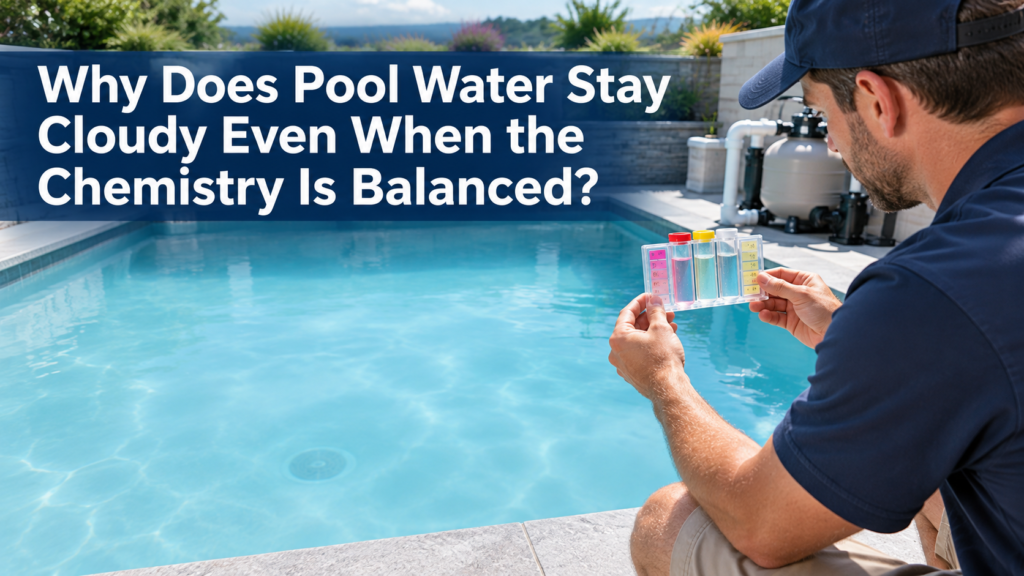
You test the pool. The pH looks right. Free chlorine sits inside the recommended range. Total alkalinity seems steady, and calcium hardness is not waving a red flag. Yet the water still has that dull, milky look—and the main drain appears as though someone placed a thin sheet of tracing paper over it.
It is frustrating, especially when the numbers say everything should be fine.
Here is the key: balanced pool chemistry and clear pool water are related, but they are not the same thing. A test kit measures selected chemical conditions. It does not count every grain of dust, fragment of dead algae, droplet of body oil, or microscopic particle suspended in the water. Nor does it tell you whether the filter is capturing those particles or whether water is moving through every corner of the pool.
So yes, pool water can stay cloudy even when the chemistry is balanced. The cause may sit outside the small group of values shown on a routine test strip.
Let’s sort out what may be happening—and, more importantly, what to check before adding yet another chemical.
Balanced Chemistry Is Only Part of the Picture
When pool owners say the chemistry is “balanced,” they usually mean that several familiar readings fall within their target ranges:
- Free chlorine or another sanitizer
- pH
- Total alkalinity
- Calcium hardness
- Cyanuric acid in stabilized chlorine pools
- Salt level in saltwater systems
Those numbers matter. Proper water balance supports swimmer comfort, sanitizer performance, surface protection, and equipment life. But a clear test result does not prove that the water is free from suspended matter.
Think of a cup of tea with a spoonful of very fine flour stirred into it. You could measure its pH and find a perfectly reasonable value. That would not make the flour disappear. Pool water behaves in much the same way: its dissolved chemistry can be acceptable while undissolved particles continue to scatter light.
That light scattering is what your eyes register as haze or cloudiness.
This distinction saves time because it changes the question. Instead of asking, “Which chemical number is wrong?” you begin asking, “What is still suspended in the water, and why has the treatment system not removed it?”
Tiny Suspended Particles Can Outsmart the Filter
Many cloudy pools contain particles that are too small to settle quickly and too fine for the filter to capture efficiently in a single pass. Common examples include:
- Windblown dust, pollen, and soil
- Dead algae cells
- Fine organic debris
- Residue from swimmers, including sunscreen and cosmetics
- Minute fragments from plaster, grout, or scale
- Precipitated minerals
- Contaminants introduced by rain or source water
These particles may remain suspended for hours or days. Because they are small, normal water movement keeps them drifting. Each one bends or scatters a little light. When millions are present, the pool loses its crisp, glass-like appearance.
A filter does not remove the entire pool’s particle load instantly. It can treat only the water that passes through it, and its effectiveness depends on the filter type, media condition, flow rate, and particle size. Some particles may pass through repeatedly.
If you want a closer explanation of that limitation, see Why Pool Filters Cannot Always Remove Very Fine Particles.
The Filter May Be Running—but Not Working Well
A humming pump can create a comforting impression that the filtration system is doing its job. Unfortunately, noise is not proof of effective filtration.
The filter may be dirty, damaged, incorrectly sized, poorly maintained, or operating outside a useful flow range. Each filter type brings its own possible trouble.
A sand filter may channel, allowing water to follow easy paths through the media instead of spreading evenly. Old or fouled sand can also perform poorly. A cartridge filter may be clogged with oils and fine debris, even if a quick rinse makes its surface look cleaner. A diatomaceous earth filter may have damaged grids, inadequate coating, or an incorrect amount of filter powder.
Pressure readings can help, but they need context. A high pressure reading may indicate restriction. An unusually low reading may suggest poor flow, a suction-side issue, a damaged component, or water bypassing the expected path. The “normal” pressure is the clean-filter baseline for that specific system—not a universal number copied from the internet.
Check for torn cartridges, cracked manifolds, worn seals, incorrect valve positions, and internal bypass. If debris returns through the pool returns after vacuuming, the filter deserves immediate attention.
And remember: cleaning too often can sometimes reduce the fine-particle capture of certain filters, while cleaning too late can restrict circulation. Timing matters.
Circulation Can Leave Quiet Corners Behind
Balanced water in front of the return jet does not guarantee balanced water everywhere.
Poor circulation allows particles and microorganisms to linger in steps, corners, benches, behind ladders, near lights, and across the pool floor. These zones may receive less sanitizer and less filtration than the center of the pool. Water can look cloudy because the entire volume is not being turned over and mixed effectively.
Possible circulation problems include:
- A pump that is undersized, damaged, or running too slowly
- Short daily run times
- Blocked skimmer baskets or pump baskets
- A low water level that allows the skimmer to pull air
- Poorly aimed return fittings
- Closed or partly closed valves
- Air leaks on the suction side
- Plumbing restrictions
- An overloaded filter
Run time alone does not tell the whole story. Eight hours with weak flow may accomplish less than a shorter period at an effective flow rate. Likewise, a powerful return aimed in the wrong direction may move the surface while leaving deep areas quiet.
Try watching the pool. Do leaves consistently gather in one corner? Are there areas where brushed dust barely moves? Does the surface skim poorly? These simple observations often reveal more than another test strip.
Heavy Swimmer Use Can Overwhelm an Apparently Balanced Pool
A pool may test well in the morning and turn hazy after a busy afternoon. That is not mysterious. Swimmers bring sweat, skin cells, body oils, sunscreen, hair products, dirt, and traces of many other materials into the water.
The sanitizer begins reacting with this new load. The filter receives a sudden rush of fine organic matter. If circulation or filtration cannot keep pace, clarity drops—even if a later spot test still lands inside an acceptable range.
Commercial pools, hotel pools, community pools, and family pools after a party often experience this pattern. The chemical readings are a snapshot; bather load is a moving target.
Testing frequency matters here. One reading taken well after the busiest period may miss the temporary sanitizer stress that occurred earlier. Combined chlorine, oxidation conditions, and actual sanitizer demand may tell a fuller story than one free-chlorine result.
This is why experienced operators adjust testing and filtration schedules around real pool use rather than relying on a fixed routine every day.
Dead Algae Can Keep Water Cloudy After the Algae Are Gone
This one catches many pool owners by surprise.
After an algae treatment, the green color may disappear, and chlorine may return to its target range. The biological problem may be under control, yet the water stays gray, blue-white, or dull. Why? Dead or damaged algae cells are still present.
Killing algae and removing algae are two different jobs.
Once algae cells lose their color or activity, they do not vanish. They become fine suspended debris that must be filtered or vacuumed out. A severe bloom can leave an enormous particle load behind. The filter may require longer operation, repeated cleaning, and careful monitoring before the water regains its sparkle.
Brushing remains important because affected material can cling to walls, ladders, steps, and fittings. If it is not loosened, it may continue to enter the water gradually.
Do not assume that clear chemistry means the cleanup is finished. The pool may simply have moved from the “control the growth” stage to the “remove the remains” stage.
High Calcium Can Turn Into Visible Haze
Calcium hardness can fall within a commonly quoted range while the overall water balance still favors calcium carbonate precipitation. Pool water is a system, not a row of unrelated boxes.
The tendency for calcium scale to form depends on several interacting factors, including:
- pH
- Total alkalinity
- Calcium hardness
- Water temperature
- Total dissolved solids
- Carbonate balance
If pH rises quickly, water warms, or a high-pH product is added too rapidly in one place, calcium carbonate may come out of solution as a fine white haze. This can happen even when a later test shows a reasonable pH, because the temporary local condition has already created particles.
Cloudiness after adding calcium hypochlorite, soda ash, calcium chloride, or another concentrated product may point toward a mixing, dosing, or saturation issue. Never assume the product itself was “bad” without examining how, where, and when it was added.
For plaster and cement-based pools, a saturation index calculation can give a more useful view than calcium hardness alone. It helps assess how the combined water conditions may favor scale formation or aggressive water.
A “Normal” Chlorine Reading May Not Tell the Full Sanitizing Story
Free chlorine does not work in isolation. Its practical activity is influenced by pH, cyanuric acid, temperature, sunlight, organic load, and contact time.
For example, two pools can show the same free-chlorine number while having very different cyanuric acid levels. The relationship between sanitizer and stabilizer affects the amount of active disinfecting chlorine available. A test strip may label each value “acceptable,” yet the combination may not suit the pool’s conditions or local guidance.
Testing method also matters. Old reagents, damp test strips, poor sample technique, and color-matching errors can produce reassuring but inaccurate results. A sample taken next to a return jet or immediately after chemical addition may not represent the whole pool.
If water remains cloudy without an obvious mechanical cause, confirm the readings with a reliable drop-based kit, photometer, or qualified pool professional. Take the sample away from returns and near elbow depth. Follow the test instructions closely—yes, even the waiting time.
Balanced chemistry must be real, not merely printed in friendly colors on a strip.
Rain, Wind, and Source Water Can Change Clarity Fast
Outdoor pools live under an open sky. A windy day can carry pollen, dust, smoke particles, and soil into the water. Heavy rain can wash debris from nearby surfaces, dilute sanitizer, disturb pH and alkalinity, and increase the load on the filter.
Refill water can also bring iron, manganese, calcium, silt, or other dissolved and suspended material. Some metals remain invisible until oxidation changes their form. Then the water may develop a tint or haze even though the basic pool chemistry appears reasonable.
Construction work nearby is another frequent culprit. Fine cement dust, drywall dust, landscaping soil, and airborne particles can enter a pool faster than a standard filtration cycle can remove them.
If cloudiness appeared suddenly, ask what changed outside the pool—not only what was added inside it.
Too Much Treatment Can Create a New Problem
Cloudy water often triggers a familiar reaction: add more of everything.
More sanitizer. More algaecide. More clarifier. Perhaps a little pH adjuster for good measure.
That approach can make diagnosis harder and may worsen the haze. Excess clarifier can overload the water with polymer and create sticky or difficult-to-filter material. Incompatible products can interact. Rapid additions can produce local precipitation. Repeated shock treatments can add solids or raise calcium, depending on the product used.
Even a useful chemical can perform poorly at the wrong dose.
A pool clarifier is designed to help fine particles associate into larger groups that filtration can capture more efficiently. It does not replace sanitation, brushing, circulation, or filter maintenance. Used correctly, it can support the physical removal step. Used carelessly, it becomes one more variable in an already confused system.
For a plain-language explanation of the mechanism, read What Is a Polymer Pool Clarifier and How Does It Work?.
When a Polymer Pool Clarifier May Help
Suppose the chemistry has been verified, active algae are not the main issue, circulation is adequate, and the filter is in serviceable condition—but a fine haze remains. This is where a compatible polymer clarifier may be useful.
Many suspended particles carry surface charges that help keep them separated in water. A cationic polymer can interact with certain negatively charged particles, reducing that separation and helping them gather into larger structures. The filter can then capture material that previously passed through or remained suspended.
Picture a filter trying to catch individual grains of flour. Now picture those grains gathered into soft, larger clusters. The second task is easier.
Eautrix Polymer Pool Clarifier is based on PolyDADMAC technology and is developed to support fine-particle removal in pool-water treatment programs. Formulation concentration, color, packaging, dosage directions, and regulatory requirements should be matched to the intended market and finished-product label.
Compatibility deserves attention. Cationic clarifiers should not be mixed casually with anionic products, and concentrated products should not be combined directly unless compatibility has been established. More is not better. Follow the finished-product label and allow the filtration system time to do its part.
A Practical Troubleshooting Sequence
Random chemical additions often create a longer recovery. A simple diagnostic order is far more useful.
1. Confirm the Water Test
Retest with fresh reagents or a reliable instrument. Check free chlorine, combined chlorine, pH, total alkalinity, calcium hardness, and cyanuric acid where relevant. For saltwater pools, confirm salt and cell operation as well.
2. Look Closely at the Water
Is it white, gray, greenish, brown, or simply dull? Can you see particles in a beam of light? Did the change follow rain, heavy swimming, an algae treatment, refilling, or a chemical addition? The timing and color provide clues.
3. Inspect Circulation
Empty baskets, confirm the water level, examine return flow, check for air in the pump basket, and make sure valves are correctly positioned. Brush dead zones and observe how debris moves.
4. Check the Filter
Compare pressure with the clean-filter baseline. Clean or backwash according to the equipment manufacturer’s instructions. Inspect internal components if performance remains poor. Do not keep adding chemicals to compensate for damaged filtration equipment.
5. Remove Large and Settled Debris
Skim, brush, and vacuum. If substantial material has settled and the system permits it, vacuuming to waste may prevent that load from returning through the filter. Follow local water-disposal requirements.
6. Address the Identified Cause
Treat living algae if present. Correct a genuine water-balance issue gradually. Manage metals with a suitable program if testing confirms them. If fine suspended particles remain after the main cause is controlled, consider a compatible clarifier at the label dose.
7. Give Filtration Time
Clear water rarely returns the instant a treatment is added. Continue circulation and monitor pressure because captured particles may load the filter quickly. Clean the filter when needed, then reassess before adding more product.
Clear Water and Safe Water Are Not Synonyms
A sparkling pool can still have inadequate sanitation. A cloudy pool can sometimes have acceptable sanitizer at the moment of testing. Appearance and hygiene overlap, but neither proves the other.
Cloudiness is also a safety concern because poor visibility can hide a swimmer or obscure the pool floor. If the bottom or main drain cannot be seen clearly, keep swimmers out until visibility and water conditions meet applicable safety requirements.
That may feel overly cautious when the chemical readings look fine. It is not. A test result cannot restore visual supervision.
The Real Answer: Chemistry, Hydraulics, and Filtration Must Work Together
Why does pool water stay cloudy even when the chemistry is balanced? Usually because “balanced” describes only one part of the water-care system.
Fine particles may still be suspended. The filter may be overloaded or damaged. Circulation may leave quiet zones. Dead algae may remain after treatment. Minerals may have precipitated. Swimmers, weather, or source water may have added more contamination than the system can remove quickly. Sometimes the test itself is misleading.
The solution begins with diagnosis, not another blind dose.
Verify the chemistry. Inspect the equipment. Restore effective flow. Remove debris. Then, when fine suspended particles are the remaining problem, use a suitable clarifier to help the filter finish the job.
That is how cloudy water becomes clear again—not through one magic number, but through a treatment system whose chemical and physical parts finally work together.
Frequently Asked Questions
1. Why Is My Pool Cloudy When the pH and Chlorine Are Normal?
Normal pH and chlorine do not remove fine suspended particles. Cloudiness may come from weak filtration, poor circulation, dead algae, swimmer residue, mineral precipitation, dust, or inaccurate testing. Inspect the filter and circulation before adding more chemicals.
2. How Long Does It Take a Cloudy Pool to Clear After the Chemistry Is Balanced?
The time varies with particle load, filter type, flow rate, and the underlying cause. Mild haze may improve after several effective filtration cycles, while a pool full of dead algae may take much longer and require repeated filter cleaning or vacuuming.
3. Can I Swim if the Pool Chemistry Is Balanced but the Water Is Cloudy?
Do not swim if cloudiness prevents a clear view of the pool floor or main drain. Poor visibility creates a serious supervision and rescue risk. Cloudiness may also signal an unresolved filtration, sanitation, or contamination problem.
4. Will Pool Clarifier Fix Cloudy Water With Balanced Chemistry?
A pool clarifier may help when very fine suspended particles are the main cause and the filtration system is working correctly. It will not repair poor circulation, kill an active algae bloom, correct mineral imbalance, or fix a damaged filter. Use only the label dose.
5. Can Too Much Pool Clarifier Make the Water Cloudier?
Yes. Overdosing some clarifiers can create excess polymer residue or particle masses that are difficult to filter. Follow the product label, confirm compatibility with other treatments, and allow enough filtration time before considering another dose.