
GET IN TOUCH
Ask For Sample?
What Is a Polymer Pool Clarifier and How Does It Work?
A swimming pool can have acceptable chlorine and pH readings yet still look dull, hazy, or slightly milky. That situation frustrates pool owners because the water may seem chemically balanced on paper. Still, it does not have the crisp sparkle people expect from a well-maintained pool.
The missing piece is often filtration—not disinfection.
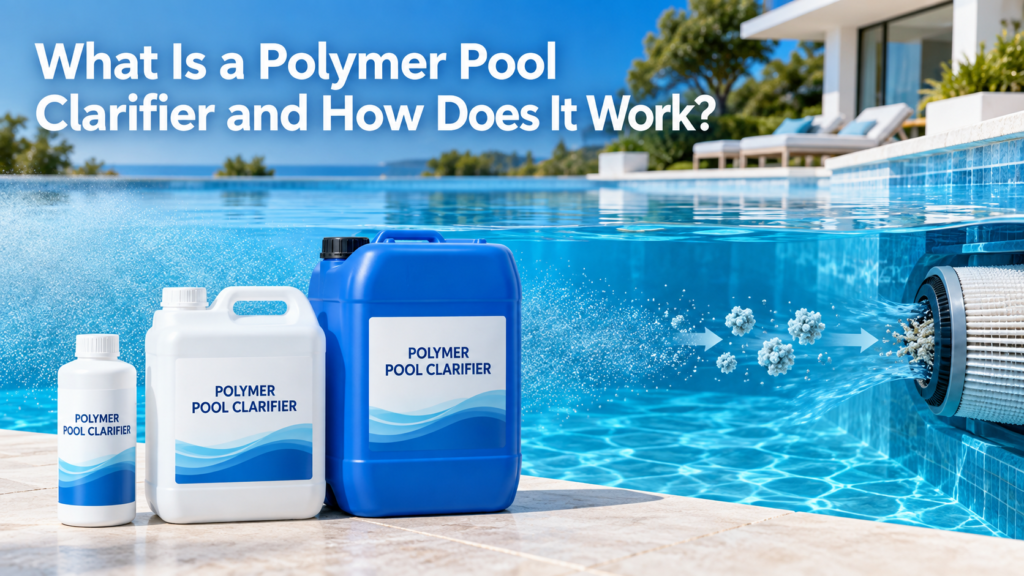
Cloudy water contains countless suspended particles. Some are so small that a standard pool filter struggles to catch them. A polymer pool clarifier helps by gathering those tiny particles into larger clusters that the filter can remove more easily.
That sounds simple. The chemistry behind it is clever, though. A clarifier does not bleach the water, kill every microorganism, or make dirt disappear. It changes how the particles behave. Think of it as giving a pool filter a better-sized target.
This guide explains what a polymer pool clarifier is, how it works, when it makes sense, and why the correct dose matters more than a generous pour.
First Things First: What Is a Polymer Pool Clarifier?
A polymer pool clarifier is a water-treatment product formulated to improve the removal of fine suspended particles from swimming pool water. Most polymer clarifiers contain long-chain molecules that interact with small particles and encourage them to come together.
The resulting particle clusters are often called flocs or aggregates. In a normal clarification program, they remain small enough to circulate through the pool yet large enough for the filter to capture.
This distinction matters. A clarifier usually works with the existing circulation and filtration system. It is not supposed to create a heavy layer of debris on the floor. That settling action is more closely associated with a pool flocculant.
Polymer clarifiers can be based on different chemistries. One widely used cationic polymer is PolyDADMAC, short for poly(diallyldimethylammonium chloride). Eautrix supplies a Polymer Pool Clarifier based on 10% PolyDADMAC, CAS No. 26062-79-3, with original or blue-colored liquid options for private-label programs.
The active chemistry is important, but the finished formulation matters too. Concentration, molecular characteristics, water quality, compatibility, and dosage instructions all affect how the product behaves in a real pool.
Why Does Clear Pool Water Become Cloudy?
Pool water can look cloudy when light scatters from fine material suspended in the water. The individual particles may be difficult to see, yet millions of them create a visible haze.
Common sources include:
- Dust, pollen, soil, and airborne debris
- Body oils, cosmetics, sunscreen, and perspiration
- Dead algae after an effective algae treatment
- Fine mineral precipitates caused by poor water balance
- Organic material introduced by swimmers, rain, or landscaping
- Debris too small for the filter to retain efficiently
- Filter media that is dirty, channelled, damaged, or poorly maintained
Cloudiness is a symptom, not one single diagnosis. That is why adding clarifier without checking the pool can become an expensive guessing game.
High pH, improper alkalinity, calcium precipitation, active algae growth, weak sanitizer, poor circulation, and an undersized or damaged filter may all produce cloudy water. A clarifier can help with suspended particles. It cannot repair equipment or correct every chemical imbalance.
Before treatment, test the water and inspect the system. The basic questions are plain: Is the sanitizer at the required level? Is the pH within the operating range? Is water reaching every part of the pool? Is the filter clean and working correctly?
Sometimes the real solution is not another chemical. It is a clean filter, a corrected pH, or another full day of circulation.
How Does a Polymer Pool Clarifier Work?
Here is the heart of the process.
Very small particles in water may remain dispersed because their surface charges help keep them apart. Instead of joining together, they repel one another and continue moving through the water. They can pass through the filter repeatedly, much like grains of powder slipping through a kitchen sieve.
A polymer clarifier changes that behavior through two closely related mechanisms: charge neutralization and bridging.
Step 1—The Polymer Approaches the Fine Particles
Many organic contaminants and colloidal particles in pool water carry a negative surface charge. A cationic polymer carries positive charges along its molecular chain.
Opposite charges attract. When the positively charged polymer meets negatively charged particles, it adsorbs onto their surfaces and reduces the electrical repulsion that keeps them separate.
Not every cloudiness problem follows one identical charge pattern, and pool water is more complicated than a textbook diagram. Still, charge interaction explains why cationic polymers can be effective at very low use levels.
Step 2—Long Polymer Chains Form Bridges
A polymer molecule is long compared with the tiny particle it contacts. One section of the chain can attach to one particle while another section extends into the water and attaches to a second particle. More contacts follow.
This is called polymer bridging.
Picture a loose fishing net gathering specks that were previously drifting alone. The particles do not vanish. They become part of a larger, more filterable structure.
Good circulation helps the polymer meet particles throughout the pool. Yet excessive shear or unsuitable treatment conditions may weaken the aggregates after they form. The goal is controlled contact, not violent mixing.
Step 3—Small Particles Become Filterable Clusters
As charge repulsion falls and bridging continues, isolated particles form larger clusters. These aggregates interact with the filter more readily than the original haze-forming material.
The process does not always create flakes visible to the naked eye. In routine pool clarification, much of the action remains microscopic. The first visible sign may simply be brighter water and sharper detail at the deep end.
Step 4—The Pool Filter Does the Heavy Lifting
The clarifier prepares the particles; the filter removes them.
That partnership is central to the treatment. After dosing, the circulation system must run long enough to move treated water through the filter. Depending on the pool, haze level, product directions, and filter condition, improvement may be gradual rather than instant.
As captured material accumulates, filter pressure can change. Operators should monitor the pressure gauge and clean or backwash the filter according to the equipment manufacturer’s instructions.
Cleaning too early may interrupt collection; waiting too long may restrict flow. The correct timing depends on the filter type and its normal operating pressure.
Clarifier, Flocculant, Sanitizer, or Algaecide—Which Is Which?
Pool chemical terms are often treated as interchangeable. They are not.
A polymer pool clarifier gathers fine suspended matter so the operating filter can capture it. It is mainly a filtration aid.
A pool flocculant creates larger, heavier flocs intended to settle to the floor. The pump is commonly stopped after distribution, and the settled material is then vacuumed to waste. The exact method must follow the product label and suit the pool equipment.
A sanitizer, such as chlorine, controls harmful microorganisms. A clarifier does not replace routine disinfection.
An algaecide helps prevent or control algae. Eautrix Polyquat 60 Algaecide, for example, is a non-foaming, polymer-based algaecide.
Although certain polymer treatments may also influence fine particles, a dedicated algaecide and a dedicated clarifier are formulated and sold for different primary jobs.
This is where labels save trouble. Never assume that two liquids with similar appearances have the same active ingredient, strength, use pattern, or regulatory status.
Clarifier Versus Flocculant: A Practical Comparison
Use a clarifier when the pool has mild to moderate haze, the water balance is under control, and the filter is operating normally. Clarification is usually less disruptive because normal filtration remains part of the treatment.
Use a flocculant only when the situation and product instructions support settling and vacuuming to waste. It may suit a severe suspended-solids problem, but it involves more labor, water loss, and equipment considerations.
Here is a quick comparison:
- Clarifier: Forms filterable clusters; circulation normally continues; the filter captures the material.
- Flocculant: Forms heavier floc; settling is normally required; debris is vacuumed from the floor.
- Sanitizer: Controls microorganisms; it remains essential whether the water looks clear or cloudy.
- Algaecide: Helps prevent or control algae; it does not substitute for filtration or sanitation.
A sparkling pool may still have unsafe sanitizer levels, while a properly sanitized pool may look hazy. Appearance and microbial control overlap, but they are not the same measure.
When Should You Use a Polymer Pool Clarifier?
A clarifier makes the most sense when fine suspended material is the confirmed or likely cause of cloudiness.
Useful situations may include:
- Light haze after heavy swimmer use
- Fine debris following wind, rain, or nearby construction
- Dead algae remaining after the algae has been controlled
- Slightly dull water before an event or reopening
- Particles that continue to pass through a functioning filter
- Routine support for filtration when allowed by the product label
Do not reach for a clarifier first when the pool has active algae, very low sanitizer, badly unbalanced water, poor circulation, or a malfunctioning filter. Correct the underlying problem.
Otherwise, the pool may clear briefly—or not at all—while the real cause continues.
If the water is green, test before assuming algae. Metals can also create color, and the response may be entirely different. If the pool is cloudy after a pH adjustment, a mineral precipitate may be involved.
Chemistry loves context; it rarely rewards guesswork.
How to Use a Polymer Pool Clarifier Correctly
The product label is the controlling instruction. Formulas differ, so no universal dose is safe to copy across brands or concentrations.
That said, a sound treatment sequence usually includes the following steps.
1. Diagnose Before You Dose
Test sanitizer, pH, total alkalinity, and other parameters required for the pool. Look for algae, scale, debris, and flow problems. Check whether the filter pressure and return flow are normal.
Clarifier is a precise helper, not a rescue potion.
2. Calculate the Pool Volume
An inaccurate pool-volume estimate produces an inaccurate chemical dose. Confirm the dimensions and account for changes in depth. For commercial pools, use the documented operating volume.
A small measuring error may not seem important, but it becomes significant when a concentrated clarifier is used. Guessing the pool volume and guessing the dose at the same time doubles the uncertainty.
3. Read the Product Label and Technical Documents
Confirm the active ingredient, concentration, recommended dose, dilution method, addition point, circulation time, compatibility limits, and storage conditions.
For professional purchasing, review the Safety Data Sheet (SDS), Technical Data Sheet (TDS), and Certificate of Analysis (COA). These documents answer different questions: safe handling, intended performance, and batch conformity.
4. Measure—Do Not Guess
More clarifier does not mean faster clarification. Excess polymer can coat filter media, raise pressure, create sticky residue, or restabilize particles instead of gathering them effectively.
Use a clean measuring device and follow the stated dose. For automatic feed systems, verify pump calibration and solution strength.
5. Distribute the Product as Directed
Some products are added slowly around the pool perimeter; others may be introduced at a specified point in the circulation system. Certain concentrates require dilution before addition.
Follow the supplier’s directions and do not mix concentrated chemicals together. If dilution is required, use a clean container and follow the stated order of addition.
6. Keep the Filtration System Working
Run the pump for the recommended time. Observe water clarity, return flow, and filter pressure. Clean or backwash the filter when the equipment instructions call for it.
Then be patient. A clarifier often improves water over a filtration cycle rather than in five dramatic minutes.
The Overdosing Trap: Why More Can Mean Less
Clarifier dosing has a useful operating window. Below it, too few polymer sites may be available to gather the suspended load. Within it, charge interaction and bridging support effective removal. Above it, excess polymer can interfere with aggregation or burden the filter.
Imagine wrapping a parcel. Enough tape holds it together. Covering every surface with several rolls creates a sticky problem, not a better package.
An overdose may produce persistent haze, rising filter pressure, or residue on surfaces and filter elements. Some formulations may also contribute to unwanted foaming.
The remedy depends on the chemical, dose, water condition, and filtration system. Do not keep adding more clarifier to fix a suspected clarifier overdose. Stop, test, improve filtration, and seek technical guidance.
For distributors and private-label brands, clear dosing directions are not a decorative part of the label. They are central to customer satisfaction.
A highly concentrated product can be economical, but only if users understand how little they may need.
Does Filter Type Change the Result?
Yes. Sand, cartridge, and diatomaceous earth filters differ in particle-retention behavior, hydraulic performance, and cleaning methods.
A clarifier can support several filter types when the product label allows it, but the operating response may vary.
A cartridge filter may show a noticeable rise in pressure as clusters collect on the element. A sand filter may require backwashing after the captured load accumulates. A diatomaceous earth filter has its own maintenance and recharging procedures.
The filter must be correctly sized, in good repair, and operated at a suitable flow rate.
No polymer can compensate for torn cartridges, channelled sand, missing filter media, a blocked skimmer, or a pump that cannot circulate the pool volume.
Is PolyDADMAC a Good Polymer for Pool Clarification?
PolyDADMAC is a water-soluble cationic polymer used in water-treatment applications. Its positive charge can help destabilize negatively charged suspended particles, while the polymer chain supports aggregation.
For pool-product formulators, it also offers practical advantages. It can be formulated into a liquid product, is easy to handle with suitable procedures, and can be supplied in different concentrations for further formulation.
The finished pool clarifier, however, should be developed and assessed for its intended market rather than treated as raw material poured straight from a drum.
Eautrix’s wider PolyDADMAC product range includes grades for water-treatment applications, while the dedicated pool clarifier is supplied as a finished 10% formulation with options for color and private-label packaging.
Buyers should confirm the active content, viscosity, appearance, pH, packaging compatibility, and batch-control procedure. The CAS number alone does not describe the entire commercial product.
What Should Pool Chemical Buyers Ask a Clarifier Supplier?
For a retail pool owner, the questions focus on safe use. For a distributor or private-label brand, they go further.
Ask the supplier:
- What is the active polymer and its CAS number?
- What is the active concentration in the finished formulation?
- Is the product supplied as a ready-to-use clarifier or a formulation ingredient?
- Which pool and filter systems suit the product?
- What quality limits appear on the COA?
- Are SDS and TDS documents available for the target market?
- Can the liquid remain original in color or be adjusted to blue?
- What packaging sizes, closures, induction seals, cartons, and labels are available?
- How are batch consistency and packaging compatibility checked?
- What is the minimum order quantity and sample policy?
- Which performance claims can be supported for the intended market?
For private-label programs, packaging should suit the sales channel.
A 1L bottle may fit pool shops and household use. A 5L jerry can can serve service companies or larger residential pools. A 25L jerry can may suit professional operators and regional distributors.
The formulation, label, and pack size should tell one coherent story. A strong concentrate with vague instructions is not a premium product. It is a complaint waiting to happen.
How Can You Tell Whether the Clarifier Is Working?
Do not judge only by the first hour.
Signs of progress may include improved visibility at the deep end, sharper reflections, reduced light scatter, and gradual collection of material in the filter. The pressure gauge may rise as the filter retains more solids.
If there is little improvement, review the basics:
- Was the pool volume calculated correctly?
- Was the dose measured accurately?
- Is the product suitable for the particle load and filter?
- Is the sanitizer level adequate?
- Are pH and alkalinity within the required range?
- Is active algae still growing?
- Is circulation reaching dead zones?
- Does the filter need service rather than chemical help?
- Were several polymer products added too close together?
Repeated dosing without diagnosis can make the water worse. Pause, test, and find the bottleneck.
Can a Clarifier Be Used for Routine Pool Maintenance?
Some polymer clarifiers can be used periodically as part of a preventive maintenance program, provided the product label supports that use.
A maintenance dose may help the filter collect the small amount of fine material that enters a pool each week. This can be useful in pools exposed to heavy bathing loads, dust, pollen, nearby landscaping, or frequent outdoor events.
Still, routine use should not become a substitute for proper filter care.
If a pool needs clarifier every few days to remain clear, something else may be wrong. The filter may be undersized, circulation may be weak, sanitizer demand may be unusually high, or the water balance may be encouraging precipitation.
Regular chemical addition can hide an equipment problem for a while. It cannot solve it.
Commercial pool operators should also confirm whether continuous or periodic dosing is permitted under local requirements and the product’s approved instructions.
Can You Use Clarifier with Other Pool Chemicals?
A pool clarification program rarely operates in isolation. Chlorine, pH adjusters, algaecides, scale-control products, phosphate removers, and other treatments may already be present.
Compatibility should never be assumed simply because each product is individually suitable for swimming pools.
Several treatment products may contain charged polymers or chemicals that affect particle behavior. Adding them together or too close in time can create excessive aggregation, unexpected haze, deposits, or higher filter pressure.
Never combine concentrated chemicals in the same container. Add each product separately and follow the spacing, circulation, and dilution instructions supplied by the manufacturer.
When planning treatment after an algae problem, first control the algae and restore the required sanitizer level. Once the dead material becomes the main cause of cloudiness, a suitable clarifier may support filtration.
The sequence matters. So does patience.
What Makes a Good Commercial Polymer Pool Clarifier?
A commercial clarifier should do more than make a laboratory sample look clear.
It should remain stable during storage, tolerate reasonable transport conditions, pour consistently, disperse through pool water, and perform predictably at the recommended dose. Its packaging should also protect the formulation from contamination, leakage, and avoidable exposure.
For distributors and brand owners, consistency is especially important. A formula that changes noticeably from one batch to the next can lead to confusing customer experiences.
A reliable supply program should therefore consider:
- Active-polymer concentration
- Finished-product appearance
- pH range
- Viscosity and pouring behavior
- Color stability
- Low-temperature and high-temperature storage behavior
- Packaging compatibility
- Closure and sealing performance
- Batch traceability
- COA specifications
- Label accuracy
The most concentrated product is not automatically the most suitable finished product. Market position, user experience, dose clarity, shipping cost, and local regulations all influence the correct formulation.
Private-Label Polymer Pool Clarifier Options
Private-label clarifier programs allow pool chemical distributors and service brands to sell the product under their own name.
A supplier may support choices such as original liquid color or dyed-blue appearance, different bottle sizes, label design, carton configuration, and shipping marks.
The package format should match the intended user.
A 1L bottle is easier to display in a retail shop and easier for a household pool owner to measure. A 5L jerry can provides a practical middle ground for pool service companies. A 25L jerry can reduces packaging cost per kilogram for professional users and distributors.
Packaging decisions should also consider the closure, liner, induction seal, label material, carton strength, pallet pattern, and conditions expected during ocean or road transport.
A beautiful label is helpful. A leak-resistant package is essential.
Clear Water Comes from a System, Not a Single Bottle
A polymer pool clarifier is valuable because it solves a very specific problem: particles too fine for efficient filtration.
Through charge interaction and polymer bridging, it gathers those particles into larger clusters. The filter then removes them from circulation.
But the clarifier is only one member of the pool-care team.
Sanitizer manages microbial risk. Water balance protects comfort, surfaces, and equipment. Circulation brings chemicals and particles together. Filtration physically removes contamination. Algaecide can support algae prevention or control. Each has its own job.
When these parts work together, clear water is not a lucky accident. It is the visible result of a controlled treatment program.
For distributors, service companies, and private-label brands seeking a PolyDADMAC-based pool clarifier in original or blue liquid, Eautrix can support formulation discussion, 1L, 5L, and 25L packaging, label development, and bulk supply.
Share your target concentration, pack size, market, and annual demand to begin a practical product review.
Frequently Asked Questions
1. Is a polymer pool clarifier the same as chlorine?
No. Chlorine is a sanitizer used to control microorganisms. A polymer pool clarifier gathers fine suspended particles so the filter can remove them. Clear-looking water still needs proper sanitizer control.
2. How long does a polymer pool clarifier take to work?
Results depend on the product, dose, particle load, circulation, and filter condition. Some pools improve within one filtration cycle, while others need longer. Always follow the label and monitor filter pressure.
3. Can too much pool clarifier make the water cloudy?
Yes. Excess polymer may interfere with particle aggregation, coat filter media, or create residue. Measure the recommended dose carefully and do not add more simply because the first result is not immediate.
4. Can I use a PolyDADMAC pool clarifier after algae treatment?
It may help remove fine dead algae after the algae has been controlled, provided the product label permits that use and the pool is balanced. Confirm compatibility and avoid stacking several polymer treatments without technical guidance.
5. What is the difference between a pool clarifier and a pool flocculant?
A clarifier forms clusters that the running filter can capture. A flocculant generally creates heavier material that settles to the pool floor for vacuuming to waste. The right choice depends on water condition, equipment, and label directions.