
GET IN TOUCH
Ask For Sample?
Why Choose a Direct Polyquat 60 Factory Supplier?
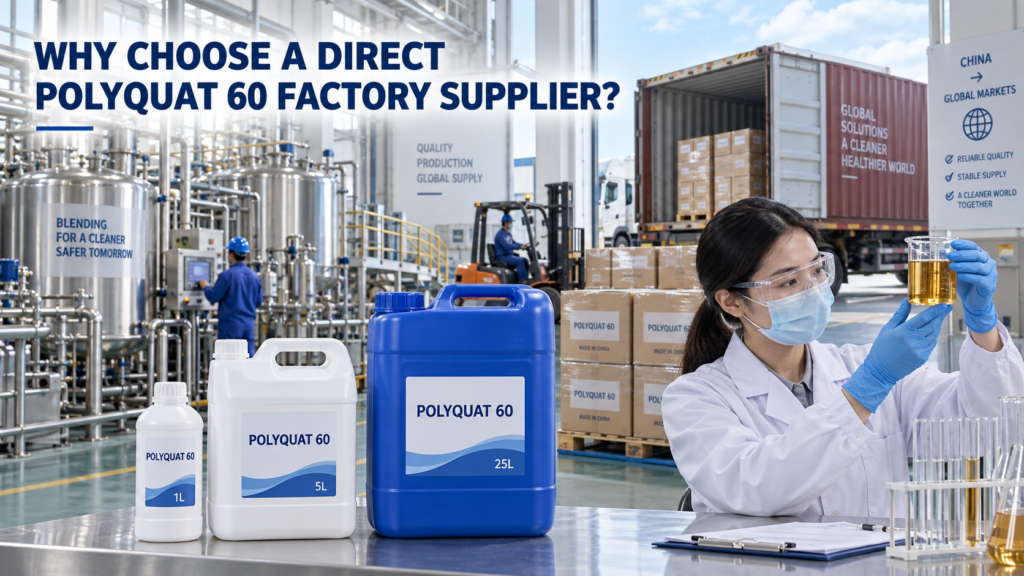
Buying Polyquat 60 may look simple on a spreadsheet. You compare active content, package size, price per kilogram, and delivery time. Then you select the lowest acceptable offer and move on.
Real purchasing is rarely that tidy.
One batch may arrive with a different viscosity. A label may peel in humid storage. A shipment may miss the peak pool season by three weeks. Perhaps the sales contact cannot explain why the Certificate of Analysis uses a different test item from the Technical Data Sheet. Suddenly, a small price saving does not feel like a saving at all.
This is why many pool chemical distributors, formulators, importers, and private-label brands prefer to work with a direct Polyquat 60 factory supplier. Direct access can shorten communication, make product specifications easier to control, and connect purchasing decisions with the people who actually produce, test, fill, and pack the material.
Still, the word “factory” is not a magic stamp of quality. A direct manufacturer should be verified just as carefully as any other supplier. The real advantage appears when manufacturing access is combined with disciplined quality control, clear documentation, responsive service, and honest production planning.
So, what should buyers expect from that relationship? Let’s take it step by step.
First, What Does “Direct Factory Supplier” Really Mean?
A direct factory supplier is normally the company that manufactures, formulates, blends, fills, or packages the product being offered. Depending on the project, one facility may handle every stage, while approved partners may perform certain packaging or logistics tasks.
That distinction matters. “Factory direct” should describe a traceable supply relationship, not just a phrase printed in an email signature.
For Polyquat 60, a qualified supplier should be able to explain:
- Which active ingredient is supplied
- The chemical name and CAS number
- The target active concentration or other declared content
- The standard test items and methods
- The usual appearance, pH, density, and viscosity range
- Where blending, filling, labeling, and final inspection take place
- How batch numbers connect production records with the finished shipment
- Which packaging sizes are routinely available
- Whether the product is sold as concentrated raw material or as a finished algaecide
This last point deserves attention. Polyquat 60 is often used as an industry name for a concentrated polymeric quaternary ammonium algaecide. Yet the name alone does not tell a buyer everything about a product. Chemical identity, concentration, intended use, local registration status, and label directions must still be checked.
Buyers can review the Polyquat 60 Algaecide product page for an example of how active ingredient, application, features, and supply options can be presented clearly.
The Lowest Price Is Only One Line on the Cost Sheet
Of course price matters. No purchasing manager ignores it. Yet a low unit price can be outweighed by rework, delayed sales, leaking packages, inconsistent concentration, rejected documents, or repeated customer complaints.
The better question is not simply, “How much does one kilogram cost?” It is, “What will this order cost by the time it is approved, shipped, received, stored, sold, and supported?”
That fuller calculation includes:
- Product cost
- Packaging and pallet cost
- Testing and inspection fees
- Freight and handling
- Import documentation
- Relabeling or repacking
- Inventory delays
- Claims, returns, and replacements
- Staff time spent resolving technical issues
A direct factory relationship can reduce some of these hidden costs because fewer messages must pass through separate commercial layers. Questions can reach production or quality staff sooner. Packaging changes can be reviewed before filling. Batch data can be traced without a long chain of forwarding emails.
Does direct purchasing always produce the lowest landed cost? No. Small orders, mixed-product containers, local stock, and credit terms may make a specialist distributor more economical. But for repeat orders, custom projects, or growing private-label programs, direct supply often gives buyers more control over the costs that do not appear in the first quotation.
Better Batch Control Starts at the Production Line
Polyquat 60 buyers need more than a product that passes once. They need repeatability.
Imagine launching a private-label algaecide after a successful sample test. The first commercial batch fills smoothly, looks right, and performs as expected. Three months later, the next batch has a noticeably different viscosity or color. Even if it remains within a broad specification, the change may affect filling speed, package appearance, dilution, or customer confidence.
A capable Polyquat 60 manufacturer should control raw materials, process conditions, in-process checks, final testing, and batch release. The precise control plan varies by producer, but the buyer should be able to see a sensible connection between the written specification and actual factory practice.
Typical purchasing checks may include:
- Appearance
- Active ingredient or declared content
- pH at a stated dilution
- Density at a stated temperature
- Viscosity under a stated test condition
- Solubility or dilution behavior
- Packaging integrity
- Net weight
- Label and batch-code accuracy
The wording “under a stated test condition” is important. Viscosity values can be misleading when the instrument, spindle, speed, temperature, or sample preparation differs. A number without a method is only half a result.
Direct technical contact makes it easier to compare like with like. If a result looks unusual, the factory can review production and laboratory records instead of guessing from a sales document.
That does not mean buyers should accept every factory report without question. Independent testing may still be appropriate for supplier approval, regulatory review, contract verification, or higher-risk orders. Trust works best when it is supported by records.
Technical Questions Reach the People Who Can Answer Them
Here is a familiar purchasing frustration: you ask whether a product can be diluted to a lower concentration, whether the color can be adjusted, or whether a certain container resin is suitable. The sales representative replies, “We are checking,” and the question begins a long trip through several inboxes.
With a well-organized direct supplier, commercial and technical teams work closer together. That can speed up answers about:
- Product identity and concentration
- Specification limits
- Test methods
- Dilution and blending
- Compatibility concerns
- Filling temperature or viscosity
- Package selection
- Shelf-life support
- Storage recommendations
- Sample-to-batch comparison
This matters because Polyquat 60 is not only purchased as a finished pool product. It may also be purchased as a concentrated input for further formulation, dilution, private labeling, or seasonal product development.
For example, a buyer developing a retail algaecide must consider more than the active ingredient. Water quality, mixing sequence, color, container compatibility, label claims, local rules, and finished-product stability may all affect the project. A factory that understands both the polymer and the filling process can give more useful answers than a contact who sees only a stock code.
There is a boundary, though. A supplier can provide product data and manufacturing support, but the finished-product owner remains responsible for confirming legal claims, registrations, directions, and market compliance in the destination country. Good technical support makes that work easier; it does not replace it.
Custom Formulation Becomes a Practical Conversation
Not every market needs the same product concentration or presentation.
One distributor may want a concentrated 60% product for professional buyers. Another may need a lower-concentration maintenance algaecide for retail sale. A third may be building a winter pool-care line with a specific color and package format.
Direct factory cooperation can make these requests easier to assess because the people reviewing the project understand the equipment, batch size, mixing limits, raw-material controls, and filling line.
Possible services may include:
- Concentration adjustment
- Custom blending
- Original or dyed appearance
- Package-size selection
- Trial production
- Private-label filling
- Carton design coordination
- Pallet configuration
- Support for customer-side blending
Not every requested change is automatically sensible. A formula that looks attractive in a marketing brief may become too viscous to fill efficiently. A dye may affect appearance during storage. A requested small batch may create disproportionate cleaning and setup costs.
This is where direct communication earns its keep. A responsible factory should explain what is workable, what requires testing, and what may introduce unnecessary risk. A quick “yes” to every request is not always good service. Sometimes the most valuable answer is, “We should test that first.”
Private Label Support Goes Beyond Printing Your Logo
Private-label pool chemicals sit at the intersection of chemistry, packaging, regulation, and brand experience. The liquid may perform well, but customers also judge the cap, seal, label, carton, pouring control, and condition of the package when it arrives.
A direct Polyquat 60 factory supplier may help coordinate:
- 1L bottles for retail shelves
- 5L jerrycans for pool service companies or larger users
- 25L stackable jerrycans for professional and commercial supply
- Label placement and print checks
- Induction seals or tamper-evident features where suitable
- Batch coding
- Carton quantities
- Pallet loading plans
- Neutral packaging for further processing
Packaging should be chosen according to the actual distribution route. A bottle that performs well in a local carton may face very different stress during ocean freight, container unloading, warehouse stacking, or last-mile courier delivery.
For that reason, buyers should discuss cap torque, seal design, container wall strength, carton grade, pallet wrapping, stacking height, and leak testing before the first commercial shipment. It is not glamorous work. It is, however, the sort of work that protects a brand.
If your business is developing seasonal products, the Winter Algaecide range offers a useful view of concentration, color, blending, and retail-ready packaging possibilities.
Production Visibility Helps You Plan the Pool Season
Pool chemical sales are seasonal in many countries. A late shipment may arrive after distributors have built their inventory, retailers have set their shelves, or service companies have made their main purchases.
Direct contact with the factory can improve planning because buyers can discuss real production factors rather than receiving a vague promise.
Useful questions include:
- Is the quoted lead time measured from deposit, label approval, or final artwork approval?
- Are containers and caps already in stock?
- Does custom color require a trial batch?
- How long does laboratory release take?
- When will the shipping marks be confirmed?
- Is the order dependent on a shared production schedule?
- How much extra time should be allowed before the peak season?
A reliable supplier will separate production time from shipping time. These are not the same thing. “Ready in 15 days” does not mean “at your warehouse in 15 days.” Export booking, port cutoffs, customs procedures, ocean transit, destination clearance, and inland delivery must also be considered.
There is another benefit to production visibility: buyers can plan repeat orders before stock becomes urgent. Rush purchasing tends to weaken negotiation, reduce packaging choices, and increase freight cost. Calm purchasing is usually cheaper purchasing.
Clear Documentation Reduces Friction at Every Handoff
Chemical shipments move through many hands: factory staff, freight forwarders, carriers, customs brokers, import teams, warehouse teams, quality departments, and sometimes regulatory reviewers. Consistent documents keep those handoffs from becoming a guessing game.
A direct Polyquat 60 supplier should be prepared to provide relevant commercial and technical documents for the product and shipment. Depending on the transaction and destination, these may include:
- Commercial Invoice
- Packing List
- Certificate of Analysis
- Safety Data Sheet
- Technical Data Sheet
- Product specification
- Certificate of Origin when requested and available
- Transport-related declarations where applicable
- Pallet or packaging information
- Batch and production details required by the contract
The documents should agree with one another. Product name, concentration, net weight, package count, batch number, and consignee details should not shift from one file to the next.
Direct access can help when a clarification is needed because the supplier can connect the shipping document with the underlying production batch. Yet buyers should review drafts early. Finding a name mismatch after cargo reaches the port is the paperwork version of discovering a loose cap after the carton is wet—possible to solve, but needlessly painful.
Faster Problem Solving When Something Does Go Wrong
Even a strong quality system cannot promise that every international order will be trouble-free. Containers can be damaged in transit. Labels can be scuffed. A laboratory result can differ because two parties used different methods. A buyer may also discover that its warehouse conditions are harsher than expected.
The key measure is not whether a supplier claims perfection. It is how the supplier investigates a problem.
A direct factory should be able to connect a complaint to:
- The batch number
- Retained samples, if part of its control system
- Production records
- Laboratory results
- Filling and packing records
- Container and cap lots where recorded
- Loading photographs or inspection records
That traceability helps both parties separate a production issue from a transport, storage, sampling, or testing issue. Without it, complaint handling becomes a debate based on photographs and opinions.
Before ordering, ask about the complaint process. Who receives the claim? What evidence is needed? How quickly will the first response arrive? Is a retained sample available? How are corrective actions documented?
These questions may feel pessimistic when a new partnership is going well. They are not. They are a sign that both sides expect to build a serious supply relationship.
Direct Access Can Support Product-Line Growth
Many buyers begin with one product and later expand.
A distributor may start with concentrated Polyquat 60, then add a lower-strength maintenance algaecide, a winter treatment, or a clarifier. A private-label brand may begin with 1L retail bottles and later add 5L and 25L packs for service and commercial accounts.
Working closely with a factory can make this growth easier because specifications, artwork procedures, packaging preferences, and quality expectations are already understood. The supplier does not need to relearn the whole project each time.
Related products should still have distinct functions. An algaecide is not automatically a clarifier, and a clarifier is not a substitute for sanitation. If fine suspended material remains after algae control, a Polymer Pool Clarifier may help filtration remove those particles more effectively as part of a balanced pool-care program.
The commercial advantage is not merely a larger catalogue. It is the ability to create a coherent product line for different customers, seasons, and package sizes without losing control of the technical story.
But Is a Factory Always Better Than a Trading Company?
No—and saying otherwise would be too easy.
A capable trading company or distributor may add real value. It may consolidate several products from different factories, offer smaller quantities, keep local stock, extend credit, provide regional language support, or manage complex logistics. For a buyer ordering a mixed container or testing a new market, those services can be worth more than direct factory access.
A factory relationship is often most attractive when the buyer needs:
- Repeat volume
- A stable specification
- Direct technical discussion
- Custom formulation or filling
- Private-label packaging
- Production planning
- Long-term product development
A distributor may be more practical when the buyer needs:
- Very small quantities
- Several unrelated chemicals in one order
- Immediate local delivery
- Local credit terms
- Regional inventory support
- A single party to source many factories
The right choice depends on the purchasing model. The goal is not to remove every intermediary. It is to understand what each party does and whether the added layer creates enough value to justify its cost.
How Can You Verify a Genuine Polyquat 60 Factory Supplier?
Start with evidence, not presentation.
A polished website, factory photograph, or video call can be useful, but none should stand alone. Verification works better as a series of connected checks.
1. Confirm the Legal Company Identity
Compare the company name on the business registration, quotation, bank account, sales contract, invoice, and product documents. If different companies are involved, ask for a clear explanation of their roles.
2. Review the Product Specification
Make sure the chemical identity, CAS number, concentration, appearance, pH, density, viscosity, and test conditions suit your intended purchase. Do not approve a product from its trade name alone.
3. Request a Representative Sample
Test the sample under conditions relevant to your process or market. If you will dilute, blend, fill, color, or store the product, include those steps in the evaluation.
4. Compare Sample and Commercial Specifications
Confirm that the approved sample represents the grade you will receive. Ask how the sample batch is recorded and how later shipments will be checked against the agreed limits.
5. Inspect the Quality Documents
Review the SDS, TDS, COA format, specification, and label information together. Look for consistent names, values, and units.
6. Arrange a Factory Audit When Justified
An on-site visit, live video review, or independent third-party audit can help assess equipment, laboratory capability, storage, filling, traceability, and housekeeping. The depth of the audit should match the order value and risk.
7. Start With a Controlled Order
A trial order can test more than product quality. It also reveals how the supplier handles artwork, packing, deadlines, documents, loading, and communication.
8. Use Independent Testing When Needed
Third-party analysis can support initial approval or periodic verification. Agree on sampling and test methods before a dispute occurs.
Questions Worth Asking Before You Place the Order
You do not need a hundred-question form. A focused list usually reveals more than a long checklist copied from the internet.
Ask the supplier:
- What is the exact active ingredient and CAS number?
- What does “60%” mean in your specification and test method?
- Which parameters appear on the batch COA?
- Can you share a typical COA, TDS, and current SDS for review?
- What is the standard production batch size?
- How do you control batch-to-batch consistency?
- Which package sizes are filled routinely?
- Can you support 1L, 5L, and 25L private-label packaging?
- What are the minimum quantities for custom labels, cartons, colors, or concentrations?
- How is packaging compatibility evaluated?
- What is the lead time after artwork and payment approval?
- How are complaints investigated and retained samples managed?
- Which export documents can you provide?
- Can an independent inspection be arranged before shipment?
Pay attention to the quality of the answers. A trustworthy supplier may need time to confirm a technical detail, but the final response should be specific. Repeatedly vague answers, unexplained document conflicts, and pressure to skip sample testing are warning signs.
The Real Advantage Is Control, Not a Factory Label
Why choose a direct Polyquat 60 factory supplier?
Because direct access can give buyers tighter control over product specifications, batch consistency, technical communication, private-label packaging, production schedules, and problem solving. It can also support a longer product roadmap—from one bulk grade to a fuller pool-care line.
But the word “factory” should never replace due diligence.
The strongest supplier is not simply the one with the lowest quotation or the largest production photograph. It is the one that can show what it makes, how it tests, how it records each batch, how it protects the package, and how it responds when a buyer asks a difficult question.
That is what reduces purchasing uncertainty. And honestly, fewer surprises are often worth far more than a few cents saved on the first order.
Frequently Asked Questions
1. Is Buying From a Direct Polyquat 60 Factory Supplier Always Cheaper?
Not always. Direct purchasing may reduce commercial layers, but small orders, custom packaging, testing, freight, and import costs still affect the landed price. Buyers should compare total purchasing cost, not only the price per kilogram.
2. What Documents Should a Polyquat 60 Manufacturer Provide?
A qualified Polyquat 60 manufacturer should normally provide a current SDS, TDS, product specification, and batch COA. Commercial shipments may also require an invoice, packing list, origin document, and transport information depending on the destination and shipping arrangement.
3. Can a Direct Factory Provide Private-Label Polyquat 60 Algaecide?
Many factories can support private-label Polyquat 60 in retail or professional packaging. Confirm the available bottle and jerrycan sizes, minimum order, label format, carton printing, sealing method, batch coding, and local regulatory responsibilities before production.
4. How Should I Evaluate a Polyquat 60 Sample Before Bulk Purchase?
Check chemical identity, concentration, appearance, pH, density, viscosity, dilution behavior, and performance relevant to your use. If the product will be blended or repacked, test those steps as well. Record the sample batch number and compare it with the agreed commercial specification.
5. What Is the Main Benefit of Working With a Polyquat 60 Factory in China?
The main benefit is direct coordination across production, quality testing, packaging, and export preparation. For repeat or custom orders, a verified Polyquat 60 factory in China may offer better specification control, faster technical feedback, and more flexible private-label support.