GET IN TOUCH
Ask For Sample?
Starting a Pool Chemical Business with Polyquat 60
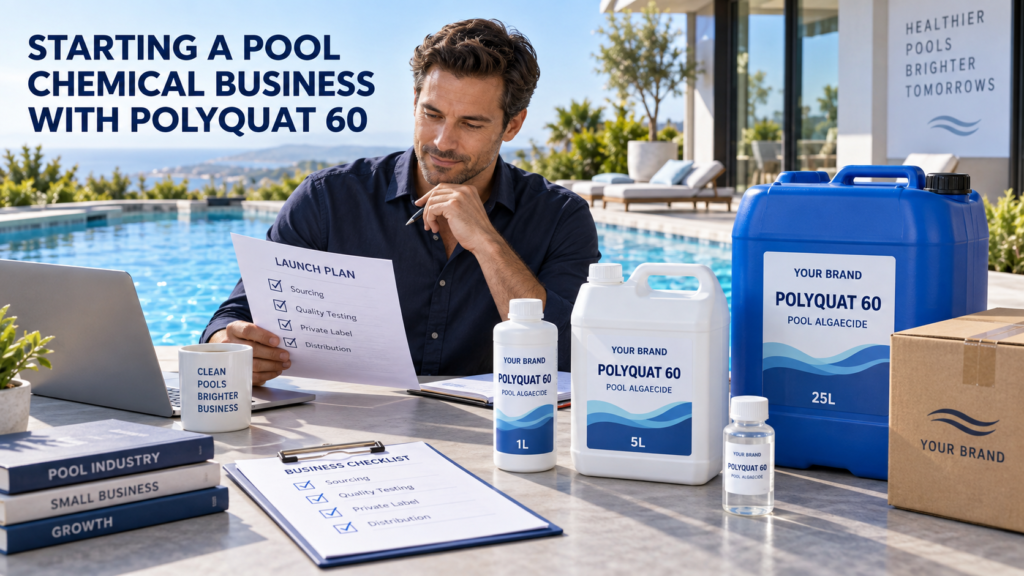
Starting a pool chemical business can feel bigger than it really is. There are formulas to choose, labels to prepare, regulations to understand, bottles to source, freight costs to calculate, and customers to win. Put all those jobs on one desk and, yes, the desk gets crowded quickly.
The good news? You do not need to launch a warehouse full of products on day one.
Polyquat 60 gives a new pool chemical brand a focused place to begin. It is a concentrated, polymer-based algaecide widely used in residential and commercial pool care. It is known for low-foaming performance, a metal-free formula, and compatibility with common pool maintenance programs when used as directed. Those qualities give distributors and private-label brands a clear story to tell.
Still, buying a drum and printing a label is not a business plan. The stronger route is to connect product chemistry, market position, compliance, packaging, margins, and customer support from the start. Let’s work through that route step by step.
Why Start with Polyquat 60?
A new pool chemical business needs a product that solves a recognizable problem. Algae certainly qualifies. Green water, slippery walls, cloudy appearance, and difficult seasonal openings are familiar headaches for pool owners and service teams.
Polyquat 60 is commonly based on Polixetonium Chloride, also known as Polyquaternium-42, with CAS No. 31512-74-0. The “60” usually refers to a product supplied at about 60% active content, although the exact specification must be confirmed with the manufacturer.
Its commercial appeal comes from several practical features:
- It is polymeric and non-oxidizing.
- It produces little or no visible foam under normal use conditions.
- It does not add copper or other metals to the pool.
- It can support preventive algae-control programs.
- It fits routine maintenance, pool opening, and winter closing product lines.
- It can be supplied as a concentrate or formulated into finished retail products.
That last point matters. A business can begin with bulk supply for professional buyers, sell a finished private-label algaecide, or build several strength and package options from one core raw material.
Polyquat 60 is not a primary sanitizer, however. It does not replace chlorine, bromine, filtration, circulation, or sound water balance. Honest positioning protects the customer and the brand. It also prevents marketing language from racing ahead of what the product is meant to do.
For a closer look at the product itself, visit Polyquat 60 Algaecide.
First, Decide What Kind of Business You Want
“Pool chemical business” can describe several very different companies. Before requesting prices, decide where you want to sit in the supply chain.
A Bulk Ingredient Supplier
This model sells concentrated Polyquat 60 to formulators, chemical distributors, and established pool care brands. Order sizes are larger, the customer base is narrower, and buyers tend to ask detailed technical questions.
You will need dependable specifications, batch documentation, suitable industrial packaging, and solid export or domestic logistics. Price matters, but consistency matters more. A formulator who has qualified one product does not want a surprise in the next batch.
A Private-Label Pool Chemical Brand
Here, a manufacturer produces and packs a finished algaecide under your brand. You control the name, label design, market position, package size, and sales channel, while the manufacturing partner handles agreed production work.
This route lowers the equipment burden, but it does not remove your responsibilities. You still need to verify the formula, label claims, packaging compatibility, local registration requirements, and quality controls.
A Distributor with an Exclusive or Semi-Exclusive Line
A regional distributor may sell a supplier’s existing product or request a customized version. This can be a sensible middle ground. You spend less time developing a formula, yet you can still negotiate territory, packaging, minimum order quantity, and marketing support.
A Formulator and Filler
This model buys Polyquat 60 concentrate, develops finished formulations, fills retail packs, and manages quality control in-house. It offers more control and, potentially, better manufacturing margins. It also requires greater technical knowledge, equipment, operating procedures, worker protection, compliance systems, and working capital.
Which model is right? The one that matches your real capabilities—not the one that sounds most impressive on a website.
Choose a Customer Before You Choose a Bottle
It is tempting to begin with packaging because bottles make the business feel real. Yet the customer should come first.
Your initial audience might be:
- Local pool service companies
- Independent pool stores
- Regional chemical distributors
- Hotel and resort maintenance suppliers
- Commercial aquatic facility contractors
- E-commerce retailers, where legally permitted
- Established pool brands seeking contract manufacturing
Each group buys differently. A pool service company may value a reliable 5L pack, quick delivery, and simple technical instructions. A retail store may care more about shelf appearance, 1L packs, barcodes, cartons, and seasonal promotions. A distributor may ask for 25L jerry cans, drums, pallets, private labels, and protected territory.
Speak with potential buyers before finalizing the product. Ask what they sell now, which algae complaints they hear most often, what package sizes move, whether customers resist premium prices, and how seasonal demand changes. Ten honest conversations can teach more than a beautiful but untested launch plan.
Concentrate or Ready-to-Sell Formula?
This is one of the first technical and commercial decisions.
A 60% active concentrate gives formulators flexibility and can reduce the amount of water shipped per unit of active ingredient. It makes sense for buyers with suitable formulation and filling capabilities.
A finished, ready-to-sell product is simpler for a new brand that does not operate a chemical plant. The manufacturer can prepare the agreed concentration, fill the chosen container, apply labels, pack cartons, and provide batch documents.
Neither route is automatically better. The key questions are:
- Who will formulate and fill the product?
- Does that party have appropriate equipment and quality controls?
- Which concentration can be legally marketed in the destination country?
- What claims will appear on the label?
- Does the selling price cover formula, packaging, freight, duties, storage, sales, and customer support?
- Can the formula remain stable through the expected shelf life?
Do not casually dilute a concentrate and assume the result is ready for sale. Water quality, pH, mixing sequence, contamination control, container compatibility, preservatives where relevant, and stability all deserve technical review. A finished product is more than concentrate plus water. That shortcut can become an expensive lesson.
Build a Small Product Line, Not a Lonely SKU
Starting small is wise. Starting with no room to grow is less wise.
Polyquat 60 can serve as the anchor product in a compact algae-control range. For example, a brand might begin with a premium non-foaming algaecide, then add a seasonal closing product and a separate clarifier. These products answer related customer needs without pretending that one bottle performs every job.
A simple first-stage line could include:
- A concentrated Polyquat 60 algaecide for professional or premium use
- A maintenance-strength algaecide for routine pool care
- A winter algaecide for seasonal closing programs
- A polymer clarifier for fine suspended particles and cloudy water
The algaecide and clarifier should be presented as complementary tools, not interchangeable ones. Algae control and particle removal are different jobs.
You can review Eautrix’s Winter Algaecide and Polymer Pool Clarifier to see how a focused product family can address seasonal care and water clarity.
Compliance Comes Before Clever Marketing
Pool algaecides are regulated products in many markets because they make claims about controlling algae. Requirements vary by country and may also vary by product use, active ingredient, concentration, sales channel, and label language.
Before placing an order, determine whether your market requires product registration, active substance approval, establishment registration, local representation, specific label wording, poison-center notification, language translations, or other filings. Speak with a qualified regulatory adviser or the relevant authority. A supplier can provide supporting documents, but the importer or brand owner may still carry important obligations.
Pay close attention to claims. Phrases such as “controls algae,” “prevents algae growth,” and “kills algae” may trigger regulatory requirements. Changing the wording does not necessarily change the product’s intended use in the eyes of an authority.
Your label may need to cover:
- Product identity and active ingredient
- Net contents
- Approved uses and directions
- Precautionary statements
- First-aid information
- Storage and disposal instructions
- Batch or lot traceability
- Manufacturer, importer, or responsible-party details
- Registration numbers where required
- Required local language
The Safety Data Sheet, or SDS, is also essential for workplace handling and supply-chain communication. It is not a substitute for a compliant consumer or professional-use product label.
This part may feel slow. Do it anyway. A good label is not decoration; it is part of the product.
How to Select a Reliable Polyquat 60 Supplier
A low quotation can grab attention, especially when cash is tight. Yet the cheapest drum may create costly problems if the active content varies, the packaging leaks, or the documents do not match the shipment.
Evaluate suppliers across five areas.
1. Product Identity and Specification
Confirm the chemical name, CAS number, active content, appearance, pH, density, viscosity, and any other parameters relevant to your use. Ask which test methods are applied. A specification without methods can leave too much room for interpretation.
2. Batch Control
Ask how raw materials are qualified, how batches are sampled, which tests are completed before release, and how retained samples are managed. Request recent Certificates of Analysis from more than one batch. Consistency should be visible across records, not merely promised during a sales call.
3. Documentation
Review the specification sheet, SDS, Certificate of Analysis, packing information, transport information, and available regulatory support. Make sure the product name and identifiers remain consistent across documents.
4. Packaging and Export Experience
Discuss closures, seals, container material, pallet pattern, carton strength, labels, and protection against leakage. For international orders, ask about shipment documents, port handling, and experience with the destination market.
5. Communication
How a supplier handles a small sample request often hints at how it will handle a large problem. Clear answers, realistic lead times, organized documents, and willingness to discuss limits are all positive signs.
Ask for a sample before a commercial order. Then test the sample against an agreed specification and in the intended formulation—not merely by color or thickness. A darker or more viscous liquid is not automatically better.
Packaging Is Part of the Business Model
One formula can behave like three different products when sold in three package sizes.
1L Bottles
These work well for retail shelves, online orders, trial purchases, and residential pool owners. They offer a lower entry price, but the packaging cost per kilogram is higher. Label quality and leak resistance matter because the bottle is also your salesperson.
5L Jerry Cans
This size often suits service companies, larger residential pools, and repeat users. It can offer a useful balance between handling convenience and product cost.
25L Jerry Cans
Larger packs may appeal to commercial operators, distributors, and professional service businesses. They reduce packaging cost per unit of product but require suitable handling, storage, and transport.
Industrial bulk supply may also use drums or intermediate bulk containers, depending on order volume, transport classification, customer facilities, and supplier capability.
Always run packaging compatibility and transport tests. Check the container resin, cap, liner, induction seal if used, label adhesive, print resistance, and carton structure. Observe filled packs under expected storage temperatures. A label that curls or a cap that loosens can make a good formula look careless.
Price from the Shelf Backward
Many new sellers calculate product cost, add a margin, and stop. That is rarely enough.
Your landed cost may include:
- Formula or concentrate
- Bottles, caps, seals, labels, and cartons
- Filling and packing charges
- Testing and batch release
- Pallets and protective materials
- Inland transport and international freight
- Insurance, duties, taxes, and customs fees
- Warehousing and local delivery
- Registration and compliance work
- Damaged stock, samples, and returns
- Sales commissions and payment fees
- Marketing and customer support
Work backward from a realistic market price. If retailers or distributors sit between you and the final customer, leave room for their margins too. A product can have a healthy factory-level margin and still lose money by the time it reaches the shelf.
Run at least three scenarios: expected sales, slower sales, and a difficult season. Pool care is seasonal in many regions. Inventory that arrives after the peak may sit for months, tying up cash and warehouse space.
The safest first order is not always the smallest possible order. Tiny production runs can make packaging painfully expensive. Instead, seek the smallest order that produces a viable landed cost and can reasonably sell within your planned period.
Create a Brand Promise You Can Actually Prove
“Premium quality” appears on countless chemical websites. It means little without evidence.
A sharper position might focus on non-foaming algae control for service professionals, metal-free pool care for appearance-conscious owners, or reliable seasonal products for distributors. The promise should match the formula, documentation, and customer experience.
Build proof around that position:
- A clear technical data sheet
- Batch-specific COA
- Current SDS
- Traceable lot code
- Packaging photos and dimensions
- Stability and compatibility information where available
- Clear directions based on the approved product label
- Responsive technical support
Avoid absolute claims such as “works in every pool” or “guaranteed to eliminate all algae.” Pool performance depends on water balance, sanitizer level, circulation, filtration, temperature, contamination load, algae type, dosage, and user practice. Thoughtful limits make a brand more credible, not less.
Plan a Sensible Market Launch
A staged launch protects cash and creates useful feedback.
Stage 1: Validate the Idea
Interview buyers. Compare existing price levels without copying competitors. Identify the most useful package and channel. Check regulatory feasibility before spending heavily on design.
Stage 2: Qualify the Product
Review documents, test samples, confirm the target specification, evaluate the intended finished formula, and inspect sample packaging. Agree on acceptance criteria in writing.
Stage 3: Prepare the Commercial System
Complete registrations where required. Finalize labels, barcodes, cartons, instructions, product photos, website content, price sheets, sales terms, and complaint-handling procedures.
Stage 4: Run a Controlled First Order
Launch in one region or with a small group of service companies and distributors. Track leaks, label damage, customer questions, repeat purchase rate, and seasonal performance. Real feedback is gold—even when it stings a little.
Stage 5: Expand with Evidence
Once the core product sells reliably, add sizes, strengths, seasonal products, or nearby markets. Let customer demand guide the next SKU rather than building a huge catalog out of enthusiasm.
Common Mistakes New Pool Chemical Brands Make
Several mistakes appear again and again:
- Treating Polyquat 60 as a replacement for sanitizer
- Selecting a supplier by price alone
- Printing labels before checking regulatory requirements
- Using unverified dosage language
- Ordering too many package sizes at launch
- Ignoring freight and storage in margin calculations
- Assuming a laboratory sample guarantees production consistency
- Making claims the business cannot document
- Launching without a complaint and recall process
- Buying seasonal inventory too late—or far too early
There is another subtle mistake: trying to look large. A new business does not need to pretend it owns five factories and serves every country. Buyers often respond well to a focused specialist who answers clearly, provides organized documents, and knows where the product fits.
Small can look capable. In fact, small can move quickly.
A Practical Pre-Launch Checklist
Before accepting your first commercial order, confirm that you can answer “yes” to the following:
- Is the target customer clearly defined?
- Is the product identity confirmed?
- Is the specification agreed in writing?
- Has a representative sample been tested?
- Is the formula suitable for the intended market and application?
- Have local regulatory requirements been reviewed?
- Is the label compliant and technically accurate?
- Are the SDS, COA template, and technical data sheet ready?
- Has the packaging been checked for compatibility and transport?
- Does the landed-cost model include hidden expenses?
- Is there enough margin for the sales channel?
- Can each batch be traced?
- Is there a method for handling complaints and product returns?
- Is the launch timing suitable for the local pool season?
If two or three answers are still “not yet,” do not panic. That is precisely what a checklist is for. Fix the weak points before they become customer problems.
Start Narrow, Learn Fast, and Earn Trust
Polyquat 60 can be a strong foundation for a pool chemical business because it addresses a common maintenance problem and supports several commercial formats. It can be sold as a concentrate to formulators, packed as a private-label finished product, or placed at the center of a compact algae-control range.
But the chemical alone does not create the business.
The business is the whole chain: a defined buyer, an appropriate formula, lawful claims, consistent batches, secure packaging, sensible pricing, reliable delivery, and support after the sale. Get those pieces working together and your first product becomes more than a bottle. It becomes evidence that your brand can be trusted.
You do not need twenty SKUs to begin. You need one product that does what the label says, reaches the right customer, and arrives in good condition. That is a quieter start than a grand launch. It is also a much stronger one.
Frequently Asked Questions
1. Is Polyquat 60 a good first product for a private-label pool chemical business?
Yes, it can be a practical first product because it has a clear algae-control role, low-foaming performance, and several packaging possibilities. The business must still confirm local registration, labeling, formulation, and supply requirements before launch.
2. Can a new business sell Polyquat 60 without owning a chemical factory?
Yes. A qualified contract manufacturer or private-label supplier can formulate, fill, label, and pack the product under agreed terms. The brand owner or importer may still have regulatory, quality, and product-liability responsibilities.
3. What is the minimum order quantity for private-label Polyquat 60?
There is no universal MOQ. It depends on formula, bottle size, label method, carton design, production schedule, and supplier policy. Ask for separate MOQs for stock packaging, custom labels, custom bottles, and fully customized formulations.
4. Which Polyquat 60 packaging size should a new pool chemical brand launch first?
Choose the size that matches the first customer group. A 1L bottle often suits retail, a 5L jerry can may suit pool service companies, and a 25L jerry can can fit professional or distributor use. Launching one or two sizes usually keeps early inventory simpler.
5. Does Polyquat 60 replace chlorine in swimming pool maintenance?
No. Polyquat 60 is used for supplemental algae control and does not replace an approved primary sanitizer. Pools still need proper sanitizer levels, water balance, circulation, filtration, cleaning, and use according to the product label.
Featured Image Alt Text: Entrepreneur planning a private-label pool chemical business beside a clear swimming pool with 1L, 5L, and 25L Polyquat 60 algaecide packaging.