GET IN TOUCH
Ask For Sample?
How to Develop Your Own Private Label Pool Algaecide Brand?
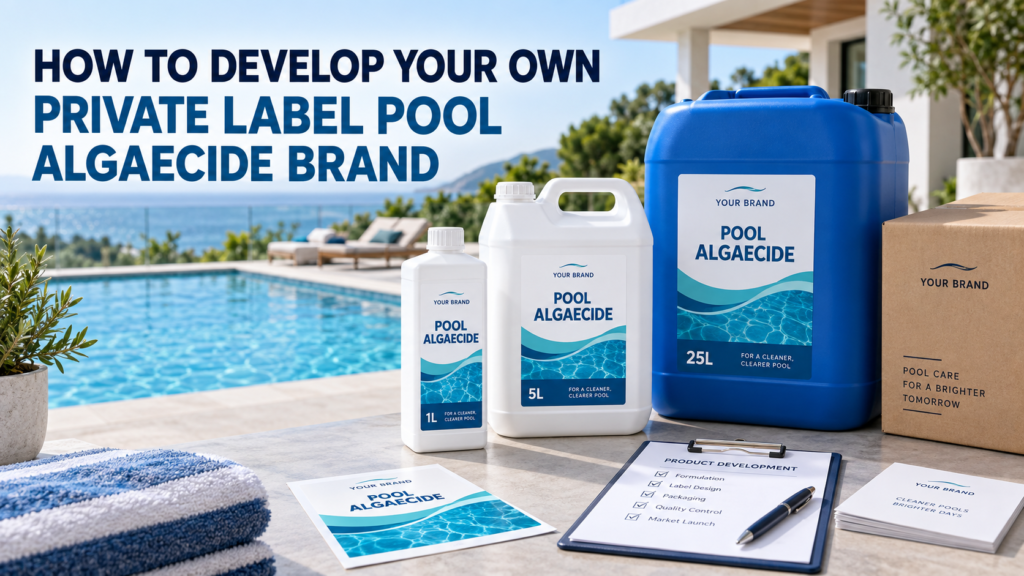
Launching a private label pool algaecide can look surprisingly simple from the outside. Find a liquid, put it in a bottle, add your logo, and start selling. Easy, right?
Not quite.
The bottle is only the visible part of the product. Behind it sit a formula, a quality standard, a regulatory path, a packaging system, a supply plan, and a promise to the customer. If one of those pieces is weak, a polished label will not save the brand.
Still, the opportunity is real. A private label product allows a pool chemical distributor, maintenance company, online retailer, or regional wholesaler to sell something customers can remember—and reorder—without building a chemical plant. It can also turn an ordinary transaction into a longer commercial relationship.
This guide explains how to develop your own private label pool algaecide brand step by step, from the first market idea to the first commercial shipment. It focuses on the decisions that matter in actual purchasing and product development, including formula choice, Polyquat 60, packaging, testing, labels, supplier evaluation, and launch planning.
Start with the Market, Not the Bottle
Before discussing color, fragrance, or container size, answer one plain question: who will buy this product?
“Pool owners” is too broad. A homeowner buying a one-liter bottle online has different needs from a service technician treating twenty pools a day. A distributor supplying hotel pools may care about documentation, predictable lead times, and larger packs. A retail chain may focus on shelf appearance, barcode placement, carton dimensions, and consumer-friendly directions.
Define your primary customer as precisely as you can. Common private label algaecide markets include:
- Residential pool owners buying through stores or e-commerce
- Pool service companies using chemicals every week
- Regional pool chemical distributors
- Builders and equipment dealers adding water-care products
- Commercial pool operators, resorts, schools, and fitness clubs
- Seasonal markets that need pool-opening or winter-closing products
Then decide what problem your brand will solve. Will it offer premium non-foaming algae control? Simple weekly maintenance? A concentrated product that reduces freight and warehouse space? A reliable professional pack for service routes? Perhaps the real advantage is not the liquid alone but a dependable supply program with flexible packaging.
This early positioning work keeps the project focused. Without it, brands often request too many bottle sizes, vague label claims, and a formula designed for everyone. That usually produces a product that feels right for no one.
Choose a Clear Brand Position
A strong pool algaecide brand does not need a dramatic story. It needs a believable one.
You might position the product around professional reliability, premium pool care, simple weekly maintenance, non-foaming performance, or seasonal protection. The message should match the formula and the buyer. If the product is intended for service professionals, technical clarity usually matters more than playful graphics. If it is sold in a retail aisle, the main benefit must be understood within seconds.
Think beyond one bottle, too. Ask whether the brand may later include a clarifier, winter treatment, stain-control product, or other pool-care chemicals. A visual identity that works only for one SKU can become restrictive when the range grows.
A practical brand brief should define:
- Target customer and sales channel
- Intended price level
- Main product benefit
- Brand personality and visual tone
- Initial package sizes
- Geographic sales markets
- Possible future products
The name must also be checked for trademark conflicts, suitable domain names, and confusing meanings in the countries where it will be sold. That small check now can prevent an expensive label change later.
Select the Right Algaecide Chemistry
Not all algaecides behave the same way. Different active ingredients can produce different levels of foaming, staining risk, compatibility, concentration, and customer perception.
Traditional quaternary ammonium algaecides can be economical, but some formulas may foam, especially in pools with strong water movement, spas, fountains, or attached water features. Metal-based systems may fit certain programs, yet their use demands careful attention to water balance and staining concerns. Polymer-based algaecides occupy another position.
Polyquat 60 is widely considered for premium private label pool algaecides because it is a concentrated, water-soluble, polymeric quaternary ammonium product. It is commonly valued for non-foaming performance and metal-free chemistry. These traits can make it easier to place in residential, professional, and seasonal pool-care ranges.
For a technical introduction, see Polyquat 60 Algaecide.
That does not mean every private label product must be sold as a 60% concentrate. A supplier may offer concentrated material for further formulation, or develop a ready-to-use product at a lower active level for a specific price point and dosing system. The important issue is clarity. Buyers should know the active ingredient, active content, finished-product specification, and intended use.
Never choose a formula only because another label appears popular. Your target market, local rules, desired dose, package size, freight cost, and brand promise all affect the right choice.
Turn the Product Idea into a Written Specification
Once the chemistry has been selected, convert the idea into a written product specification. This is where a private label project becomes real.
For a Polyquat 60-based product, the specification may include appearance, active content, pH, density, and viscosity. Packaging, net content, label material, cap type, carton quantity, shelf-life target, storage conditions, and batch coding should also be documented.
Why be so precise? Because phrases such as “good quality” or “same as the sample” are not measurable. A written specification gives the buyer, formulator, production team, and quality-control staff the same target.
Your development brief should cover at least:
- Product name and product type
- Active ingredient and target concentration
- Appearance and acceptable color range
- pH, density, and viscosity ranges where relevant
- Intended pool applications
- Required package sizes
- Bottle, jerry can, cap, seal, label, and carton details
- Batch code and traceability requirements
- Required documents, such as COA, SDS, and TDS
- Target shelf life and storage conditions
- Destination countries and languages
The specification should distinguish the concentrated raw material from the finished consumer product. This point sounds obvious, yet it causes plenty of confusion in international sourcing. A 60% active concentrate and a diluted maintenance algaecide are not interchangeable simply because both are described with similar product names.
Check the Regulatory Path Before Finalizing the Label
Here is the part no serious brand owner should leave until the end.
An algaecide makes a pesticidal claim, so registration and labeling rules may apply in the destination market. Requirements differ by country, and sometimes by state, province, or sales channel. The manufacturer can provide technical information, but the brand owner or importer must confirm the legal route for the market where the product will be sold.
In the United States, for example, pool algaecides are regulated as pesticide products. A company generally needs its own federal product registration or must follow the supplemental distribution route for an already registered product. Under supplemental distribution, the distributor product is tied to the basic registered product, and only limited label differences are permitted. The US EPA explains the process in its Pesticide Registration Manual.
This has a direct commercial lesson: do not print thousands of labels before the regulatory route and approved claims are clear.
Confirm these points for every target market:
- Product registration or authorization status
- Responsible legal entity or local registration holder
- Permitted active ingredient and concentration
- Approved uses and marketing claims
- Mandatory hazard and precautionary statements
- Required languages
- Packaging and child-resistant closure rules, if applicable
- Disposal instructions and environmental statements
- Import documentation and customs classification
Treat the label as a controlled technical and legal document, not merely a colorful advertisement. Claims such as “safe,” “non-toxic,” “kills all algae,” or “works in every condition” can create regulatory and credibility problems when they are unsupported or too broad.
Find a Supplier Who Can Support the Brand, Not Just Fill the Drum
A low quotation may be attractive, but private label work demands more than bulk liquid. The supplier must coordinate formulation, quality control, packaging, labels, documents, production timing, and export handling.
Begin with a structured supplier questionnaire. Ask about manufacturing responsibility, raw-material control, batch records, testing equipment, retained samples, complaint handling, production capacity, and change-control procedures. If part of the process is outsourced, find out who controls each stage.
Useful questions include:
- Is the product manufactured regularly or only made against occasional orders?
- Which tests are performed on every batch?
- Can the supplier provide a batch-specific COA?
- Are retained samples kept, and for how long?
- Can third-party testing be arranged?
- How are out-of-specification results handled?
- Will the supplier notify the buyer before changing the formula, raw material, container, cap, or label stock?
- Can the supplier support formulation, blending, filling, labeling, and export documents?
- What are the minimum order quantities for stock and custom packaging?
- What happens if bottles leak or labels fail during transport?
A factory visit, live video audit, or independent inspection can reveal details that a sales brochure will not. Look at housekeeping, batch identification, filling controls, storage conditions, and how finished goods are separated. You do not need a theatrical tour. You need evidence that the process is controlled.
Test the Product Before You Fall in Love with the Packaging
Packaging design is fun. Testing is less glamorous—but testing protects the brand.
Start with a representative sample. Confirm its identity and basic specification. Review the COA, SDS, and TDS together; the product name, active ingredient, concentration, and physical description should tell a consistent story across all documents.
Then assess performance under conditions relevant to your customers. Depending on the product and permitted claims, a development program may examine algae-control performance, foaming tendency, water clarity, ease of dosing, compatibility with normal pool-care routines, and behavior across a reasonable pH and temperature range.
Package compatibility matters as well. A liquid can meet every chemical specification and still become a commercial problem if the cap loosens, the induction seal fails, the bottle panels inward, or the label wrinkles in a humid warehouse.
Consider conducting:
- Chemical specification testing
- Comparative application trials
- Accelerated and real-time stability studies
- Low- and high-temperature storage checks
- Freeze-thaw testing where climate and transport justify it
- Container and closure compatibility tests
- Leak, drop, stacking, and carton tests
- Label adhesion and print-resistance checks
Agree on acceptance criteria before testing begins. “Looks fine” is not a quality standard. A sample can also be excellent while later production drifts, so commercial batches still need defined release tests.
Build Packaging Around the Way Customers Actually Buy
Packaging should support the sales channel, dose, handling conditions, and freight plan. It should not be selected only because it looks impressive in a rendering.
A 1L bottle can suit retail shelves and e-commerce, where manageable weight and a neat appearance matter. A 5L jerry can often fits pool service companies, specialty stores, and frequent users. A 25L jerry can may serve distributors, professional operators, or repacking programs, subject to local rules and safe handling requirements.
For a closer look at a retail-ready product format, see Algae Control 60.
Discuss every component rather than approving “a bottle” as one item:
- Container resin and nominal volume
- Brimful capacity and fill level
- Neck finish and cap thread
- Tamper evidence or induction seal
- Gasket or liner material
- Measuring chamber or dosing cup, if suitable
- Label dimensions and material
- Batch-code location
- Units per carton
- Inner dividers or protective bags
- Pallet pattern and stretch wrapping
Stock bottles with pressure-sensitive labels usually allow a lower starting quantity and faster development. Custom-colored containers, printed sleeves, embossed logos, or custom molds can make a brand distinctive, but they also raise minimum orders, tooling costs, and inventory risk.
For a first launch, restraint is often wise. A clean stock package with an excellent waterproof label can look professional while leaving room to learn from the market.
Design a Label That Works at Three Distances
A useful pool chemical label works from across the aisle, at arm’s length, and up close.
From a distance, shoppers should recognize the brand and product category. At arm’s length, they should see the main permitted benefit, pack size, and product variant. Up close, they need directions, precautions, ingredient information, company details, batch identification, and other mandatory content.
Keep the front panel disciplined. Too many icons and claims make a product look less trustworthy, not more. The back panel can carry detailed directions, but clarity still matters. Short sentences, readable type, sensible spacing, and well-organized sections help people use the product correctly.
The final artwork should be reviewed by the relevant technical and regulatory parties before printing. Verify barcodes with an actual scanner. Print the artwork at full size and place it on the real container. Curved shoulders, handle recesses, and label-panel edges can change the appearance dramatically.
Also ask a wonderfully practical question: can a wet customer with pool water on their hands still read it?
Set a Realistic Minimum Order and Cost Model
Private label cost is more than the price per kilogram of liquid. A proper model includes formulation, filling loss, bottles, caps, seals, labels, cartons, pallets, testing, inspections, documents, inland freight, ocean or air freight, duties, registration expenses, warehousing, marketing, and possible product returns.
Separate one-time costs from recurring costs. Trademark work, label design, registration, tooling, and initial testing may not repeat with every order. Containers, labels, filling, cartons, and freight will.
Minimum order quantity may also come from several places:
- The blending batch size
- The filling-line setup
- The label printer’s minimum run
- The bottle supplier’s carton or production minimum
- The carton printer’s minimum run
- The freight economics of a pallet or container
This is why a “small trial order” can be easy for the liquid but difficult for the packaging. One sensible approach is to start with a standard formula, stock containers, and digitally printed labels. More customized components can follow after repeat demand is visible.
Remember working capital. A low unit cost is not automatically good if twelve months of slow-moving packaging must be purchased in advance.
Run a Pilot Batch Before Full Commercial Production
The pilot batch connects the approved sample to the real production process. It allows you to check filling accuracy, label placement, cap torque, seals, batch coding, carton fit, appearance, and documentation without risking a full commercial quantity.
Use a written approval checklist. Photograph the finished packs from several angles and record the approved color, fill level, code format, and carton markings. If more than one language or package size is involved, treat each SKU as its own controlled item.
The pilot is also the right time to simulate handling. Open cartons, carry the jerry cans, pour the product using the intended directions, and repack everything. Minor frustrations become customer complaints once the product reaches the market.
After approval, create a “golden sample”—a signed reference pack representing the accepted commercial appearance. Keep matching artwork files, specifications, and component records. This gives both sides something concrete to compare against when the next batch is produced.
Put Quality Control into the Purchase Agreement
Good relationships are valuable, but written controls keep good relationships good.
The purchase agreement or quality agreement should state the product specification, test methods, packaging components, acceptable tolerances, inspection method, release documents, handling of nonconforming goods, and change-notification requirements.
Each commercial batch should have traceable production and test records. A batch-specific COA should report actual results rather than simply repeating specification limits. Retained samples can help investigate future questions. If third-party inspection is required, define the inspection stage—before shipment is usually far more useful than after arrival.
Discuss complaint handling before a complaint exists. Who collects evidence? Which samples will be tested? How quickly will the supplier respond? What remedy applies if a confirmed manufacturing or packaging defect is found?
These conversations may feel cautious, but they signal professionalism. A serious supplier should understand why a brand owner needs them.
Plan the Launch as a Product System
Your first sale depends on marketing. Your second sale depends on product experience.
Prepare the materials customers and sales partners need: product page, technical data sheet, safety data sheet, directions, frequently asked questions, application guide, pack photos, carton information, and contact route for technical questions. Keep the message consistent across the website, catalog, label, marketplace listing, and distributor training.
Samples can help professional buyers evaluate the product, but they should come with a clear identification, specification, and feedback plan. Ask testers about dosing, foaming, clarity, package handling, and the questions their customers raised.
Launch with a manageable SKU range. One strong formula in two well-chosen sizes may perform better than six variants that divide purchasing, inventory, and marketing attention. After sales data arrives, expansion becomes less speculative.
A private label partner that offers formulation, filling, labels, and tailored packs can reduce coordination work. Eautrix supports private labeling and custom packaging for pool chemical projects, including different packaging formats and technical documentation.
Grow the Range Without Diluting the Brand
Once the core algaecide earns repeat orders, related products can raise customer value and make the brand more useful throughout the pool season.
Possible additions may include a lower-concentration maintenance product, a clarifier, a winter algaecide, or products designed for particular professional routines. The right sequence depends on customer feedback, local demand, compatibility with your positioning, and the regulatory work required for each SKU.
For seasonal programs, Winter Algaecide can illustrate how packaging and formulation may be adapted for pool-closing needs.
Do not extend the range merely to make a catalog look larger. Every new SKU adds artwork, forecasts, packaging inventory, testing, documents, and customer questions. Add products that solve a real adjacent problem and strengthen the original brand promise.
Common Mistakes That Quietly Damage New Brands
Most private label failures are not caused by one spectacular error. They grow from several small shortcuts.
Common mistakes include choosing a product before defining the customer, treating a supplier sample as proof of long-term consistency, printing labels before confirming compliance, ordering custom packaging too early, comparing quotations with different active concentrations, and ignoring cap or label compatibility.
Another mistake is building the brand entirely around price. A cheaper product can always appear. A reliable specification, clear label, responsive technical support, and steady supply are harder to replace.
Finally, do not promise more than the product and approved label can support. Trust grows slowly—one clean pool, one intact carton, and one correctly documented batch at a time.
From Idea to Shelf: A Practical Development Sequence
The whole process can be summarized in twelve steps:
- Define the target buyer, channel, and country.
- Choose a clear brand position and price level.
- Select the algaecide chemistry and target concentration.
- Confirm the regulatory and registration route.
- Create a written product and packaging specification.
- Audit and compare suitable manufacturing partners.
- Test representative product samples.
- Select compatible containers, closures, labels, and cartons.
- Complete technical, regulatory, and design review of the label.
- Produce and inspect a pilot batch.
- Approve commercial production under written quality controls.
- Launch, collect field feedback, and improve the next order.
That sequence may take longer than applying a logo to a stock bottle. It also creates something far more valuable: a product customers can trust and a supply system the brand can grow with.
Final Thoughts
Developing your own private label pool algaecide brand is part chemistry, part packaging, part compliance, and part patient commercial judgment. The strongest brands connect all four.
Begin with a narrow market need. Choose a formula that supports a truthful, useful promise. Put measurable standards behind the product. Test the liquid and the package. Confirm local rules before printing. Then launch with enough focus to learn what customers actually value.
The logo may attract the first glance. Consistent quality earns the next order.
Frequently Asked Questions About Private Label Pool Algaecides
1. What is the best algaecide for a private label pool chemical brand?
The best choice depends on the market, claims, price level, and local regulations. Polyquat 60 is often considered for premium non-foaming, metal-free pool algaecide products, while other chemistries may suit different price points or programs.
2. What is the minimum order quantity for private label Polyquat 60 algaecide?
The MOQ depends on the blend size, bottle availability, label printing, carton production, and degree of customization. Stock bottles and digitally printed labels usually support a smaller trial order than custom molds or specially colored packaging.
3. Can I sell a pool algaecide under my own brand name?
Yes, subject to the registration, labeling, and distribution rules in the sales market. Because algaecides make pesticidal claims, brand owners should confirm the legal route before production or label printing.
4. Which package sizes work for a private label pool algaecide?
Common options include 1L bottles for retail, 5L jerry cans for service users, and 25L jerry cans for professional or distribution channels. The right size should match dosing, handling, freight, and local packaging requirements.
5. What documents should a private label algaecide supplier provide?
A professional supplier should normally support a batch-specific COA, current SDS, TDS, product specification, packing details, commercial invoice, packing list, and relevant export documents. Additional registration or compliance documents depend on the destination country.