
GET IN TOUCH
Ask For Sample?
How to Evaluate Polyquat 60 Quality Before Purchase?
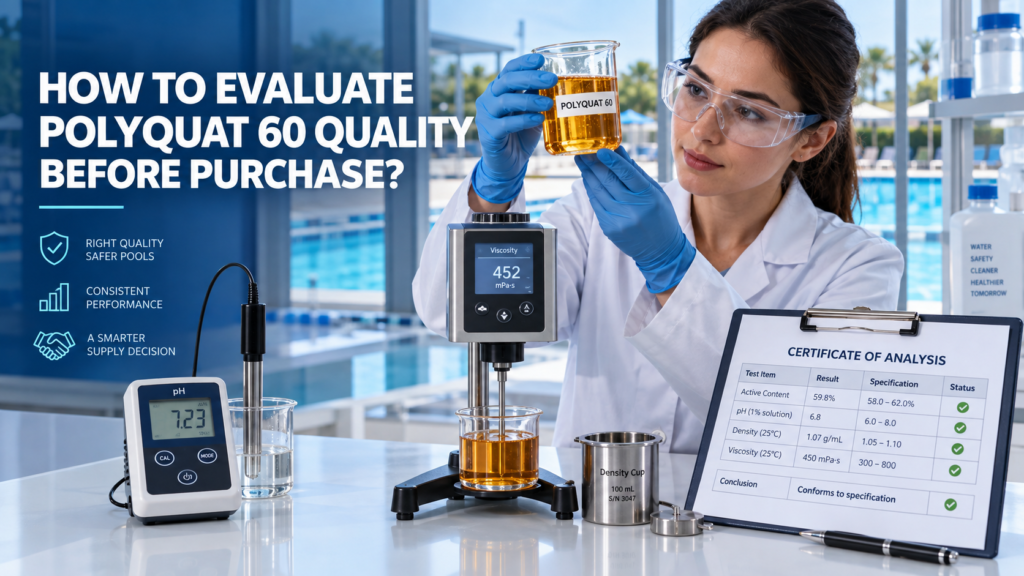
Buying Polyquat 60 should be simple. The name contains a concentration, the supplier sends a Certificate of Analysis, and the liquid looks more or less as expected. What could go wrong?
Quite a lot, actually.
Two samples may both be sold as “Polyquat 60,” yet differ in active content, viscosity, color, residual raw materials, storage stability, or batch consistency. One may blend smoothly into a retail algaecide. The other may create filling problems, unexpected haze, unstable color, or customer complaints months after delivery.
That is why a serious buyer does more than ask, “Is it 60%?” Quality evaluation should confirm three things: the material is chemically correct, the batch meets an agreed specification, and the supplier can reproduce that result again and again.
This guide explains how pool chemical distributors, private-label brands, formulators, and importers can evaluate Polyquat 60 before placing a commercial order. You do not need a huge laboratory. You do need the right questions, comparable test methods, and a sample approval process that reflects real production conditions.
Start with Product Identity, Not the Sales Name
“Polyquat 60” is a common commercial description, not a complete chemical identity. Before comparing prices or samples, confirm what the supplier is actually offering.
For the product discussed here, the active ingredient is poly(oxyethylene(dimethyliminio)ethylene(dimethyliminio)ethylene dichloride), commonly associated with CAS No. 31512-74-0. It is also known as Polixetonium Chloride and Polyquaternium-42. The concentrated commercial solution is widely used in non-foaming pool algaecide formulations.
That long chemical name may seem awkward, but it matters. Similar trade descriptions can be used loosely in the market, and not every cationic polymer sold as a “polyquat” has the same structure, concentration, viscosity, or application profile.
Ask the supplier to place the following information on the Technical Data Sheet, Safety Data Sheet, and Certificate of Analysis:
- Full chemical name
- CAS number
- Active ingredient concentration
- Product grade or internal grade code
- Manufacturing batch number
- Production date and recommended shelf life
- Storage conditions
- Intended application
The name, CAS number, and concentration should tell the same story across all documents. If the quotation says Polyquat 60, the SDS names a different polymer, and the COA uses only a vague phrase such as “cationic polymer,” pause the purchase. A paperwork mismatch is not a harmless typo when the material will go into a regulated retail product.
Buyers looking for the concentrated product can review the Polyquat 60 Algaecide specification and packaging options before requesting a sample.
What Does “60%” Really Mean?
Here is the first trap: active content, solids content, and “content” do not always mean exactly the same thing.
A supplier may report active polymer through a defined chemical or internal analytical method. Another may report total nonvolatile matter after drying. Total solids can include the polymer plus salts and other nonvolatile components. As a result, a solids result should not automatically be treated as the active ingredient result.
Imagine two COAs:
- Supplier A reports active content at 59.8%.
- Supplier B reports solids at 63.0% and calls the product “60%.”
Those numbers may both be reasonable, but they are not directly comparable until you know the methods behind them. This is where many procurement comparisons quietly go off the rails.
Ask one simple question: “What analytical method is used for this result?” Then request the test procedure or, at minimum, the method principle, sample preparation, test temperature, calculation basis, and acceptance range.
A practical purchase specification may include separate limits for active content and total content when the manufacturer controls both. One representative concentrated grade, for example, may use an active-content range around 58.0–61.0% and a broader total-content range around 62.0–65.0%. These figures are not a universal legal definition for every Polyquat 60 product. They are an example of how a clear supplier specification can separate two different measurements.
The key is method consistency. A number without a method is just a number wearing a lab coat.
Check the COA, but Do Not Stop There
A Certificate of Analysis is the natural starting point. It should be batch-specific, dated, traceable, and signed or electronically approved by the supplier’s quality unit. A generic “typical values” sheet is useful for product selection, but it is not a batch COA.
For concentrated Polyquat 60, the core COA often covers:
- Appearance
- Active content or assay
- Total solids or total content, when applicable
- pH
- Density or specific gravity
- Viscosity
- Batch number
- Production date
Some buyers ask for every possible test. More data sounds safer, doesn’t it? Not always. A short COA with meaningful limits and controlled methods can be more valuable than a long document filled with tests that have no clear connection to product performance.
Review the document in four passes.
First, compare the batch results with the stated limits. Second, compare the units and methods with earlier batches. Third, look for suspicious repetition: identical results across many lots may deserve a question. Fourth, confirm that the batch number on the COA matches the sample bottle, drum label, and shipping documents.
If you are qualifying a new supplier, request two or three recent anonymized COAs. You are not trying to obtain another customer’s private information. You are checking whether the producer records batch variation in a credible way.
Real production has variation. Perfectly identical viscosity, pH, density, and assay values across a long series of batches can look tidy, but almost too tidy.
Appearance: A Fast Screen, Not a Final Verdict
Visual inspection costs almost nothing and can reveal obvious problems. Pour the sample into a clean, clear glass container and inspect it under neutral white light.
A typical concentrated Polyquat 60 solution may appear clear and amber, with a visibly viscous flow. The exact acceptable color should be agreed between buyer and supplier because raw-material sources, process control, age, and storage conditions can influence shade.
Look for:
- Unexpected cloudiness
- Sediment or floating matter
- Phase separation
- Gel particles or “fish eyes”
- Unusual darkness
- Foreign odor
- Crusting around the closure
- Leakage or a swollen sample bottle
Do not judge concentration by color alone. A darker sample is not automatically stronger, and a lighter sample is not automatically purer. Color can act as a process-consistency signal, but it cannot replace an assay.
For repeat purchases, keep an approved reference sample in a controlled place. Comparing a new lot beside the retained sample under the same light is far more useful than relying on memory. Human color memory is surprisingly poor—especially after a few weeks and several dozen other samples.
pH: Small Test, Useful Clue
pH is easy to measure, but the result is meaningful only when sample preparation and temperature are controlled. A COA might report pH on the concentrated material or on a stated dilution, such as a 10% solution. Those results should not be compared as if they came from the same procedure.
A representative purchase specification for a 10% solution may use a range such as pH 6.0–8.0. Your agreed range may differ according to grade, method, and downstream formulation.
Why does pH matter?
An unexpected shift can point to a raw-material difference, process deviation, contamination, aging, or a testing mismatch. It can also affect the way the concentrated material behaves when blended with dyes, fragrances, preservatives, clarifiers, or other pool treatment ingredients.
When checking a sample:
- Calibrate the pH meter with fresh buffers.
- Record the sample concentration used for the test.
- Use deionized water for dilution.
- Allow the sample to reach the stated temperature.
- Rinse the electrode well before and after testing.
- Record the actual result, not only “pass.”
One odd pH result does not prove the material is poor. Retest with fresh dilution and calibrated equipment. If the difference remains, compare methods with the supplier before drawing a conclusion.
Density: A Quietly Powerful Consistency Check
Density can reveal dilution errors and batch inconsistency quickly. It is not a substitute for active-content testing, yet it is an excellent supporting check because it is inexpensive, repeatable, and easy to use during incoming inspection.
A representative concentrated grade may have a density range around 1.148–1.153 g/cm³ under a defined test temperature. Again, treat this as an example specification, not a universal value for every material sold under the Polyquat 60 name.
Temperature matters. Liquids expand and contract, so a density reading taken in a warm warehouse should not be compared blindly with a laboratory result measured at 20°C or 25°C.
Use a calibrated density cup, pycnometer, or digital density meter. Remove trapped air bubbles, keep the equipment clean, and record temperature with the result.
Density also helps procurement teams check shipment quantities. If a product is sold by mass but filled by volume, a wrong density assumption can affect net weight, container fill level, freight estimates, and formulation calculations. That tiny decimal may have a larger commercial shadow than expected.
Viscosity: Never Compare a Naked Number
Viscosity is one of the most useful and most frequently misunderstood Polyquat 60 quality indicators.
A representative concentrated product may show a viscosity range around 150–400 mPa·s. But the number means very little unless the method states the instrument, spindle, speed, temperature, sample conditioning, and reading procedure.
Why? Because polymer solutions respond strongly to temperature and test conditions. A sample tested at 15°C can appear much thicker than the same sample at 25°C. Different spindle and speed settings may also produce results that cannot be fairly compared.
Whenever a supplier gives a viscosity result, ask for:
- Instrument type
- Spindle number or geometry
- Rotational speed
- Test temperature
- Sample equilibration time
- Whether the sample was mixed before testing
- Unit used, usually mPa·s or cP
Viscosity can help indicate polymer consistency and process control, but “higher” does not always mean “better.” A very high result may create pumping, dilution, or filling difficulties. A very low result may suggest a different molecular profile, excess water, degradation, or a method difference.
The target is not maximum thickness. The target is a controlled range that works in your factory and stays repeatable from lot to lot.
Ask About Residuals and Impurities That Matter to Your Market
Routine COAs usually focus on release tests, not every possible residual. For a new supplier or a sensitive application, ask what additional impurity controls are available.
The relevant list depends on the synthesis process, formulation, target country, and end use. It may include residual monomers or raw materials, inorganic salts, trace metals, microbiological condition, or other process-related substances. Do not copy an impurity panel from an unrelated chemical and demand it without context. Work backward from regulatory needs and formulation risks.
For a private-label pool product, the questions may include:
- Does the color remain stable during storage?
- Are there residuals that could affect odor?
- Could trace metals influence product color or staining risk?
- Does the material remain clear after dilution with local water?
- Are any intentionally added dyes, fragrances, or auxiliaries present?
If the supplier claims “no added copper” or “no antifoam,” ask whether this is a formulation statement, a controlled specification, or a tested batch result. Those are three different levels of evidence.
Third-party testing is especially useful during initial qualification, after a major process change, or when your local registration dossier needs independent data. It need not be repeated for every shipment if a risk-based incoming program and stable supplier history are in place.
Run a Dilution Test That Resembles Real Use
A concentrated sample can pass its COA and still behave poorly in your production process. That is why application testing matters.
Prepare the dilution using the water, mixing sequence, equipment, and target concentration used in your plant. Watch the liquid during addition. Does it disperse cleanly, or form local gels? Does the diluted product remain clear after 24 hours, seven days, and a suitable longer interval? Does the color drift? Is there sediment?
If you plan to add color, fragrance, preservative, or another polymer, test the complete formula. Cationic polymers can be incompatible with strongly anionic materials. A beautiful single-ingredient sample tells you little about an unstable finished blend.
For product-line planning, remember that an algaecide and a clarifier serve different primary functions. If water clarity is also part of the commercial concept, evaluate compatibility with a separate Polymer Pool Clarifier rather than assuming that every cationic polymer can be mixed freely.
A useful bench evaluation can include:
- Dilution behavior
- Clarity after mixing
- Foam observation under a repeatable agitation test
- Color and odor stability
- Freeze–thaw screening where relevant
- Warm-storage screening
- Compatibility with packaging
- Compatibility with the full finished formula
Bench tests do not replace formal efficacy or registration studies. They answer a different question: will this raw material behave reliably in your product and process?
Stability Is More Than a Shelf-Life Statement
A supplier may state a shelf life of 24 or 36 months. Fine—but ask what supports that claim.
Useful stability evidence tracks the same properties that matter at release: appearance, pH, density, viscosity, active content, and package condition. Accelerated storage can help identify risks sooner, while real-time data provides the stronger picture of long-term behavior.
The transport route deserves attention too. A container may spend weeks in a hot freight environment, sit in an unheated warehouse, or pass through repeated temperature cycles. Ask what happens if the product becomes unusually cold, and whether it recovers after controlled warming and mixing.
For seasonal products, storage performance has direct commercial impact. Pool chemicals may be produced months before the selling season and remain in distributor stock through winter. A formula used for pool closing may also face long off-season storage. Buyers developing that range can compare formulation approaches on the Winter Algaecide page.
Do not accept “stable” as a complete answer. Ask for conditions, test intervals, package type, and the properties monitored.
Packaging Quality Is Part of Chemical Quality
Even an excellent batch can arrive as a poor product if the packaging is wrong.
Polyquat 60 is commonly supplied in retail containers, jerrycans, drums, or IBC totes. The packaging should tolerate the product, shipment duration, stacking load, temperature changes, and normal handling. Closures should seal reliably without becoming brittle or distorted.
Inspect sample and trial-order packaging for:
- Container material and wall strength
- Cap and liner compatibility
- Tamper-evident features when required
- Net weight consistency
- Label adhesion
- Batch coding and legibility
- Pallet pattern and load stability
- Leakage after vibration or inversion screening
- Headspace suitable for transport conditions
For private-label orders, approve the bottle, cap, liner, label, carton, and printed batch code as a system. A cap that works on one bottle finish may leak on another. A label that looks perfect in an office may peel in a humid pool store.
Request photos of the packed goods before shipment, but do not let photos replace specifications. A neat pallet cannot prove what is inside the containers.
Use a Sample Approval Process That Protects the Purchase
The most reliable buying process connects the pre-shipment sample with the commercial batch.
Begin with a representative sample from normal production, not a hand-prepared laboratory sample unless it is clearly identified as such. Test it against your agreed specification and complete your formulation trial. If it passes, create a signed sample-approval record.
For the first commercial order, consider this sequence:
- Approve the written specification and test methods.
- Test a representative sample.
- Place a controlled trial order.
- Request the batch COA before shipment.
- Draw or request a sealed retention sample from the shipment batch.
- Conduct incoming inspection after arrival.
- Compare the result with the approved sample and supplier COA.
- Record performance during blending, filling, and storage.
If risk or order value is high, arrange pre-shipment sampling by an independent inspection company. The sampling procedure matters as much as the laboratory name. A perfectly accurate test on an unrepresentative sample still gives the wrong purchasing decision.
Seal retention samples from both sides. The supplier keeps one; the buyer keeps one. Record batch number, sampling date, sampler, container number, and seal number. If a dispute appears later, both parties have a traceable reference.
Judge the Supplier’s Quality System, Not One Lucky Sample
A good sample proves that the supplier can make one good sample. It does not yet prove dependable supply.
Ask how the manufacturer controls raw materials, reaction conditions, in-process tests, finished-product release, nonconforming batches, retained samples, and change notification. You do not need a theatrical factory tour. You need evidence that quality is built into routine production.
Useful supplier questions include:
- Is every commercial batch tested before release?
- Who approves the COA?
- How long are retention samples kept?
- How are out-of-specification results investigated?
- Will the buyer be notified before a raw-material, process, site, or specification change?
- Can the supplier provide recent batch-trend data?
- Can customer-specific limits be included in the sales contract?
- Is third-party inspection accepted?
- How are complaints traced back to production records?
Certification can support the review, but a certificate should not end it. Confirm its scope, issuing body, manufacturing site, and validity. A quality-management certificate for a trading office does not automatically describe controls at the production plant.
The strongest sign is often not a polished certificate. It is the supplier’s ability to answer technical questions clearly, share controlled documents, acknowledge normal variation, and explain what happens when a batch fails.
Compare Suppliers with a Weighted Scorecard
Price per kilogram is easy to compare. Total purchasing risk is not. A simple weighted scorecard keeps the decision grounded.
You might assign scores to:
- Product identity and document consistency: 15%
- Active content and agreed chemical specification: 20%
- Physical-property consistency: 15%
- Application and formulation performance: 20%
- Batch traceability and quality system: 15%
- Packaging and logistics: 10%
- Technical response and complaint handling: 5%
Adjust the weights for your business. A bulk formulator may care more about viscosity and unloading. A private-label brand may place greater weight on color stability, retail packaging, and documentation.
Also calculate cost on an active basis where possible. A cheaper material with lower effective concentration, unstable viscosity, or higher formulation loss may cost more per finished bottle. Freight, rework, rejected packaging, customer returns, and delayed registration all belong in the commercial calculation.
Cheap material is not always poor, and expensive material is not automatically superior. The fair comparison is evidence against evidence.
Red Flags That Deserve a Closer Look
One red flag does not always mean “walk away,” but several together should slow the purchase.
Watch for:
- The supplier will not state the complete chemical identity.
- The CAS number changes between documents.
- “60%” is reported without explaining whether it means active content or solids.
- Viscosity has no temperature or method.
- Every historical COA shows identical results.
- The sample label has no batch number.
- The sample is not linked to normal production.
- Shelf life is claimed without storage conditions.
- A major process or site change can occur without customer notice.
- The supplier rejects reasonable third-party testing.
- Packaging details change after sample approval.
- Technical questions receive only sales language.
Good procurement is not about catching a supplier in a mistake. It is about removing ambiguity before a container is on the water and everyone becomes less cheerful.
A Practical Pre-Purchase Checklist
Before approving Polyquat 60, confirm that you have:
- Matched the chemical name, CAS number, and concentration across the TDS, SDS, COA, label, and quotation
- Agreed whether “60%” refers to active content, solids, or another defined result
- Reviewed the analytical methods and test conditions
- Checked appearance, pH, density, viscosity, and active content
- Tested dilution and finished-formula compatibility
- Reviewed stability evidence and storage limits
- Approved the actual packaging system
- Linked the sample to a traceable production batch
- Agreed on pre-shipment and incoming inspection rules
- Defined rejection, retest, and complaint procedures in the purchase contract
- Evaluated batch consistency, not only one sample
If one of these points is missing, the answer is not always to reject the supplier. Often, the next step is simply to turn an assumption into a written requirement.
The Real Goal Is Repeatability
The best Polyquat 60 is not the darkest, thickest, or most expensive sample. It is the product that matches its identity, meets a clear specification, performs in your formula, survives the supply chain, and arrives with the same dependable profile from batch to batch.
That repeatability protects more than a laboratory result. It protects filling speed, label claims, warehouse stock, distributor confidence, and the experience of the person standing beside a pool months later.
So, before your next purchase, ask for more than a quotation and a tidy COA. Ask how the result was measured. Test the sample in your own formulation. Approve the packaging. Keep a retention sample. Then make the commercial decision with evidence in hand.
That is quality control made practical—not complicated for the sake of it, just careful where it counts.
Frequently Asked Questions
1. What tests should be included on a Polyquat 60 COA?
A useful batch COA normally includes appearance, active content or assay, pH, density, viscosity, batch number, and production date. If total solids or total content is reported, the document should distinguish it from active content and identify the test method.
2. Can I judge Polyquat 60 concentration by viscosity?
No. Viscosity can support a consistency check, but it cannot replace an active-content test. Temperature, molecular profile, test speed, spindle, and sample condition can all change the reading.
3. Why do two Polyquat 60 suppliers report different solids and active-content values?
They may use different analytical methods or report different properties. Total nonvolatile matter can include polymer and other nonvolatile components, while active content is intended to measure the functional polymer. Compare method definitions before comparing numbers.
4. How should I test a Polyquat 60 sample before a bulk order?
Confirm its identity and COA, then test appearance, pH, density, viscosity, and active content using agreed methods. Follow with dilution, complete-formula, packaging, and short-term stability trials. A small production trial is more informative than a beaker test alone.
5. Is third-party testing necessary for every Polyquat 60 shipment?
Usually not. It is most valuable during new-supplier qualification, high-value first orders, suspected quality changes, disputes, or regulatory work. After a stable history is established, buyers can use risk-based incoming tests and periodic independent verification.