
GET IN TOUCH
Ask For Sample?
Bulk Purchasing Guide for Polyquat 60 60% Solution
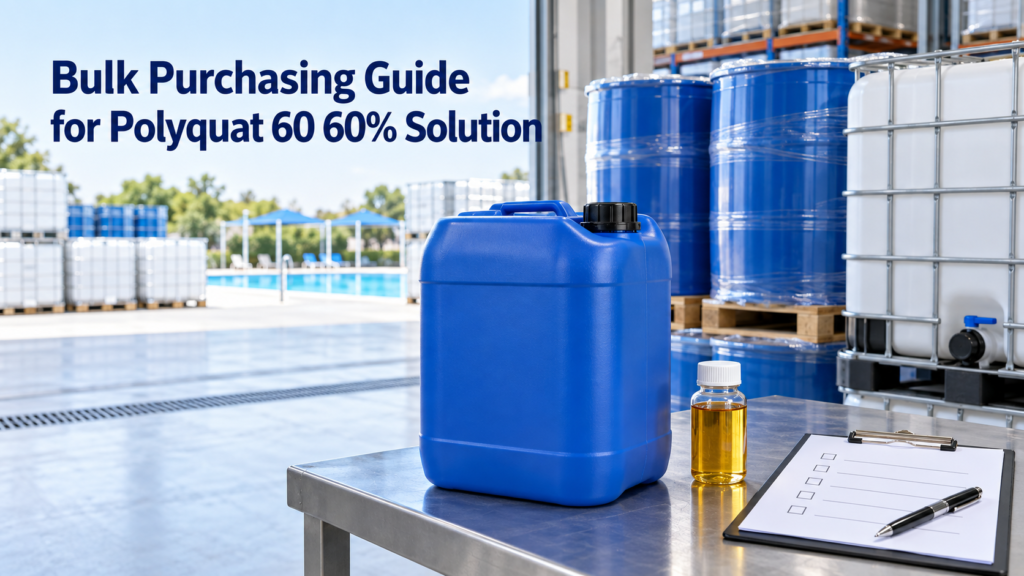
Buying one drum of Polyquat 60 is fairly simple. Buying a commercial quantity is different. A low price can look attractive on a quotation, yet the real purchasing result depends on concentration, batch consistency, packaging, documents, freight, and what happens when the material reaches your warehouse.
That is why a bulk order should never begin with one question alone: “What is your price per kilogram?” A better starting point is: “What exactly will arrive, how will its quality be verified, and what will the total landed cost be?”
This guide explains how pool chemical distributors, private-label brands, formulators, and professional water treatment buyers can purchase Polyquat 60 60% solution with greater confidence. It covers specifications, samples, quality documents, packaging, quotations, shipping, contracts, and incoming inspection. The aim is practical: fewer surprises, cleaner comparisons, and a supply arrangement that still works after the first order.
First, Confirm What “Polyquat 60” Means
Product names in the pool chemical market can be surprisingly slippery. “Polyquat 60” commonly refers to a 60% aqueous solution of a polymeric quaternary ammonium compound used as a non-foaming algaecide. However, commercial names, chemical descriptions, active concentrations, and local registration wording may vary.
Before requesting a bulk quotation, ask the supplier to state all of the following in writing:
- Full chemical name
- CAS number
- Active ingredient concentration and test method
- Product appearance
- pH and the concentration at which pH is tested
- Density at a stated temperature
- Viscosity and test conditions
- Intended application
- Shelf life and recommended storage conditions
- Country of origin
For the Eautrix product based on polixetonium chloride, the listed CAS number is 31512-74-0. The material is supplied as a clear amber liquid, with an active content specification of 59.0%–62.0%. Buyers can review the current Polixetonium Chloride and Polyquat 60 product information before discussing a sample or commercial order.
Why be so precise? Because two quotations headed “Polyquat 60” may not describe identical material. One may report active matter by colloid titration, another may use a different internal method, and a third may quote total solids as though it were active content. The numbers can look similar while the products behave differently.
The name gets you into the conversation. The specification tells you what you are actually buying.
Build a Purchase Specification Before Asking for Prices
A strong bulk purchase starts with a written buyer specification. It does not have to be a forty-page document. A clear one-page specification can prevent weeks of confusion.
At minimum, define the properties that affect your use, filling process, label claims, and customer expectations. A typical discussion for a 60% product may include:
| Quality item | Example purchasing point | Why it matters |
|---|---|---|
| Appearance | Clear amber liquid | Helps identify contamination, haze, or an unexpected process change |
| Active content | 59.0%–62.0% | Confirms commercial strength and supports formulation calculations |
| pH | 6.0–8.0 at the stated dilution | May affect formulation stability and compatibility |
| Density | 1.14–1.16 g/mL | Useful for filling, inventory conversion, and consistency checks |
| Viscosity | 200–500 cP under stated conditions | Influences pumping, filling, mixing, and batch consistency |
| Packaging | Agreed drum, IBC, or retail pack | Affects freight, handling, leakage risk, and market presentation |
| Shelf life | Confirmed by the supplier | Supports inventory planning and label preparation |
These values are not a universal rule for every product sold under a similar trade description. They are an example based on the current Eautrix specification. Your signed purchase specification should match the exact grade, test methods, packaging, and regulatory needs of your market.
Ask an important follow-up question: are the figures “typical values” or “release limits”? A typical value describes what production often looks like. A release limit defines the range a batch must meet before shipment. For purchasing control, release limits are far more useful.
Do Not Compare Active Content and Total Solids as If They Were the Same
This point causes more trouble than it should.
Active content measures the functional cationic polymer according to a defined analytical method. Total solids, meanwhile, may include all non-volatile material left after water is removed. Depending on the production process and method, those two results need not be identical.
Imagine Supplier A quotes 60% active content. Supplier B quotes 60% solids but does not state active content. Their prices differ by only a few cents per kilogram. Is Supplier B cheaper? No one can answer until both materials are measured on a comparable basis.
Ask each supplier to provide:
- The property being reported: active content, solids, or both
- The test method used
- The acceptable range
- A recent batch COA
- The laboratory procedure or method reference, when available
If you have an independent laboratory, confirm that it can test the cationic active matter by a suitable method. Results obtained by different methods may not match perfectly, so agree on the contractual method before a dispute occurs. It is much easier to settle the rule before money and cargo are involved.
Sample First—but Make the Sample Work Harder
A sample is not a ceremonial bottle sent before the “real” order. It is your first technical checkpoint.
Request a sample from a recent production batch and ask the supplier to provide the corresponding COA and SDS. The sample label should show the product name, batch number, production date, and net quantity. If the sample arrives with no batch identity, its value as procurement evidence drops sharply.
Your sample review can include three levels:
- Document review. Compare the label, COA, SDS, technical data sheet, and quoted specification. Names, concentration, batch number, and manufacturer details should make sense together.
- Laboratory checks. Test active content, pH, density, viscosity, appearance, and any application-specific property that matters to you.
- Use test. Evaluate the material in your formulation or pool-care program under controlled conditions. Compare it with your approved reference material rather than judging it in isolation.
Do not rely only on color or thickness. A buyer may think a darker liquid is “stronger,” or a thicker liquid is “more concentrated.” Neither conclusion is reliable without test data. Appearance can flag a problem, but it cannot prove active content.
If the first order is significant, ask for a retained sample from the actual shipment batch. You may also request a pre-shipment sample once production is complete. This gives both parties a physical reference if the incoming material later raises questions.
Read the COA Like a Purchasing Document, Not a Decoration
A Certificate of Analysis should connect the shipment to measured results. A useful COA normally includes:
- Supplier or manufacturer identity
- Product name and grade
- Batch or lot number
- Production date or release date
- Test items and specification limits
- Actual batch results
- Test methods or method references, where relevant
- Quality approval or authorized signature
Watch for COAs that show only “Pass” for every result. That format may be acceptable for certain attributes, but numerical properties such as pH, density, active content, and viscosity are more informative when actual values are shown.
Also compare the COA batch number with the package markings and packing list. One missing digit can create an awkward traceability gap. It sounds minor—until a customer complaint arrives six months later.
The SDS serves a different purpose. It communicates hazard, handling, storage, first-aid, transport, and disposal information. It is not proof that the batch meets your commercial specification. Buyers need both documents because they answer different questions.
Audit the Supplier Beyond the Sales Email
A polished reply and a competitive quote are welcome, but they do not prove manufacturing control. Bulk buyers should learn who makes the material, who releases the batch, and who takes responsibility if a problem appears.
Ask the supplier about:
- Legal company name and business registration
- Manufacturing site address
- Whether the seller is the manufacturer, exporter, or trading company
- Production experience with cationic polymers
- Batch size and normal production lead time
- Raw-material and in-process controls
- Finished-product release procedure
- Traceability and retained-sample policy
- Handling of non-conforming material
- Packaging inspection and leak testing
- Export experience to your destination region
- Availability of third-party inspection
A trading company is not automatically a poor choice, and a factory is not automatically a safe one. The real question is whether the supply chain is visible and controlled. Who can answer a technical question? Who can trace the batch? Who has the authority to correct a problem?
For a large contract, a remote video audit, live production review, or independent factory inspection may be worthwhile. Ask to see the relevant production area, laboratory equipment, packaging line, warehouse conditions, and batch records. Sensitive process details can remain confidential; basic evidence of control should not.
Decide Whether You Need Raw Material, Finished Algaecide, or Private Label
Not every buyer needs the same commercial form.
A formulator may want 60% concentrate in drums or IBCs for further dilution and blending. A distributor may want a finished algaecide in 1 L, 5 L, or 25 L packaging. A pool brand may require private labels, cartons, barcodes, tamper-evident closures, and market-specific instructions.
Clarify the supply model before comparing prices:
- Bulk concentrate: suited to buyers with suitable storage, handling, dilution, and filling capacity.
- Finished formulation: supplied at an agreed concentration and ready for the buyer’s intended commercial channel, subject to local requirements.
- Private-label product: filled and labeled for the buyer’s brand, with agreed packaging and artwork controls.
- Custom formulation: adjusted for a defined use or market need and confirmed through testing.
The lowest cost per kilogram may come from a large bulk pack, but that does not automatically create the lowest business cost. Local repacking requires equipment, labor, quality control, labels, containers, waste handling, and chemical management. For a smaller market launch, factory-packed goods may reduce operational pressure even when the unit price is higher.
Choose Packaging by Handling Reality, Not Habit
Packaging affects far more than appearance. It changes freight efficiency, warehouse work, leakage exposure, filling costs, and customer convenience.
Common commercial options may include drums, IBC totes, or customized smaller packs. Before placing the order, specify:
- Container material and compatibility
- Nominal and net fill weight
- Closure design and sealing method
- Tamper evidence, if needed
- Pallet type and pallet dimensions
- Number of units per pallet
- Gross weight per pallet
- Labels and batch markings
- Whether pallets can be stacked
- Photographs or drawings of the final package
For private-label packs, approve the bottle or jerry can, cap, induction seal if used, label stock, label position, carton, and shipping mark. A beautiful label does little good if it wrinkles in a humid warehouse or the cap loosens during a long ocean journey.
Run a packaging trial when possible. Fill several units, store them at relevant temperatures, place them on their sides for a controlled period, and check for paneling, swelling, stress cracking, seepage, or label damage. That modest test can prevent a very expensive container of wet cartons.
Calculate Quantity From Demand, Shelf Life, and Freight
MOQ is only one number. The right order quantity sits at the intersection of sales demand, production lead time, shipping schedule, safety stock, storage space, cash flow, and shelf life.
Start with a simple purchasing model:
Order quantity = forecast demand during replenishment time + safety stock − usable inventory on hand
Then test that result against these practical questions:
- Will the goods be sold or consumed well within their approved shelf life?
- Can the warehouse store the quantity under the recommended conditions?
- Does the shipment fit an efficient pallet or container configuration?
- How much cash will remain tied up in inventory?
- Is demand seasonal in the destination market?
- What happens if customs clearance or peak-season shipping takes longer than expected?
Pool chemical demand often rises before and during the swimming season. Buyers should place orders early enough to absorb production, documentation, booking, transit, customs, and domestic delivery time. A cheap shipment that arrives after the season is not cheap. It is inventory wearing a very expensive hat.
For a new supplier, consider a staged approach: laboratory sample, trial order, then a larger seasonal contract. This lets the supplier demonstrate consistency before the financial exposure grows.
Compare Quotations on a Landed-Cost Basis
Price comparisons must use the same commercial basis. Ask each supplier to quote the same product specification, packaging, quantity, Incoterm, destination, currency, and payment terms.
Your landed-cost model may include:
- Product cost
- Export packaging and pallets
- Inland transport at origin
- Export handling and documentation
- Ocean or air freight
- Insurance
- Destination terminal charges
- Customs duty and import tax
- Customs broker fees
- Local delivery
- Inspection or laboratory testing
- Financing and bank charges
- Leakage, damage, or normal operational loss allowance
Check whether the quotation is based on net product weight or gross shipment weight. Confirm what is included in the stated Incoterm. “CIF” does not mean every destination charge is paid, and “FOB” does not include ocean freight. Use the current Incoterms rule named in the contract, together with the exact port or place.
For concentrate comparisons, calculate cost per kilogram of active matter:
Cost per kilogram of active matter = product price per kilogram ÷ active fraction
If a product costs USD 2.40/kg at 60% active content, the product cost is USD 4.00 per kilogram of active matter before freight and other charges. This calculation is simple, but it exposes misleading comparisons between different concentrations.
Confirm Regulatory and Transport Requirements Before Production
Chemical compliance is destination-specific. A product that can be produced and exported does not automatically have permission to be sold for every claim in every country.
The buyer should verify, with qualified local advisers where needed:
- Whether the substance or product requires chemical inventory notification or registration
- Whether an algaecide or antimicrobial claim triggers pesticide, biocide, or similar product authorization
- Required language and content for labels and SDS documents
- Packaging and child-resistant closure rules for retail products
- Customs classification and duty treatment
- Import permits or local responsible-party requirements
- Transport classification under the applicable mode and current rules
- Waste and packaging obligations
Do not ask a supplier to “make it non-hazardous on the SDS.” Classification must follow the composition, available data, destination rules, and applicable transport criteria. Commercial preference cannot rewrite chemistry.
Before shipment, share the current SDS with your freight forwarder and destination broker. Ask them to review the cargo description, classification, packaging, route, and carrier acceptance. Carriers may apply operational restrictions even when a product is not regulated as dangerous goods under a particular mode.
For broader preparation, the Eautrix pool chemical purchasing and application guides include related discussions on import documents, COA and SDS review, packaging, and concentrated versus ready-to-use products.
Put Quality Agreements Into the Purchase Contract
Goodwill is helpful. Clear contract language is better.
Your purchase order or supply agreement should identify:
- Exact product and approved specification
- Referenced test methods
- Quantity and permitted tolerance
- Packaging and labeling requirements
- Approved artwork version, if applicable
- Price, currency, and Incoterm
- Named port or delivery place
- Production and shipment schedule
- Documents required before and after shipment
- Inspection rights
- Rules for pre-shipment samples and retained samples
- Acceptance period after receipt
- Procedure for reporting a claim
- Remedy for confirmed non-conforming goods
- Governing law or dispute method, as appropriate
Agree on how results will be handled if the buyer’s laboratory and supplier’s laboratory disagree. The contract may name an independent laboratory and specify the sampling protocol, sealed samples, test method, and allocation of testing cost.
Sampling matters because a poor sample can produce a poor conclusion. Define whether samples will be taken from one package, several packages, or a composite across the lot. For a large order, independent pre-shipment sampling can create a cleaner evidence trail.
Review the Pre-Shipment File Before Cargo Leaves
Do not wait until the vessel is sailing to discover that a document is missing.
Depending on the order and destination, the pre-shipment file may contain:
- Commercial invoice draft
- Packing list draft
- Batch COA
- Current SDS
- Product specification or technical data sheet
- Certificate of origin, if required
- Insurance document under the agreed term
- Inspection certificate, if contracted
- Package and pallet photographs
- Container loading photographs
- Label and shipping-mark confirmation
- Bill of lading instructions
Names, addresses, product descriptions, weights, package counts, batch numbers, and marks should agree across the documents. Ask the customs broker to review drafts for the first shipment. Fixing a description before departure is usually painless. Fixing it while cargo is held at a terminal is rarely so pleasant.
Buyers can use the Eautrix contact page to request current specifications, sample support, packaging details, and a quotation for a defined destination and order quantity.
Inspect the Shipment When It Arrives
Incoming inspection closes the purchasing loop. It tells you whether the cargo received matches the cargo approved.
When the shipment arrives:
- Record the container or vehicle condition before unloading.
- Check seal numbers where applicable.
- Photograph the load, pallets, labels, and any visible damage.
- Count packages and compare gross and net weights with the documents.
- Check for leaks, deformed containers, loose closures, wet cartons, or broken pallets.
- Match package batch numbers to the COA and packing list.
- Quarantine damaged or questionable units.
- Take representative samples under your agreed procedure.
- Complete identity and quality tests before releasing the material for production or sale.
Keep records of the received batch, test results, storage location, and customer allocation. Traceability should work in both directions: from a package back to its production batch, and from a batch forward to the customers who received it.
If a result falls outside the agreed limit, notify the supplier promptly and preserve evidence. Do not mix or consume the disputed material before the investigation unless both parties agree on a controlled plan.
Manage the Supplier After the First Order
Supplier approval is not a one-time ceremony. Performance should be reviewed order by order.
A simple scorecard can track:
- Batch conformity
- COA accuracy
- Packaging condition
- On-time production
- On-time document submission
- Shipping reliability
- Response time
- Complaint handling
- Corrective-action quality
- Commercial stability
Look for trends, not only dramatic failures. A gradual shift in viscosity, repeated label errors, or slower document response may signal pressure in the process before a serious problem appears.
Share useful feedback. A reliable supplier benefits from knowing how the product pumps, fills, stores, and performs in your actual operation. That exchange can improve future batches and help both sides plan seasonal demand.
Still, keep approved backup options for critical supply. Dual sourcing or a qualified contingency supplier can protect your brand when freight routes tighten, raw materials become scarce, or production schedules change.
A Practical Bulk Purchase Checklist
Before issuing a purchase order, confirm that you can answer “yes” to these questions:
- Is the chemical identity clear?
- Is the active concentration defined by an agreed test method?
- Are specification limits written and approved?
- Has a representative sample passed document, laboratory, and use testing?
- Do the COA, SDS, and technical data agree?
- Is the manufacturer or supply chain traceable?
- Are packaging, labels, pallets, and fill weights approved?
- Have you calculated landed cost rather than product price alone?
- Have destination compliance and transport requirements been reviewed?
- Are contract remedies and claim procedures clear?
- Will documents be checked before shipment?
- Is incoming inspection planned?
- Does the order quantity fit realistic demand and shelf life?
If several answers are “not yet,” pause the purchase. A short delay before payment is usually kinder than a long argument after arrival.
Buy the Batch, Not Just the Price
Bulk Polyquat 60 purchasing is really a chain of evidence. The specification defines the product. The sample shows whether it may work. The COA connects results to a batch. The package protects the liquid. The contract assigns responsibility. Incoming inspection confirms what arrived.
When those links are strong, price negotiation becomes more meaningful because the buyer is comparing known value rather than hopeful descriptions.
That is the quiet difference between buying a chemical and building a dependable supply program. One fills a warehouse. The other protects your product, your customers, and your reputation through every swimming season.
Frequently Asked Questions About Bulk Polyquat 60 60% Solution
1. What should buyers test before purchasing Polyquat 60 60% solution in bulk?
Buyers should normally verify chemical identity, active content, appearance, pH, density, viscosity, and application performance. The sample batch number should match its COA, and the agreed test methods should also be used for commercial batches.
2. Is a 60% solids result the same as 60% active Polyquat content?
Not necessarily. Total solids and cationic active content measure different things and may use different test methods. Ask suppliers to state exactly what the result represents and compare quotations using the same analytical basis.
3. Which packaging is suitable for wholesale Polyquat 60 orders?
The right pack depends on volume, handling equipment, repacking plans, freight, and customer channel. Drums or IBCs may suit formulators, while smaller factory-filled packs may suit distributors and private-label brands. Material compatibility and closure testing should be confirmed.
4. How can an importer compare Polyquat 60 bulk prices fairly?
Use the same specification, concentration, packaging, quantity, Incoterm, and destination for every quote. Then calculate total landed cost and cost per kilogram of active matter, including freight, destination charges, duty, testing, and local delivery.
5. What documents are commonly requested for a bulk Polyquat 60 shipment?
Buyers commonly request a commercial invoice, packing list, batch COA, current SDS, and transport document. A certificate of origin, insurance certificate, inspection report, or other document may also be needed depending on the destination, contract, and customs requirements.