
GET IN TOUCH
Ask For Sample?
COA and MSDS Requirements for Polyquat 60 Buyers
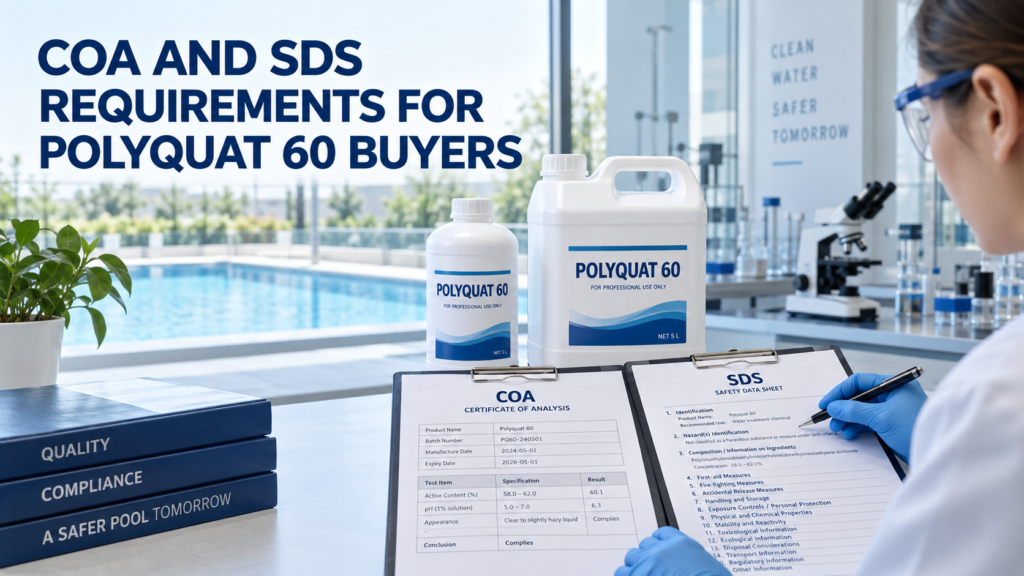
Buying Polyquat 60 is not only a matter of comparing concentration, packaging, and price. The paperwork matters just as much. A shipment may look fine when it leaves the factory, yet a missing batch number, an outdated safety data sheet, or a mismatch between the product name and shipping documents can slow customs clearance, delay production, and raise awkward questions from your customers.
That is why experienced buyers ask for two core documents before approving an order: the Certificate of Analysis (COA) and the Safety Data Sheet (SDS), still commonly called an MSDS.
These documents serve different purposes. The COA tells you whether a particular batch meets the agreed quality specification. The SDS explains the product’s hazards, handling controls, emergency measures, storage conditions, and transport information. One is batch-specific quality evidence; the other is a hazard communication document. They work together, but they are not interchangeable.
This guide explains what Polyquat 60 buyers should expect, what details deserve a second look, and what to confirm before the goods are packed. It is written for pool chemical distributors, private-label brands, formulators, importers, and purchasing teams handling international orders.
A Quick Outline Before We Start
We will cover:
- the difference between a COA, SDS, MSDS, and TDS;
- the essential fields on a Polyquat 60 COA;
- how to review test results without overcomplicating the job;
- the 16 sections expected in a modern SDS;
- country, language, and product-identity considerations;
- common document problems that delay orders;
- a practical pre-shipment document checklist;
- five frequently asked questions from Polyquat 60 buyers.
COA and SDS: Similar Paperwork, Very Different Jobs
Let’s clear up the most common misunderstanding first.
A Certificate of Analysis is tied to a production batch. If you buy 5,000 kg of concentrated Polyquat 60, the COA should identify the actual lot supplied and show its tested results against the approved specification. It answers a straightforward question: “Did this batch pass?”
An SDS is normally issued for the product or formulation, not for every batch. It communicates safety information across the supply chain. It should remain consistent with the exact material being sold, including its identity, concentration range, hazard classification, recommended use, and supplier details.
Here is the practical difference:
| Document | Main purpose | Batch-specific? | Typical user |
|---|---|---|---|
| COA | Confirms quality against specification | Yes | Buyer, QC team, formulator |
| SDS/MSDS | Communicates hazards and safe handling | Usually no | Importer, warehouse, carrier, safety team |
| TDS | Describes technical features and applications | Usually no | Sales, R&D, product manager |
| Commercial invoice | States transaction and customs value | Shipment-specific | Customs, finance, importer |
| Packing list | Shows packages, weights, and dimensions | Shipment-specific | Warehouse, customs, logistics |
A glossy TDS cannot replace a COA. Likewise, a COA with good results cannot replace an SDS. That may sound obvious, but document packages are often assembled by several departments, and gaps happen.
For product identity and current packaging information, buyers can review the Polyquat 60 Algaecide product page before confirming the purchase specification.
MSDS or SDS—Which Term Should Buyers Use?
“MSDS” means Material Safety Data Sheet. “SDS” means Safety Data Sheet. The older term remains common in purchasing emails, especially in international chemical trade, but SDS is the current term under the Globally Harmonized System of Classification and Labelling of Chemicals (GHS).
In the United States, OSHA’s Hazard Communication Standard specifies a 16-section SDS format. In the European Union, SDS content is governed through REACH Annex II, as amended by Commission Regulation (EU) 2020/878. Other markets apply their own national GHS implementation, language rules, and local additions.
So, if someone asks for an “MSDS,” sending a current SDS may be entirely appropriate. The title matters less than the substance of the document. Still, a file created many years ago under an old format deserves careful review. A document should not be considered current merely because the PDF opens cleanly.
What Must Appear on a Polyquat 60 COA?
A useful COA needs more than a table with three passing results. It should connect the product, batch, specification, and approving laboratory in a traceable way.
At minimum, check for the following information:
- manufacturer or supplier name;
- product name and grade;
- chemical identity where appropriate;
- batch or lot number;
- manufacturing date;
- retest date or expiry date, if part of the supplier’s system;
- test item;
- agreed specification or acceptance range;
- actual result for the batch;
- test method or method reference, when relevant;
- conclusion such as “Pass” or “Conforms”;
- authorized approval, signature, or controlled electronic release;
- COA issue date and document version, where used.
The batch number is the bridge between paper and product. It should match the number printed on the drum, jerry can, IBC label, pallet label, or production record. If the COA lists Batch PQ60-260901 but the packages show PQ60-260910, stop and ask. It may be a typing mistake—or it may be the wrong COA.
Which Test Items Matter Most for Polyquat 60?
Polyquat 60 is a trade description used for a concentrated polymeric quaternary algaecide. Buyers should make sure both parties agree on the chemical identity, concentration basis, and test methods before treating the name alone as a specification.
For a product based on polixetonium chloride, CAS No. 31512-74-0, a commercial COA may include the following controls:
- appearance;
- active content or assay;
- pH, with the test concentration stated;
- density or specific gravity, with test temperature stated;
- viscosity, with temperature, instrument, spindle, and speed stated when needed;
- additional agreed quality parameters.
Do not copy a generic range into a purchase contract without checking the supplier’s approved product specification. Two products marketed as Polyquat 60 may use different analytical methods, reporting bases, or acceptance ranges. Even a small detail—pH measured neat versus pH measured in a 10% aqueous solution—can produce results that should not be compared directly.
The same issue appears with viscosity. A number without temperature and method can be almost decorative. Polymer solutions change viscosity with temperature, and different instruments or settings may produce different readings. If viscosity matters for pumping, filling, dilution, or blending, define the method before the first commercial batch.
Actual Results Beat a Row of “Pass” Statements
Imagine two COAs.
The first says:
- Active content: Pass
- pH: Pass
- Density: Pass
The second lists the specification beside the measured value for each test. Which one helps your quality team more? The second, of course.
“Pass” confirms a decision, but an actual result helps buyers watch batch-to-batch consistency. If three consecutive lots sit near the middle of the approved range and the fourth suddenly approaches a limit, the batch may still conform, yet the shift deserves attention. Trends tell a story that a single checkmark cannot.
For regular purchasing, keep COAs in a simple batch register. Record the batch number, production date, active content, pH, density, viscosity, received quantity, and any complaint or blending observation. You do not need a complicated system. A well-kept spreadsheet can reveal drift before the market does.
Should Buyers Request Independent Testing?
Not for every shipment. That would add cost and slow routine orders. Yet third-party testing can make sense in several situations:
- the first order from a new supplier;
- a large annual contract;
- a private-label launch with strict claims;
- a noticeable change in color, odor, viscosity, or performance;
- repeated results near a specification limit;
- a customer audit or regulatory request;
- a dispute about concentration or identity.
The key is to agree on the laboratory, sampling method, test method, and decision rule before a disagreement occurs. A sample taken only from the top of an IBC may not represent the whole lot. Likewise, two laboratories using different assay methods may report values that are not directly comparable.
For sample qualification before a full order, buyers can also use the Eautrix contact and sample request page to provide their target specification and intended application.
The 16 Sections a Modern SDS Should Contain
A GHS-style SDS follows a familiar sequence. OSHA describes a specified 16-section format, and EU REACH rules also use 16 headings. The exact legal duties and required content differ by jurisdiction, so buyers should review the document against the destination market—not just against a generic template.
The 16 sections are:
- Identification
- Hazard identification
- Composition/information on ingredients
- First-aid measures
- Fire-fighting measures
- Accidental release measures
- Handling and storage
- Exposure controls/personal protection
- Physical and chemical properties
- Stability and reactivity
- Toxicological information
- Ecological information
- Disposal considerations
- Transport information
- Regulatory information
- Other information, including preparation or revision details
The official OSHA Hazard Communication overview confirms the specified 16-section format for the United States. For EU-bound products, buyers should refer to Commission Regulation (EU) 2020/878, which sets requirements for compiling SDSs under REACH Annex II.
Which SDS Sections Deserve Extra Attention?
All 16 sections matter, but a Polyquat 60 buyer can catch many problems by examining a few high-impact sections first.
Section 1 should show the product identifier, recommended use, restrictions on use, supplier details, and emergency contact information. The name should match the commercial product closely enough that warehouse staff can connect the SDS to the label.
Section 2 states the hazard classification and label elements. Any signal word, pictogram, hazard statement, and precautionary statement should be consistent with the product label required in the destination market. A supplier should classify the actual formulation, not paste the classification of a raw material at a different concentration.
Section 3 explains composition. For a mixture, it may provide hazardous ingredients and concentration ranges as required by the applicable rules. Confidential business information may affect how composition is disclosed, but “trade secret” should not become a blanket excuse for a document that cannot support safe handling.
Section 8 covers exposure controls and personal protective equipment. Warehouse and repacking teams often use this section to prepare gloves, eye protection, ventilation, and operating procedures.
Section 9 describes physical and chemical properties. Check whether appearance, physical state, color, pH, density, solubility, and other reported properties agree with the supplied product and technical specification.
Section 14 addresses transport information. It may state a UN number, proper shipping name, transport hazard class, packing group, environmental hazards, or that the product is not regulated as dangerous goods under a named transport mode. Do not treat one sentence as a universal shipping decision. Sea, air, road, package size, formulation, destination, and current carrier rules can all matter.
Section 16 should show when the SDS was prepared or last revised. A recent date is useful, but internal consistency is more important than cosmetic freshness. An old document is not automatically wrong; a newly dated document is not automatically correct.
Product Identity Must Match Across the Document Set
Here is where small inconsistencies become expensive.
Suppose the purchase order says “Polyquat 60 Algaecide,” the invoice says “Water Treatment Polymer,” the SDS says “Cationic Polymer Solution,” and the drum label uses a fourth name. Those descriptions may refer to the same product, yet customs, carriers, auditors, or customers may not know that.
Consistency does not mean every document must use only one phrase. It means the relationship should be clear. A sound document set may show:
- commercial product name;
- chemical name or recognized identity;
- CAS number where applicable;
- concentration or grade;
- intended use;
- batch number on batch-specific documents;
- package and net weight information consistent with the shipment.
For Eautrix concentrated Polyquat 60, the product page identifies polixetonium chloride, CAS No. 31512-74-0, as the active ingredient. Buyers should still confirm that this identity matches the exact grade and formulation quoted for their order.
One English SDS Is Not Automatically a Global SDS
An English SDS is often requested for international trade, but local compliance may require more.
The United States requires SDS information to follow OSHA’s Hazard Communication Standard. EU supply is subject to REACH and CLP duties, including language requirements in the Member State where the chemical is placed on the market unless that state provides otherwise. Other countries may follow GHS while using their own building blocks, classification thresholds, emergency numbers, or national standards.
This creates a shared responsibility. The manufacturer supplies accurate product data. The exporter prepares suitable documentation. The importer must understand the destination country’s rules and local product registrations. If the product is marketed with pesticidal or biocidal claims, separate authorization and labeling laws may apply; a well-written SDS does not grant permission to sell an algaecide.
That last point is easy to miss. Safety documentation supports compliance, but it is not a market authorization certificate.
When Should an SDS Be Updated?
Ask for the current revision before your first order and again when something material changes. Common triggers include:
- a change in formulation or concentration;
- new hazard or toxicological information;
- a revised classification;
- a supplier or emergency contact change;
- updated regulatory requirements;
- a change in recommended use or restriction;
- new transport or disposal information.
Buyers should keep the SDS version received with the order records. If a later revision arrives, do not simply overwrite the old file without retaining traceability. Your complaint team may need to know which version applied when a batch was received.
Common COA Problems Buyers Should Catch Early
Most document problems are mundane. That is good news because mundane problems can be prevented.
Watch for:
- a COA issued before the stated manufacturing or testing date;
- missing or mismatched batch numbers;
- specification limits that differ from the purchase agreement;
- results copied identically across many batches without explanation;
- test values with no units;
- pH without sample concentration;
- viscosity without method or test temperature when viscosity is critical;
- a signed COA that cannot be linked to the shipped lot;
- an expiry or retest date that conflicts with the label;
- unexplained handwritten corrections.
None of these automatically proves a quality failure. Still, they are reasons to pause. A good supplier should be able to explain and correct a document without turning a simple question into a week-long mystery.
Common SDS Problems That Create Risk
SDS errors tend to be broader because one flawed document may follow many shipments.
Frequent warning signs include:
- fewer than 16 section headings;
- no revision date;
- a product name that does not match the label;
- supplier contact information that is incomplete or outdated;
- conflicting appearance or pH data between Sections 3 and 9 or between the SDS and TDS;
- hazard statements that do not match the classification;
- transport information presented without naming the regulatory framework or mode;
- a generic emergency number that does not work in the destination country;
- statements such as “non-hazardous” used without a clear classification basis;
- local-language needs ignored;
- composition data copied from a different concentration.
Here is a useful rule: if the SDS appears to describe “a polymer” rather than the exact Polyquat 60 product being purchased, request clarification.
A Practical Document Review Before You Pay the Balance
Document review works best when it is scheduled, not rushed. Asking for corrections after the vessel booking puts everyone under pressure.
Before approving production, confirm the product name, chemical identity, target concentration, quality limits, test methods, packaging, label language, and destination-market requirements.
Before shipment, request a draft or final document set and check the following:
- COA batch number matches package labels;
- actual COA results fall within the agreed specification;
- quantities and net weights agree across invoice and packing list;
- SDS product identifier matches the label and commercial documents;
- SDS revision is current for the supplied formulation;
- required language versions are available;
- transport status has been reviewed for the actual formulation, package, and shipping mode;
- emergency contact information is appropriate;
- TDS claims do not contradict the SDS;
- private-label artwork uses consistent identity and safety information.
If you are building a broader pool care range, document control should cover each formulation separately. A clarifier SDS cannot be reused for an algaecide simply because both products are cationic polymers. The Polymer Pool Clarifier and Winter Algaecide pages illustrate products with different formulations and intended roles; each needs its own appropriate quality and safety documentation.
Private-Label Buyers Need One More Layer of Control
Private labeling adds commercial value, but it also adds document coordination.
Your consumer label, master carton, SDS, TDS, website description, and local registration should describe the same product. If the factory supplies a concentrated raw material and also fills a diluted retail formula, the two products may require different specifications, different COAs, and different SDS classifications.
Do not assume that a 10% ready-to-use formula can use the 60% concentrate SDS with only the product name changed. Concentration can affect physical properties, composition disclosure, classification, transport status, handling advice, and claims.
Before printing thousands of labels, ask the responsible compliance party to review the final artwork against the finished formulation’s SDS. Paper corrections are cheap. Printed packaging is not.
Build a Supplier File, Not a Folder Full of PDFs
A well-managed supplier file should help you answer four questions quickly:
- What exactly did we approve?
- Which batch did we receive?
- Which safety document applied at the time?
- What changed afterward?
Keep the approved specification, sample evaluation, COAs, SDS revisions, TDS, labels, purchase orders, complaint records, and change notifications under a consistent naming system. For example:
Polyquat60_Supplier_Batch_DocumentType_Date
It is not glamorous, but it saves time during audits, claims, and reorders. More importantly, it prevents the quiet mistake of using last year’s file for this year’s changed formulation.
The Bottom Line for Polyquat 60 Buyers
A strong document package does not need to be complicated. It needs to be accurate, traceable, consistent, and suitable for the destination market.
Use the COA to judge the actual batch. Use the SDS to manage hazards and safe handling. Use the TDS to understand technical features. Then compare all three so the product identity, concentration, and physical properties make sense together.
The best time to find a mismatch is before the balance payment and before the labels reach the filling line. Once the container is at sea, a small paperwork issue has a habit of becoming a large, expensive one.
Eautrix can provide COA, SDS, TDS, commercial shipping documents, packaging support, and customer-specific quality coordination for qualified Polyquat 60 orders. Buyers should share their destination country, application, target concentration, package size, and any local document format or language needs at the inquiry stage.
Frequently Asked Questions
1. Is a COA required for every Polyquat 60 shipment?
A batch-specific COA is strongly recommended for every commercial shipment. It links the delivered lot to actual test results and the agreed specification. Contractual or regulatory requirements may vary, but serious buyers normally include it in the shipping document package.
2. Can an MSDS prove that Polyquat 60 contains 60% active ingredient?
No. An SDS may state a concentration or range for hazard communication, but it is not batch-specific proof of assay. Use the COA—and, when needed, independent testing—to verify the active content of a particular batch.
3. What should a Polyquat 60 COA include for import inspection?
It should include the product and grade, batch number, manufacturing date, specification limits, actual results, units, relevant methods, approval, and issue date. The exact tests should match the purchase specification and any destination-market needs.
4. Does a Polyquat 60 SDS need to be in the local language?
Often, yes. The rule depends on the destination country. EU Member States generally require the SDS in the official language or languages of the market unless the Member State provides otherwise. Importers should verify local language and emergency-contact requirements before shipment.
5. Is Polyquat 60 always classified the same way for transport?
No. Transport classification can depend on the exact formulation, concentration, package, transport mode, and applicable regulations. Buyers should review Section 14 of the current SDS and confirm the shipping decision with the supplier, carrier, and a qualified dangerous-goods professional when necessary.