GET IN TOUCH
Ask For Sample?
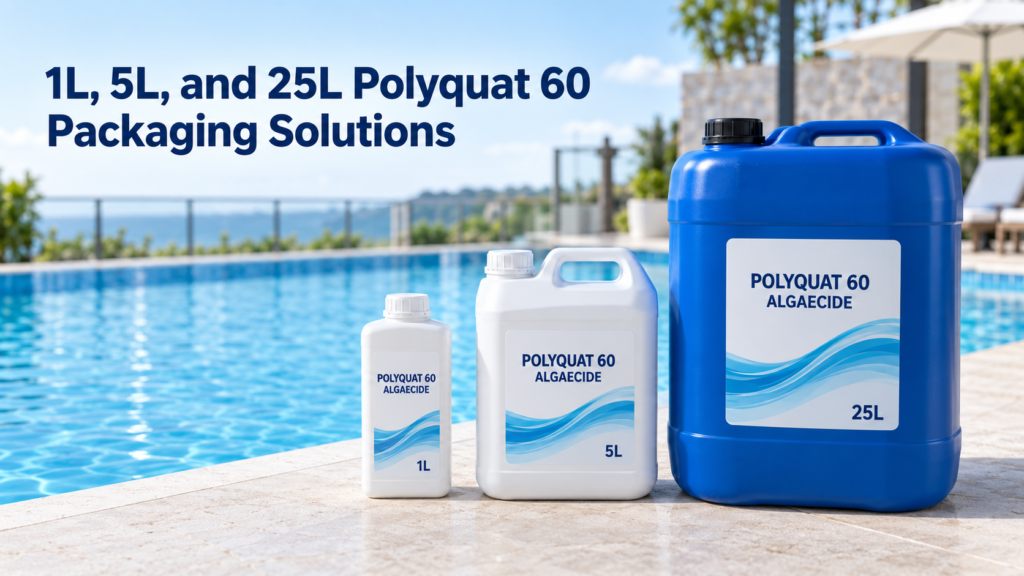
1L, 5L, and 25L Polyquat 60 Packaging Solutions
A good pool chemical needs more than reliable performance. It also needs the right container.
That sounds simple, but packaging decisions can influence nearly every part of a Polyquat 60 business—from production costs and freight efficiency to shelf presence and the way customers use the product. A bottle that works beautifully in a garden-center aisle may feel completely out of place in a commercial pool plant room. Likewise, a large container that saves money for a service company may be far too heavy for a residential pool owner.
This is why 1L, 5L, and 25L packaging solutions serve different roles. They are not merely three versions of the same product. Each pack size speaks to a different buyer, sales channel, purchasing habit, and application environment.
For pool chemical importers, distributors, service companies, and private-label brands, building the right packaging structure can make a product easier to sell—and easier to reorder.
One Chemical, Three Very Different Jobs
Polyquat 60 Algaecide is a concentrated, water-soluble polymer-based algaecide used in swimming pools, spas, fountains, and related water systems. It is commonly valued for non-foaming algae control and for its suitability in routine and seasonal pool treatment programs.
However, customers do not all buy or apply it in the same way.
A residential pool owner may want a neat bottle with clear dosing directions. A pool technician may prefer a practical jerrycan that can be carried between service visits. A commercial operator may care more about cost per kilogram, storage efficiency, and fewer empty containers.
The packaging must fit the job.
Here is a simple comparison:
| Pack size | Typical buyer | Main sales channel | Key advantage |
|---|---|---|---|
| 1L bottle | Residential pool owner | Retail, e-commerce, pool shops | Convenient and brand-friendly |
| 5L jerrycan | Pool service company | Professional distribution | Balance of volume and portability |
| 25L jerrycan | Commercial operator or distributor | B2B and bulk supply | Lower packaging cost per unit |
These roles can overlap. Some service companies buy 25L containers, while some large pool owners prefer 5L packs. Still, the table gives a useful starting point.
1L Bottles: Small Pack, Big Branding Opportunity
The 1L bottle is usually the most consumer-facing Polyquat 60 package. It sits on shelves, appears in online product listings, and may be the customer’s first physical contact with a pool chemical brand.
That makes appearance important—but not more important than function.
A practical 1L bottle should be easy to lift, pour, close, and store. An opaque HDPE bottle is commonly suitable for liquid pool chemical packaging because it is light, impact-resistant, and available in several shapes. Exact material compatibility should still be checked against the finished formulation, especially when other ingredients, dyes, fragrances, or additives are present.
The bottle shape also affects how the product feels in the customer’s hand. A tall rectangular bottle uses shelf space efficiently. A molded grip can make pouring more comfortable. A wider base may improve stability when the bottle is placed beside a pool.
Small details matter. Anyone who has tried to measure a slippery chemical bottle with wet hands knows that packaging design is not merely decoration.
A 1L Polyquat 60 bottle is well suited to:
- Residential pool maintenance
- Spa and hot tub care
- Seasonal algae prevention
- Pool opening and closing kits
- E-commerce sales
- Hardware and garden retail
- Private-label pool care ranges
- Trial purchases in new markets
Eautrix’s current retail-ready configuration lists 1L bottles with a 1kg net fill and 12 bottles per carton. Final capacity, net weight, headspace, and carton arrangement should be confirmed for the chosen formulation because product density and local labeling practices can affect the finished pack.
Why the 1L Format Works So Well in Retail?
Retail customers tend to think in treatments rather than kilograms. They ask, “How many times can I use this bottle?” or “Will this be enough for my pool?”
A well-prepared 1L label should answer those questions quickly. It may include:
- Product identity
- Active ingredient information
- Net content
- Suitable pool applications
- Dosing directions
- Dilution or application instructions
- Storage guidance
- Batch number
- Production or expiry information
- Safety statements required by the destination market
- Manufacturer or responsible supplier details
The front panel should remain clean. Trying to place every technical detail on the front often creates a label that feels crowded and difficult to read. The front attracts attention; the back helps the customer use the product correctly.
This format also gives private-label brands room to build a recognizable visual family. Matching colors, wave patterns, icons, and label structures can connect Polyquat 60 with clarifiers, winter products, and other pool care chemicals.
For instance, the same brand could offer a 1L algaecide beside a Polymer Pool Clarifier using coordinated packaging. Customers can immediately see that the products belong to one treatment program, even though their functions differ.
Is 1L Always the Easiest Size to Sell?
Not necessarily.
A small bottle has a higher packaging cost per kilogram of product. Bottles, caps, labels, cartons, dividers, filling labor, and pallet handling all add cost. For markets driven mainly by low unit prices, a 1L pack may look attractive on the shelf but deliver tighter margins.
It may also create more empty packaging for a high-volume user.
So, while 1L is strong for brand visibility and consumer convenience, it is rarely the most economical format for professional daily use. That is where the 5L jerrycan steps in.
5L Jerrycans: The Useful Middle Ground
The 5L jerrycan is, frankly, the quiet workhorse of many pool chemical ranges.
It offers more product than a retail bottle without becoming difficult for one person to carry. An integrated handle supports transport and controlled pouring, while the rectangular body usually stacks and stores more efficiently than several loose bottles.
This packaging size often suits:
- Pool maintenance companies
- Hotels and resorts
- Apartment and community pools
- Schools and leisure centers
- Small commercial pools
- Regional pool chemical dealers
- Professional pool technicians
- Customers who maintain several residential pools
Eautrix’s current packaging configuration lists 5L jerrycans with a 5kg net fill and four jerrycans per carton. As with the 1L format, the final fill specification should reflect formulation density, legal label requirements, and the practical headspace needed for filling and transport.
The 5L container has another commercial advantage: it can serve both professional and premium retail markets.
A homeowner with a large pool may see it as an economical family-size pack. A service technician may see it as a compact professional container. The packaging has the same volume, yet the sales message changes with the channel.
A Handle Is More Important Than It Looks
The integrated handle is one of the strongest features of a 5L jerrycan. Still, not every handle design feels the same.
The grip opening should provide enough room for a gloved hand. The handle should remain comfortable when the container is full. The bottle body should resist excessive flexing during pouring. Meanwhile, the cap and neck design must help reduce drips after use.
A badly balanced jerrycan can turn a simple dose into a small wrestling match. That is hardly the experience a professional brand wants to create.
A controlled-pour insert or compatible dispensing accessory may be considered where the market requires more accurate application. Any accessory should be tested with the actual product and closure. A part that fits the neck is not automatically suitable for long-term chemical contact.
Why Pool Service Companies Often Prefer 5L
Pool technicians need packaging that works in vans, storerooms, and equipment rooms—not only in polished product photos.
A 5L pack offers several practical benefits:
- It is easier to carry than a 25L container.
- It reduces the number of small bottles needed for multiple jobs.
- It fits more easily into service vehicles.
- It supports professional-looking chemical organization.
- It can reduce packaging waste compared with repeated 1L purchases.
- It allows technicians to keep separate containers for different routes or teams.
The label can also carry professional dosing information. Rather than using only broad consumer instructions, a service-oriented version may present treatment quantities in milliliters per cubic meter, liters per defined pool volume, or another unit familiar to the target market.
The chemistry has not changed. The communication has.
25L Jerrycans: Built for Volume and Efficiency
The 25L stackable jerrycan moves the product firmly into professional B2B territory.
It is designed for customers who use Polyquat 60 regularly and care about purchasing efficiency. Compared with many small bottles, a 25L pack reduces the number of caps, labels, cartons, and individual units that must be handled.
That can make warehouse work simpler and reduce packaging cost per kilogram.
Typical users include:
- Commercial swimming pool operators
- Water parks
- Large resorts
- Pool chemical distributors
- Contract blenders
- Repackers
- Regional service companies
- Industrial or institutional water management teams
Eautrix’s listed configuration uses 25L stackable jerrycans with a 25kg net fill, arranged at 32 or 48 jerrycans per pallet depending on the selected pallet plan and shipping requirements.
The word “stackable” deserves attention. A shaped top and base can help containers sit more securely during storage. Yet stackability does not remove the need for correct pallet loading, stretch wrapping, corner protection, and transport testing. A stable-looking stack in a warehouse may behave very differently inside a container moving across the ocean.
Large Packaging Changes the Way Customers Handle the Product
A full 25L jerrycan is not simply a larger 5L pack. Its weight changes the handling process.
Customers may use a pump, tap, dispensing stand, or controlled transfer system rather than lifting and pouring directly. The container neck and closure should therefore be selected with likely dispensing methods in mind.
Clear operating guidance is valuable. The label or supporting document may explain:
- How to open and reseal the container
- Whether a compatible pump can be used
- How to avoid contamination during repeated dispensing
- Where the product should be stored
- How to manage spills
- Whether the original container should be retained
- How empty packaging should be handled under local rules
A 25L pack can reduce cost, but only if it remains practical. If workers struggle to transfer the product cleanly, the saving can quickly be swallowed by spills, damaged labels, or inaccurate dosing.
White or Blue Containers?
Container color can support both branding and product recognition.
White packaging looks clean and works well with many private-label designs. It gives label colors a neutral background and is widely associated with retail chemical products.
Blue packaging has a natural connection with pools and water. A blue 25L jerrycan can also help distinguish the professional bulk format from smaller retail packs.
There is no universal rule saying all three sizes must use the same container color. A coordinated system might use white 1L and 5L packs, then a blue 25L jerrycan for professional supply. Consistent label graphics can hold the range together.
The final container color should be reviewed alongside resin availability, order quantity, label contrast, product identification needs, and local market expectations.
The Cap Has a Small Size but a Large Responsibility
A cap does more than close the container. It supports leak prevention, product integrity, and customer confidence.
Possible closure features include:
- Tamper-evident rings
- Induction seals
- Inner plugs
- Gaskets or liners
- Child-resistant designs where required
- Venting systems for products that need them
- Compatible dispensing taps or pumps
The right closure depends on the formulation, container neck, filling process, transport conditions, and legal requirements. A cap cannot be selected by appearance alone.
Closure testing should use the final container, final formula, and expected storage conditions. This is especially important for international shipments, where a package may experience heat, vibration, stacking pressure, and repeated handling.
A tiny leak inside a carton does more than waste product. It can stain labels, weaken corrugated board, affect nearby goods, and undermine trust in the entire shipment.
Labels Need to Survive the Real Pool Environment
Pool chemical labels face a rather unfriendly working environment. They may encounter moisture, splashes, sunlight, friction, and changing temperatures.
A label that looks perfect when freshly applied may wrinkle or lift after weeks in a humid storeroom. Adhesive selection should therefore consider both the HDPE surface and the actual use environment.
For private-label projects, buyers should define:
- Label dimensions
- Front and back panel layout
- Language requirements
- Barcode format
- Batch coding area
- Regulatory statements
- Brand colors
- Label material
- Adhesive type
- Surface finish
- Application direction
- Carton markings
Glossy labels can make pool colors look bright and energetic. Matte labels may feel more technical or premium. Neither is automatically better; the right finish depends on the desired brand character and resistance requirements.
Cartons and Pallets Are Part of the Product Too
Buyers often spend weeks refining bottle labels, then treat the outer carton as an afterthought. That is risky.
The carton protects the saleable unit. It must cope with stacking, warehouse handling, moisture exposure, and export transport. Internal dividers may help reduce movement and label abrasion, especially for 1L bottles.
A clear shipping mark can include:
- Product name
- Pack size
- Units per carton
- Net and gross weight
- Batch information
- Carton number
- Handling marks
- Destination or customer code
For palletized 25L jerrycans, load height and total pallet weight deserve careful review. More units per pallet may reduce freight cost per unit, but an overly high or heavy pallet can create handling problems. The most efficient pallet is the one that travels safely through the full supply chain—not merely the one that looks impressive on a spreadsheet.
Should You Sell One Size or All Three?
Launching all three sizes at once can expand market coverage, but it also adds inventory, artwork, carton, and production complexity.
A focused launch may be wiser for a new brand.
For example:
- Start with 1L if the main channel is retail or e-commerce.
- Start with 5L if pool service companies are the core customers.
- Start with 25L if the business supplies distributors or commercial operators.
- Combine 1L and 5L for a retail-plus-professional strategy.
- Combine 5L and 25L when service companies and commercial pools lead demand.
- Use all three when established distribution can support several buyer groups.
Mixed-size ordering can also help an importer test demand. However, minimum production quantities, label setup, carton printing, and pallet planning must be discussed before the order is confirmed.
More sizes create more opportunities—but also more stock-keeping units. A slow-moving 25L pack cannot rescue a fast-moving 1L shortage, even though the chemical inside may be identical.
Packaging Can Support a Complete Pool Care Range
Once a packaging family is established, the same visual structure can be adapted across related products.
A brand might offer:
- Polyquat 60 Algaecide
- Maintenance algaecide
- Pool clarifier
- Winter treatment
- Pool opening treatment
- Multi-function seasonal products
A Winter Algaecide may use seasonal colors or closing instructions while retaining the same bottle shape and brand structure. This makes the range easier for dealers to display and easier for customers to recognize.
Packaging consistency can also simplify future product development. The brand does not need to reinvent its visual language every time it introduces another pool chemical.
Still, product identification must remain clear. Two products should not look so similar that users can easily confuse them. Color bands, large product names, distinct icons, and different cap colors can help separate formulations within the same family.
Packaging Needs to Match the Sales Channel
Before approving 1L, 5L, or 25L packaging, prepare a detailed specification rather than relying on a photograph.
Confirm the following:
- Finished product formulation and concentration
- Nominal container capacity
- Target net weight or net volume
- Container resin and color
- Bottle or jerrycan dimensions
- Neck finish
- Cap type and color
- Tamper-evident features
- Seal or liner requirements
- Label dimensions and material
- Printed language
- Batch coding method
- Units per carton
- Carton strength and printing
- Pallet quantity and pattern
- Stretch wrapping and corner protection
- Required export documentation
- Sample and pre-production approval process
Buyers should also request compatibility and shipment-related checks appropriate for the final pack. Requirements can differ by product classification, route, carrier, and destination country, so transport compliance should be verified for each project.
There is no single “perfect” Polyquat 60 container.
The 1L bottle gives brands strong retail presence and customer convenience. The 5L jerrycan offers a sensible balance for professional pool care. The 25L jerrycan supports larger users who value lower packaging cost and fewer individual units.
The strongest packaging plan begins with the buyer—not the bottle.
Who will carry it? Where will it be stored? How will the product be measured? Will it sit on a retail shelf, travel in a technician’s van, or feed a commercial treatment program? Once those questions are clear, the right package usually becomes much easier to see.
Eautrix supports retail-ready packaging, private labeling, custom labels, carton printing, container color choices, and packaging configurations for different distribution channels. Buyers can discuss the target market, estimated order volume, preferred pack sizes, and brand requirements before requesting samples or commercial production.
After all, packaging is not the last step in a Polyquat 60 project. It is part of the product experience from the warehouse to the poolside.
Frequently Asked Questions
1. Which Polyquat 60 packaging size is best for residential pool retail?
A 1L bottle is usually the most suitable format for residential retail because it is easy to carry, display, store, and dose. It also provides useful label space for branding and consumer instructions.
2. Is a 5L Polyquat 60 jerrycan suitable for pool service companies?
Yes. A 5L Polyquat 60 jerrycan provides more product than a retail bottle while remaining portable for technicians. Its integrated handle also supports regular transport and controlled pouring.
3. Can 25L Polyquat 60 containers be supplied with private labels?
Yes. Private-label 25L Polyquat 60 packaging can include customized labels, container colors, shipping marks, and pallet configurations, subject to technical feasibility and order requirements.
4. Can I order 1L, 5L, and 25L Polyquat 60 packaging in one shipment?
Mixed packaging sizes may be arranged depending on production quantities, label requirements, carton setup, and pallet planning. Buyers should provide the quantity required for each size before receiving a confirmed proposal.
5. What information is needed for a custom Polyquat 60 packaging quotation?
A supplier will normally need the desired formulation, concentration, pack sizes, quantities, container colors, label artwork, destination country, and delivery terms. Regulatory or transport requirements should also be shared early.