GET IN TOUCH
Ask For Sample?
How Packaging Options Support Different Pool Markets?
A pool chemical may perform beautifully in the water, yet struggle in the market because it arrives in the wrong package.
That sounds a little unfair, doesn’t it? After all, the active ingredient controls the algae, improves clarity, or supports water maintenance. The bottle does none of those things. Still, packaging affects how the product is transported, displayed, stored, measured, handled, and remembered. It influences freight costs, distributor margins, customer confidence, and even the number of complaints a brand receives.
For pool chemical brands, importers, and distributors, packaging is therefore not a decorative decision made at the end of product development. It is part of the commercial formula.
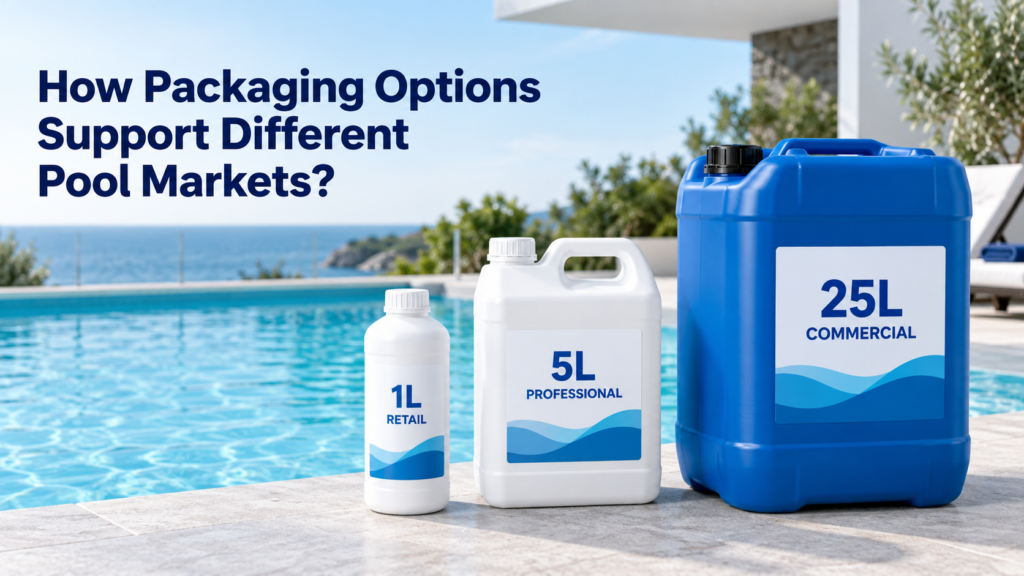
A 1 L bottle may work well on a retail shelf. A 5 L jerry can can be more practical for a pool service technician treating several properties each week. A 25 L stackable jerry can may make better economic sense for hotels, resorts, aquatic centers, and regional repacking operations.
Same chemical. Very different market experience.
The key is to connect the package with the people who will actually lift it, store it, sell it, and pour from it. Once that connection becomes clear, packaging stops being a minor purchasing detail. It becomes a way to enter more markets without forcing every customer into the same buying pattern.
Pool Markets Are Not All Built the Same
The phrase “pool market” covers a surprisingly broad range of customers.
It may refer to a homeowner purchasing one bottle before summer. It may mean a local pool shop serving a few hundred residential pools. It could describe a maintenance company whose technicians drive from site to site with chemicals in their vans. It may also refer to a hotel group, municipal pool, water park, or national distributor buying pallet quantities.
These buyers do not use products in the same way.
A homeowner usually wants a manageable container, clear directions, and a label that explains the product without sounding like a chemistry textbook. A service company values fast dosing, reliable closures, and packages that fit neatly into a vehicle. A distributor pays closer attention to pallet efficiency, carton strength, leakage risk, and landed cost per kilogram.
Climate changes the picture too. In warm regions, pools may operate all year and require regular chemical replenishment. In colder areas, demand can rise sharply during opening and closing seasons. A package that sells steadily in one country may be strongly seasonal in another.
Sales channels introduce another layer:
- Pool shops generally favor retail-ready bottles.
- E-commerce sellers need packages that can survive parcel delivery.
- Service companies may prefer medium-sized jerry cans.
- Commercial operators often need larger, cost-efficient containers.
- Importers and local blenders may purchase concentrates in bulk.
This is why one standard package rarely serves every opportunity well. A thoughtful packaging range allows the product to travel through several channels while keeping the formulation consistent.
The 1 L Bottle: Small Format, Big Retail Value
A 1 L bottle is often the most approachable format for residential pool owners.
It looks familiar. It fits on a shelf, can be carried with one hand, and does not feel like an industrial chemical package. For a first-time buyer, that matters. People may hesitate before purchasing a large container of an unfamiliar treatment, even when the price per liter is attractive. A smaller bottle lowers the perceived commitment.
This format is particularly useful for:
- Residential pool maintenance
- Seasonal pool opening products
- Pool closing treatments
- Trial sales in new markets
- Specialist pool shops
- E-commerce orders
- Private-label product launches
The front label has to work hard. It should quickly tell the buyer what the product is, where it fits in the maintenance routine, and whether it addresses prevention, visible algae, water clarity, or seasonal care. The back label can then carry directions, precautions, storage information, batch details, and local regulatory text.
For concentrated products, the label should make concentration and dosage especially clear. “More concentrated” may sound valuable, but it also means the user must measure carefully. A practical dosing chart or clear treatment-volume guide can reduce confusion.
The closure matters just as much as the artwork. A bottle that looks polished but leaks around the cap will not build repeat business. The neck finish, cap liner, sealing method, and bottle material should be checked against the formulation. Chemical compatibility cannot be judged by appearance alone.
For private-label brands, a 1 L bottle also offers generous room for visual identity. Color, typography, product naming, and label structure can help create a recognizable family of pool products. An algaecide, clarifier, and winter product may use the same bottle shape while being distinguished through carefully controlled label colors.
That creates consistency without making every product look identical.
Customers can spot the brand. Dealers can arrange an orderly display. Warehouse staff can still tell the products apart. Simple? Yes. But simple systems are often the ones that survive busy pool season.
Businesses developing a retail algaecide can review Eautrix’s Polyquat 60 Algaecide packaging and private-label options for residential and professional pool channels.
The 5 L Jerry Can: The Practical Middle Ground
The 5 L jerry can sits in a useful space between retail bottles and commercial containers.
It is large enough to lower packaging cost per liter, yet small enough for many technicians to handle without special equipment. For pool service companies, this can be the sweet spot.
Imagine a technician treating several residential pools in one day. Carrying many small bottles creates clutter and waste. A 25 L container, however, may be inconvenient to move in and out of a service vehicle. The 5 L jerry can offers a workable compromise: more product per package, fewer empty bottles, and reasonable portability.
This format can suit:
- Pool maintenance contractors
- Small hotels and guesthouses
- Apartment complexes
- Schools with swimming facilities
- Pool builders offering after-sales maintenance
- Specialist chemical dealers
- Small commercial pools
- High-use residential customers
A strong handle is essential. So is controlled pouring. If the container glugs, drips, or splashes, technicians may lose product and dose less accurately. The package should support the real working environment—not an idealized laboratory bench.
Pool service vehicles can become hot during summer. Containers may be moved repeatedly, placed on uneven floors, or exposed to vibration during transport. A suitable jerry can therefore needs dependable wall strength, good closure performance, and enough headspace for the specific product and shipping conditions.
The rectangular shape of a jerry can can improve storage efficiency compared with some round bottles. It may also make carton packing more orderly. Still, the exact benefit depends on the container dimensions, carton pattern, and pallet layout. That calculation should happen before a large label order is printed.
There is another commercial benefit. A 5 L package can make a professional-grade product feel genuinely professional. It signals that the buyer is not purchasing a one-time remedy from a supermarket shelf. The product is part of an ongoing maintenance program.
That impression is useful—but only when the instructions match professional use. Dosage tables may need to cover several pool volumes. The label should make clear whether the product is concentrated or ready to use. Batch traceability should be easy to find, not hidden beneath a fold or seam.
The 25 L Jerry Can: Built for Volume and Repeated Use
For larger users, the economics of small bottles can become difficult to justify.
A hotel, resort, aquatic center, or pool maintenance company may consume pool chemicals regularly. Purchasing many 1 L bottles increases the number of containers to open, store, count, and discard. It also increases the amount of packaging material per kilogram of product.
A 25 L stackable jerry can reduces that burden.
This format is commonly suited to:
- Commercial swimming pools
- Hotels and resorts
- Water parks
- Municipal facilities
- Large pool service companies
- Regional distributors
- Institutional buyers
- Repacking or formulation operations, where permitted
Stackability can make a meaningful difference in the warehouse. Containers that sit securely can use pallet space more effectively and reduce movement during storage. Yet “stackable” should never be treated as a marketing word alone. The filled package needs to be assessed under realistic stacking, temperature, transport, and storage conditions.
A 25 L package also changes the way the product is handled. It is heavier, so pouring directly from the container may be awkward or unsafe. Customers may need a compatible pump, dispensing tap, or transfer method. These accessories should be discussed during product planning rather than after the first shipment arrives.
The label may look physically larger, but the communication challenge remains. Commercial users need clear information quickly:
- Product name and concentration
- Intended application
- Dosage guidance
- Net content
- Batch number
- Manufacturing or filling date
- Storage conditions
- Safety information
- Local-language instructions
- Supplier and importer details, where required
In practice, the 25 L jerry can is not simply a larger version of a retail bottle. It is a different working tool. Its design should reflect the routines of warehouses, plant rooms, maintenance teams, and commercial purchasing departments.
For off-season programs, larger professional users may also consider Winter Algaecide formats suited to pool closing and extended maintenance periods.
Concentrated or Ready to Use? Packaging Should Tell the Truth
Concentration changes packaging economics.
A concentrated product can reduce the amount of water shipped across borders. This may lower the number of containers, cartons, pallets, and freight units required to deliver a given amount of active ingredient. For overseas distributors, that can make concentrated pool chemicals commercially attractive.
But concentration also transfers some responsibility to the next stage of the supply chain.
A distributor may sell the concentrate directly with suitable directions. Another may dilute or formulate it locally, subject to technical capability and applicable rules. A private-label brand may request a finished, ready-to-use product that is easier for residential customers to understand.
Each model needs different packaging communication.
A concentrated Polyquat 60 product, for example, should not look so similar to a diluted maintenance formula that warehouse staff or customers can easily confuse them. Label color alone may not be enough. The product name, concentration, and dosing instructions should be prominent.
Ready-to-use products may require more packaging per unit of active ingredient, but they can offer advantages in consumer channels:
- Simpler dosing
- Lower risk of dilution mistakes
- Easier retail communication
- More accessible price per bottle
- Faster product adoption
- Less technical work for the distributor
So, is concentrate always better? Not quite.
Concentrates can improve international shipping efficiency and give professional buyers greater flexibility. Ready-to-use formulas can make the product easier to sell and use. The better format depends on who performs the final dosing, how the product is positioned, and what the local market expects.
Sometimes the strongest portfolio includes both.
One Formula Can Wear More Than One Commercial Outfit
Packaging variations allow a supplier to serve different customer groups without rebuilding the entire product range.
Consider a non-foaming polymer-based algaecide. It might be supplied as:
- A 1 L private-label bottle for home pool owners
- A 5 L jerry can for maintenance companies
- A 25 L jerry can for commercial operators
- A bulk package for approved local formulation or repacking
The chemical foundation may remain similar, but the product presentation, dosage communication, and route to market change.
This approach can help an importer test several channels. A small initial quantity of retail packaging may be used to collect customer feedback. Medium packages can be introduced to service companies. Larger formats can then support commercial accounts once local demand becomes clearer.
It also reduces the temptation to force one package into every sales situation. A retail buyer should not need to wrestle with a commercial container. A high-volume service company should not have to empty dozens of small bottles each week.
That mismatch creates hidden costs—extra labor, more waste, inaccurate dosing, damaged cartons, and irritated customers. None of those appears in the chemical specification, but all of them affect repeat orders.
Private-Label Packaging Is More Than Adding a Logo
A private label is sometimes treated as a simple design exercise: place a logo on the bottle, choose a blue background, and the work is done.
If only it were that easy.
A useful private-label package must connect brand identity with technical clarity. It should look distinctive while remaining readable. It should support sales while leaving enough space for legal, safety, and application information.
A complete private-label project may involve:
- Bottle or jerry-can selection
- Container color
- Cap style and color
- Induction sealing or another suitable closure system
- Front and back label dimensions
- Product naming
- Brand color system
- Local-language content
- Barcode placement
- Batch coding area
- Carton design
- Pallet labels
- Shipping marks
- Regulatory review
The design also needs to survive physical handling. Fine text that looks elegant on a computer screen may become difficult to read after printing. Dark artwork may hide a poorly printed batch code. A label edge placed too close to a molded curve may lift during storage.
These are small details until several thousand packages are already filled.
For a new pool chemical brand, it is often wiser to begin with an established bottle shape and concentrate creative effort on label structure, product hierarchy, and brand consistency. A custom mold can create distinction, but it also brings higher tooling costs, larger purchasing commitments, and less flexibility if the design needs to change.
A reliable package does not need to shout. It needs to make the buyer think, “Yes, I understand what this is, and I trust it.”
Cartons and Pallets Quietly Shape Profit Margins
The primary package gets most of the attention. The carton and pallet, meanwhile, do the heavy lifting—quite literally.
Carton configuration affects warehouse handling, shipping strength, distributor counting, and retail replenishment. Eautrix packaging examples include 12 × 1 L bottles per carton and 4 × 5 L jerry cans per carton. These groupings can simplify inventory control while protecting individual containers during transport.
However, carton performance depends on more than the number of units inside. Factors such as board grade, internal dividers, package fit, closure direction, stacking height, humidity, and route conditions can all influence shipping results.
Export shipments face long journeys. A carton may pass through a factory warehouse, truck, port terminal, shipping container, destination warehouse, and local delivery vehicle before reaching the customer. Every handoff adds stress.
Pallet planning deserves equal attention. A package that looks efficient by itself may create unused gaps when arranged on a pallet. A few centimeters in container width can change the number of units per layer. That change can affect the total product carried in each shipment.
This is where packaging and freight calculations need to meet.
Before finalizing a format, suppliers and buyers should confirm:
- Units per carton
- Cartons or containers per pallet
- Pallet dimensions
- Net and gross weight
- Pallet height
- Stack stability
- Container-loading pattern
- Use of stretch film, corner protection, or strapping
- Applicable transport requirements
A cheaper bottle can become expensive if it wastes pallet space or suffers a higher leakage rate. A slightly stronger carton may cost more at the packing stage but prevent far greater losses later.
Packaging cost should therefore be measured as part of delivered cost—not as an isolated line on a quotation.
E-Commerce Puts Packaging Through a Different Test
A carton shipped on a pallet moves differently from a bottle sent through a parcel network.
Palletized products are usually kept upright and moved as a group. An e-commerce package may be dropped, tilted, stacked beneath other parcels, or exposed to repeated vibration. A beautiful retail bottle may not survive that journey without secondary protection.
Pool brands selling online should consider:
- Tamper-evident sealing
- Secure cap torque
- Individual bagging where appropriate
- Absorbent or protective material
- A close-fitting outer carton
- Protection against cap impact
- Clear orientation and handling marks
- Applicable carrier restrictions for chemical products
Leakage harms more than one sale. It can damage nearby parcels, trigger marketplace complaints, and lead carriers to restrict future shipments.
The package must also photograph well. Online buyers cannot pick up the bottle, feel its weight, or turn it around. The product image and label must communicate size, purpose, concentration, and usage clearly.
Still, visual appeal should not encourage exaggerated claims. A label is a compact promise. If it promises more than the formulation or approved directions can support, attractive packaging may simply accelerate customer disappointment.
Packaging for Seasonal Pool Markets
Pool care follows the calendar.
In colder regions, spring opening and autumn closing create concentrated demand. Retailers need products that can be stocked, displayed, and sold quickly during a relatively short window. Residential-size bottles and complete maintenance kits may perform well in these channels.
Winter products may benefit from packaging that clearly separates them from weekly summer treatments. The user should not need to study the fine print to understand that a formula is intended for pool closing or off-season maintenance.
Commercial customers may buy earlier and in larger quantities. Distributors preparing for the closing season may place orders months before consumers begin thinking about winter. That timing affects production schedules, label approval, container purchasing, and shipping plans.
Warm-climate markets behave differently. Year-round operation can support steady demand for maintenance algaecides and clarifiers. Medium and larger packages may turn over more consistently because service companies treat pools throughout the year.
There is no universal “seasonal package.” The right format depends on climate, pool ownership patterns, distribution channels, and local maintenance habits.
The chemistry may be global. Pool routines remain local.
Packaging Can Help Build a Product Family
A well-planned packaging system makes it easier to add related products later.
Suppose a brand begins with Polyquat 60 Algaecide. It may later introduce a routine maintenance algaecide, pool clarifier, or winter treatment. Using related container shapes and a shared label system can make the range look established, even while each product retains its own identity.
This visual connection helps in several places:
- Retail shelves
- Distributor catalogs
- Trade show displays
- Online stores
- Sales brochures
- Service vehicles
- Warehouse picking areas
Color coding can be useful, but it should be supported by product names and other visible differences. Relying entirely on color may create problems under poor lighting, after label fading, or for people with color-vision differences.
A clarifier, for example, should be easy to distinguish from an algaecide during a rushed maintenance visit. Clear product identification is not merely a branding issue. It supports correct handling.
Brands expanding their maintenance range can connect algaecide programs with a Cationic Polymer Pool Clarifier for markets seeking coordinated water-clarity products.
Safety and Chemical Compatibility Come First
A container that works for one liquid may not work for another.
The formulation can interact with the bottle resin, cap, liner, seal, label adhesive, or printing system. These interactions may lead to softening, swelling, discoloration, stress cracking, label lifting, or leakage.
That is why packaging evaluation should use the actual formulation—not just water or a vaguely similar liquid.
Testing may include:
- Container compatibility
- Closure compatibility
- Leakage checks
- Filled-package storage
- Temperature exposure
- Drop performance
- Compression or stacking checks
- Label adhesion
- Seal integrity
- Transport simulation
- Observation over the intended shelf-life period
The required tests will vary by product, package, market, and shipping route. Local chemical labeling, transport, child-resistant closure, tamper-evidence, and language requirements may also apply. Suppliers and importers should confirm the rules for each destination before commercial production.
It is tempting to treat packaging compliance as paperwork. In reality, it protects warehouse workers, carriers, technicians, retailers, and pool owners. That is not paperwork. That is part of responsible product design.
Sustainability Requires More Than a Green Label
Customers increasingly ask about packaging waste. Pool brands should take the question seriously, but vague environmental language does not help anyone.
A larger or concentrated package may reduce packaging material per unit of active ingredient. Efficient pallet layouts may lower the number of shipments required. Durable containers can reduce losses caused by leakage or damage. Correct dosing can also prevent unnecessary product use.
These are practical improvements.
However, recyclability depends on container material, residual chemical content, local collection systems, and waste rules. A technically recyclable container may not be accepted by a local recycling program. Claims should therefore be precise and supported by the conditions in the target market.
Useful sustainability steps may include:
- Reducing unnecessary packaging weight
- Improving product-to-package ratio
- Selecting mono-material components where practical
- Avoiding oversized cartons
- Increasing pallet efficiency
- Providing correct disposal guidance
- Offering concentrated formats to qualified customers
- Preventing damage and leakage
- Reviewing local recycling conditions before making claims
The greenest-looking package is not always the one with the lowest overall impact. Sometimes a stronger container that prevents product loss is more responsible than a lighter one that fails during shipment.
Packaging decisions, like pool chemistry, are about balance.
How to Choose the Right Packaging Portfolio
A brand does not need every possible package on the first day.
A focused portfolio may be more manageable. For many pool chemical businesses, three primary formats create a useful starting structure:
- 1 L bottles for retail, residential use, e-commerce, and market trials
- 5 L jerry cans for pool service companies, dealers, and small commercial users
- 25 L stackable jerry cans for commercial pools, high-volume contractors, and distributors
From there, the business can adjust according to real demand.
Before selecting the package, ask a few direct questions:
- Who will use the product?
- How often will they use it?
- How will they measure and pour it?
- Will it be sold in a shop, online, or through a professional distributor?
- How far will it travel?
- Will it move by carton, pallet, or full-container shipment?
- Does the destination require local-language or market-specific label content?
- Is the product concentrated or ready to use?
- Does the customer need a private label?
- What annual volume justifies custom packaging?
These questions prevent packaging decisions from being driven only by unit price.
A low-cost container is not economical if customers dislike handling it. A premium bottle is not commercially sensible if its shape cuts pallet capacity. A large package is not convenient if the end user lacks safe dispensing equipment.
Good packaging sits at the meeting point of chemistry, logistics, branding, and human behavior.
The Right Package Helps the Right Product Reach the Right Customer
Pool chemicals do not arrive in the market as laboratory samples. They arrive as bottles, jerry cans, cartons, and pallets.
That physical form influences almost every commercial step. It affects whether an importer can achieve a workable landed cost. It affects whether a retailer can display the product. It affects whether a technician can dose it without spilling. It affects whether a homeowner understands what to do next.
A 1 L bottle creates accessibility. A 5 L jerry can supports repeated professional use. A 25 L stackable jerry can improves efficiency for higher-volume customers. Concentrated and ready-to-use products can then extend the range further, provided their labels and handling instructions remain clear.
The goal is not to offer the largest number of packaging choices. The goal is to offer meaningful choices.
Eautrix supports formulation, blending, private labeling, and custom packaging for pool chemical businesses serving different regional and customer markets. Buyers can request packaging information or a product quotation based on their desired formulation, package size, label language, order quantity, and sales channel.
Because when the chemistry is right and the package fits the market, the product has a much better chance of earning its place—on the shelf, in the service vehicle, and in the customer’s next order.
Frequently Asked Questions
1. What is the best packaging size for private-label pool algaecide?
A 1 L bottle is often suitable for residential retail and e-commerce sales, while 5 L jerry cans work well for pool service companies. Commercial buyers may prefer 25 L containers. The best private-label pool algaecide packaging depends on dosage, sales channel, handling needs, and local buying habits.
2. Why do pool service companies prefer 5 L chemical jerry cans?
A 5 L jerry can provides more product than a retail bottle without becoming too difficult to carry. It can reduce packaging waste, save vehicle space, and support repeated dosing across several pools. Handle strength, closure quality, and pouring control remain important.
3. Are 25 L jerry cans suitable for commercial swimming pool chemicals?
Yes. A 25 L stackable jerry can can suit hotels, resorts, aquatic centers, water parks, and high-volume maintenance contractors. Buyers should also consider package weight, dispensing equipment, storage space, label requirements, and safe handling procedures.
4. Can Polyquat 60 Algaecide be supplied with custom labels?
Polyquat 60 Algaecide can be offered with private-label support, subject to formulation, packaging, order quantity, and destination-market requirements. Customization may include label design, container size, container color, carton printing, and brand information.
5. How does concentrated pool chemical packaging reduce international shipping costs?
Concentrated products contain less added water per unit of active ingredient. This can reduce the packaging, pallet space, and freight needed to deliver an equivalent amount of active material. The actual saving depends on package configuration, shipment size, destination, and local dilution or formulation capability.