
GET IN TOUCH
Ask For Sample?
Why Concentrated Polyquat 60 Is Better for Global Distribution?
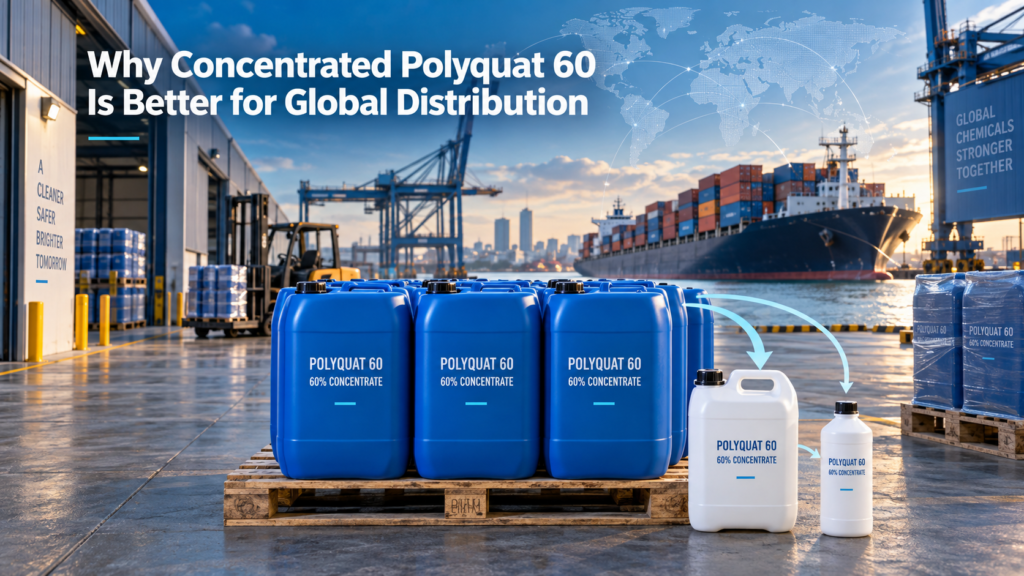
Moving pool chemicals across borders is rarely as simple as filling a container and sending it to sea. Every liter occupies space. Every package adds weight, handling work, labeling, and possible leakage risk. Once the shipment arrives, the importer still has to store it, move it through the warehouse, and deliver it to customers.
That is why concentration matters.
For many importers, distributors, pool chemical brands, and regional blenders, concentrated Polyquat 60 provides a more practical starting point than a heavily diluted, ready-to-use algaecide. It carries more active ingredient in a given shipment and gives the receiving company greater freedom to decide how the final product should be formulated, packaged, and positioned.
The basic idea is easy to understand: shipping water over a long distance is not always the most sensible use of freight capacity.
Still, concentrated supply is not automatically right for every buyer. A distributor must have suitable equipment, trained staff, controlled water quality, and reliable dilution procedures. Without those elements, the apparent savings can quickly disappear.
So, why is concentrated Polyquat 60 often a better fit for global distribution—and when is it not? Let’s take it piece by piece.
What Does “Concentrated Polyquat 60” Actually Mean?
Polyquat 60 is commonly used as the name for a non-foaming polymeric algaecide containing approximately 60% active ingredient. The product is supplied as a liquid concentrate rather than as a fully diluted retail treatment.
The concentrate can be sold directly to professional formulators or used as the active base for finished pool products. Depending on the target market and approved formulation, a regional producer may dilute it, combine it with permitted supporting ingredients, and fill it into consumer or commercial packages.
This flexibility separates an active concentrate from a standard ready-to-use product.
A ready-to-use algaecide has already been brought to its final selling strength. It may arrive in a labeled one-liter bottle, a five-liter jerry can, or another retail format. The importer can place it in inventory and begin distributing it with little additional production work.
A concentrate takes a different route. It arrives as a high-active raw material or semi-finished product. The importer then controls more of the downstream process.
Neither format is universally superior. Yet when goods must travel thousands of kilometers, concentration can make a meaningful commercial difference.
More Active Ingredient, Less Transported Volume
Imagine that two products are intended to provide the same amount of active polymer to the final market. One contains 60% active ingredient, while the other contains 10%.
To transport 600 kilograms of active ingredient, the distributor would theoretically need:
- About 1,000 kilograms of a 60% concentrate
- About 6,000 kilograms of a 10% finished solution
The exact calculation may vary with specification, density, processing loss, and the final formula. Even so, the broader point remains: the diluted product requires the supply chain to carry far more liquid.
Most of that added liquid is water.
For short-distance delivery, this may be acceptable. A local manufacturer can deliver finished algaecide directly to nearby retailers without crossing oceans or managing multiple customs procedures. For an importer receiving material from another continent, however, the economics change.
Concentrated Polyquat 60 may allow the buyer to carry more active ingredient within the same freight allocation. That can improve the commercial value of each shipment and reduce the number of replenishment orders needed during a season.
Freight is not priced by chemistry alone. Carriers consider weight, volume, packaging, route, equipment availability, and cargo classification. Concentration does not remove these factors, but it can reduce the amount of low-value water moving through the international supply chain.
That is a quiet advantage—and often a substantial one.
Better Use of Container and Warehouse Capacity
International distributors rarely have unlimited space. Containers have payload and volume limits, while warehouses have finite pallet positions, handling capacity, and working capital.
A concentrated product can help on both sides of the journey.
At the shipping stage, more active ingredient can be placed into a given number of drums, jerry cans, or other suitable bulk packages. At the destination, the distributor stores the concentrated base and produces finished inventory according to demand.
This can be especially useful in markets where seasonal consumption changes quickly.
Suppose early summer sales exceed the forecast. A distributor holding ready-to-use products can only sell the package sizes and concentrations already in stock. If the one-liter line sells out while larger packages remain untouched, the company may have plenty of chemical but still be unable to meet retail demand.
A distributor holding concentrate has another possibility. Subject to its approved formula, production controls, packaging supply, and local rules, it may prepare the required finished product and fill the package size that customers are actually buying.
In other words, concentrated inventory is not merely smaller inventory. It can be more adaptable inventory.
One Concentrate Can Support Several Market Positions
Pool chemical demand is not identical across countries. It is not even identical across customers in the same country.
A pool service company may prefer a concentrated professional treatment supplied in a five-liter or 25-liter jerry can. A retail customer may want a lighter maintenance product in a one-liter bottle. A hotel group may require a commercial package with clear dosing instructions and batch traceability.
Starting with concentrated Polyquat 60 can give a qualified local formulator room to serve these different channels.
For example, the same approved concentrate may support:
- Professional-strength algae prevention products
- Lower-active maintenance formulations
- Seasonal pool-closing products
- Private-label products for regional distributors
- Commercial packages for pool service contractors
- Custom package sizes for retail chains
This does not mean that a concentrate can be diluted casually into any strength a seller wishes. Final formulations must be tested, documented, labeled correctly, and handled under the rules of the destination market.
Still, the commercial freedom is real. Instead of importing a separate finished product for every sales channel, a distributor may build several carefully controlled products around one consistent active base.
For companies developing their own pool care range, Polyquat 60 Algaecide bulk and private-label supply can therefore become a platform rather than a single stock-keeping unit.
Local Packaging Becomes a Strategic Advantage
Retail packaging is expensive to transport. Small bottles create unused spaces between containers, require more cartons, and need additional pallet protection. Caps, labels, measuring chambers, and outer cases also occupy freight capacity.
Concentrated bulk supply separates the international movement of the chemical from the local movement of the retail package.
The concentrate can travel in suitable industrial packaging, while retail bottles and cartons are sourced or prepared closer to the final market. Local filling can then respond to regional preferences.
A European distributor might need multilingual labels and one-liter bottles. A Middle Eastern buyer may prefer five-liter jerry cans for pool service companies. A distributor in a resort market may need larger professional packages because hotels and commercial pools dominate demand.
Why ship every finished bottle from the original manufacturing country if reliable filling can be completed closer to the customer?
Local packaging may also make regulatory label revisions easier. If a warning statement, language requirement, barcode, or distributor address changes, the company can update future packaging without relabeling a large quantity of imported finished goods.
That said, local filling brings responsibility. The facility needs accurate meters or weighing systems, clean containers, controlled filling records, batch identification, and procedures for handling spills and rejected packages. Flexibility only creates value when the operation remains disciplined.
A Stronger Foundation for Private-Label Programs
Private-label pool chemicals live or die by consistency.
A customer buying the same bottle in June and August expects the liquid to look, pour, and perform the same way. The distributor therefore needs a dependable concentrated base with a clear specification and consistent batch quality.
Once that foundation is established, the company can concentrate on brand presentation and regional selling.
A local private-label program may control:
- Brand name and packaging design
- Bottle or jerry-can size
- Label language
- Product positioning
- Distributor contact details
- Carton configuration
- Retail margin
- Promotional bundles
- Seasonal production volume
This approach can be particularly valuable for distributors that already sell chlorine products, pH adjusters, clarifiers, and testing supplies. Concentrated Polyquat 60 gives them a way to add a non-foaming polymeric algaecide under their own brand without depending entirely on imported retail packs.
It may also sit beside Algae Control 60 formulations or a polymer pool clarifier within a broader pool maintenance range.
The result is not just another bottle on the shelf. It is a more coherent product family.
Faster Reaction to Seasonal Demand
Pool chemical sales can move with the weather. A warm spring may bring pool openings forward. Several weeks of heat and rain can place sudden pressure on algae-control inventory. An early cold spell may shift demand toward winterizing products.
Ready-to-use imported products require decisions months before the sales season. The distributor forecasts package sizes, prints labels, schedules production, books freight, and waits for the shipment. If the forecast is wrong, the company may finish the season with too much of one product and too little of another.
Concentrated supply can shorten the final production decision.
The concentrate still needs to be imported and stocked, of course. Yet the distributor may delay part of the packaging decision until better demand information becomes available. One month, production can favor routine summer algaecide. Later, the same supply program may support an approved winter product.
That delayed decision has value. It gives the company more time to observe actual orders rather than relying entirely on a preseason estimate.
For a regional distributor serving many dealers, that extra flexibility can mean fewer missed sales and less obsolete packaging.
Fewer Finished SKUs May Simplify Purchasing
Every finished product creates an additional purchasing line. Different concentrations, bottle sizes, labels, cartons, and language versions can multiply rapidly.
A distributor serving four countries might otherwise need several separate products:
- One-liter retail bottles for two languages
- Five-liter professional packs
- A maintenance-strength formula
- A stronger professional formula
- A winter product
- Custom labels for key accounts
Managing all those imported finished SKUs can become a paperwork puzzle.
Concentrated Polyquat 60 may simplify the upstream side of purchasing. The buyer imports a more limited number of concentrated grades or specifications and creates finished SKUs closer to the sales market.
Local production still needs its own planning, but the international supply structure becomes easier to understand. Forecasting focuses on total active demand rather than predicting every bottle configuration many months ahead.
This can also help when a distributor is testing a new region. Instead of committing to a large imported run of one finished label, it may produce a smaller local batch after verifying customer interest.
Concentration Can Reduce Packaging per Unit of Active Ingredient
Packaging protects the chemical, but packaging also costs money and eventually becomes waste.
When a low-active product is shipped internationally, a larger number of containers may be required to carry the same amount of useful active ingredient. That means more closures, labels, cartons, stretch film, pallets, and handling steps.
A 60% concentrate can require less primary and secondary packaging per kilogram of active material delivered to the receiving market. Local dilution will still require finished-product packaging, so the packaging does not disappear. The difference is that retail containers can be introduced closer to where the product will be sold.
This distinction matters.
It would be misleading to claim that concentrated supply always cuts total packaging by a fixed percentage. Package design, returnable containers, local sourcing, order volume, and final product strength all affect the calculation. Yet concentration can reduce the amount of international packaging and allow local teams to choose formats suited to their customers.
That is a more defensible benefit than a broad environmental slogan.
Better Control of Regional Package Sizes
Package preferences vary more than many exporters expect.
A one-liter bottle may work well for residential pool owners. Pool maintenance companies often prefer five-liter packs because they treat several properties each day. Larger commercial operators may favor 20- or 25-liter containers, provided the packaging and handling procedure suit the product and local requirements.
Importing every format from one overseas plant can create high minimum-order quantities for each package. Concentrate allows regional filling in volumes that reflect actual demand.
It can also make promotions easier. A distributor may introduce a trial size, a seasonal package, or a professional refill without asking the upstream producer to interrupt a major production run.
Again, this requires a competent local filling partner. But where that capability already exists, concentrated supply turns package size into a sales decision rather than a shipping constraint.
Quality Consistency Must Come Before Freight Savings
A cheaper shipment is not valuable if the concentrate varies from batch to batch.
For global distribution, buyers should assess more than the nominal “60%” shown on a quotation. The agreed specification may include active content, pH, density, viscosity, appearance, and other relevant control items.
The supplier should provide appropriate technical and commercial documentation, which may include:
- Certificate of Analysis for each batch
- Safety Data Sheet
- Product specification
- Batch and production identification
- Packaging information
- Storage guidance
- Shelf-life information
- Transport documentation where applicable
Pre-shipment samples or third-party inspection may be helpful for first orders and important supply programs. The buyer should also confirm how the supplier handles specification deviations and retained samples.
Viscosity deserves special attention. A concentrated polymer solution may require different pumping and filling conditions from a thin ready-to-use liquid. Cold temperatures can also affect handling behavior. The receiving facility should test the actual material with its equipment before planning large production volumes.
This is where technical preparation earns its keep. A few careful trials are far less expensive than discovering, halfway through a filling run, that the pump cannot deliver a stable flow.
Local Dilution Is Simple in Theory, Controlled in Practice
Adding water sounds easy. Producing a repeatable commercial chemical is not.
The water used for dilution can influence the finished product. Its mineral content, microbial condition, appearance, and general quality should be evaluated. The mixing order, mixing time, temperature, equipment cleanliness, and batch calculation should also be documented.
A sensible local process normally includes:
- Verification of the concentrate batch and specification
- Inspection and cleaning of the mixing vessel
- Confirmation of dilution-water quality
- Accurate measurement of concentrate and water
- Controlled mixing under an established procedure
- Sampling and testing of the finished batch
- Filling into compatible, clean packaging
- Batch coding and record retention
The exact procedure should be developed for the specific product and facility. A formula should not be scaled from a laboratory beaker to a large tank by guesswork.
Small-volume validation trials can reveal problems with mixing, foam entrainment, filling accuracy, appearance, or package compatibility before commercial production begins.
Seriously, this is not unnecessary bureaucracy. It is what protects the brand when thousands of bottles carry the same name.
Concentrated Supply Can Improve Working-Capital Flexibility
Buying concentrate may require a higher value per kilogram of liquid, but the relevant comparison is not the price of a liter. It is the cost of usable active ingredient and the cost of the final saleable product.
A good commercial calculation should include:
- Concentrate purchase price
- Active content
- International freight
- Customs-related charges
- Cargo insurance
- Local transport
- Import duty and tax treatment
- Dilution water
- Mixing and filling labor
- Local packaging
- Quality testing
- Production loss
- Warehousing
- Regulatory and registration costs
Only then can the distributor compare concentrated and ready-to-use supply fairly.
Concentrate may improve working-capital flexibility because the buyer is not forced to convert the entire supply into finished inventory immediately. Part of the stock can remain in bulk form until sales orders become clearer.
However, this benefit depends on shelf life, storage conditions, production planning, and minimum filling quantities. The numbers should be modeled rather than assumed.
The right question is not, “Which liquid has the lower price per ton?”
It is, “What does each route cost per saleable bottle, per kilogram of active ingredient, and per dollar of gross margin?”
Transport Classification Still Depends on the Actual Product
Concentration alone does not determine whether a product is regulated as dangerous goods.
Transport classification depends on the actual composition, test data, SDS, mode of transport, package configuration, quantity, route, and applicable regulations. Sea, air, and road rules may not produce identical shipping requirements.
Likewise, a limited-quantity provision cannot be assumed merely because a package holds five liters or less. The permitted quantity and conditions must be checked against the product’s proper shipping classification and the governing regulations. Official frameworks such as the UN dangerous goods provisions and applicable national transport rules should be reviewed by a qualified logistics provider.
Importers should therefore request the current SDS before quoting freight. The freight forwarder or dangerous-goods specialist should evaluate the precise material and packaging plan.
This step matters because a concentration advantage can be partly offset by regulated-cargo surcharges, carrier restrictions, or special documentation. Those costs need to appear in the commercial comparison from the beginning.
When Ready-to-Use Polyquat Products Make More Sense
Concentrated Polyquat 60 is not the right answer for every distributor.
Ready-to-use supply may be more suitable when the buyer:
- Has no blending or filling equipment
- Cannot qualify a local contract packer
- Needs a small launch quantity
- Wants immediate retail inventory
- Has limited technical staff
- Operates in a market with complex formulation approvals
- Prefers one party to control the complete finished product
- Cannot reliably source suitable local packaging
A new distributor may begin with finished private-label products, learn which sizes sell, and move part of its volume to local formulation later. That can be a sensible progression.
Concentrate becomes most valuable when the buyer has enough demand and operational capability to use its flexibility. Without that capability, a finished product may offer lower risk even if the imported volume is higher.
There is no shame in that. The commercially mature decision is the one that fits the actual business—not the one that sounds most sophisticated.
How to Evaluate a Concentrated Polyquat 60 Program
Before placing a bulk order, a distributor should complete a structured technical and commercial review.
Start with the concentrate itself. Confirm its identity, active content, physical properties, batch consistency, shelf life, packaging, and documentation. Ask for a representative sample and test it under the conditions expected at the destination.
Next, examine the local process. Who will dilute and fill the product? What equipment will be used? How will water quality, mixing accuracy, finished-product testing, and batch traceability be controlled?
Then examine the market. Which final concentrations and package sizes are required? Are they intended for residential pools, professional service companies, commercial facilities, or winter treatment programs? What claims and directions are allowed on the label?
Finally, calculate the full delivered economics. Include freight, regulated-cargo charges where applicable, packaging, labor, losses, testing, compliance work, and inventory carrying cost.
A strong program should answer four questions:
- Is the concentrate technically consistent?
- Can the destination facility produce repeatable finished batches?
- Does local packaging match real customer demand?
- Is the final cost better after every relevant expense is included?
If the answer to all four is yes, concentrated Polyquat 60 can become a powerful distribution tool.
The Real Advantage Is Commercial Freedom
The greatest benefit of concentrated Polyquat 60 is not simply that it contains less water. Its deeper value is the freedom it gives a capable distributor.
More active ingredient can move within the international supply chain. Finished strength can be prepared closer to the market. Package sizes can follow local buying habits. Private-label production can respond to seasonal demand. Inventory can remain useful even when the sales mix changes.
That flexibility can support stronger margins and fewer forecasting mistakes—but only when quality systems and local operations are ready.
Concentrate is therefore not a shortcut. It is a more capable supply format.
For distributors with regional filling facilities, qualified contract packers, or an established pool chemical production line, concentrated Polyquat 60 can provide a practical base for long-term growth. For smaller buyers, finished private-label supply may remain the safer starting point.
The smart move is to compare both routes using the same specification, the same amount of active ingredient, and the full cost of producing a saleable product. Once the comparison is made that way, the value of concentration becomes much easier to see.
Frequently Asked Questions About Concentrated Polyquat 60
1. Why is 60% Polyquat more economical for international shipping?
A 60% Polyquat concentrate carries more active ingredient per unit of transported liquid than a diluted product. This may reduce the freight volume, bulk packaging, and warehouse space needed for a given amount of active ingredient. The actual saving depends on route, weight, cargo classification, and local production costs.
2. Can concentrated Polyquat 60 be diluted locally?
Yes, a qualified facility may dilute concentrated Polyquat 60 under a validated formulation and controlled production procedure. The company should check dilution-water quality, measurement accuracy, mixing conditions, finished-product specifications, labeling, and local regulatory requirements.
3. What packaging is suitable for bulk Polyquat 60 distribution?
The correct packaging depends on product compatibility, shipment size, transport classification, and customer needs. Common commercial programs may use compatible jerry cans, drums, or larger bulk containers. The supplier and logistics provider should confirm packaging suitability for the precise product.
4. Is concentrated Polyquat 60 automatically classified as dangerous goods?
No. Concentration by itself does not establish transport classification. The decision must be based on the complete composition, available test data, current SDS, shipping method, packaging, and applicable national and international regulations.
5. Is concentrated or ready-to-use Polyquat 60 better for private-label brands?
Concentrate is often better for established distributors with local blending and filling capability because it supports several package sizes and approved product strengths. Ready-to-use supply may be better for new brands that need a simpler launch with limited production responsibility.