
GET IN TOUCH
Ask For Sample?
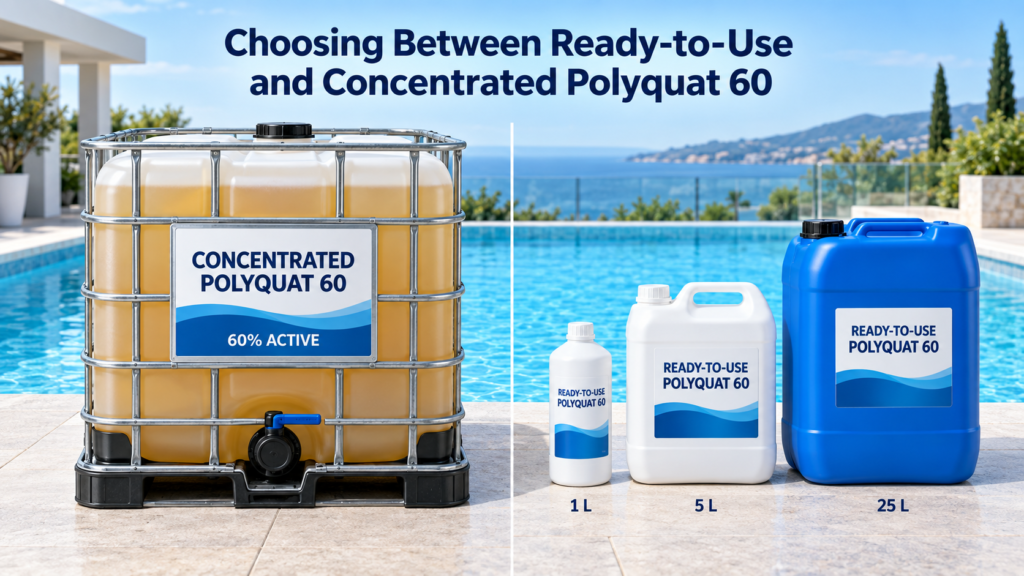
Choosing Between Ready-to-Use and Concentrated Polyquat 60
Choosing a Polyquat 60 product may sound simple. You check the active ingredient, compare prices, select a package size, and place the order.
If only it were always that easy.
One supplier may offer a 60% concentrated polymer in an IBC tote. Another may present a 10%, 20%, or 30% retail formulation in a neat one-liter bottle. Both products may be described as “Polyquat 60 algaecide,” even though they serve rather different commercial purposes.
This creates a common question for pool chemical distributors, private-label brands, wholesalers, and professional maintenance companies:
Should you buy concentrated Polyquat 60, or should you purchase a ready-to-use product?
There is no single answer that fits every buyer. Concentrated material can reduce freight per unit of active ingredient and give formulators greater flexibility. Ready-to-use products, meanwhile, simplify operations and can move from the warehouse to the customer with very little additional handling.
The right choice depends on what your business can safely and consistently manage—not merely on which drum has the lower price.
Let’s sort through the differences.
First, What Does “Polyquat 60” Actually Mean?
The name Polyquat 60 is commonly used in the swimming pool industry for a non-foaming polymeric algaecide supplied at approximately 60% active ingredient.
One widely used active ingredient is Polixetonium Chloride, identified by CAS No. 31512-74-0. It is a water-soluble cationic polymer used to help prevent and control algae in swimming pools, spas, and related water systems.
The “60” normally refers to the concentration of the commercial raw material. It does not refer to a recommended pool dose, product strength after dilution, or percentage of algae removed.
That detail is important.
Strictly speaking, a 10% or 20% finished formulation is no longer a 60% active solution. Yet commercial labels and buyer discussions sometimes continue to use “Polyquat 60” as a broad reference to the original active ingredient or formulation base.
This can cause purchasing mistakes. A buyer may compare the price of a 60% concentrate with the price of a 10% finished algaecide as though they were equivalent liquids. They are not.
Before comparing quotations, confirm:
- The chemical name of the active ingredient
- The CAS number
- The declared active concentration
- Whether the quoted percentage is based on active ingredient or supplied product
- Whether the material is a raw concentrate or a finished retail formulation
- The net weight or net volume in each package
The product name alone does not tell the whole story. The specification does.
For a closer explanation of the chemistry, see Understanding the Active Ingredient Behind Polyquat 60.
Concentrated and Ready-to-Use: The Basic Difference
A concentrated Polyquat 60 product is generally supplied as a high-active liquid for further blending, repacking, or carefully calculated direct application.
It contains more active polymer per kilogram of shipped product. Buyers may dilute it with suitable water, incorporate it into a proprietary formula, or pack it in bulk containers for professional use.
A ready-to-use Polyquat 60 algaecide is a finished or nearly finished formulation. Its active concentration has already been adjusted for a particular market, dose rate, package size, or user group.
Depending on the brand and intended application, a ready-to-use product may include:
- Polyquat active ingredient
- Treated or demineralized water
- Approved colorants
- Compatible supporting ingredients
- Market-specific labeling
- Consumer or professional directions
- Retail-ready packaging
The phrase “ready-to-use” needs a little care, though. It does not always mean that the liquid should be poured into the pool without measuring. Pool chemicals still require a dose based on water volume and conditions.
Here, ready-to-use means that the buyer does not need to formulate or dilute the product before selling or applying it according to its label.
Why Concentration Changes the Whole Commercial Calculation
Suppose Buyer A imports 1,000 kilograms of a 60% active product. Buyer B imports 1,000 kilograms of a 10% formulation.
Buyer A receives approximately 600 kilograms of active ingredient. Buyer B receives about 100 kilograms, assuming both percentages are stated on the same basis.
That is a sixfold difference in active content.
This is why price per drum or price per kilogram can be misleading. A better comparison is the cost per kilogram of active ingredient:
Cost per kilogram of active ingredient = Product cost per kilogram ÷ Active fraction
For example:
- A 60% product costing $2.40 per kilogram equals $4.00 per kilogram of active ingredient.
- A 20% product costing $1.20 per kilogram equals $6.00 per kilogram of active ingredient.
- A 10% product costing $0.80 per kilogram equals $8.00 per kilogram of active ingredient.
These figures are only examples, not market quotations. They show why a more expensive concentrate can produce a lower active-ingredient cost.
Still, the cheapest active cost does not automatically create the highest profit. Local labor, packaging, water treatment, factory controls, waste, testing, and smaller production runs all influence the final number.
A spreadsheet may favor the concentrate. Your operating conditions may tell another story.
When Concentrated Polyquat 60 Makes Sense
Concentrated material is often the stronger commercial choice for established chemical formulators, regional blenders, large distributors, and companies serving several market segments.
Its main benefit is flexibility.
A buyer can use one concentrated raw material to prepare several product strengths. A 60% concentrate, for example, might support a premium maintenance algaecide, a lower-concentration retail product, or a seasonal formulation—provided every formula has been properly developed, tested, labeled, and approved for its market.
That gives brand owners more room to design products around local expectations.
Concentrated supply can also reduce the amount of water transported across long distances. Why pay international freight for water if your facility can add controlled-quality water locally?
The potential advantages include:
- More active ingredient in each shipment
- Lower freight cost per unit of active material
- Less storage space per unit of active material
- Greater freedom to adjust finished-product concentration
- More packaging possibilities
- Support for several product lines from one raw material
- Better economics at suitable production volumes
- Greater control over the finished brand presentation
This format is particularly useful when a buyer already has mixing tanks, calibrated scales, transfer pumps, suitable water, trained operators, and basic laboratory controls.
Without those capabilities, the advantages can disappear surprisingly quickly.
Concentrate Is Not “Just Add Water”
Dilution looks easy on paper. Measure the concentrate, add water, mix, and fill the bottles. In practice, consistent manufacturing requires more discipline.
Water quality matters. Untreated water may contain hardness ions, suspended matter, metals, microorganisms, or other contaminants that affect product appearance and storage stability.
Mixing order matters too. The concentrate may be viscous, so careless addition can create local concentration differences, slow mixing, or excessive air entrainment.
Then there is batch control. If one operator measures by volume while another measures by weight, the final active content may drift. A small error repeated across several batches can lead to inconsistent performance and customer complaints.
A reliable dilution or blending process should address:
- Raw material identification
- Water quality
- Accurate weighing
- Mixing sequence
- Mixing time and speed
- Batch temperature
- Finished-product homogeneity
- Active-content verification
- pH and appearance
- Packaging compatibility
- Batch coding and traceability
- Retained samples
- Cleaning procedures
The calculation itself also deserves attention.
If a 60% concentrate is used to prepare a 10% product, a simplified mass-based calculation is:
Required concentrate = Target concentration × Final batch weight ÷ Concentrate concentration
For a 1,000 kg finished batch:
10% × 1,000 kg ÷ 60% = approximately 166.7 kg of concentrate
The remaining batch weight would consist mainly of suitable dilution water and any validated formulation ingredients.
However, that simple equation does not replace formulation testing. Commercial concentrates may have specification ranges rather than one perfectly fixed value. Density, viscosity, packaging loss, and the analytical basis used by the supplier can also affect batch calculations.
Serious buyers should formulate from the certificate of analysis and an approved batch sheet, not from the front label alone.
When Ready-to-Use Polyquat 60 Is the Better Fit
Ready-to-use products are attractive because they remove several production steps from the buyer’s operation.
A distributor can receive labeled bottles or jerrycans, inspect the shipment, place the goods in inventory, and begin selling through the appropriate channels. There is no need to install a blending line simply to introduce one algaecide.
This can be especially valuable for:
- New pool chemical brands
- Importers testing a market
- Distributors without blending equipment
- Pool service companies
- Regional wholesalers
- Seasonal businesses
- Companies with limited warehouse space
- Buyers serving small numbers of retail customers
The clearest advantage is operational simplicity.
You do not need to purchase tanks, filling equipment, caps, labels, cartons, water-treatment equipment, or laboratory instruments. You also avoid the daily work of managing batch records, cleaning containers, checking fill weights, and investigating production variation.
Ready-to-use supply can offer:
- Faster product launches
- Lower initial investment
- Predictable finished concentration
- Consistent packaging
- Reduced local chemical handling
- Easier inventory management
- Smaller starting orders
- Less production labor
- Clearer responsibility for finished-product quality
- Convenient support for private-label sales
For a young brand, these advantages can matter more than the lower theoretical cost of concentrated material.
A slightly higher unit cost may be perfectly reasonable if it prevents a large equipment purchase and gets the product into customers’ hands several months earlier.
Convenience Has a Price—But So Does Complexity
Ready-to-use products usually contain more water per unit of active ingredient. That means more weight, more containers, and sometimes more pallets must be transported to deliver the same quantity of active polymer.
Packaging also represents a larger share of the product cost.
A finished one-liter bottle may require:
- The bottle
- A compatible closure
- An induction seal or tamper-evident feature
- A printed label
- A shipping carton
- Dividers or protective materials
- Pallet wrapping
- Batch and date coding
Those components add value because they create a sellable product. They also add cost.
Concentrate shifts part of that expense and responsibility to the buyer. Ready-to-use supply keeps more of it with the manufacturer.
So the real question is not simply, “Which liquid is cheaper?”
It is this:
Where do you want the formulation, quality-control, packaging, and operational work to happen?
Once you ask that question, the decision becomes much clearer.
Freight and Storage: Concentrate Usually Has the Edge
International freight can strongly influence product economics, especially for liquid chemicals.
Because a concentrate carries more active ingredient per kilogram, it generally uses shipping capacity more efficiently. One IBC of concentrated material can support a much larger volume of diluted finished product after local processing.
That can reduce:
- Ocean freight per unit of active ingredient
- Port and handling charges per unit of active ingredient
- Warehouse area needed for raw material
- The number of inbound shipments
- Packaging waste at the importing stage
However, concentrate may require controlled storage, suitable transfer equipment, and careful handling due to its higher viscosity.
A buyer should not assume that every pump or filling system can manage it comfortably. Cold conditions may further affect flow, even when the product remains chemically stable.
Ready-to-use liquid is often easier to pour, pump, and measure. Yet it occupies more warehouse space for the same amount of active ingredient. Retail packages can also be vulnerable to cap damage, label scuffing, carton compression, and leakage during long-distance transport.
Concentrate usually wins the freight calculation. Ready-to-use material often wins the convenience calculation.
Packaging Should Follow the Customer—not Habit
The most suitable format also depends on who will use the product.
A homeowner maintaining one residential pool may prefer a one-liter bottle with clear dose instructions. A pool service technician may want a five-liter jerrycan that fits neatly inside a service vehicle. A large aquatic facility may favor a 25-liter container or bulk supply.
A formulator serving several brands may prefer IBC totes.
Typical packaging choices can include:
- 1 L bottles for retail pool care
- 5 L jerrycans for service companies and larger residential pools
- 25 L stackable jerrycans for professional users
- Drums for commercial treatment programs
- IBC totes for blending and bulk distribution
The package is part of the product experience. A low-cost container that drips down the side after every pour can damage a premium brand faster than most companies expect.
Similarly, an oversized package may discourage smaller customers, even if its price per liter looks attractive.
Eautrix supports retail-ready and bulk packaging for concentrated Polyquat 60 algaecide, including private-label formats for different buyer groups.
Which Product Creates the Better Margin?
Concentrate often offers the better theoretical gross margin because the importer adds water, packaging, labeling, and local production value.
But theoretical margin is not the same as earned margin.
Local blending introduces expenses that are easy to overlook:
- Production labor
- Equipment depreciation
- Factory rent
- Treated water
- Electricity
- Laboratory testing
- Packaging inventory
- Product loss
- Cleaning and wastewater handling
- Rejected batches
- Regulatory work
- Insurance
- Customer complaint management
Small production runs can be particularly expensive. Changing labels, cleaning equipment, and preparing a new batch may require almost as much work for 500 bottles as for 5,000.
Ready-to-use supply places more cost into the purchase price, but it also makes that cost easier to predict.
For many smaller businesses, predictable profit is more valuable than an impressive margin that exists only before overhead is counted.
A useful comparison should include landed cost, local processing cost, packaging cost, expected selling price, inventory turnover, and likely product loss.
Private Label or Local Blending?
Private-label manufacturing sits between simple distribution and full local production.
The manufacturer prepares the requested concentration, fills the approved package, applies the buyer’s branding, and ships a finished product. The buyer owns the market position without operating the production line.
This model suits companies that want:
- Their own brand
- Custom label design
- Several package sizes
- A market-specific concentration
- Consistent factory production
- Lower operational complexity
- Technical help during product development
Local blending offers more direct control and may become economical as volume grows. It also allows a buyer to react more quickly to local demand once raw material is available.
Still, control comes with responsibility. Every locally produced batch must match the registered or declared specification, where applicable. The label, SDS, directions, claims, and chemical composition must meet the requirements of the destination market.
A sensible path for a new brand is often to begin with finished private-label products, learn what customers actually buy, and consider local blending after sales volume becomes steady.
Why build an entire blending operation around a concentration the market may not want?
Product Registration and Labeling Cannot Be an Afterthought
Algaecides may be regulated differently across countries. Requirements can depend on product claims, active ingredient, concentration, application, packaging, and whether the product is sold to professional or household users.
Diluting a registered concentrate locally does not automatically make the resulting formulation compliant.
The finished product may require its own:
- Product authorization or registration
- Approved label
- Safety Data Sheet
- Technical Data Sheet
- Hazard classification
- Packaging standard
- Transport classification
- Local-language information
- Use directions
- Batch traceability
Claims matter as well. A label that says a product “controls algae” may face different regulatory treatment from one that only describes water-conditioning properties.
Before importing either format, buyers should confirm the rules with qualified local regulatory professionals. The supplier can provide documents and formulation information, but the importer remains responsible for market-entry requirements in many jurisdictions.
Quality Questions to Ask a Concentrate Supplier
Concentrated material gives the buyer flexibility, but it also makes raw-material consistency especially important.
Ask the supplier for:
- Active-content specification
- Test method
- Appearance range
- pH range
- Density
- Viscosity range
- Certificate of Analysis
- Safety Data Sheet
- Technical Data Sheet
- Shelf-life information
- Recommended storage conditions
- Batch traceability
- Packaging options
- Sample availability
- Third-party testing support
Viscosity deserves attention because it affects pumping, transfer, dilution, and filling. Two batches may meet the same active-content requirement while behaving somewhat differently on a production line if their viscosity differs substantially.
A pre-shipment sample can help the buyer test the material with local water and equipment before committing to a commercial volume.
Quality Questions to Ask for a Ready-to-Use Product
Finished products require a different set of checks.
Besides confirming the active ingredient and concentration, examine:
- Fill-weight consistency
- Bottle and closure compatibility
- Label adhesion
- Tamper evidence
- Carton strength
- Pallet arrangement
- Leakage resistance
- Finished-product stability
- Color consistency
- Batch coding
- Directions for use
- Private-label artwork control
- Shelf-life documentation
Requesting a production sample is wise. A laboratory sample in a plain bottle does not reveal how the commercial cap, label, carton, and pallet will perform during transport.
If the product will be sold under your name, small presentation details become your details. Customers rarely separate the brand from the manufacturer behind it.
A Simple Decision Guide
Concentrated Polyquat 60 may be the better choice when:
- You operate a suitable blending and filling facility.
- You have reliable quality-control procedures.
- You purchase enough volume to justify local production.
- International freight represents a major part of landed cost.
- You want to manufacture several concentrations.
- You need flexible packaging for different customer groups.
- You can manage local regulatory and labeling duties.
A ready-to-use formulation may be more suitable when:
- You are launching a new pool chemical brand.
- You want to test demand with a smaller operational commitment.
- You do not have mixing or filling equipment.
- You need retail-ready packaging.
- You prefer predictable finished-product costs.
- You want to reduce chemical handling at your facility.
- Speed to market matters more than the lowest possible active cost.
Some companies use both.
They may import retail-ready bottles for small customers while purchasing concentrate for large commercial accounts or local formulation. This mixed model can work well when sales channels have clearly different needs.
Don’t Forget the Intended Pool Program
Concentration should support the way the product will be sold and applied.
A professional operator may be comfortable measuring a high-strength product with calibrated equipment. A homeowner needs simpler instructions and a reasonable dose volume. If the required dose is extremely small, household measurement errors become more likely.
A ready-to-use formulation can make dosing more manageable by increasing the measurable volume needed for a typical pool.
Seasonal use also matters. A concentrated product may suit bulk commercial operations, while a formulated winter algaecide can offer a more targeted package for pool closing and off-season care.
Product design is not only about chemistry. It is about human behavior around the chemistry.
The easier a product is to measure, understand, store, and apply, the more likely customers are to use it correctly.
The Final Choice Comes Down to Capability
Concentrated Polyquat 60 offers efficiency, formulation freedom, and strong bulk economics. It is often the logical format for experienced chemical blenders and higher-volume distributors.
Ready-to-use Polyquat 60 offers speed, convenience, and lower operational demands. It is often the safer commercial starting point for new brands, smaller distributors, and pool service companies.
Neither format is universally better.
The better product is the one your company can import, store, handle, document, sell, and support consistently.
That last word matters: consistently.
A beautifully calculated concentrate is not a bargain if batch strength varies after local dilution. A finished retail bottle is not convenient if packaging costs leave no room for distributor margin. Every advantage depends on the surrounding business system.
Compare the active ingredient. Calculate the real landed cost. Consider your equipment, staff, customer type, sales volume, and regulatory duties. Then select the format that supports the business you actually operate—not the business you might build someday.
Frequently Asked Questions
1. Is ready-to-use Polyquat 60 the same as 60% concentrated Polyquat 60?
Not usually. Concentrated Polyquat 60 generally contains approximately 60% active polymer, while a ready-to-use algaecide may contain a lower concentration that has already been prepared for sale or application. Always confirm the active percentage on the specification and label.
2. Can a 60% Polyquat concentrate be applied directly to a swimming pool?
It may be used only at a correctly calculated dose and according to the supplier’s directions, local regulations, and approved product label. High-strength material is easy to overdose, so professional measuring and good distribution are essential. Consumer products are often diluted to make routine dosing easier.
3. Is concentrated Polyquat 60 cheaper than a finished algaecide?
It often has a lower freight and purchasing cost per kilogram of active ingredient. However, the buyer must also count dilution, labor, equipment, testing, packaging, regulatory work, and production loss. Ready-to-use supply may have a higher unit price but a lower operational burden.
4. What water should be used when diluting Polyquat 60 concentrate?
Use water that meets the validated formulation requirements. Depending on the formula, treated, softened, deionized, or demineralized water may be preferred. Test the finished product for active content, pH, appearance, stability, and packaging compatibility before commercial production.
5. Which Polyquat 60 format is better for a private-label pool chemical brand?
A ready-to-use private-label formulation is often practical for a new brand because it shortens launch time and avoids local production investment. Concentrated Polyquat 60 becomes more attractive when demand is steady and the company has suitable blending, testing, filling, and regulatory capabilities.