
GET IN TOUCH
Ask For Sample?
Why Non-Foaming Algaecides Are More Valuable in Premium Pool Markets?
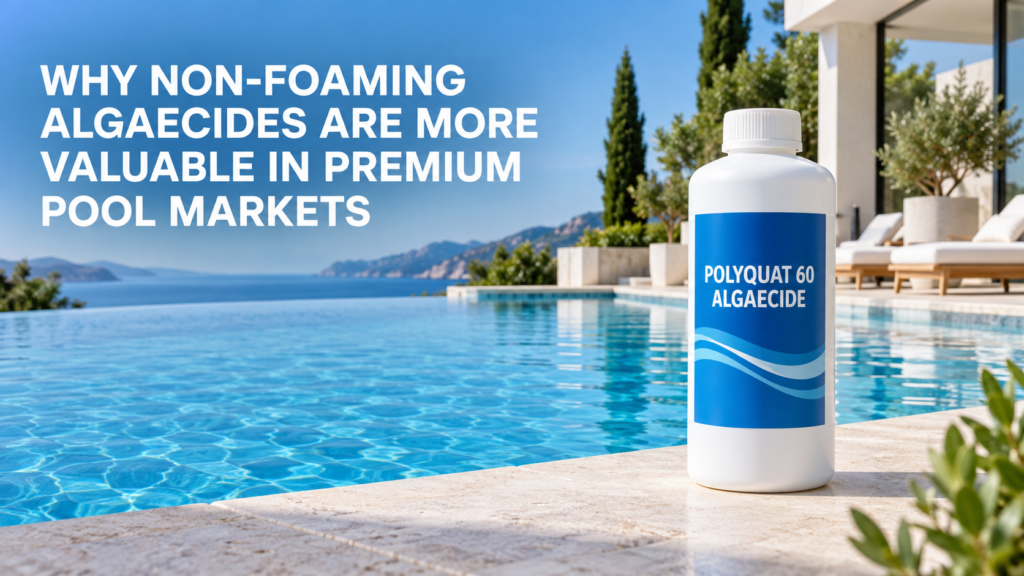
A luxury swimming pool is judged long before anyone tests its chlorine level.
Guests notice the color of the water. They notice whether the surface looks calm, clean, and inviting. They notice the shine of the tiles, the absence of odors, and—perhaps more than pool operators would like—the smallest patch of foam gathering beside a return jet.
That foam may not always represent a serious water-quality problem. Yet appearance shapes perception. In a premium hotel, private club, high-end villa, wellness center, or luxury residential property, perception carries real financial weight.
Customers paying for a premium experience do not want water that looks as though someone poured dishwashing liquid into it. Even a thin layer of bubbles can raise uncomfortable questions:
“Is the water dirty?”
“Was too much chemical added?”
“Is it safe to swim?”
Those questions reveal why a non-foaming pool algaecide offers more than technical convenience. It protects the appearance of the pool, the confidence of swimmers, the reputation of the service provider, and the value of the chemical brand behind the treatment.
Put simply, algae control is essential—but in a premium pool, how that control is achieved matters too.
Premium Pools Sell an Experience, Not Just Clean Water
Every swimming pool needs sanitation, circulation, filtration, and balanced water. Premium pools require all of those things, plus something less measurable: visual perfection.
Think about the photographs used to market a five-star resort. The pool water is smooth, blue, and nearly glasslike. Sunlight moves across the floor in sharp, clean patterns. There is no floating residue, no dull haze, and certainly no ring of chemical foam around the steps.
The pool is part of the property’s identity.
This is true across several premium market segments:
- Luxury hotels and resorts
- Private villas and high-value residential properties
- Wellness centers and hydrotherapy facilities
- Exclusive health clubs
- Rooftop pools
- Infinity pools
- Designer pools with waterfalls or fountains
- High-end spas and hot tubs
- Cruise, yacht, and marine leisure facilities
- Competition and training facilities with strict presentation standards
In these settings, the maintenance team cannot focus only on whether an algaecide controls algae. The team must also consider how the product behaves when pumps, jets, fountains, and swimmers agitate the water.
A treatment may work against algae and still create a visible problem. That is the awkward truth.
Why Do Some Pool Algaecides Cause Foam?
Many conventional algaecides are based on quaternary ammonium compounds, commonly called “quats.” These positively charged compounds can interact with algae cell surfaces and interfere with cell function.
However, some low-molecular-weight quats also behave like surfactants.
A surfactant reduces the surface tension of water. This allows air bubbles to form more easily and remain stable for longer. When water passes through return jets, spa nozzles, waterfalls, or other high-agitation equipment, those bubbles can collect at the surface as visible foam.
The effect may become more noticeable when:
- The algaecide is overdosed
- Water circulation is highly turbulent
- A pool has attached spa jets
- The water contains body oils or cosmetics
- Detergent residue enters through swimsuits or cleaning equipment
- Dissolved organic material has accumulated
- Several chemical products interact in the water
- The pool has limited water replacement
Foaming does not automatically mean the algaecide has failed. In fact, algae may be well controlled. The difficulty is that swimmers rarely judge chemical treatment through laboratory data. They judge what they see.
And what they see is foam.
Non-Foaming Does Not Mean “Removes Every Kind of Foam”
There is an important distinction here.
A non-foaming algaecide is formulated to avoid becoming a major source of foam under normal use. It is not a universal defoamer, nor can it remove every bubble created by contaminants already present in the pool.
Foam may also result from:
- Shampoo or soap residue on swimmers
- Laundry detergent remaining in swimsuits
- Sunscreen, lotion, and body oils
- High levels of dissolved organic compounds
- Poor filtration
- Improper water balance
- Certain cleaning products entering the water
- Excessive chemical dosing
Using a non-foaming algaecide removes one potential contributor from the equation. It helps maintenance teams diagnose other foam sources without wondering whether the algae treatment itself caused the problem.
That clarity has practical value. When several variables are involved, eliminating one predictable source of trouble makes water management far easier.
The Water Looks Better—and That Matters More Than It Sounds
A clear, foam-free surface reflects light cleanly. It allows swimmers to see the floor and gives the water the polished appearance associated with professional care.
Foam does the opposite.
It breaks up reflections, collects around edges, and can trap fine debris. Around steps, corners, skimmers, and vanishing edges, a small amount may become highly visible. White bubbles against blue water are hard to ignore.
In a residential pool, an owner may find this annoying. In a premium commercial property, it can become a guest-experience issue.
Imagine a wedding venue preparing for an evening event. The lighting is perfect. The landscaping has been checked. The pool should serve as the visual centerpiece—then foam begins collecting below the waterfall.
The maintenance team may need to investigate, adjust circulation, check the dose, skim the surface, or partially replace the water. Even if the issue is resolved, staff time has been lost at exactly the wrong moment.
A non-foaming treatment reduces this avoidable uncertainty.
High-Agitation Pools Expose Weak Formulas Quickly
Not all pools place the same physical demands on an algaecide.
A simple residential pool with gentle circulation may show little visible foam after a conventional quat treatment. Move the same product into a spa, fountain pool, or resort water feature, however, and its behavior can change dramatically.
High-agitation systems continuously mix air with water. Common examples include:
- Massage jets
- Aerators
- Counter-current swimming systems
- Cascades and waterfalls
- Deck jets
- Laminar fountains
- Bubblers
- Infinity edges
- Splash features
- Rapid circulation systems
These features are common in premium pool design because they make the water more engaging and visually impressive. Ironically, they can also magnify the foaming tendency of a poorly suited chemical.
A formula that appears acceptable in still water may produce persistent bubbles once it reaches an attached spa or waterfall. For that reason, non-foaming performance is especially valuable in pools where water movement forms part of the design.
Swimmer Confidence Is a Commercial Asset
Pool professionals understand that foam can have several causes. Most guests do not.
To a swimmer, foam may suggest contamination, excessive chemicals, or inadequate maintenance. The assumption may be technically wrong, but it still affects behavior.
A hotel guest who distrusts the water may avoid the pool. A homeowner may call the service company. A club member may complain to management. A property manager may question the chemical supplier.
Once doubt enters the conversation, staff must spend time explaining what happened. Even a harmless visual issue can weaken confidence in the entire treatment program.
Premium service depends heavily on reassurance. Customers want to feel that the water is being managed carefully, consistently, and professionally. A foam-free surface quietly supports that confidence.
No explanation is needed. The pool simply looks right.
Fewer Complaints Mean Lower Service Costs
The price of an algaecide is only one part of its actual cost.
Consider what happens after a foaming complaint:
- A pool owner contacts the service company.
- A technician reviews recent chemical additions.
- Water chemistry is tested.
- Equipment and circulation are inspected.
- The technician may revisit the property.
- Treatment may be adjusted or water replaced.
- The service company explains the issue to the customer.
- Confidence must be rebuilt.
The chemical itself may have been inexpensive. The service response is not.
Travel time, technician labor, water replacement, additional testing, and customer support can quickly exceed the savings gained from buying a lower-cost product. For distributors, repeated complaints may also lead to returns, credit requests, or lost accounts.
This is where premium chemistry earns its price.
A reliable non-foaming formula helps reduce the chance that routine algae prevention will generate a new maintenance problem. It will not eliminate every service call, naturally, but it removes a familiar and avoidable one.
Non-Foaming Performance Protects the Service Company’s Reputation
Pool service companies sell trust.
Customers rarely observe every measurement, brush stroke, or filtration adjustment. They see the final result. If the water stays clear and attractive, the service appears professional. If foam suddenly develops after a technician’s visit, the treatment itself may be blamed.
That can be frustrating because the pool may be sanitary and algae-free. Still, visual results influence customer judgment.
A non-foaming algaecide supports service consistency in several ways:
- It reduces treatment-related surface foam
- It performs more comfortably in pools with jets and water features
- It lowers the chance of customers interpreting bubbles as overdosing
- It makes routine preventive treatment less visually disruptive
- It supports a cleaner “before and after” result
- It reduces the need to explain a known side effect
For a company maintaining dozens or hundreds of pools, small reductions in complaints can add up. Fewer return visits create more room in the schedule, while reliable results make contracts easier to retain.
That is not glamorous chemistry. It is good business.
Premium Pool Owners Often Prefer Quiet Performance
The most valuable pool chemical is not always the one that creates the most dramatic visible reaction.
Sometimes the opposite is true.
Premium customers often want treatment to remain almost invisible. They want the water to stay clear without strong odors, staining, discoloration, persistent foam, or complicated corrections.
A non-foaming algaecide fits this expectation. When used correctly, it works in the background as part of a wider maintenance program.
There is no theatrical bubbling. No detergent-like surface. No awkward conversation beside the pool.
The treatment does its job and leaves the experience alone.
Why Polyquat 60 Is Commonly Associated with Premium Algae Control
Polyquat 60 is a concentrated polymeric quaternary ammonium algaecide. Many formulations in this category are based on Polixetonium Chloride, a water-soluble cationic polymer used for algae prevention and control.
Unlike conventional low-molecular-weight quats, the polymer structure of Polyquat 60 gives it low-foaming or non-foaming behavior when the product is properly formulated and applied.
Its positive charges allow the polymer to interact with negatively charged algae cell surfaces. This disrupts normal cell function and helps prevent algae from multiplying. It works as a supplemental algaecide rather than replacing an approved primary sanitizer.
The commercial appeal goes beyond foam control. A well-designed Polyquat 60 formulation may also provide:
- Metal-free algae control
- No introduction of copper ions
- Low risk of metal-related pool staining
- Compatibility with common chlorine or bromine programs
- Suitability for routine and seasonal maintenance
- Concentrated active content
- Easy liquid dosing
- Use in residential and commercial pools
- Good performance in systems with water movement
Eautrix offers Polyquat 60 Algaecide for pool chemical brands, distributors, and professional water-treatment programs seeking concentrated, non-foaming algae control.
The product should always be used according to its approved label, local regulatory requirements, and the conditions of the particular pool.
Metal-Free and Non-Foaming: Two Different Advantages
“Non-foaming” and “metal-free” are sometimes grouped together in marketing material. They describe different product benefits.
Non-foaming performance relates to the behavior of the treatment at the air-water interface, especially when the pool water is agitated.
Metal-free performance means the algaecide does not depend on copper or another metal as its algae-control component.
Why does that difference matter?
Copper-based treatments can be effective, but copper levels require careful control. Under unfavorable water conditions, dissolved copper may contribute to stains on pool finishes or discoloration of light-colored hair.
A polymeric algaecide does not add copper. This can be especially attractive for:
- White plaster pools
- Light-colored grout
- Decorative tile
- Natural-looking premium finishes
- Properties concerned about hair discoloration
- Pool programs seeking to limit metal accumulation
For premium markets, combining non-foaming behavior with metal-free algae control creates a stronger value proposition. The formula addresses two visible concerns at once: surface foam and metal-related discoloration.
Non-Foaming Formulas Work Better with Premium Pool Design
Modern premium pools are rarely plain rectangles with one return line.
They may combine a swimming area, spa section, shallow sun shelf, infinity edge, and decorative water wall in a single hydraulic system. This design creates an impressive experience, but it also increases chemical complexity.
Water may move quickly between sections. Air may enter through jets. Evaporation can concentrate dissolved substances. Guests may introduce sunscreen and body-care products. A chemical with even moderate foaming potential may become much more noticeable under these conditions.
Non-foaming algaecides fit such systems because they are less likely to compete with the visual design.
This point matters to architects, builders, and facility managers—not just chemical technicians. A premium water feature should look like water, not a bubble bath.
There Is Also a Strong Private-Label Advantage
For pool chemical brands, non-foaming performance is easy for customers to understand.
Highly technical claims often require long explanations. “Helps control algae without creating foam” is direct. A pool owner can see the benefit.
This makes non-foaming algaecides attractive for premium private-label ranges. The feature can support several market messages:
- Suitable for pools with attached spas
- Designed for fountains and water features
- Helps maintain a clean water surface
- Metal-free algae prevention
- Professional-strength polymer formula
- Suitable for high-value pool finishes
- Designed for routine premium pool care
The claim must, of course, match the actual formulation and local labeling rules. Packaging cannot rescue inconsistent chemistry.
A private-label supplier should therefore control the active ingredient, concentration, viscosity, appearance, pH, packaging compatibility, and production consistency. If one batch behaves differently from the next, the brand owner will carry the reputational risk.
For companies developing a specialized pool-care line, non-foaming algae control can become a meaningful point of distinction rather than just another sentence on the back label.
Distributors Benefit from a Product That Is Easier to Recommend
Distributors serve many types of customers: homeowners, retailers, technicians, builders, hotels, and commercial facility managers.
A product that works only in quiet residential pools requires careful qualification. A non-foaming polymeric formula can cover a broader set of applications, particularly where water agitation is involved.
That makes the sales conversation easier:
“Does the pool have spa jets?”
“Yes.”
“Then use a non-foaming polymer algaecide and follow the labeled dose.”
Straightforward recommendations reduce confusion at the counter and help distributors build a cleaner product range. They may also reduce complaints caused by customers using a foaming quat in a high-agitation system.
Still, distributors should avoid presenting any algaecide as a substitute for sanitation. Algaecide supports algae management; it does not replace proper disinfectant residuals, circulation, filtration, brushing, or water balance.
A Better Product Still Needs Correct Dosing
Non-foaming does not mean “dose as much as you like.”
Every pool treatment should be measured according to the product label and actual pool volume. Excess chemical may waste money, affect water quality, or interact with other treatment components.
Before adding an algaecide, operators should normally review:
- Pool volume
- Sanitizer level
- pH
- Circulation condition
- Visible algae severity
- Recent shock treatment
- Other chemicals recently added
- Product concentration
- Label directions
- Local regulations
The treatment should be distributed into circulating water as directed. Concentrated liquid should not be allowed to sit on one pool surface unless the label specifically permits that application method.
If the pool has an active algae bloom, physical cleaning and sanitizer correction may also be necessary. Algaecide is most valuable when it supports a complete program rather than being asked to compensate for poor circulation or neglected sanitation.
What If the Pool Is Already Foaming?
Start by identifying the source.
Do not automatically add another chemical. Test the water, review treatment records, and inspect recent changes. Ask whether swimsuits were washed with detergent, whether a cleaning product entered the water, or whether an algaecide was overdosed.
Depending on the cause, corrective steps may include:
- Stopping the foaming chemical source
- Cleaning skimmers and filters
- Improving filtration
- Removing surface contaminants
- Correcting water balance
- Partially replacing the water
- Addressing excessive dissolved organic material
- Allowing the existing product to break down
- Changing the future maintenance formula
Moving to a non-foaming algaecide may prevent the same product-related issue from returning. It will not instantly cure foam produced by contaminants already present.
Clear Water Needs More Than One Product
A premium pool program works as a system.
Sanitizer controls harmful microorganisms. The filter removes suspended material. Circulation distributes treatment. Brushing disrupts biofilm and reaches areas with weak flow. Algaecide provides added protection against algae.
When tiny suspended particles make the water look dull, a Polymer Pool Clarifier can help bind fine material into larger aggregates that the filtration system can capture more easily.
Seasonal pools have another challenge. Months of limited circulation can give algae time to become established. A Winter Algaecide can support off-season algae prevention and help make spring opening less troublesome when it is used as part of a complete closing procedure.
Each product has a defined role. Combining those roles thoughtfully produces a more reliable result than simply adding more of one chemical.
How Buyers Should Evaluate a Non-Foaming Algaecide Supplier
The phrase “non-foaming” is important, but professional buyers need more than a front-label claim.
Ask the supplier for product specifications and supporting documents. Depending on the market and intended use, the review may cover:
- Active ingredient identity
- Active concentration
- Product appearance
- pH range
- Density
- Viscosity
- Batch consistency
- Storage stability
- Packaging compatibility
- Certificate of Analysis
- Safety Data Sheet
- Regulatory status in the destination market
- Recommended application range
- Private-label and packaging capabilities
Foaming performance should be evaluated under realistic conditions. Still-water observation alone may not represent what happens in a spa, fountain, or high-flow commercial system.
Trial batches can be tested under controlled agitation and compared at equal use concentrations. Buyers should also look for changes after storage, dilution, temperature cycling, and contact with typical pool-water conditions.
The goal is not to find a liquid that merely carries the right product name. It is to build a formulation that behaves consistently from the factory drum to the customer’s pool.
Why the Higher Purchase Price Can Make Economic Sense
Non-foaming polymeric algaecides often cost more per kilogram or per bottle than basic quat products. Looking only at the purchase price can therefore make the premium product appear less attractive.
That comparison is incomplete.
A more useful calculation includes:
- Active concentration
- Dose per pool
- Frequency of treatment
- Risk of foaming complaints
- Technician call-backs
- Water replacement costs
- Product returns
- Customer retention
- Suitability for premium applications
- Brand positioning
- Packaging and freight efficiency
A concentrated formula may treat more water per container. A product that produces fewer complaints may lower support costs. A formula suitable for spas and decorative water features may also address a more valuable customer segment.
The lowest-priced product is not always the lowest-cost treatment. Pool professionals learn this quickly—usually after one inconvenient Saturday service call.
Premium Value Comes from Problems the Customer Never Sees
The clearest sign of a successful pool treatment program is often the absence of drama.
No green walls. No cloudy water. No stained finish. No persistent foam. No nervous guest asking whether the pool is safe.
A non-foaming algaecide contributes to that quiet reliability. It controls a biological problem without introducing an obvious visual distraction. In premium pool markets, that is a meaningful advantage.
The value reaches beyond chemistry:
- Swimmers feel more confident
- Pool surfaces look cleaner
- Water features remain visually appealing
- Service companies face fewer avoidable complaints
- Distributors can recommend the product across more pool types
- Private-label brands gain a clear premium selling point
- Property managers protect the experience their facilities promise
Premium customers are not paying only for algae-free water. They are paying for water that looks effortless.
Non-foaming algae control helps deliver exactly that.
Frequently Asked Questions
1. Why are non-foaming algaecides recommended for luxury swimming pools?
Non-foaming algaecides help preserve a clean, polished water surface. This is especially valuable in luxury hotels, villas, clubs, and wellness facilities where pool appearance directly affects the guest experience.
2. Can a non-foaming pool algaecide stop existing foam?
Not necessarily. It avoids adding a major chemical source of foam, but existing foam may come from detergents, cosmetics, body oils, dissolved organic material, or another pool product. The underlying source must still be identified and corrected.
3. Is Polyquat 60 suitable for pools with spas and water features?
Polyquat 60 is commonly chosen for pools with attached spas, jets, waterfalls, and fountains because properly formulated products have low-foaming or non-foaming behavior. Users must still follow the approved product label and recommended dose.
4. Does a non-foaming algaecide replace chlorine?
No. A non-foaming algaecide provides supplemental algae prevention or control. It does not replace an approved primary sanitizer, proper filtration, circulation, brushing, or balanced pool water.
5. What should private-label brands check when sourcing a premium non-foaming algaecide?
Brands should verify the active ingredient, concentration, pH, viscosity, appearance, batch consistency, stability, packaging compatibility, safety documentation, and destination-market regulatory requirements. A production sample should also be tested under realistic water agitation.