
GET IN TOUCH
Ask For Sample?
Creating Premium Pool Chemical Products with Polyquat 60
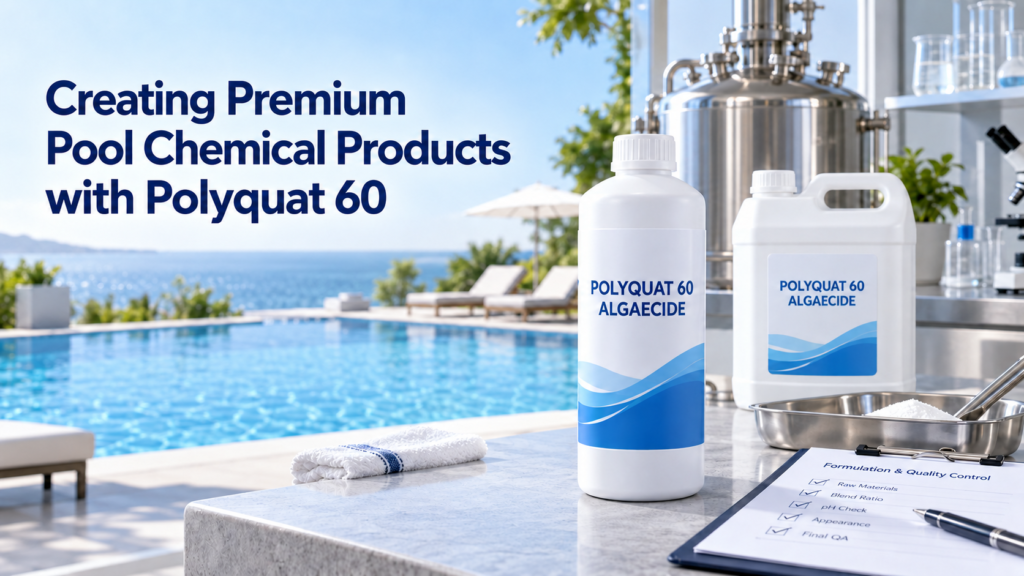
A premium pool chemical is not defined by a glossy bottle alone.
It must work reliably, remain stable on the shelf, pour cleanly, carry clear instructions, and fit naturally into the customer’s maintenance routine. If any one of those pieces fails, the product can quickly lose its premium image—no matter how attractive the label looks.
This is where Polyquat 60 offers an interesting foundation for pool chemical manufacturers and private-label brands.
Polyquat 60 is a concentrated, water-soluble polymeric algaecide. It is widely valued for preventive algae control, low-foaming performance, and the absence of copper or other staining metals. These characteristics make it suitable for residential pools, commercial facilities, service companies, seasonal closing products, and professional maintenance programs.
Still, buying a drum of Polyquat 60 and filling smaller bottles does not automatically create a premium finished product. Real value comes from the decisions made around the active ingredient: concentration, formulation, testing, packaging, instructions, regulatory compliance, and brand positioning.
So, how do you turn a functional algaecide into a product that distributors want to stock and pool owners trust? Let’s break it down.
Premium Starts with a Clearly Defined Product
The word “premium” gets printed on plenty of labels. Sometimes it means something. Sometimes it is just decoration.
For a pool chemical, premium quality should be visible in measurable ways:
- Consistent active ingredient concentration
- Reliable batch-to-batch appearance
- Suitable viscosity for pouring and dosing
- Stable pH during storage
- Low-foaming performance
- Clear and accurate application instructions
- Packaging that survives transport and warehouse handling
- Technical documents that match the supplied product
- Claims supported by formulation data and local registration
Customers may not inspect every production record, but they notice the results. They notice if one bottle is almost colorless while the next one is dark yellow. They notice if a cap leaks, if the liquid is difficult to measure, or if the label gives confusing doses for different pool sizes.
That is the quiet truth of premium manufacturing: consistency creates confidence.
The finished product should also have a clearly defined role. Is it a concentrated professional algaecide? A weekly maintenance treatment? A pool-closing product? A combined algaecide and clarifier? Trying to make one formula sound like it solves every water problem usually weakens the message.
A focused product is easier to formulate, explain, sell, and use correctly.
Why Polyquat 60 Works Well in Premium Product Lines
Polyquat 60 belongs to the family of cationic polymers. Its positively charged polymer structure interacts with negatively charged biological surfaces and suspended material in pool water. In an appropriately formulated and legally registered algaecide, this chemistry helps prevent or control algae.
Unlike copper-based treatments, Polyquat 60 does not depend on metal ions for its algae-control function. That gives manufacturers a valuable marketing and technical distinction: the formula can provide algae protection without intentionally adding copper to the pool.
This matters because poorly managed copper levels may contribute to surface discoloration or hair staining. A metal-free Polyquat 60 formulation avoids introducing that particular source of trouble.
Polyquat 60 is also generally described as non-foaming or low-foaming when it is formulated and used correctly. That makes it attractive for pools with return jets, water features, fountains, spas, and other areas where strong circulation can make foam highly visible.
Other commercially useful characteristics include:
- Water solubility
- Suitability for concentrated liquid products
- Compatibility with many common pool maintenance programs
- Application in both residential and commercial settings
- Use in routine maintenance and seasonal pool closing
- Flexible private-label packaging possibilities
There is an important boundary, though. Polyquat 60 should support a complete pool maintenance program; it should not be presented as a replacement for proper sanitation, filtration, circulation, brushing, or water balance.
The US Centers for Disease Control and Prevention identifies disinfectant concentration and pH as the first defense against germs in recreational water. Its residential guidance recommends regularly testing both values and maintaining pool pH between 7.0 and 7.8. An algaecide can strengthen algae management, but it does not replace the primary sanitizer required for safe pool operation.
That distinction protects swimmers, supports honest marketing, and helps the brand earn long-term trust.
First, Confirm What “Polyquat 60” Means in Your Formula
Here is a detail that deserves more attention than it usually receives: “Polyquat 60” can be used as a commercial description, but a commercial name alone is not enough for technical documentation.
The manufacturer must confirm the exact chemical identity of the active ingredient, including:
- Chemical name
- CAS number
- Active concentration
- Manufacturing specification
- Regulatory status in the target market
- Intended product claims
- Safety and handling classification
For a typical Polyquat 60 pool algaecide, the active ingredient may be identified as poly[oxyethylene(dimethyliminio)ethylene(dimethyliminio)ethylene dichloride], commonly associated with CAS No. 31512-74-0. However, other cationic polymers may also be promoted in the market using similar shorthand descriptions.
Never assume two materials are interchangeable simply because both are called “polyquat.”
The chemical name and CAS number on the technical data sheet, safety data sheet, label, certificate of analysis, and registration file should refer to the same substance. If those documents disagree, the product has a credibility problem before it even reaches the pool.
This is especially important for exporters. A familiar commercial name in one country may not satisfy customs, transport, pesticide, or labeling requirements in another country.
Decide Whether You Are Selling Concentrate or Convenience
One of the first formulation decisions is concentration.
A 60% active raw material can be sold as a concentrated professional product, used as the base for a lower-strength maintenance algaecide, or incorporated into a seasonal formula. Each format serves a different customer.
A concentrated product may appeal to:
- Pool service companies
- Commercial pool operators
- Regional chemical distributors
- Professional maintenance contractors
- Buyers who want lower freight cost per unit of active ingredient
A ready-to-use or diluted product may be easier for:
- Residential pool owners
- Retail stores
- E-commerce customers
- First-time pool chemical users
- Markets where simple dosing is a major sales advantage
Neither format is automatically more premium.
A strong concentrate feels premium when it offers measurable value, efficient shipping, controlled dosing, and professional documentation. A ready-to-use product feels premium when it reduces calculation errors and makes routine treatment pleasantly simple.
The customer’s experience should guide the format.
Imagine two pool owners standing beside the same 50,000-liter pool. One maintains several commercial properties and uses a graduated dosing container every day. The other simply wants the backyard pool to stay clear through a hot weekend. Giving both customers the same bottle and instructions may be convenient for the manufacturer, but it is not especially thoughtful.
Premium products are designed around real use, not only production efficiency.
Build a Product Family, Not Just a Single Bottle
Polyquat 60 can support several positions within a broader pool chemical range. This creates room for multiple price points, seasonal campaigns, and distribution channels.
A carefully planned family might include:
- A concentrated Polyquat 60 professional algaecide
- A diluted weekly maintenance algaecide
- A pool-opening algae-control treatment
- A long-term winterization product
- A service-company bulk format
- A private-label retail bottle
- A complementary pool clarifier
The formulas do not need to be identical. In fact, they should not be identical if they promise different benefits or require different doses.
The concentrated Polyquat 60 Algaecide, for example, can serve as the central algae-control product. A lower-concentration maintenance formula may be positioned around convenient weekly care, while a dedicated Winter Algaecide can address the longer treatment period associated with pool closing.
When cloudiness rather than algae is the main concern, a separate Polymer Pool Clarifier gives the brand a more precise answer. Algaecides and clarifiers may both involve cationic polymer chemistry, but they are designed for different primary jobs.
That distinction makes the product range easier to understand. It also creates natural cross-selling opportunities without forcing exaggerated claims onto a single formula.
Formulation Is More Than Adding Water
Diluting Polyquat 60 may appear straightforward. Measure the concentrate, add water, mix, and fill. In production, however, the details decide whether the finished liquid stays consistent.
Water quality is one of the first variables to control. Minerals, suspended solids, microorganisms, and extreme pH can affect appearance, stability, or long-term quality. The required water standard should therefore be defined during product development instead of left to whichever water source happens to be available.
Mixing order also matters.
A manufacturer should establish a written process covering:
- Inspection of the raw material before use
- Water quality requirements
- Addition sequence
- Mixing speed
- Mixing time
- Temperature range
- Resting or deaeration time
- In-process sampling
- Filtration requirements, if any
- Filling temperature and fill weight
Overly aggressive mixing can trap air in a viscous polymer solution. The product may then appear cloudy or foamy during filling, even if its chemical quality is acceptable. Air can also interfere with volumetric filling accuracy.
On the other hand, inadequate mixing can create concentration differences between the top and bottom of the vessel.
The process should be strong enough to produce uniformity without treating the polymer like cake batter at full mixer speed. Gentle, controlled mixing often works better than brute force.
Any added dye, fragrance, stabilizer, clarifying component, or secondary functional ingredient must be assessed for compatibility. A cationic polymer can interact with negatively charged ingredients. What looks stable on the first day may form haze, sediment, or stringy material after several weeks.
Small laboratory trials, followed by pilot production and stability observation, are far less expensive than discovering incompatibility after thousands of bottles have entered distribution.
Batch Consistency Is Where Premium Claims Are Proven
A quality specification gives the manufacturing team a clear pass-or-fail standard. It also gives commercial buyers something more useful than a vague promise of “high quality.”
Depending on the formula and concentration, the finished product specification may include:
- Appearance
- Color
- Odor
- Active ingredient content
- pH
- Density or specific gravity
- Viscosity
- Water solubility or dispersibility
- Microbiological quality, where relevant
- Packaging integrity
- Net content
- Storage stability
Not every parameter must appear on a customer-facing certificate, but every meaningful parameter should have a reason for being tested.
Active concentration deserves particular attention. A diluted maintenance algaecide cannot be judged only by appearance. Two clear blue liquids may contain very different amounts of active polymer.
Raw material traceability is equally important. Each finished batch should be linked to the raw material lot, production date, production vessel, inspection results, filling record, and packaging lot where practical.
If a customer reports an issue six months later, the supplier should be able to investigate that exact batch. “We think it was produced sometime in spring” is not a premium quality system.
A representative retained sample from each batch can also support complaint investigation and shelf-life monitoring.
Stability Testing Protects the Brand After Shipment
A product can look perfect when it leaves the factory and still fail after several months in a warehouse.
Pool chemicals may face hot shipping containers, cold regional storage, repeated temperature changes, direct sunlight in shop windows, and long periods of inactivity. Those conditions can affect color, viscosity, odor, package shape, closure performance, and label adhesion.
A stability program may examine:
- Room-temperature storage
- Elevated-temperature storage
- Low-temperature exposure
- Freeze-thaw cycles where relevant
- Light exposure
- Package compatibility
- Color change
- Sediment or phase separation
- pH drift
- Viscosity change
- Active ingredient retention
Accelerated stability testing can reveal weaknesses sooner, but it does not always predict every long-term storage behavior. Real-time samples still matter.
The container and formulation should be tested together. A stable liquid inside an incompatible bottle is not a stable commercial product.
Cap liners, induction seals, bottle resin, colorants, label adhesives, and printing inks can all behave differently around chemical products. Even the shoulder shape of the bottle can affect pouring and residue.
It sounds rather ordinary, doesn’t it? Yet these ordinary details decide whether the customer receives a clean bottle or a sticky carton.
Packaging Should Make the Product Easier to Trust
Pool chemical packaging has several jobs at once. It protects the contents, communicates the product’s purpose, helps the customer dose correctly, and represents the brand.
Common formats include:
- 1-liter retail bottles
- 5-liter jerrycans
- 25-liter commercial containers
- Larger drums for qualified industrial or professional buyers
- Bulk supply for local blending and filling
The right format depends on concentration, local buying habits, freight economics, and regulatory requirements.
A premium bottle should feel secure in the hand. The closure should resist leakage during normal transport, and the label should remain readable if a small amount of water reaches the surface.
Useful label information may include:
- Product name
- Product function
- Active ingredient statement
- Net contents
- Directions for use
- Dose table
- Precautionary language
- First-aid information where required
- Storage and disposal instructions
- Batch number
- Production or expiration information
- Manufacturer or responsible company details
- Registration number where required
Dose instructions should be written for the target market. If customers measure pools in gallons, instructions given only in cubic meters create needless friction. If the product is sold in several countries, separate labels may be safer and clearer than crowding five languages onto one small panel.
A good dose table should also distinguish routine maintenance from initial, corrective, or seasonal treatment—provided those uses are supported by the approved formula and label.
Attractive Claims Must Still Be Defensible
Marketing teams naturally want strong claims:
“Controls every type of algae.”
“Safe for all pools.”
“Works with every sanitizer.”
“Completely harmless.”
Those statements may look persuasive, but absolute promises are risky. Performance depends on the formulation, dose, water condition, algae pressure, circulation, sanitation, and application method.
More responsible wording might include:
- Helps prevent and control common pool algae
- Non-metallic formula
- Non-foaming when used as directed
- Suitable for routine pool maintenance
- Supports clean, clear pool water
- Compatible with many standard pool treatment programs
- Suitable for residential and commercial applications
- Available for seasonal pool closing formulations
Even these claims should match actual evidence and local regulations.
In the United States, a product that claims to prevent, destroy, repel, or mitigate algae may fall under pesticide regulation. The formula, facility, label, and distribution route may therefore require EPA and state-level compliance. Similar principles apply in other countries, although the responsible authorities and approval processes differ.
The label is not merely advertising. For a regulated algaecide, it is part of the legal conditions governing how the product may be sold and used.
A manufacturer planning private-label production should review the destination market before printing packaging. Regulatory work completed for one brand, concentration, or country may not automatically cover another.
Private Label Does Not Have to Mean Generic
Some buyers worry that private-label products will look and feel like the same formula wearing different clothes. That can happen, but it is not inevitable.
A private-label Polyquat 60 program can be differentiated through:
- Active concentration
- Intended treatment program
- Bottle size and shape
- Cap and tamper-evident system
- Label design
- Dose presentation
- Language options
- Carton configuration
- Technical support
- Product documentation
- Minimum order quantity
- Complementary products in the range
The strongest differentiation usually combines product quality with customer experience.
For instance, a service-company formula might include a dosing chart for several standard pool volumes, durable packaging for vehicle transport, and larger pack sizes. A retail formula might use simpler instructions, a controlled-pour opening, and a QR code linking to a short application guide.
The liquid inside the bottle matters most—but the way people store, measure, understand, and reorder it matters too.
Technical Documents Are Part of the Product
Commercial buyers often judge a supplier before they test the first sample.
They may request a technical data sheet, safety data sheet, certificate of analysis, product label, packing details, shelf-life statement, and regulatory information. Slow or inconsistent answers create doubt, even when the physical product is sound.
A professional document package should be prepared for the exact product being offered.
The safety data sheet should not be borrowed from a different concentration. The certificate of analysis should reflect the supplied batch. The technical data sheet should not make claims missing from the approved product label.
Product photographs should also match the actual packaging. A polished image showing a one-liter bottle is not very helpful if the minimum shipment is only available in 25-liter containers.
Small inconsistencies accumulate. So does trust.
Consider the Distributor’s Business, Not Only the Formula
Distributors evaluate more than chemical performance. They also think about warehouse space, shipping damage, inventory turnover, product training, margins, complaint risk, and repeat demand.
A premium supply program can support them with:
- Predictable lead times
- Stable production specifications
- Flexible but controlled packaging choices
- Pallet and carton data
- Clear minimum order quantities
- Samples from representative production
- Sales and technical materials
- Prompt investigation of quality concerns
- Advance notice of formulation or packaging changes
Territory and channel strategy may also matter. If the same label appears through many sellers at sharply different prices, the distributor may struggle to defend its position.
For private-label buyers, confidentiality is another part of quality. Formulas, artwork, pricing, and market plans should be handled with care.
A supplier becomes more valuable when it understands the buyer’s commercial risk, not just the viscosity of the polymer.
Common Mistakes That Make a Premium Product Feel Ordinary
One common mistake is competing only through active concentration. A higher percentage can be useful, but concentration alone does not create a better product. Accuracy, stability, instructions, packaging, and market fit still decide the customer experience.
Another mistake is adding color simply because bright blue “looks like a pool chemical.” Dye may improve shelf appeal, but it introduces another raw material, another compatibility question, and another specification to control.
The same caution applies to combining too many functions. An algaecide-clarifier blend can be commercially useful when it has been properly developed and tested. Randomly mixing two cationic polymer products because both appear clear is not product development.
Other avoidable errors include:
- Using an unverified commercial name instead of confirming chemical identity
- Copying another market’s label directions
- Making sanitizer or public-health claims that the product cannot support
- Filling before trapped air has left the batch
- Changing water quality between production runs
- Ignoring cold-weather stability
- Using packaging that has not passed leakage testing
- Treating every customer segment as if it doses chemicals the same way
- Promising universal compatibility without testing
- Failing to keep retained samples or batch records
Premium manufacturing is rarely about one dramatic invention. More often, it is the discipline of removing small, preventable sources of failure.
A Better Product Begins with a Better Product Brief
Before laboratory work begins, the manufacturer and brand owner should agree on a written product brief.
It should answer several basic questions:
- Who will buy the product?
- Who will actually use it?
- What pool problem is it designed to address?
- What active concentration is required?
- Which countries will receive it?
- What claims are intended?
- Which package sizes are needed?
- How will customers measure the dose?
- What shelf life is expected?
- What price position should it occupy?
- Which technical and regulatory documents are required?
These questions connect chemistry with commercial reality.
Without a product brief, development tends to move backward. A formula is created first, then the team tries to invent a customer, a label, and a reason to buy it. Sometimes that works. Often it produces a perfectly acceptable liquid with no clear place in the market.
Polyquat 60 gives manufacturers a capable starting material. The premium result comes from shaping it around a real maintenance need and delivering the same dependable experience, bottle after bottle.
Frequently Asked Questions About Premium Polyquat 60 Products
1. What makes a Polyquat 60 pool algaecide a premium product?
A premium Polyquat 60 pool algaecide combines consistent active concentration, stable appearance, controlled viscosity, reliable packaging, clear dosing instructions, accurate documentation, and claims supported by testing and local regulations.
2. Can Polyquat 60 replace chlorine in a swimming pool?
No. Polyquat 60 is used for supplemental algae control and should not replace the primary sanitizer. Pool owners must continue maintaining the disinfectant level, pH, circulation, and filtration required by the product labels and local pool regulations.
3. Can Polyquat 60 be used to create a private-label pool chemical range?
Yes. It can support concentrated professional algaecides, weekly maintenance products, seasonal treatments, and winter pool-closing formulas. The exact formula, concentration, label, and registration must suit the intended market.
4. Is a 60% Polyquat product always better than a diluted algaecide?
Not necessarily. A 60% concentrate can reduce freight per unit of active ingredient and appeal to professional users. A diluted formula may offer easier dosing for residential customers. The better format is the one that matches the user, application, and price position.
5. What should buyers check when sourcing Polyquat 60 for pool chemical manufacturing?
Buyers should confirm the chemical name, CAS number, active content, pH, density, viscosity, appearance, batch consistency, shelf life, packaging compatibility, safety data, certificate of analysis, and regulatory suitability for the destination market.