
GET IN TOUCH
Ask For Sample?
How Polyquat 60 Improves Customer Satisfaction for Pool Service Companies?
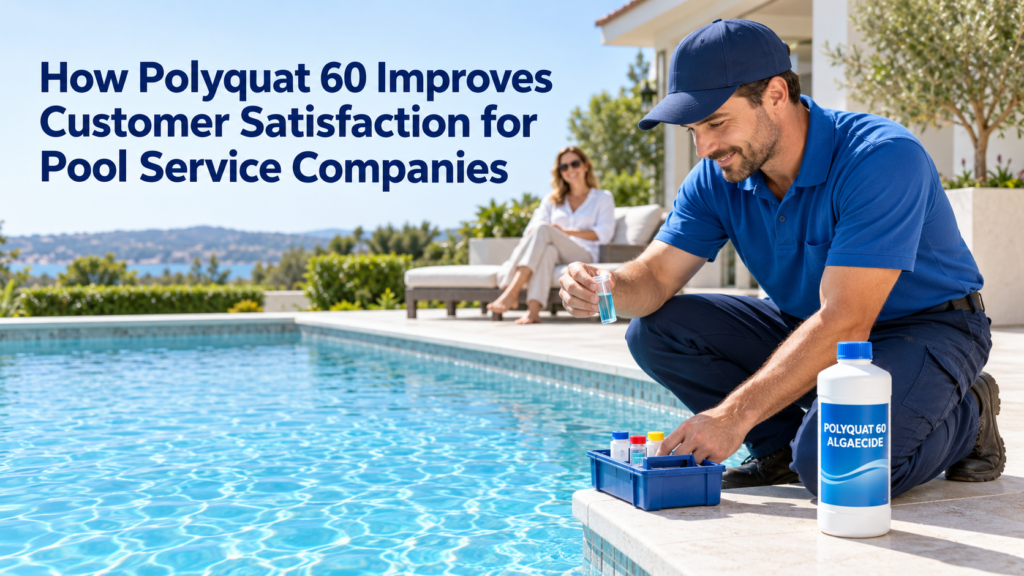
A pool service company is not judged by the number of chemicals its technicians add. Customers judge it by what they can see, feel, and experience.
Is the water clear when friends arrive for a weekend barbecue? Are the steps free from slippery algae? Does the pool smell clean without becoming unpleasant? Can the family enjoy the water without calling the service company every few days?
These ordinary moments shape customer satisfaction.
For that reason, algae prevention is more than a technical maintenance task. It affects the customer’s confidence in the entire service. One unexpected algae bloom can lead to complaints, emergency visits, extra chemical costs, and uncomfortable questions about whether the pool has been maintained properly.
Polyquat 60 can help pool service companies avoid many of these situations. As a concentrated, polymer-based algaecide, it adds another layer of algae control to a complete maintenance program. It does not replace chlorine, filtration, circulation, brushing, or water testing. Instead, it helps those parts work together more reliably.
The result is simple: fewer unwelcome surprises for the customer and fewer urgent problems for the service company.
Customer Satisfaction Begins with Consistent Pool Conditions
Pool owners rarely think about water chemistry when everything is working well. They notice the blue water, clean tile line, and comfortable swimming conditions. Then they move on with their day.
That is exactly what good pool service should achieve.
Problems begin when pool conditions change between visits. The water may look clear on service day but turn dull after heavy rain, high temperatures, or a crowded weekend. A patch of green algae may appear on a shaded wall. Mustard-colored dust may return even after brushing.
From the customer’s point of view, these changes can feel sudden. From a technician’s point of view, they usually result from several factors working together:
- Low sanitizer levels
- Poor circulation in corners or behind ladders
- High swimmer loads
- Warm water and strong sunlight
- Leaves, pollen, and other organic matter
- Inadequate brushing
- Dirty or poorly operating filters
- Incorrect water balance
- Missed or delayed service visits
A service company cannot control the weather or the number of people using a pool. It can, however, build a maintenance program with enough protection to handle normal changes between visits.
That is where Polyquat 60 becomes useful.
What Is Polyquat 60?
Polyquat 60 is a concentrated polymeric quaternary ammonium algaecide. In many pool formulations, the active ingredient is polixetonium chloride, identified by CAS No. 31512-74-0.
Unlike chlorine, Polyquat 60 is not an oxidizing sanitizer. Its positively charged polymer structure interacts with negatively charged algae cell surfaces, disturbing their normal biological activity and helping control their growth.
This difference matters.
Chlorine remains essential for sanitizing pool water and controlling microorganisms. Polyquat 60 performs a supporting role focused on algae prevention and control. When both are used correctly, the maintenance program is less dependent on a single chemical barrier.
A commercial Polyquat 60 Algaecide is commonly chosen for professional pool care because it combines concentrated algae-control performance with a non-foaming, metal-free formulation. Service companies can integrate it into routine maintenance, seasonal opening, pool closing, and corrective treatment programs—always according to the registered product label and local regulations.
Clear Water Makes Service Quality Visible
Customers cannot see chlorine residuals or polymer chains. They can see clear water.
Visual appearance becomes an informal report card for the pool company. Bright, clean-looking water suggests that the technician is careful and knowledgeable. Green, cloudy, or dull water creates the opposite impression—even when an equipment failure or unexpected storm caused the problem.
Polyquat 60 helps reduce the chance of visible algae developing between scheduled visits. Used preventively, it can control algae before a light film becomes an obvious green patch.
This early control matters because established algae are more difficult to remove. Once algae attach to rough plaster, grout lines, steps, ladders, and low-circulation areas, the technician may need to brush repeatedly, adjust sanitizer levels, clean the filter, and return for follow-up treatment.
Prevention is quieter. Customers may never notice that anything was done—and that is often a sign of successful service.
Polyquat 60 may also support water clarity as a secondary benefit. Cationic polymers can interact with certain negatively charged suspended material, helping small particles form larger groups that the filtration system can capture more easily. However, Polyquat 60 should not be presented as a complete substitute for a dedicated clarifier.
If cloudy water is the main problem, a Polymer Pool Clarifier may provide more targeted support for fine-particle removal. The important point is to match each product with the actual pool condition.
Fewer Algae Complaints Mean Fewer Emergency Visits
A normal route is predictable. Emergency calls are not.
When a customer reports green water, the service company may need to interrupt its planned schedule, send a technician across town, test the water, brush the pool, apply corrective treatment, and return to confirm the recovery. One troubled pool can consume the time normally allocated to several maintenance visits.
There are direct costs:
- Technician labor
- Fuel and vehicle time
- Extra chemicals
- Filter cleaning or backwashing
- Repeated water testing
- Customer credits or free return visits
There are also hidden costs. The office must manage the complaint. Other appointments may be delayed. The technician becomes rushed. A customer who was previously satisfied may begin checking every detail of the service.
A preventive Polyquat 60 program cannot eliminate every algae incident. Pump failures, severely low sanitizer levels, poor circulation, neglected filters, and extreme environmental conditions can still cause trouble. Yet an added algae-control barrier may reduce the frequency of routine outbreaks, especially when it is combined with sound sanitation and circulation.
Even a modest reduction in callbacks can make a meaningful difference across a large service route.
Suppose a company maintains 200 pools. If algae-related callbacks fall by only a few visits each month, the company saves labor while protecting customer relationships. The technician spends more time completing scheduled work and less time correcting avoidable problems.
That improves both operational efficiency and the customer experience.
Non-Foaming Performance Prevents an Awkward Surprise
Some traditional quaternary ammonium algaecides can produce visible foam, particularly in pools with waterfalls, spa jets, fountains, or strong return flow.
Foam may not always indicate a serious water-quality problem, but try explaining that to a customer who sees bubbles collecting around the steps before a pool party. Appearance shapes perception. If the pool suddenly resembles a bathtub, the customer may assume that the wrong chemical was used.
Polyquat 60 is valued for its non-foaming character when formulated and applied correctly. This makes it especially useful for:
- Pools with attached spas
- Pools with deck jets or waterfalls
- Commercial pools with active circulation
- Decorative water features
- Properties where visual presentation is important
For service companies, non-foaming performance removes one potential source of customer anxiety. The water can circulate normally without creating a distracting surface effect.
It is a small detail, perhaps, but service quality is often built from small details.
A Metal-Free Formula Helps Protect Pool Appearance
Metal-based algaecides can be effective, but adding metals to pool water requires careful control. Under certain water conditions, dissolved copper may contribute to surface staining or discoloration. Metal-related staining can become more likely when product dosage, pH, water balance, or existing metal levels are not managed properly.
Polyquat 60 does not rely on copper or other metal ions for algae control.
That metal-free chemistry is attractive to service companies working with different pool finishes, including plaster, tile, vinyl liners, and fiberglass. It reduces one category of concern: adding a metal-based algae treatment to water whose full history may not be known.
This does not mean that Polyquat 60 can never be misapplied. Concentrated chemicals should always be measured carefully, distributed correctly, and used according to their labels. Still, avoiding added metals helps simplify chemical decision-making across a mixed service route.
Customers also appreciate the reassurance. They want algae control, but they do not want a treatment that creates a new cosmetic problem.
After all, what is the value of removing green algae if the customer later worries about discolored surfaces?
One Versatile Product Can Simplify Technician Training
Pool service companies often maintain many kinds of pools:
- Residential chlorine pools
- Saltwater pools
- Hotel and apartment pools
- Indoor aquatic facilities
- Pools with attached spas
- Seasonal pools
- Pools surrounded by heavy landscaping
Carrying a large collection of specialized algaecides can complicate inventory and technician training. Employees must remember which product is suitable for each pool, how strong it is, and which limitations apply.
Polyquat 60 offers broad practical value because it can be incorporated into many common maintenance programs. A service company can establish clear procedures covering:
- Routine preventive dosing
- Treatment during favorable algae-growth conditions
- Support after heavy rain or high swimmer use
- Pool opening
- Pool closing
- Corrective algae treatment
A shared procedure reduces guesswork. Technicians still need to test the water, inspect equipment, calculate pool volume, and follow the product label. Yet the chemical decision becomes more consistent across the team.
Consistency is essential when customers expect the same service quality regardless of which technician arrives.
Correct Dosage Builds Trust—Guessing Destroys It
Polyquat 60 is concentrated. More is not automatically better.
Overdosing increases chemical costs and may interfere with the intended maintenance program. Underdosing, meanwhile, may provide inadequate algae protection. The right quantity depends on the specific formulation, product label, pool volume, water condition, and purpose of treatment.
Technicians should never rely on an unmarked splash from the bottle. A professional application process should include:
- Confirming the pool volume.
- Testing sanitizer level, pH, and other relevant water conditions.
- Inspecting circulation and filtration.
- Reading the dosage stated on the finished product label.
- Measuring with suitable equipment.
- Distributing the product as directed.
- Recording the treatment in the service log.
This process protects the customer and the service company.
Accurate records are especially helpful when a customer asks what was added to the pool. Instead of offering a vague answer, the company can provide the product name, amount, date, and relevant test results.
That level of transparency builds confidence. It also helps managers identify patterns across problem pools.
Better Prevention Can Make Service Pricing Easier to Defend
Pool owners sometimes compare service companies by monthly price alone. Yet the lowest advertised price is not always the lowest total cost.
A cheaper service may become expensive when the customer pays for repeated algae cleanup, additional chemicals, filter attention, or unplanned visits. A well-designed preventive program may carry a slightly higher routine cost while producing more stable water conditions.
Polyquat 60 can support a value-based service package. Rather than selling “one more chemical,” the company can explain the real benefit:
- More consistent algae prevention
- Lower risk of visible outbreaks between visits
- Non-foaming maintenance
- No added copper from the algaecide
- Reduced likelihood of algae-related cleanup
- Better seasonal opening and closing results
Customers are often willing to pay for reliability when the value is made clear. They are not purchasing a measured dose of liquid. They are purchasing the confidence that their pool will be ready when they want to use it.
That distinction can help a service company compete on quality instead of constantly cutting prices.
Polyquat 60 Supports a More Comfortable Customer Conversation
Complaint management is not only about fixing water. It is also about managing emotion.
A homeowner who discovers green water before a birthday party may be frustrated or embarrassed. A hotel manager dealing with a pool closure may face unhappy guests and lost revenue. Saying “algae sometimes happens” is technically true, but it does not restore confidence.
A documented preventive program creates a stronger conversation.
The company can explain that it monitors sanitizer, circulation, filtration, and water balance while using a supporting algaecide during higher-risk periods. If an outbreak still occurs, the technician has service records that help identify the likely cause.
This changes the discussion from blame to diagnosis.
Perhaps a storm diluted the sanitizer. Maybe a pump stopped after the last visit. A filter could be overdue for cleaning, or the pool may have hosted far more swimmers than usual. With accurate records, the technician can explain the situation using evidence rather than assumptions.
Customers tend to trust companies that communicate clearly, acknowledge limitations, and present a sensible corrective plan.
Seasonal Service Becomes Less Stressful
Spring opening and winter closing are emotionally important service moments.
At opening, the customer wants a clean pool quickly. Nobody enjoys watching a technician battle dark green water for several days while warm weather slips away. At closing, the customer wants confidence that the pool will remain protected through the off-season.
Polyquat 60 can support both periods.
During opening, it may be included after debris removal, water balancing, required sanitizer treatment, and restoration of normal circulation. The sequence must follow the finished product label, especially where high sanitizer levels could affect the algaecide.
During winterization, a suitable Winter Algaecide can help suppress algae while the pool is closed. Cleaner off-season water may mean less brushing, chemical correction, and filtration work when the pool reopens.
Customers remember an easy opening. They also remember an unpleasant one.
A pool that opens with manageable water conditions gives the customer an immediate sense that the closing service was worth the price. That positive result can influence renewal decisions months later.
It Helps Service Companies Deliver the Same Standard Across a Growing Route
Growth creates a difficult question: can the company maintain its service quality as the number of accounts increases?
A small owner-operated route may rely heavily on one person’s experience. That person recognizes problem pools from memory and adjusts treatment almost instinctively. As technicians are added, undocumented knowledge becomes a weakness.
A structured Polyquat 60 program can become part of a repeatable service system. The company may define when technicians should consider preventive treatment, which observations require supervisor review, how applications are recorded, and when follow-up testing is needed.
For example, a treatment decision may consider:
- Recent algae history
- Water temperature
- Rainfall
- Sun exposure
- Swimmer load
- Sanitizer demand
- Circulation limitations
- Upcoming customer events
- Seasonal closing plans
These factors should guide professional judgment rather than encourage automatic chemical addition. Some pools may need routine preventive treatment, while others may require it only during high-risk periods.
A consistent framework helps technicians make better decisions without treating every pool as identical.
Polyquat 60 Is a Supporting Player, Not the Whole Team
It is tempting to describe a good product as the answer to every problem. That may sound persuasive in a sales brochure, but it leads to poor field results.
Polyquat 60 cannot compensate indefinitely for:
- A failed circulation pump
- A badly clogged filter
- Chronically low sanitizer
- Incorrect pH
- Heavy debris accumulation
- Inaccurate pool-volume calculations
- Infrequent brushing
- Severe established algae growth
A successful program still requires testing, filtration, circulation, sanitation, brushing, debris removal, and equipment maintenance.
Polyquat 60 strengthens that program by adding targeted algae control. Think of it as a dependable goalkeeper. It can stop many problems from reaching the customer, but it cannot play every position on the field.
This honest explanation is good for customer satisfaction. It creates realistic expectations and makes technicians less likely to overpromise.
Product Quality Also Affects the Customer Experience
Not every product sold under a similar description will provide identical handling or performance.
Pool service companies and private label brands should evaluate more than active concentration. Important supplier considerations may include:
- Batch-to-batch consistency
- Active ingredient specifications
- Appearance and viscosity
- Storage stability
- Packaging quality
- Label compliance
- Technical documentation
- Traceable batch identification
- Reliable delivery
- Support for different package sizes
A product that arrives late, leaks in the service vehicle, or varies noticeably between batches creates problems long before it reaches the pool.
Dependable manufacturing and packaging help technicians dose more consistently. They also reduce inventory disruptions during the busiest months, when an algae-control product is most valuable.
For private label service companies, package design matters too. Clear directions, readable measurements, strong closures, and suitable bottle sizes make field application easier. Branding attracts attention, but reliable daily handling keeps technicians loyal to the product.
Customer Satisfaction Eventually Becomes Customer Retention
Most pool service customers do not cancel because of one imperfect test result. They leave after repeated frustration.
Maybe the water keeps turning green. Perhaps calls are returned slowly. The technician gives a different explanation each week. Small doubts accumulate until the customer begins looking for another provider.
The opposite pattern also holds true.
When the water remains clear, technicians communicate well, and seasonal work goes smoothly, customers have fewer reasons to reconsider the relationship. They renew their service, recommend the company to neighbors, and become more receptive to higher-value maintenance packages.
Polyquat 60 contributes to that outcome by helping the company provide steady, visible results. It may reduce algae-related callbacks, protect appearance, support seasonal maintenance, and simplify treatment across different pools.
No single chemical creates customer loyalty. Reliable experiences do.
Still, a carefully selected algaecide can help pool service companies deliver those experiences week after week. And in a business built on recurring service, that consistency is not a minor advantage. It is the foundation of sustainable growth.
Frequently Asked Questions
1. How does Polyquat 60 improve customer satisfaction for pool service companies?
Polyquat 60 supports preventive algae control, helping pools maintain a cleaner and more attractive appearance between service visits. Fewer algae outbreaks may mean fewer complaints, emergency treatments, and disrupted swimming plans.
2. Can pool service companies use Polyquat 60 instead of chlorine?
No. Polyquat 60 is an algaecide, not a primary sanitizer. Chlorine or another approved sanitizer remains necessary. Polyquat 60 should be used as one part of a complete program that includes sanitation, filtration, circulation, testing, and brushing.
3. Why do professional pool technicians prefer non-foaming Polyquat 60 algaecide?
Its non-foaming character makes it suitable for pools with active return flow, attached spas, waterfalls, and other water features. It helps control algae without creating the visible foam that may concern customers.
4. Does Polyquat 60 reduce the risk of pool surface staining?
Polyquat 60 controls algae without adding copper or other metal ions to the water. This removes a source of metal-related staining concern, although technicians must still follow label directions and maintain proper water balance.
5. When should a pool service company add Polyquat 60?
Possible uses include routine preventive maintenance, high-risk weather periods, pool opening, winter closing, and corrective algae treatment. The exact timing and dosage must follow the finished product label, local regulations, pool volume, and current water conditions.