GET IN TOUCH
Ask For Sample?
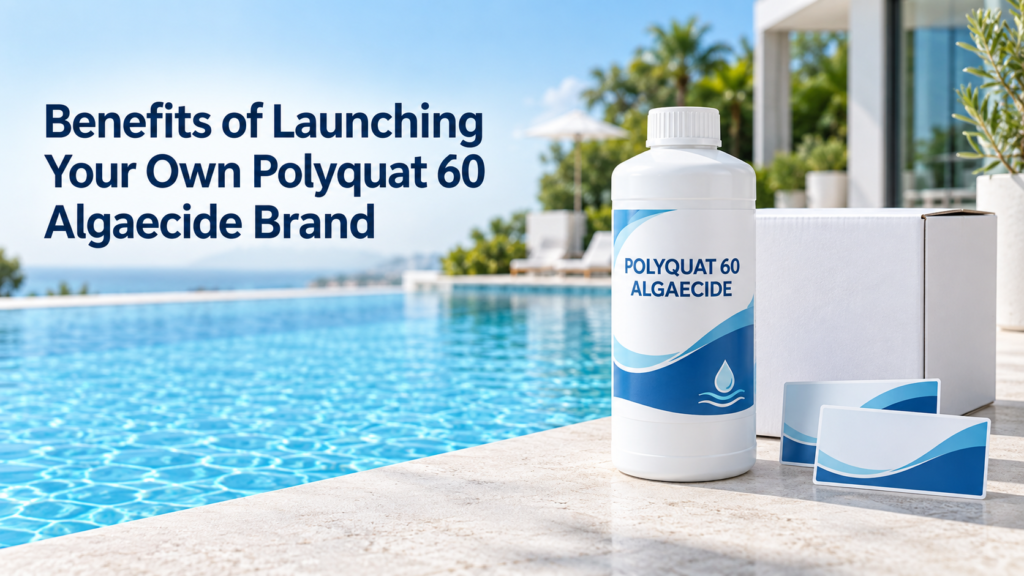
Benefits of Launching Your Own Polyquat 60 Algaecide Brand
Selling pool chemicals made by other companies can produce revenue. Building a recognizable pool chemical brand, however, can create something more durable: customer preference.
That distinction matters.
When customers buy an unbranded or widely distributed chemical, they usually compare suppliers by price, availability, and delivery time. When they buy a product carrying your name, packaging, instructions, and service promise, the buying decision becomes less mechanical. They begin to associate the product with your company—not merely with the chemical inside the bottle.
This is one reason more pool chemical distributors, maintenance companies, importers, and regional wholesalers are considering private-label Polyquat 60 algaecide.
Polyquat 60 is familiar to professional pool operators as a non-foaming, polymer-based algaecide. It is commonly used to help prevent and control algae without introducing copper into pool water. It can also fit routine maintenance, seasonal care, and pool-closing programs.
Those practical qualities give a new brand several stories to tell. You are not launching another mystery bottle filled with blue liquid and grand promises. You are building a product around a defined chemical category, recognizable applications, and real maintenance needs.
Still, putting a logo on a bottle is the easy part. Creating a brand customers reorder takes more thought. Let’s look at why the opportunity can be worthwhile—and what must be handled carefully.
You Stop Selling a Commodity and Start Building an Asset
A distributor that sells only third-party brands helps build recognition for someone else.
Every product demonstration, sales call, online advertisement, and technical explanation strengthens the manufacturer’s brand. If that supplier changes its distribution policy, increases prices, or appoints another distributor in your territory, much of the value created by your sales work may stay with the supplier.
Your own Polyquat 60 brand changes that relationship.
The brand name, label design, customer reviews, local reputation, product photography, technical content, and distributor network can all become commercial assets belonging to your business. The underlying chemical still matters, of course, but customers encounter it through an identity that you control.
This brings several long-term advantages:
- Customers can ask for your product by name.
- Dealers can distinguish your bottle from competing offers.
- Marketing spending contributes to your own brand recognition.
- Product information can be tailored to your target market.
- You gain more control over pricing and channel strategy.
- Future products can be introduced under the same brand family.
A single algaecide may begin the relationship. Later, the same buyer might purchase clarifiers, winter treatments, maintenance chemicals, or other pool-care products carrying your brand.
That is when a bottle becomes more than a bottle. It becomes the front door to a wider product portfolio.
Polyquat 60 Gives a New Brand a Clear Technical Position
Launching a chemical brand is easier when the product has a clear reason to exist.
Polyquat 60 can be positioned as a non-foaming polymeric algaecide for preventive pool maintenance and algae-control programs. It does not depend on copper as its active algae-control component. This is important because copper-based treatments can create concerns about surface staining or hair discoloration when metal levels, pH, and water balance are poorly managed.
Polyquat chemistry provides a different approach. Its positively charged polymer chains interact with negatively charged algae cell surfaces, interfering with normal cell function. The polymeric structure also helps distinguish it from conventional small-molecule quaternary ammonium algaecides, which may produce more visible foam under circulation.
For pool professionals, that creates several easy-to-understand selling points:
- Non-foaming performance under normal recommended use
- Copper-free algae control
- Suitability for routine preventive treatment
- Compatibility with many standard pool maintenance programs
- Application in residential and commercial pools
- Possible use in seasonal closing or winter maintenance products
These points are practical. A service technician does not want a decorative chemistry lecture while standing beside a cloudy pool on a hot Friday afternoon. The technician wants to know whether the product foams, how it fits with the sanitizer program, what dose the label permits, and whether it creates avoidable problems.
A strong private-label product answers those questions quickly.
For a closer look at the product category, buyers can review Polyquat 60 Algaecide, a concentrated polymer-based solution developed for professional pool and spa water-treatment applications.
Your Packaging Can Speak to the Customers You Actually Serve
Third-party brands often arrive in fixed bottle sizes, fixed carton quantities, and fixed label formats. The product may be perfectly acceptable, yet the packaging can feel wrong for your market.
Perhaps your customers use metric dosing, but the bottle instructions emphasize US gallons and fluid ounces. Maybe you sell to service companies that want 5-liter containers, while the existing brand is available only in small retail bottles. Or your dealers need bilingual labels because they serve two language communities.
A private-label program gives you more room to match the package to the buyer.
Depending on manufacturing capability, order volume, transport conditions, and local rules, possible formats may include:
- 1-liter bottles for specialty retail and residential pool owners
- 5-liter containers for pool service companies
- 20- or 25-liter drums for commercial users and repacking operations
- Multi-bottle cartons for distributors
- Tamper-evident closures for retail channels
- Measuring caps or dosing cups where suitable
- Multilingual labels for regional markets
Packaging is not merely decoration. It affects leakage risk, freight efficiency, warehouse handling, dosing accuracy, shelf presentation, and customer confidence.
Even small details matter. A strong cap, a clean label, a readable batch code, and an induction seal can say more about product reliability than a paragraph of promotional copy.
Think about the moment a customer opens the carton. Is the bottle clean? Is the label straight? Can the user find the dosage directions without squinting? Does the container feel suitable for a chemical product?
Brand trust often starts there—in a warehouse, beside an open box, long before the product reaches a swimming pool.
Private Labeling Gives You More Control Over Market Position
When several distributors sell the same brand, pricing becomes transparent very quickly. Buyers can request quotations from multiple sellers and compare almost identical offers.
That tends to squeeze margins.
With a private-label Polyquat 60 product, direct price comparison becomes less straightforward. Customers can still compare chemistry, active concentration, package size, and service, but your product has its own commercial identity.
You can position it around the needs of a specific customer group rather than trying to appeal to everyone.
For example, the brand could be presented as:
- A professional-strength product for pool service technicians
- A dependable maintenance algaecide for residential pools
- A copper-free choice for high-value pool surfaces
- A low-foam product for pools with strong circulation or water features
- A seasonal solution for pool closing and reopening
- A concentrated format for regional distributors
- A private-label range for pool builders and equipment dealers
Each position calls for different packaging, instructions, photography, sales materials, and perhaps even a different concentration.
The key is consistency. A product marketed as professional-grade should not arrive with a vague consumer-style label. A residential product should not read like a raw material specification sheet. The chemistry may be similar, but the customer experience should match the intended channel.
Better Margins Are Possible—but They Are Not Automatic
Private-label products can offer healthier margins because the brand owner takes responsibility for marketing, distribution, customer education, and inventory. There may be fewer layers between the producer and the final buyer.
But let’s be honest: a custom label does not magically produce profit.
Your real margin depends on several connected costs:
- Product and filling cost
- Bottles, caps, seals, labels, and cartons
- Label design and translation
- Laboratory testing
- Freight and insurance
- Import duty and local taxes
- Registration or authorization expenses
- Warehousing and stock turnover
- Leakage, damage, and customer returns
- Dealer discounts
- Marketing and technical support
Small orders can carry high unit costs because packaging materials are usually purchased in fixed quantities. A custom bottle may look impressive, yet a standard chemical-resistant bottle with a well-designed label may be financially wiser during the first launch.
The same applies to carton printing. Fully printed cartons can be attractive, but branded labels on plain export cartons may reduce early-stage inventory risk.
A careful launch protects cash. Start with the elements customers notice most—reliable product quality, secure packaging, clear instructions, and credible branding. Add expensive packaging features only when sales volume supports them.
Margin should be calculated from the landed and market-ready cost, not simply from the supplier’s factory price. That sounds obvious, but it is where many attractive spreadsheets begin to wobble.
Your Brand Can Encourage Repeat Orders
Pool care is recurring by nature.
Water chemistry changes. Rain falls. Temperatures rise. Swimmers enter the pool. Sanitizer levels fluctuate. Algae pressure returns. A product that performs well is likely to be purchased again because the underlying maintenance need does not disappear.
That makes pool chemicals well suited to brand-building.
Once a pool service company finds an algaecide that fits its treatment routine, changing products creates inconvenience. Technicians must learn new dose rates. Managers must update purchasing records. Customers may ask why the bottle has changed. Unless there is a price, supply, or performance problem, staying with a familiar product is often easier.
A good private-label brand can strengthen that natural repeat-purchase pattern by providing:
- Consistent concentration
- Stable appearance and viscosity
- Clear batch identification
- Dependable lead times
- Familiar packaging
- Simple dosage guidance
- Responsive technical support
Consistency is less glamorous than a striking logo. It is also far more valuable.
A customer may admire the bottle once. They reorder because the product arrives on time and behaves as expected.
Polyquat 60 Can Become the Anchor of a Broader Pool-Care Range
Launching one product is usually easier than launching ten. Yet a single product should ideally leave room for expansion.
Polyquat 60 can act as an anchor product because it connects naturally with several parts of a pool maintenance program. Customers using an algaecide may also need help with suspended particles, seasonal closing, or recurring clarity problems.
For example, your future range could include:
- Routine algae-control products
- Pool clarifiers
- Winter algaecides
- Pool-opening treatments
- Specialty maintenance products
- Commercial package sizes
When fine suspended matter affects water appearance, a dedicated Polymer Pool Clarifier can complement an algae-control program by helping small particles form larger, filterable aggregates. The two products serve different primary purposes, so the sales message should keep that distinction clear.
Seasonal markets provide another route for expansion. A Winter Algaecide can be positioned for pool-closing and off-season care, particularly in regions where pools remain covered and unused for several months.
This portfolio approach can raise the average order value. It can also make your brand more useful to dealers. A retailer may hesitate to create shelf space for one isolated bottle, but a coordinated treatment family gives the range more visual and commercial weight.
You Can Adapt the Product to Local Selling Conditions
Pool markets are not identical.
A sunny coastal region with year-round swimming has different purchasing rhythms from a northern market where pools close before winter. A region dominated by private villas behaves differently from one with hotels, schools, fitness centers, and municipal facilities.
Private labeling allows the product presentation to reflect these realities.
In a warm market, the message might emphasize routine algae prevention during long periods of high water temperature. In a seasonal market, the same brand may give more attention to spring opening, summer maintenance, and winter closing. For commercial operators, larger containers and technical dosing tables may be more important than glossy retail packaging.
Language matters too.
Dosage directions should use the units familiar to local users. Safety statements must meet applicable rules. Product claims should be accurate and legally permitted. Translated text should be reviewed by someone who understands both the language and pool chemistry—preferably not by a general translation app working alone at midnight.
A phrase can be grammatically correct and still confuse the person holding the bottle. Chemical labels have little room for poetic ambiguity.
Brand Ownership Can Strengthen Distributor Relationships
Regional dealers often want some protection from direct online price competition.
If they stock a famous mass-market brand, customers may examine the product in store and then purchase it online from the cheapest seller. The dealer provides advice but loses the order. Understandably, that gets old.
Your own brand can support a more controlled channel structure.
You might create territory-based distribution, professional package sizes, dealer-specific promotions, or separate product formats for retail and service channels. You can also provide marketing materials that make the dealer’s job easier:
- Product data sheets
- Safety data sheets
- Dosage charts
- Product photographs
- Short training videos
- Shelf cards
- Seasonal sales guides
- Frequently asked questions
- Batch-specific certificates of analysis
This support gives the distributor something useful to sell, not just something to stock.
It also helps prevent inconsistent claims. If every dealer invents a different explanation of what Polyquat 60 does, confusion spreads quickly. Central sales materials keep the product message accurate and recognizable.
Technical Documentation Builds Quiet Confidence
Chemical buyers notice missing documents.
A polished website cannot compensate for an outdated safety data sheet, incomplete specification, or certificate of analysis that does not match the batch number on the package. Professional customers may not comment on these details when everything is correct. They certainly notice when something is wrong.
A credible Polyquat 60 program should establish which documents will accompany the product and who controls them.
Depending on the product, market, and transaction, the documentation set may include:
- Product specification
- Safety Data Sheet
- Certificate of Analysis
- Batch and manufacturing records
- Packaging specification
- Storage guidance
- Shelf-life statement supported by available data
- Transport information
- Label artwork approval records
- Regulatory documents required by the destination market
The brand owner and manufacturer should agree on release standards before commercial production begins. Active content, pH, density, viscosity, appearance, and other relevant properties may form part of the agreed specification.
Testing methods matter as well. Two laboratories can report different results if they use different methods, sample preparation procedures, or calculation bases. A number without a defined method is only half a specification.
Quality Control Protects the Name Printed on the Bottle
A private-label product carries your reputation even when another company manufactures it.
If a batch leaks, separates, arrives underweight, or falls outside specification, customers will call the brand owner. They will not begin by studying the supply agreement to determine which subcontractor filled the bottle.
That is why supplier qualification deserves more attention than logo design.
Before launch, evaluate questions such as:
- Does the producer manufacture the active material or only blend and fill it?
- Are incoming raw materials identified and tested?
- Is each batch checked against an agreed specification?
- Can the supplier provide retain samples?
- How are filling weights controlled?
- Are bottles tested for chemical compatibility and leakage?
- How are batch numbers assigned and traced?
- What happens when a batch fails?
- Can production records be retrieved after shipment?
- How are label changes reviewed and approved?
It is also sensible to test the complete package—not merely the liquid. Store filled bottles under expected warehouse conditions and examine the caps, seals, labels, and container walls over time.
A formula may remain stable while an unsuitable label adhesive curls at the edges. A cap liner may swell. Ink may smear after contact with product residue. None of these failures changes the chemistry, yet every one of them damages the brand.
Concentration Needs to Be Communicated with Precision
The name “Polyquat 60” can create misunderstanding because the number is commonly associated with a concentrated active ingredient solution. Finished retail products, however, may be formulated at different active levels.
This affects dose rates, cost comparisons, shipping economics, and product positioning.
A 60% concentrate cannot be compared fairly with a lower-concentration finished product by bottle price alone. Customers need to consider the active ingredient delivered per container and the dose stated on the approved product label.
For brand owners, there are two broad commercial approaches.
The first is to sell a concentrated product aimed at experienced users, distributors, or service companies. This can reduce packaging per unit of active material and may support professional positioning.
The second is to offer a diluted, ready-to-use format with simpler dosing for residential users. The unit price may be lower, and dosing errors may be easier to control, but freight and packaging costs per unit of active ingredient will rise.
Neither format is automatically superior. The right concentration depends on the customer, channel, local rules, and intended claims.
What matters is clarity. The label, specification, sales sheet, and quotation should all describe concentration on the same basis.
Regulatory Planning Must Begin Before the Label Is Printed
This is the part no serious brand owner should treat as an afterthought.
An algaecide is commonly regulated as a pesticide or biocidal product because it is marketed to control algae. Requirements differ by country and may apply to the active substance, finished formulation, manufacturing site, claims, label, importer, and local distributor.
In the United States, antimicrobial pesticides are handled by the US Environmental Protection Agency’s Antimicrobials Division. A product sold under a distributor’s brand may require an accepted supplemental distribution arrangement tied to a registered primary product, as well as applicable state registrations. The exact route depends on the product and commercial arrangement.
Other markets follow their own systems. Registration in one country does not automatically authorize sale in another.
This means the launch sequence should usually be:
- Define the target country and customer channel.
- Confirm how the product and claims are regulated.
- Select the lawful registration or authorization route.
- Confirm the accepted formula and source requirements.
- Prepare compliant label text.
- Complete required registrations or notifications.
- Print commercial packaging only after artwork approval.
Do not assume that calling the product a “water conditioner” removes regulatory duties if the label and advertising still claim algae control. Regulators generally look at intended use and claims, not creative wording alone.
Likewise, avoid claims such as “completely safe,” “non-toxic,” or “works in every water condition.” These are difficult to support and may conflict with labeling rules. Accurate claims build more trust anyway.
Private Labeling Can Shorten Product Development Time
Developing a new active chemistry from the laboratory stage can take years. It may require synthesis development, toxicology work, stability studies, application testing, manufacturing trials, and regulatory review.
A private-label Polyquat 60 product can begin from an established chemical and manufacturing platform. That may reduce development time because the supplier already understands production, handling, testing, and packaging.
The brand owner can focus on market-facing work:
- Selecting the target concentration
- Choosing package sizes
- Creating the brand identity
- Preparing compliant artwork
- Building the sales channel
- Training distributors
- Planning inventory
- Developing educational content
This does not eliminate technical work. It shifts the work toward adapting a known product category for a defined market.
For a small or mid-sized company, that can be the difference between discussing a pool chemical brand for three years and placing a carefully planned first production order.
A Focused Brand Can Compete Without Being the Largest
A new brand rarely wins by being louder than every established supplier. It can win by being more relevant to a particular group of buyers.
Maybe your advantage is fast regional delivery. Perhaps it is multilingual technical support. It could be flexible carton quantities, a dependable 5-liter professional package, or assistance with seasonal inventory planning.
None of these sounds dramatic. Together, they can create a persuasive offer.
A focused Polyquat 60 brand can compete through:
- Product consistency
- Responsive communication
- Clear technical information
- Sensible package sizes
- Reliable stock
- Local market knowledge
- Dealer support
- Honest claims
- Fast handling of complaints
Customers remember how a supplier behaves when something goes wrong. A missing carton resolved within hours may build more loyalty than ten cheerful promotional emails.
That human element matters in chemical sales. Buyers may compare specifications, but they continue working with people who make their job easier.
Content Marketing Becomes More Valuable When You Own the Brand
Pool owners and technicians regularly search for answers:
- How much algaecide should be added?
- Can Polyquat 60 be used with chlorine?
- When should it be added after shock treatment?
- Does water temperature affect performance?
- Can it be used in a saltwater pool?
- Why is algae returning?
- How should the product be stored?
A brand that answers these questions clearly can attract customers before they begin comparing quotations.
Educational content also improves sales conversations. Instead of explaining the same topic from scratch, your team can send a relevant guide, dosage article, or troubleshooting page. The customer receives useful information, while the brand demonstrates technical competence.
There is a boundary, though. Content should not replace the registered label or prescribe unsupported doses. Advice should remind readers to follow the directions approved for the specific finished product.
Good education reduces confusion. Loose advice creates liability.
How to Move from an Idea to a Commercial Product
The launch does not need to be enormous. It needs to be controlled.
Begin with one clearly defined customer group. Interview existing buyers and ask what package size they use, how often they reorder, which product complaints they hear, and what documents they require.
Next, create a written product brief covering:
- Target market
- Intended customer
- Active concentration
- Package sizes
- Expected annual volume
- Required documents
- Label languages
- Performance position
- Target landed cost
- Regulatory route
- Launch schedule
Then evaluate manufacturing partners against the same brief. This makes supplier comparisons more meaningful. One quotation may be cheaper because it excludes induction seals, custom cartons, testing, or artwork support. A proper comparison brings those differences into view.
Before full production, review a filled and labeled sample. Check the liquid, bottle, closure, seal, label, carton, batch code, and printed instructions. Have a technically qualified person and a regulatory specialist review the artwork.
Finally, run a limited commercial release if the market and regulations allow it. A smaller first run provides real feedback on freight damage, shelf appearance, customer questions, and reorder behavior.
Listen carefully during that stage. Customers often reveal useful improvements through casual remarks: “The dosage table is hard to read,” “We need a larger handle,” or “Our technicians prefer five-liter cans.”
Those comments are product development in work clothes.
The Real Benefit Is Control—Paired with Responsibility
Launching your own Polyquat 60 algaecide brand can improve differentiation, customer retention, portfolio breadth, and margin potential. It can also help a distributor or service company move from selling interchangeable chemicals to building recognizable commercial value.
Yet the largest benefit is control.
You gain more influence over packaging, product positioning, channel strategy, customer education, and future range development. At the same time, you accept responsibility for quality, labels, claims, documentation, inventory, and after-sales support.
That trade is usually worthwhile when the business already understands its customers and can work with a dependable manufacturing partner.
The smartest launch is not necessarily the biggest. It is the one in which the chemistry, market, packaging, compliance plan, and customer promise fit together.
When those pieces support each other, Polyquat 60 is no longer just another item in a quotation. It becomes a product customers recognize, request, and—most importantly—purchase again.
Frequently Asked Questions About Launching a Polyquat 60 Brand
1. Is Polyquat 60 suitable for a private-label pool chemical product?
Yes. Its non-foaming, polymer-based, and copper-free positioning makes Polyquat 60 suitable for professional maintenance, retail, and seasonal pool-care ranges. The finished formula and claims must meet the rules of the target market.
2. What is the minimum order quantity for private-label Polyquat 60 algaecide?
The minimum order quantity depends on the manufacturer, concentration, bottle size, label type, and carton requirements. Standard bottles and pressure-sensitive labels usually permit a smaller first order than custom-molded packaging.
3. Can I sell Polyquat 60 under my own brand in the United States?
Potentially, but an algaecide is regulated as a pesticide in the United States. The finished product, manufacturing arrangement, distributor label, EPA requirements, and state registrations must be confirmed before sale.
4. Should a new brand sell concentrated or ready-to-use Polyquat 60?
A concentrated product may suit distributors and professional pool service companies, while a lower-concentration format may provide simpler dosing for residential users. The decision should reflect local regulations, freight costs, package size, and customer experience.
5. What should I check when choosing a Polyquat 60 private-label manufacturer?
Check active-content control, testing methods, batch traceability, packaging compatibility, filling accuracy, documentation, production capacity, regulatory support, complaint handling, and the supplier’s ability to maintain consistent quality across repeat orders.