GET IN TOUCH
Ask For Sample?
Why Pool Chemical Brands Choose Polyquat 60 for Private Label Products?
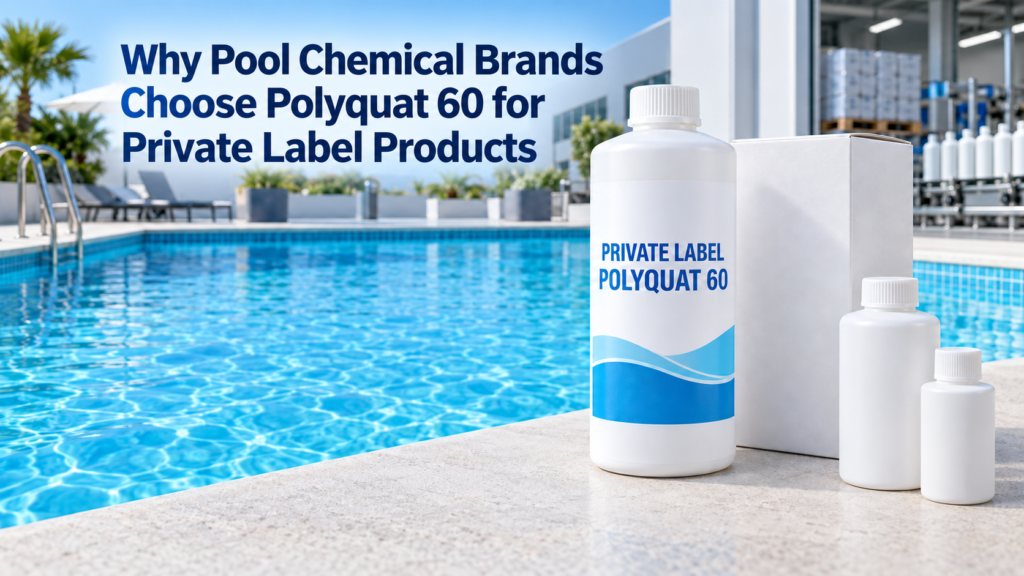
Launching a private label pool chemical is rarely as simple as filling a bottle and adding an attractive logo.
The product must perform reliably in real pools. It must remain stable during storage. Its packaging must survive shipping, warehousing, and the occasional rough hand at a retail counter. The directions must make sense to pool owners. Just as importantly, the product must fit the brand’s wider chemical range.
That is quite a list.
This is one reason many pool chemical companies consider Polyquat 60 when developing a private label algaecide. It combines concentrated polymer chemistry with several practical characteristics that suit retail, professional, and seasonal pool-care products.
Polyquat 60 is generally known as a non-foaming, polymer-based algaecide. It is commonly used to help prevent or control algae in swimming pools, spas, and certain water features. Unlike metal-based algaecides, it does not depend on copper or silver ions. Unlike some conventional quaternary ammonium products, a suitable Polyquat 60 formulation is not expected to create persistent foam when used according to its label.
Those are useful technical features. Yet private label buyers look beyond chemistry.
They are asking a commercial question: can this ingredient become a dependable product that customers will understand, use correctly, and buy again?
For many brands, the answer is yes—provided that formulation, quality control, packaging, labeling, and local registration are handled properly.
First, What Does “Polyquat 60” Actually Mean?
The name sounds precise, but buyers should not treat it as a complete chemical specification.
“Polyquat” is a market term associated with polymeric quaternary ammonium compounds. The number “60” usually indicates that the supplied liquid contains approximately 60% active ingredient. However, product names used in the pool industry can vary between countries and suppliers.
The active ingredient offered by Eautrix as Polyquat 60 Algaecide is polixetonium chloride:
- Chemical description: Poly(oxyethylene(dimethyliminio)ethylene(dimethyliminio)ethylene dichloride)
- CAS number: 31512-74-0
- Typical active concentration: approximately 60%
- Product form: water-soluble concentrated liquid
- Primary pool-care role: algae prevention and control
This distinction matters.
A purchasing team should never approve a material based only on the words “Polyquat 60.” The team should confirm the chemical identity, CAS number, active content, appearance, pH, density, viscosity, supporting documents, and intended application.
Why be so careful? Because two products with similar marketing names may not have identical chemistry, specifications, or regulatory status.
A well-managed private label project begins with an agreed technical specification. The brand and supplier should know exactly what is entering the bottle before they begin discussing label colors or carton artwork.
Non-Foaming Performance Protects the Customer Experience
Foam is not always evidence of a serious water chemistry problem, but it looks like one.
Picture a hotel pool on a busy Saturday. The water is moving through return jets, children are splashing, and the circulation system is working hard. If a maintenance chemical encourages foam, even a harmless layer of bubbles can make the pool appear dirty or badly managed.
Guests do not inspect the chemical mechanism. They see foam and become concerned.
This makes non-foaming performance valuable for private label products sold to:
- Residential pool owners
- Pool service companies
- Hotels and resorts
- Health clubs
- Public aquatic facilities
- Water parks
- Commercial property managers
- Operators of decorative water features
Polyquat 60 is often chosen because its polymeric structure gives it different behavior from lower-cost, non-polymeric quaternary ammonium algaecides. When the product is formulated and applied correctly, it can support algae control without producing the obvious foaming commonly associated with some conventional quat treatments.
For a chemical brand, that characteristic reduces an awkward type of complaint: the product may be doing its job, yet the customer thinks it has damaged the pool experience.
A private label product must perform chemically and look acceptable while it performs. Pool water is highly visual. There is nowhere for a poorly selected formulation to hide.
Metal-Free Algae Control Creates a Clearer Product Position
Copper-based algaecides can be effective, but they bring formulation and water-management questions that some brands would rather avoid.
When metal ions accumulate or interact with unsuitable water conditions, they may contribute to staining or discoloration. Pool surfaces, fittings, grout lines, and even light-colored hair can become areas of concern. The exact risk depends on concentration, pH, water balance, and other factors, but customers rarely enjoy hearing that explanation after a stain has appeared.
Polyquat 60 does not add copper ions to pool water.
That gives brands a straightforward claim direction: polymer-based, metal-free algae control. It can be particularly attractive in product ranges designed for pools with decorative finishes, saltwater chlorine generators, or customers who have previously experienced metal staining.
Still, wording matters. “Does not introduce metal ions” is a more technically responsible statement than promising that no discoloration of any kind can ever occur. Many unrelated water conditions can affect pool surfaces.
Careful claims build trust. Grand promises often build returns.
Brands can learn more about this distinction through Polyquat 60 Algaecide, which is formulated around a 60% polixetonium chloride active ingredient for private label and bulk supply applications.
Concentration Gives Brands Room to Build Different Products
A concentrated raw material creates commercial flexibility.
Some companies want a premium-strength product aimed at experienced pool professionals. Others need a lower-strength maintenance algaecide for retail shelves. A seasonal product may require a different concentration, color, viscosity, or supporting ingredient system.
Starting with a controlled concentrated material can support several routes:
- A 60% concentrated algaecide
- A diluted routine-maintenance product
- A professional service-company formulation
- A pool-opening treatment
- A pool-closing or winter maintenance product
- A multi-function algae-control and water-clarity formulation
- Different pack sizes for retail and commercial users
This does not mean that a supplier should casually dilute the concentrate and ship it. Water quality, mixing order, preservation, viscosity, packaging compatibility, and final-product stability all require attention.
Even a seemingly simple dilution can behave badly if unsuitable water is used. Minerals, anionic contaminants, or microbial contamination may affect appearance and storage stability. The finished product should therefore be evaluated as a new formulation rather than treated as a smaller number on a specification sheet.
Private label buyers should ask for information about:
- Active content
- Finished-product pH
- Density
- Viscosity
- Appearance and color
- Low-temperature behavior
- Accelerated and real-time stability
- Packaging compatibility
- Recommended storage conditions
- Expected shelf life
Here is the key: concentration is not merely a cost calculation. It shapes the dosage, label language, package size, product position, and customer’s perception of value.
It Fits Naturally into a Complete Pool-Care Range
A good private label product should not sit alone like a forgotten bottle at the back of a warehouse.
It should connect with the rest of the brand’s range.
Polyquat 60 works as an algaecide rather than a primary sanitizer. It is generally used alongside a properly managed chlorine or bromine program. This makes it suitable for brands that want to build a clear, step-based maintenance system:
- Test and balance the pool water.
- Maintain the approved sanitizer residual.
- Use an algaecide where preventive or corrective treatment is needed.
- Brush and circulate the pool.
- Remove dead algae and suspended debris through filtration and cleaning.
- Apply a suitable clarifier if fine particles continue to affect water clarity.
This product architecture is easy to explain online, on labels, and through distributor training.
It also creates sensible cross-selling opportunities. Once active algae growth has been addressed, a Polymer Pool Clarifier can support the removal of fine suspended material that makes the water look cloudy or dull.
The two products have different primary jobs.
The algaecide addresses biological growth. The clarifier helps the filtration system capture difficult suspended particles. Combining those roles in a maintenance guide can help customers understand why algae may be under control while the pool still needs time and filtration to regain its bright appearance.
That is good technical communication—and good merchandising.
Long-Lasting Prevention Supports a Premium Story
Private label brands do not always win by being the cheapest bottle on the shelf.
A premium product can earn its position by reducing inconvenience. Customers may accept a higher purchase price when a product is concentrated, easy to dose, non-foaming, and designed for routine prevention.
Polyquat 60 is often associated with longer-lasting algae-control support than basic quat products. Its cationic polymer chains interact with negatively charged biological surfaces. This helps interfere with algae cell function and reduces the chance of growth gaining an easy foothold.
Yet “long-lasting” must be kept in perspective.
Polyquat 60 can still be affected by sanitizer levels, organic load, sunlight, filtration, water replacement, bather use, temperature, and the severity of an existing algae problem. No responsible supplier should present it as permanent protection.
The practical value lies in scheduled preventive treatment. A brand can build it into a weekly, seasonal, or service-visit program based on the approved product label and local market requirements.
Regular maintenance is less dramatic than turning a green pool blue again, but customers tend to prefer the less dramatic route. So do service technicians.
Water-Clarity Support Adds Perceived Value
Polyquat 60 is primarily an algaecide, not a dedicated clarifier. That point should remain clear.
However, its cationic polymer character may also influence negatively charged suspended matter. Under suitable water conditions, this can support particle association and filtration. Pool owners may notice that the water looks brighter after treatment and circulation, especially when algae and fine debris are being removed.
This secondary effect can add value to a private label product, but it should not be exaggerated.
A product label should not promise that Polyquat 60 will solve every form of cloudy water. Cloudiness can result from poor filtration, calcium precipitation, high pH, inadequate sanitizer, heavy bather load, dead algae, or other causes. Each problem needs the right response.
Brands that communicate this honestly often sound more knowledgeable—not less.
“Helps support clear pool water” is generally more credible than “instantly clears every cloudy pool.” One sounds like chemistry. The other sounds like wishful thinking printed in large letters.
Compatibility Makes Formulation Easier—but Not Careless
Polyquat 60 is commonly used within standard chlorine- or bromine-based pool maintenance programs. Published U.S. EPA product labeling for a 60% polymeric algaecide describes non-foaming performance and compatibility with chlorinating products and other pool-treatment chemicals.
There is an important warning, though: compatibility in the pool does not mean concentrated chemicals should be mixed together in a container.
Direct contact between concentrated algaecide and concentrated chlorine products may cause an undesirable reaction or reduce performance. Each chemical should be added separately, according to its approved directions, with suitable circulation and spacing where required.
Anionic products also deserve attention. Polyquat 60 is cationic, meaning the polymer carries positive charges. Strongly anionic surfactants or treatment polymers carry negative charges. When incompatible materials meet at high local concentrations, they may form haze, precipitate, or inactive complexes.
This is why formula review and application instructions matter so much.
A supplier should ask what else will be placed in the final formulation. A brand should disclose proposed surfactants, dyes, fragrances, clarifiers, preservatives, and other active ingredients before commercial production.
Liquid Handling Simplifies Manufacturing and Application
A water-soluble liquid is convenient at several stages of the supply chain.
During production, it can be measured, transferred, blended, and filled with standard liquid-processing equipment suited to its viscosity. During pool treatment, the end user can measure the required volume and distribute it into circulating water.
There is no tablet to dissolve and no powder dust to control.
For private label operations, this may support:
- Faster filling
- Several bottle-size choices
- Easier concentration adjustment
- Reduced dust exposure during handling
- Consistent liquid dosing
- Convenient use by service technicians
- Straightforward integration into maintenance kits
Viscosity must still be managed. A concentrated Polyquat 60 product may require suitable pumps, filling nozzles, transfer lines, and production temperatures. Bottle design should also allow the customer to pour the liquid without excessive dripping.
Small packaging details can have a large effect on how “premium” a chemical feels.
A secure cap, clean induction seal, readable batch code, strong handle, and controlled pour are not glamorous. They are simply the things customers remember when they work—and complain about when they do not.
Private Label Packaging Can Serve More Than One Sales Channel
The same chemical may need very different packaging for different customers.
A homeowner may prefer a compact 1-liter bottle with clear dosing instructions. A pool service business may want a 5-liter jerrycan. A distributor or local blender may purchase 25-liter containers or bulk packaging.
Common private label formats can include:
| Format | Typical Market Role | Main Packaging Priority |
|---|---|---|
| 1 L bottle | Residential retail and e-commerce | Shelf appeal, dosing clarity, leak resistance |
| 5 L jerrycan | Pool service companies and commercial maintenance | Strong handle, controlled pouring, durability |
| 25 L container | Distributors and larger operators | Stackability, chemical resistance, pallet stability |
| IBC or bulk supply | Local blending and filling | Batch consistency, logistics efficiency, traceability |
Container selection should be tested with the actual formulation. The supplier should consider resin type, wall thickness, cap liner, seal system, label adhesive, storage temperature, and transport route.
E-commerce brings its own punishment test. A bottle may travel sideways, upside down, or beneath other parcels. The package must protect the product even when the delivery journey is, let’s say, less gentle than promised.
Private label support may also cover:
- Bottle and cap colors
- Front and back label application
- Carton printing
- Pallet configuration
- Date and batch coding
- Tamper-evident sealing
- Barcode placement
- Multilingual label space
- Sample or trial sizes
These details allow the brand to create a recognizable product without building its own filling line.
Seasonal Formulations Open Another Revenue Window
Pool chemical demand changes with the seasons.
During warm months, brands focus on routine algae prevention, shock treatment, clarification, and daily water care. In cooler markets, pool closing creates a second important sales period.
Polyquat-based formulations can be developed for off-season algae prevention. A non-foaming polymeric system is appealing because the pool may remain covered and receive limited attention for months.
A dedicated Winter Algaecide can be positioned to help reduce green water and algae buildup while supporting an easier spring opening.
This does not mean one formula suits every climate.
A lightly covered pool in a mild coastal region faces different conditions from a pool frozen through a long northern winter. Brands should consider water temperature, expected closing period, cover type, organic debris, rainfall, and whether mid-season treatment is practical.
Seasonal line extensions can help a brand remain relevant after the peak swimming period ends. More importantly, they solve a genuine customer problem: nobody wants to remove a pool cover in spring and discover a green swamp underneath.
Quality Consistency Protects the Brand Name
The manufacturer produces the liquid, but the private label company owns the customer relationship.
If one batch is clear and another is hazy, the customer blames the name printed on the bottle. If concentration varies, dosing becomes unreliable. If caps leak, online reviews will not discuss polymer chemistry—they will discuss the wet cardboard box on the doorstep.
A private label buyer should establish an agreed specification and inspection plan before the first commercial order.
Relevant checks may include:
- Active ingredient content
- Appearance
- Color
- pH
- Density
- Viscosity
- Solubility or dilution behavior
- Low-temperature stability
- Package seal integrity
- Fill weight or volume
- Label placement
- Batch identification
- Carton strength
- Pallet condition
The Certificate of Analysis should refer to the supplied batch rather than present only a generic typical specification. Retained samples can help investigate future questions. Production and filling records should provide traceability from raw material to finished product.
Third-party inspection may also be useful for early orders, new packaging formats, or shipments prepared for distant markets.
Trust is built batch by batch. It can be lost bottle by bottle.
Private Label Does Not Remove Regulatory Responsibility
This is one of the most important parts of the project.
Pool algaecides may be regulated as pesticides, biocides, or antimicrobial products, depending on the destination country. The active ingredient, concentration, claims, packaging, label, and local responsible party may all affect the registration route.
A product that can legally be sold in one country may not automatically be legal in another.
Before placing a commercial order, the brand should verify:
- Whether the active ingredient is permitted
- Whether the finished product requires registration
- Who will hold the registration
- Which efficacy data are required
- Which claims may appear on the label
- Required precautionary and first-aid statements
- Language requirements
- Packaging restrictions
- SDS format and classification
- Transport classification
- Recordkeeping and adverse-event duties
- Rules for samples and promotional quantities
The supplier can provide technical documents such as a specification, COA, SDS, TDS, composition statement, and available stability information. However, market authorization normally requires work by the brand, importer, registration holder, or a qualified local consultant.
A “private label” is a commercial arrangement. It is not a shortcut around chemical regulation.
Why Brands Often Prefer a Formulation Partner
Some buyers only need bulk Polyquat 60. Others need a finished retail product.
The second project involves far more coordination. Someone must connect the chemistry, water quality, concentration, color, packaging, label space, carton configuration, shipping documents, and production schedule.
A formulation partner can help the brand consider questions such as:
- Should the product remain at approximately 60% active content?
- Would a lower concentration better suit the local retail market?
- Is an original or dyed appearance preferred?
- Which bottle sizes match the dosage and price position?
- Can the formulation tolerate expected warehouse temperatures?
- Are all proposed ingredients mutually compatible?
- Will the label remain attached in humid pool-storage conditions?
- What documents will the importer and carrier require?
- Can the supplier retain the same specification for repeat orders?
For a new brand, this support shortens the path from concept to a testable sample. For an established company, it can extend the product range without adding a new production line.
The brand still controls its market identity. The manufacturing partner handles agreed parts of formulation, blending, filling, packing, and export preparation.
When this relationship works well, customers see one coherent product—not the dozens of technical decisions behind it.
How Should a Brand Evaluate a Polyquat 60 Supplier?
Price matters, naturally. It should not be the first and only filter.
A low quotation can hide a lower active concentration, inconsistent raw material, weak packaging, incomplete documentation, or unrealistic shipping assumptions. Comparing price per drum without comparing active content is especially misleading.
A stronger supplier review should examine five areas.
First, confirm chemical identity and specification. Ask for the active ingredient name, CAS number, concentration range, test methods, and recent batch data.
Second, assess formulation capability. Determine whether the supplier only sells raw material or can also support dilution, blending, stability review, and finished-product filling.
Third, inspect packaging experience. A chemical manufacturer may understand reactors yet have limited knowledge of retail bottles, seals, labels, cartons, and parcel shipping.
Fourth, review export documentation. International orders may require an SDS, COA, packing list, commercial invoice, origin documents, transport information, and destination-specific paperwork.
Fifth, test communication. Private label development involves revisions. Slow, vague, or inconsistent answers during the sample stage rarely improve after the deposit is paid.
A pilot sample is a sensible starting point. Test the material in representative pool water and in the proposed container. Review appearance, dilution, dosing, storage, cap performance, and label durability.
Then document what has been approved. Memory is not a quality-control system.
The Real Reason Polyquat 60 Works for Private Label
The appeal of Polyquat 60 is not based on a single dramatic feature.
It is the combination that matters:
- Concentrated polymer-based algae control
- Non-foaming performance
- No added copper or other active metal ions
- Suitability for preventive maintenance
- Compatibility with established pool-care programs when properly applied
- Liquid handling and dosing
- Multiple concentration and packaging possibilities
- Strong retail, professional, and seasonal product positions
That combination gives pool chemical brands room to develop a product that is technically credible and commercially distinct.
There is still work to do. The formula must be tested. Claims must be supported. The package must survive its journey. Local regulatory requirements must be met. Repeat batches must match the approved specification.
But once those pieces are handled well, Polyquat 60 can become more than another algaecide on the shelf. It can serve as a dependable anchor for a branded algae-control range—one that customers understand, service companies can use, and distributors can sell with confidence.
Frequently Asked Questions
1. Is Polyquat 60 suitable for private label pool algaecide products?
Yes. Its concentrated liquid form, non-foaming character, metal-free chemistry, and flexible packaging possibilities make it suitable for private label pool algaecides. The finished formula and label must still meet local regulatory requirements.
2. Can a private label Polyquat 60 algaecide replace chlorine?
No. Polyquat 60 is an algaecide, not a primary pool sanitizer. It should be used as part of a complete maintenance program that includes an approved sanitizer, correct pH, circulation, filtration, and physical cleaning.
3. What information should a brand request from a Polyquat 60 manufacturer?
The brand should request the chemical identity, CAS number, active concentration, specification, COA, SDS, TDS, stability information, packaging details, recommended storage conditions, and batch-traceability procedure.
4. Can Polyquat 60 private label products be supplied in different concentrations?
Yes, different concentrations may be developed for professional, retail, maintenance, or seasonal products. Each finished formulation should be checked for stability, packaging compatibility, dosage accuracy, and regulatory suitability.
5. Why do pool brands choose non-foaming Polyquat 60 instead of metal-based algaecides?
Polyquat 60 supports algae control without adding copper ions and without the persistent foam associated with some conventional quat products. This helps brands offer a cleaner product position for residential and commercial pool maintenance.