
GET IN TOUCH
Ask For Sample?
How to Dilute Polyquat 60 for Different Pool Sizes?
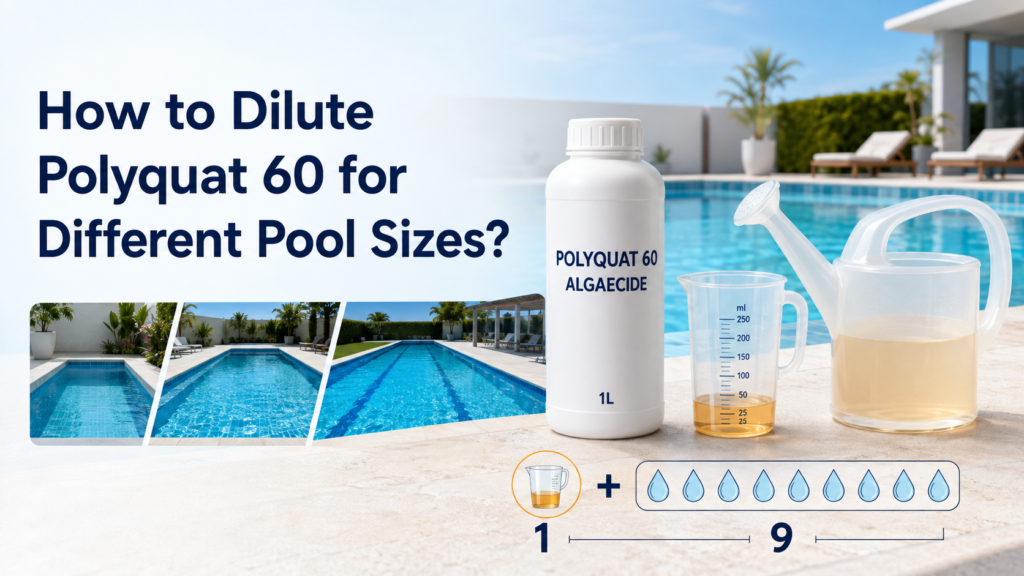
Clear pool water can make chemical treatment look wonderfully simple: measure the product, pour it into the pool, and let the circulation system take care of the rest. Yet concentrated Polyquat 60 deserves a little more thought.
Should you add it directly to the water? Should you mix it with nine parts water? Does a 20,000-gallon pool need a stronger dilution than a 5,000-gallon pool?
Here is the key point: pool size changes the amount of Polyquat 60 you need, but it does not necessarily change the dilution ratio.
If the product label calls for pre-dilution with at least nine parts water, that ratio can remain the same for a small residential pool or a large commercial pool. You simply prepare more diluted solution for the larger pool.
Sounds straightforward. It is—once the dose and the dilution water are treated as two separate calculations.
First, What Does “Dilute Polyquat 60” Actually Mean?
Diluting Polyquat 60 means mixing a measured quantity of the concentrate with clean water before distributing it around the pool.
It does not mean reducing the required product dose.
Suppose your pool needs 4 US fluid ounces of Polyquat 60. If the label says to dilute the product with at least nine parts water, you would mix:
- 4 fl oz of Polyquat 60
- At least 36 fl oz of clean water
- 40 fl oz of prepared solution in total
The pool still receives 4 fl oz of active product. The extra 36 fl oz simply helps spread that product more evenly.
This distinction matters. Adding more dilution water does not weaken the treatment after the entire mixture enters the pool. The pool already contains thousands of gallons of water, after all. Pre-dilution is mainly a handling and distribution step.
A useful way to picture it is concentrated fruit syrup. A spoonful sitting at the bottom of a large pitcher will not disperse instantly. Mix it first, and distribution becomes much easier. Polyquat 60 is not fruit syrup, of course, but the physical principle is similar.
Why Pre-Dilute Polyquat 60 Before Pool Application?
Polyquat 60 is commonly supplied as a concentrated polymer solution. Depending on the formulation, it may be more viscous than ordinary pool water. Pouring a thick concentrate into one location can temporarily create a highly concentrated chemical zone.
Pre-dilution offers several practical advantages.
It encourages more even distribution
A larger solution volume is easier to sprinkle around the pool perimeter than a few ounces of concentrate. This is especially helpful around steps, corners, shallow shelves, ladders, and areas with weaker circulation.
It reduces local overconcentration
Even when a product is compatible with common pool surfaces, good distribution is sensible chemical handling. You want the treatment moving throughout the water—not sitting in one concentrated stream near a wall or fitting.
It makes small doses easier to apply
A 5,000-gallon pool may need only 2 fl oz during routine maintenance. Trying to distribute such a small amount around the whole pool is awkward. After 1:9 pre-dilution, those 2 fl oz become 20 fl oz of prepared solution.
That is much easier to spread.
It supports consistent treatment in larger pools
Commercial pools often have complicated shapes, greater surface areas, multiple returns, or circulation zones that behave differently. Preparing a larger diluted batch can help the operator divide the treatment among several application points.
One Polyquat 60% label, for example, directs users to dilute the measured product with at least nine parts water and apply it around the pool while circulation is running. Your particular label may give different directions, so always let that label take priority.
The Two Calculations You Need
Before mixing anything, complete two calculations:
- Calculate the required Polyquat 60 dose.
- Calculate the water needed for pre-dilution.
Do not reverse that order. The product dose depends on pool volume and treatment purpose. The dilution water depends on the amount of product already calculated.
Step 1: Calculate the product dose
For a label expressed per 10,000 US gallons:
Required Polyquat 60 dose = Pool volume ÷ 10,000 × Label dose
For example, imagine a 15,000-gallon pool and a maintenance rate of 4 fl oz per 10,000 gallons:
15,000 ÷ 10,000 × 4 = 6 fl oz
The required concentrate dose is 6 fl oz.
Step 2: Calculate the dilution water
For a minimum 1:9 product-to-water ratio:
Dilution water = Polyquat 60 dose × 9
Using the same example:
6 × 9 = 54 fl oz of water
The complete batch contains:
- 6 fl oz Polyquat 60
- 54 fl oz water
- 60 fl oz diluted solution
Notice how the numbers behave. At a 1:9 ratio, the final prepared solution is ten times the original concentrate volume.
A Note About Label Dosages
Polyquat product names can be confusing. Some retail products contain 60% active ingredient, while others contain 30%, 15%, or another concentration. Two bottles may both use the word “polyquat,” yet require different volumes per treatment.
That is why the active-ingredient panel matters more than the front-label name.
For the calculation tables below, we will use the following representative rates for a 60% Polyquat 60 formulation:
| Treatment purpose | Example dose per 10,000 US gallons |
|---|---|
| Initial clean-water treatment | 9 fl oz |
| Routine maintenance | 4 fl oz |
| Visible algae treatment | 16 fl oz |
These example rates correspond to the registered label cited above. They illustrate the calculation method; they do not replace the directions on your product.
Eautrix’s detailed Polyquat 60 dosage guide for swimming pool applications explains how concentration, pool condition, and treatment purpose influence the selected dose.
Polyquat 60 Dilution Chart for Different Pool Sizes
The table below uses a 1:9 product-to-water ratio. “Prepared solution” means the combined volume of Polyquat 60 and dilution water.
Routine Maintenance Example
| Pool size | Polyquat 60 dose | Dilution water | Total prepared solution |
|---|---|---|---|
| 5,000 gal | 2 fl oz | 18 fl oz | 20 fl oz |
| 10,000 gal | 4 fl oz | 36 fl oz | 40 fl oz |
| 15,000 gal | 6 fl oz | 54 fl oz | 60 fl oz |
| 20,000 gal | 8 fl oz | 72 fl oz | 80 fl oz |
| 25,000 gal | 10 fl oz | 90 fl oz | 100 fl oz |
| 30,000 gal | 12 fl oz | 108 fl oz | 120 fl oz |
This table demonstrates the central idea beautifully: the pool becomes larger, the product quantity increases, and the dilution water increases at the same rate. The ratio stays at 1:9.
Initial Clean-Water Treatment Example
| Pool size | Polyquat 60 dose | Dilution water | Total prepared solution |
|---|---|---|---|
| 5,000 gal | 4.5 fl oz | 40.5 fl oz | 45 fl oz |
| 10,000 gal | 9 fl oz | 81 fl oz | 90 fl oz |
| 15,000 gal | 13.5 fl oz | 121.5 fl oz | 135 fl oz |
| 20,000 gal | 18 fl oz | 162 fl oz | 180 fl oz |
| 25,000 gal | 22.5 fl oz | 202.5 fl oz | 225 fl oz |
| 30,000 gal | 27 fl oz | 243 fl oz | 270 fl oz |
For a large pool, the prepared batch may exceed the capacity of a household watering can. That is no problem. Divide the treatment into several equal batches while keeping the same ratio.
For example, a 20,000-gallon pool needs 18 fl oz of concentrate at this example rate. You could prepare two batches, each containing:
- 9 fl oz Polyquat 60
- 81 fl oz water
- 90 fl oz prepared solution
Both batches together still deliver the correct 18 fl oz dose.
Visible Algae Treatment Example
| Pool size | Polyquat 60 dose | Dilution water | Total prepared solution |
|---|---|---|---|
| 5,000 gal | 8 fl oz | 72 fl oz | 80 fl oz |
| 10,000 gal | 16 fl oz | 144 fl oz | 160 fl oz |
| 15,000 gal | 24 fl oz | 216 fl oz | 240 fl oz |
| 20,000 gal | 32 fl oz | 288 fl oz | 320 fl oz |
| 25,000 gal | 40 fl oz | 360 fl oz | 400 fl oz |
| 30,000 gal | 48 fl oz | 432 fl oz | 480 fl oz |
A visible algae problem usually needs more than algaecide alone. Brushing, filtration, debris removal, circulation, sanitizer management, and correct water balance all matter.
Polyquat 60 can support algae control, but it does not replace an approved primary sanitizer. Pouring in extra product while ignoring a dirty filter or low sanitizer level is a bit like mopping the floor while the tap is still running. More chemical is not always the answer.
Metric Calculations for Residential and Commercial Pools
Many pool operators work in cubic metres and millilitres rather than gallons and fluid ounces.
The following conversions are helpful:
- 1 US fluid ounce = approximately 29.57 mL
- 1 cubic metre = 1,000 litres
- 10,000 US gallons = approximately 37.85 m³
If a label rate is given per 10,000 gallons, the metric formula is:
Dose in mL = Pool volume in m³ ÷ 37.85 × Label dose in mL
At the example maintenance rate of 4 fl oz per 10,000 gallons:
- 4 fl oz = approximately 118 mL
- 118 ÷ 37.85 = approximately 3.12 mL per m³
Metric Maintenance Example
| Pool volume | Polyquat 60 concentrate | Water for 1:9 dilution | Prepared solution |
|---|---|---|---|
| 10 m³ | 31 mL | 279 mL | 310 mL |
| 20 m³ | 62 mL | 558 mL | 620 mL |
| 30 m³ | 94 mL | 846 mL | 940 mL |
| 40 m³ | 125 mL | 1,125 mL | 1,250 mL |
| 50 m³ | 156 mL | 1,404 mL | 1,560 mL |
| 100 m³ | 312 mL | 2,808 mL | 3,120 mL |
Small differences caused by rounding are normal. Use a properly graduated chemical measuring container rather than an ordinary drinking cup or kitchen spoon.
For commercial operations, recording the unrounded calculation in a maintenance log can improve consistency between shifts. The actual measured dose can then be rounded only as far as the equipment allows.
How to Pre-Dilute and Apply Polyquat 60
Before starting, read the complete product label and safety data sheet. Wear the personal protective equipment stated in those documents, and keep swimmers away during chemical application according to label directions and local operating rules.
1. Confirm the product concentration
Check the active-ingredient panel. Do not assume every bottle carrying the word “polyquat” contains 60% active material.
The Polyquat 60 Algaecide provides the active ingredient, chemical identity, CAS number, and product positioning for the Eautrix formulation.
2. Confirm the pool volume
Use the pool’s documented volume when available. If you need an estimate, calculate it from the pool dimensions and average depth.
For a rectangular pool measured in feet:
Length × Width × Average depth × 7.48 = Approximate US gallons
For a circular pool:
Diameter × Diameter × Average depth × 5.9 = Approximate US gallons
Irregular pools may need to be divided into smaller geometric sections. An inaccurate volume estimate creates an inaccurate chemical dose, no matter how carefully you measure afterward.
3. Choose the correct label rate
Decide whether the application is:
- An initial treatment for clean water
- Routine preventive maintenance
- Treatment for visible algae
- Pool opening
- Pool closing or winterization
Do not use a visible-algae rate merely because “a little more should work better.” Higher dosing can increase cost, consume sanitizer, affect filtration, or create unnecessary treatment complications.
4. Measure the concentrate
Use a dedicated, chemical-resistant measuring cup with clear fluid-ounce or millilitre markings. Never return excess measured product to the original container unless the label specifically permits it; contamination can compromise the remaining material.
5. Prepare the diluted solution
Use a clean plastic watering can or another label-approved plastic container.
Follow the order and ratio printed on the product label. For a label requiring at least nine parts water, ensure the container has enough free capacity for the full diluted batch. If it does not, prepare several smaller batches.
Never combine Polyquat 60 with chlorine, acid, alkali, oxidizer, or another concentrated pool chemical in the same container. Compatibility in the pool does not mean concentrated chemicals are safe to premix.
6. Keep the circulation system running
Operating the circulation system helps move the treatment through the pool. Check that the pump, returns, and filter are working normally before application.
A chemical cannot distribute well through water that barely moves.
7. Apply around the pool perimeter
Distribute the diluted solution gradually around the edge of the pool, following the label. Give extra attention to areas with weaker circulation, but do not pour the whole batch into a single corner or directly through the skimmer unless your product label specifically instructs you to do so.
Avoid splashing and work from a stable position. A wet pool deck is not the place for hurried chemical handling.
8. Allow adequate circulation
Continue circulating for the period stated on the label. For visible algae, brush affected surfaces and remove dead or loosened material through normal vacuuming and filtration procedures.
The article When Should You Add Polyquat 60 During Pool Maintenance? explains how application timing fits with routine sanitation, pool shocking, and seasonal care.
Does a Larger Pool Need a Stronger Mixture?
Usually, no.
If the label specifies a 1:9 product-to-water ratio, a 30,000-gallon pool does not need a 1:4 mixture simply because it is larger. It needs a larger quantity of product and, correspondingly, a larger quantity of dilution water.
Compare these maintenance examples:
| Pool volume | Concentrate | Water | Ratio |
|---|---|---|---|
| 5,000 gal | 2 fl oz | 18 fl oz | 1:9 |
| 20,000 gal | 8 fl oz | 72 fl oz | 1:9 |
| 30,000 gal | 12 fl oz | 108 fl oz | 1:9 |
The prepared solution volume changes. The mixing ratio does not.
There may be operational reasons to use more dilution water than the stated minimum. A large commercial pool, for instance, may benefit from a greater application volume because it must be divided among several zones. If the label permits additional water, that does not change the active Polyquat 60 dose.
Common Polyquat 60 Dilution Mistakes
Confusing dilution ratio with dosage rate
A 1:9 dilution does not mean adding one gallon of Polyquat 60 for every nine gallons of pool water. It describes the temporary mixture in the application container.
That misunderstanding would cause a spectacular overdose. Not the kind of pool story anyone wants to tell.
Measuring fluid ounces as weight
Pool labels commonly express liquid doses in US fluid ounces, which measure volume. A kitchen scale measures weight. The two values are not interchangeable unless the product density is known and the conversion has been calculated correctly.
Use a graduated liquid measure.
Calculating from the wrong pool volume
A pool described as “about 20,000 gallons” may actually hold 16,000 or 23,000 gallons. Construction plans, equipment records, water-meter readings during filling, or reliable dimensional calculations can provide a better figure.
Using the same dose for every treatment
Maintenance, initial treatment, visible algae, and winter closing may require different label rates. The dilution process may look the same, but the concentrate dose can change substantially.
Adding concentrate and other chemicals together
Never premix concentrated Polyquat 60 with chlorine shock, acid, or other treatment products. Add each chemical separately and follow the spacing, circulation, and timing directions on its label.
Treating dilution water as part of the product dose
If a pool needs 8 fl oz of Polyquat 60, preparing 80 fl oz of diluted solution does not mean the product dose became 80 fl oz. Only 8 fl oz is concentrate; the other 72 fl oz is carrier water.
Write both figures on your service sheet to prevent confusion.
Dilution During Routine Maintenance
Routine Polyquat 60 treatment works as a supporting layer in a broader maintenance program.
Before application, check:
- Sanitizer concentration
- pH
- Circulation and filtration
- Visible debris
- Water clarity
- Recent rainfall or heavy swimming
- Signs of algae in low-flow areas
Hot weather, storms, heavy swimmer loads, and long periods of direct sunlight can raise algae pressure. Still, the answer is not automatically a stronger Polyquat mixture. First determine whether the pool needs an adjusted label-approved dose, better circulation, additional brushing, or correction of the sanitizer level.
The Polymer Pool Clarifier may also support water clarity when suspended particles are part of the problem. A clarifier and an algaecide serve different primary purposes, so they should be selected and applied according to their individual labels.
What About Pool Closing and Winterization?
Pool closing deserves its own calculation.
Winter products may contain Polyquat 60 or another polyquat-based formulation, but the correct dose can differ from the normal weekly rate. Water temperature, closing conditions, off-season length, cover type, and sanitizer level can all influence the treatment program.
Do not simply multiply the weekly dose by the number of winter months. The chemistry does not work like a prepaid calendar subscription.
Instead:
- Clean the pool thoroughly.
- Balance the water.
- Follow the required sanitizer procedure.
- Allow sanitizer levels to reach the range permitted by the winter-treatment label.
- Measure the specified winter dose.
- Pre-dilute it only as directed.
- Distribute it with adequate circulation before completing the closing process.
For seasonal formulations, see the Eautrix Winter Algaecide.
A Simple Field Checklist
Before leaving the equipment room, confirm five numbers:
- Pool volume
- Product concentration
- Label dose per reference volume
- Calculated concentrate dose
- Required dilution water
Then record:
- Date and time
- Water-test results
- Amount applied
- Dilution ratio
- Circulation status
- Operator name or initials
This small habit prevents many repeat-dosing errors. It also gives pool service companies a clear treatment history if water conditions change unexpectedly.
The Practical Takeaway
Diluting Polyquat 60 for different pool sizes is less complicated than it first appears.
Start with the pool volume. Select the label rate for the actual treatment purpose. Calculate the required concentrate dose. Only then calculate the dilution water.
If the label requires at least nine parts water for every one part product, keep that ratio consistent:
Polyquat 60 dose × 9 = Minimum dilution water
A small pool needs a smaller batch. A large pool needs a larger batch. The chemistry behind the ratio remains the same.
And one final reminder: a calculation table is a planning tool, not permission to ignore the container label. Product concentration and registered directions can vary. When the label and a general guide disagree, the label wins.
Frequently Asked Questions
1. What is the correct water-to-Polyquat 60 dilution ratio?
Some 60% Polyquat 60 product labels direct users to mix one part product with at least nine parts water before application. This creates a 1:9 product-to-water mixture. Always check your own label because dilution directions can vary.
2. How much diluted Polyquat 60 do I need for a 10,000-gallon pool?
Using an example maintenance dose of 4 fl oz and a 1:9 dilution ratio, mix 4 fl oz of Polyquat 60 with 36 fl oz of water. This produces 40 fl oz of prepared solution. Use the dose printed on your specific product label.
3. Can I pour Polyquat 60 directly into my swimming pool?
Only if the product label allows direct application. When the label calls for pre-dilution, measure the concentrate, mix it with the specified amount of clean water, and distribute the solution around the pool while circulation is running.
4. Does adding more dilution water reduce Polyquat 60 effectiveness?
Adding more carrier water does not reduce the final dose as long as the entire prepared solution is added to the pool. The amount of Polyquat 60 concentrate—not the temporary solution volume—determines the treatment dose.
5. Should I use a stronger Polyquat 60 dilution for visible algae?
Visible algae may require a higher label-approved product dose, but not necessarily a stronger pre-dilution ratio. Increase the concentrate only according to the label, maintain the required water ratio, and combine treatment with brushing, filtration, sanitation, and debris removal.