
GET IN TOUCH
Ask For Sample?
Polyquat 60 vs Quaternary Ammonium Algaecides
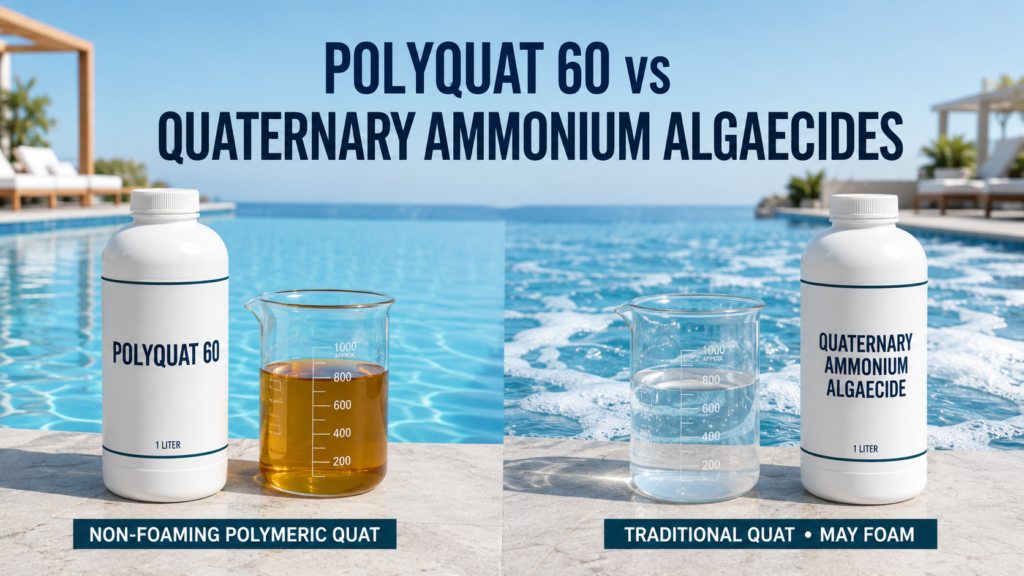
A swimming pool algaecide labeled “quat” may sound almost identical to a product labeled “Polyquat 60.” Chemically, they do belong to the same broad family. In the pool, though, their behavior can be quite different.
Traditional quaternary ammonium algaecides—often called linear quats—are economical and can work well in light-duty algae-prevention programs. Their main drawback is familiar to many pool operators: too much product, strong circulation, or aerated water may produce a blanket of foam.
Polyquat 60 was developed around a polymeric quaternary ammonium structure. It retains the positive charge that makes quats useful against algae, but its longer molecular chains provide a different performance profile. It is generally non-foaming, metal-free, concentrated, and suitable for pools where appearance and water movement matter.
So, is Polyquat 60 always the better algaecide? Not automatically. The right answer depends on the pool, the maintenance program, the formulation concentration, and the result the buyer expects.
This comparison explains where the two chemistries overlap—and where they clearly part ways.
First, Let’s Clear Up the Naming Confusion
Polyquat 60 and quaternary ammonium algaecides are sometimes presented as two unrelated product classes. Strictly speaking, that is not accurate.
Polyquat 60 is itself a quaternary ammonium compound. More precisely, it is a polymeric quaternary ammonium compound—a cationic polymer containing multiple positively charged sites along its molecular chain.
Traditional pool quats, by comparison, are generally smaller, non-polymeric cationic surfactants. Alkyl dimethyl benzyl ammonium chloride, commonly abbreviated as ADBAC and often associated with benzalkonium chloride chemistry, is a familiar example. The U.S. Environmental Protection Agency has documented ADBAC-containing end-use products for residential and commercial swimming pools.
In plain English, the comparison is not really “quat versus non-quat.” It is:
- Polymeric quaternary ammonium algaecide
- Conventional or linear quaternary ammonium algaecide
That distinction matters. Molecular structure affects how a chemical moves through water, interacts with cell surfaces, behaves under aeration, and performs alongside other pool-treatment products.
There is another naming detail worth noticing. The number “60” normally refers to a product containing about 60% active polymer—not to a molecular-weight grade or a promise that the product is 60% stronger than every alternative.
For Eautrix formulations, the active ingredient commonly associated with Polyquat 60 Algaecide is Polixetonium Chloride, also identified as Polyquaternium-42 and CAS No. 31512-74-0. PubChem lists Polixetonium Chloride and Polyquaternium-42 under this CAS identity.
Still, commercial naming practices vary. Buyers should always examine the active ingredient, active concentration, technical data sheet, safety data sheet, and applicable registration documents rather than relying on the front-label name alone.
Polymeric Chains Change the Way the Product Behaves
Traditional quaternary ammonium compounds are cationic surfactants. A typical molecule has a positively charged nitrogen center and hydrophobic groups that interact with biological membranes and organic material.
This dual character gives conventional quats their antimicrobial and algaecidal activity. It also makes many of them surface-active—and surface activity is closely connected with foam.
Polyquat 60 takes a different structural route. Instead of depending on relatively small surfactant molecules, it uses a long-chain, water-soluble polymer carrying repeated cationic sites.
Imagine the difference between a small hook and a long strip containing many hooks. Both can catch onto a surface, but the pattern and strength of interaction will not be the same.
This polymeric structure helps explain several familiar Polyquat 60 characteristics:
- Low foaming tendency
- Strong attraction to negatively charged biological surfaces
- Good dispersion in properly circulated water
- Added interaction with suspended particles
- Longer practical persistence than many conventional linear quats
- Effective performance at relatively low in-pool concentrations
These characteristics do not mean the product remains unchanged forever. Chlorine, organic contamination, filtration, sunlight, dilution, and contact with pool surfaces can all reduce the amount of active material available in the water.
“Long-lasting” should therefore mean more persistent within a maintenance program—not permanent.
How Do These Algaecides Affect Algae?
Both product types rely on cationic chemistry.
“Cationic” means positively charged. Algae cell surfaces commonly contain negatively charged components. When a cationic algaecide reaches the cell, electrostatic attraction helps bring the active material into close contact with that surface.
Traditional quats can interact with the cell membrane and disturb its normal barrier function. When that barrier loses integrity, essential cellular processes fail. The algae may no longer regulate the movement of water, nutrients, and dissolved substances correctly.
Polyquat 60 also attaches to negatively charged cell surfaces. Because the active ingredient is a polymer with multiple cationic sites, it can create broader contact with biological material. This interaction can interfere with cell-envelope function, restrict growth, and help prevent algae from becoming established.
There may also be a secondary water-clarity benefit. Cationic polymers can interact with small negatively charged suspended particles and algae debris, making some material easier for the filtration system to capture.
That does not turn every Polyquat 60 product into a dedicated clarifier. Nor does it eliminate the need to clean the filter. It simply explains why well-formulated polymeric algaecides may support a cleaner-looking pool while controlling algae.
Where fine suspended particles—not active algae—are the main problem, a dedicated Polymer Pool Clarifier is the more suitable formulation. Algaecide and clarifier can support the same maintenance program, but they do different jobs.
The Quick Comparison
| Performance factor | Polyquat 60 | Traditional quaternary ammonium algaecide |
|---|---|---|
| Chemical type | Polymeric quaternary ammonium compound | Usually a smaller, linear quaternary ammonium surfactant |
| Typical commercial strength | Often about 60% active | Frequently sold at lower active concentrations, although formulas vary |
| Foam tendency | Very low or non-foaming when formulated and dosed correctly | Can foam, especially after overdosing or under strong aeration |
| Metal content | Metal-free | Generally metal-free |
| Staining risk from active ingredient | Does not introduce copper or other staining metals | Does not introduce copper or other staining metals |
| Residual performance | Generally more persistent | Often has a shorter practical residual |
| Water features and spas | Usually a better fit where turbulence is high | Foam can become noticeable in aerated systems |
| Purchase price per liter | Usually higher | Usually lower |
| Amount required | Concentrated products often require less volume | Dilute formulas may require more product |
| Main role | Professional preventive treatment, seasonal care, and sensitive installations | Economical routine prevention in suitable pools |
| Chlorine relationship | Compatible when label directions are followed, but chlorine gradually consumes it | Generally compatible at labeled levels, although excessive sanitizer or poor timing can reduce performance |
| Corrective treatment | Can assist algae-control programs | May assist light algae treatment; severe blooms still require full remediation |
This table gives the broad pattern. The product label remains the final authority because two containers carrying similar marketing names may contain very different active concentrations.
Foam Is the Difference Pool Owners Notice First
Foam is usually where traditional quats reveal themselves.
Because many conventional quaternary ammonium compounds behave like surfactants, they lower surface tension. If water is heavily agitated—through spa jets, fountains, waterfalls, return lines, or vigorous swimming—air becomes trapped and persistent bubbles may form.
A correctly dosed linear quat may produce little visible foam in a calm pool. Add too much, however, and the water can start looking as though someone poured in detergent.
The problem becomes more obvious in:
- Pools with attached spas
- Infinity-edge pools
- Splash pads
- Pools with waterfalls or deck jets
- Therapy pools with strong aeration
- Commercial pools with high swimmer activity
Polyquat 60 is widely described as non-foaming because its polymeric structure is much less likely to create stable surfactant foam. This makes it particularly useful in pools where turbulence is unavoidable or where appearance must remain consistently polished.
A hotel guest does not care that the foam is chemically explainable. Foam looks like poor housekeeping. That perception alone can make a non-foaming formula worth the additional cost.
Still, “non-foaming” assumes correct formulation and use. Added surfactants, incompatible blended ingredients, contamination from cleaning products, or extreme overdosing may change what appears in the pool. Buyers evaluating a private-label formula should test the complete finished product—not just the raw active ingredient.
What About Pool-Surface Staining?
Neither Polyquat 60 nor a conventional quat needs copper to control algae. Both can therefore be formulated as metal-free algaecides.
That is an important advantage over copper-based products. Dissolved copper may contribute to blue, green, blue-green, turquoise, or dark discoloration when it precipitates or deposits on certain surfaces. The exact appearance depends on water chemistry, oxidation state, surface type, and other substances present.
Polyquat 60 does not introduce copper ions, so it does not create copper-related staining by itself. The same is generally true for a pure conventional quat formula.
This does not mean every stain appearing after treatment was caused—or prevented—by the algaecide. Existing metals may already be present in:
- Fill water
- Corroding equipment
- Copper plumbing or heat exchangers
- Previous metal-based treatments
- Certain mineral systems
- Contaminated chemicals
If a pool turns green immediately after shock treatment while the water remains clear rather than cloudy, metals may be involved. Green algae more often brings dullness, cloudiness, slippery surfaces, or visible deposits.
So, yes, metal-free chemistry lowers a specific staining risk. It cannot remove metals that are already in the water.
Polyquat 60 Usually Wins the Residual-Protection Round
Traditional quats can act quickly on exposed algae cells, but their smaller surfactant molecules may be consumed, diluted, filtered, or bound by organic matter relatively quickly. Their useful activity can decline sooner in a busy outdoor pool.
Polyquat 60 generally provides a more persistent preventive effect. Its polymer chains interact strongly with algae and suspended material, which can help it remain useful through a longer maintenance window.
This is valuable during periods when algae risk rises:
- Hot summer weather
- Heavy rain and wind
- High swimmer loads
- Reduced circulation
- Pool closing
- Extended periods without daily supervision
- Startup after a temporary shutdown
Persistence should not be confused with immunity from chlorine. Chlorine gradually oxidizes Polyquat 60. A high shock dose may consume it faster than a normal sanitizer residual does.
Timing therefore matters. Depending on the registered product directions, a maintenance team may add Polyquat 60 after shock treatment has circulated and the sanitizer level has returned to the appropriate range.
For winter closing, operators should follow the specific label sequence rather than improvising from a general dosing chart.
Neither Product Replaces Chlorine
This point deserves repeating: an algaecide is not a full substitute for a primary pool sanitizer.
Chlorine and bromine are used to control a much broader range of microorganisms and to oxidize swimmer waste and other contaminants. Polyquat 60 and conventional quat algaecides are primarily selected to prevent or control algae within a complete pool-care program.
A dependable program still requires:
- Correct sanitizer residual
- Suitable pH
- Adequate circulation
- Effective filtration
- Routine brushing
- Debris removal
- Filter cleaning or backwashing
- Attention to cyanuric acid in stabilized chlorine pools
- Accurate testing
If a pool already resembles pea soup, pouring in extra algaecide is rarely the whole answer. The pool may need brushing, filtration, oxidation, vacuuming, water balancing, and repeated testing.
Think of algaecide as a guard at the gate. It helps stop algae from settling in. It is not a cleanup crew for every severe bloom.
Which Product Works Better with Chlorine?
Both types can be used in chlorinated pools when the finished product is registered for that application and label directions are followed.
Polyquat 60 is often preferred in routine chlorine programs because it adds algae control without adding metals or causing the typical foam associated with linear quats. It also works through a non-oxidizing mechanism, so it supports rather than duplicates the sanitizer’s role.
That said, chlorine will gradually react with organic polymeric algaecide. This is normal. It means treatment intervals and dosage must account for sanitizer level, bather load, water temperature, and contamination.
Conventional quats may also be affected by chlorine and organic load. Their shorter practical persistence can require more frequent maintenance dosing, depending on the formulation.
Avoid adding concentrated chemicals into the same bucket or pouring them together into one spot. “Compatible in pool water” does not mean “safe to mix as concentrates.” Each product should be added separately according to its label, with circulation running where instructed.
Cost per Bottle Can Be Misleading
Traditional quat algaecides often have a lower shelf price. For price-sensitive residential markets, that is appealing. A pool owner sees two bottles and naturally reaches for the cheaper one.
But price per bottle is not the same as treatment cost.
A useful comparison considers:
- Active ingredient identity
- Active concentration
- Initial treatment dose
- Weekly maintenance dose
- Frequency of application
- Pool volume treated
- Foam-control requirements
- Labor needed for repeat dosing
- Risk of customer complaints
- Packaging and shipping cost per treatment
Suppose a dilute traditional quat requires a larger weekly dose and needs more frequent addition. Its initial price may be lower, yet the cost per treated cubic meter may be closer to that of a concentrated polymeric product than expected.
Polyquat 60 normally costs more per kilogram or liter because it is concentrated and the polymer chemistry is more expensive. Its lower dose volume, low-foam behavior, and residual performance can justify that price in professional markets.
For distributors, this creates two different positions rather than one simple winner:
- Traditional quat: economical, entry-level algae prevention
- Polyquat 60: concentrated, professional, non-foaming algae control
The better commercial choice depends on the customer segment.
When Does a Traditional Quat Still Make Sense?
Traditional quaternary ammonium algaecides have not disappeared—and for good reason. They can provide practical algae prevention when used correctly.
A conventional quat may suit:
- Calm residential pools without water features
- Budget-oriented maintenance ranges
- Low-dose preventive programs
- Pools with limited aeration
- Markets accustomed to economical weekly treatments
- Formulations where mild foaming is acceptable
The crucial phrase is “used correctly.” Overdosing does not guarantee better algae control. It often guarantees more foam.
Traditional quats may also be sold in several concentrations. A 10% product and a 50% product cannot be compared by container size alone. Dilution, dosing instructions, and active-cost calculations must be included.
For a simple backyard pool with steady sanitation and no attached spa, a well-formulated traditional quat may do the intended job at a sensible cost.
When Is Polyquat 60 the Stronger Choice?
Polyquat 60 becomes more attractive when water appearance, formulation quality, and maintenance reliability carry more weight than the lowest possible purchase price.
It is often selected for:
- Hotels and resorts
- Commercial pools
- Pools with spas or water features
- High-circulation systems
- Premium residential pool-care lines
- Professional service programs
- Metal-sensitive pool finishes
- Winter closing products
- Private-label non-foaming algaecides
- Pools that need added preventive support during high-risk weather
Its metal-free formulation avoids introducing copper, while its low-foam profile preserves the clean visual effect customers expect.
For long off-season periods, Polyquat-based products may also be incorporated into a purpose-designed Winter Algaecide. A winter formula should be evaluated as a complete product, since closing conditions, temperature, circulation, and expected storage time differ from weekly summer maintenance.
Can Either One Remove Established Black Algae?
Black algae is not simply green algae wearing a darker coat. It can form stubborn colonies protected by layered growth and can anchor itself in porous plaster or concrete surfaces.
An algaecide may contribute to the treatment, but the chemistry must reach the living material. That often requires firm brushing to break the protective layer, attention to sanitizer levels, repeated treatment, and thorough filtration.
Polyquat 60 is frequently used in broad algae-control programs, including support against difficult algae. Its polymeric character and non-foaming performance make it useful in intensive treatment plans.
Yet no honest product description should imply that one dose will always erase a mature black-algae infestation. Pool surface, colony depth, circulation, sanitizer condition, and application method all matter.
Traditional quats may help with early growth or ongoing prevention, but they are generally less attractive for a demanding corrective program—especially if the required dose creates foam.
For either chemistry, prevention is easier than rescue. A faint spot today can become a weekend-long cleaning job later.
What Pool Chemical Buyers Should Check
A buyer sourcing algaecide for distribution or private labeling should look beyond claims such as “strong,” “professional,” or “premium.”
Ask for specific information:
- Exact active ingredient
- CAS number
- Active-content range
- Appearance and color
- pH
- Density
- Viscosity
- Foaming test results
- Recommended dosage range
- Compatibility information
- Shelf-life data
- Packaging options
- Certificate of Analysis
- Safety Data Sheet
- Regulatory status in the destination market
For Polyquat 60, viscosity and active content deserve particular attention. Polixetonium Chloride-based Polyquat 60 is commonly supplied as a clear amber, water-soluble, viscous liquid, although appearance can vary with specification and production conditions.
A very thin product offered as “Polyquat 60” should invite questions. It might still be legitimate, but the supplier should be able to explain the specification and provide analytical data.
The same caution applies to a product sold merely as “quat algaecide.” Which quat? At what active concentration? Is it a single active or a blend? Is the dosage based on the concentrate or on active material?
Names sell products. Specifications tell you what you are buying.
So, Which Algaecide Is Better?
Polyquat 60 provides the more balanced performance profile for many professional pool applications. It is concentrated, non-metallic, normally non-foaming, and well suited to preventive and seasonal maintenance.
Traditional quaternary ammonium algaecides remain useful when cost is the primary concern and the pool has limited aeration. They can deliver economical algae prevention, provided the user controls the dose and accepts the possibility of foam.
The real choice can be summarized simply:
Choose a traditional quat when you need an economical preventive product for a relatively calm pool.
Choose Polyquat 60 when you need low foam, concentrated performance, broader application flexibility, and a more professional product position.
Neither choice excuses poor sanitation, weak circulation, or neglected filtration. Good pool care is a system. Even an excellent algaecide cannot compensate forever for water chemistry that has been left to drift.
Frequently Asked Questions
1. Is Polyquat 60 a Quaternary Ammonium Algaecide?
Yes. Polyquat 60 is a polymeric quaternary ammonium algaecide. Unlike traditional linear quats, it contains long polymer chains with repeated positive charges. That structural difference contributes to its low-foam and persistent performance.
2. Does Polyquat 60 Foam in Swimming Pools?
A properly formulated and correctly dosed Polyquat 60 algaecide is generally considered non-foaming. This makes it suitable for pools with spas, fountains, waterfalls, jets, and other features that strongly agitate the water.
3. Can Traditional Quaternary Ammonium Algaecide Cause Staining?
Traditional quats are normally metal-free and do not create copper staining by themselves. Their more familiar drawback is foam. However, a finished blend should always be checked because additional ingredients may change its behavior.
4. Can Polyquat 60 Be Used with Chlorine Shock?
Polyquat 60 can be used in chlorine-maintained pools, but concentrated chemicals should never be mixed directly. High chlorine levels can consume the polymer more quickly, so application timing must follow the registered product label.
5. Is Polyquat 60 Worth the Higher Price Compared with a Regular Quat Algaecide?
It often is for commercial pools, premium residential products, attached spas, water features, and seasonal maintenance. Buyers should compare active concentration, dose per pool volume, treatment frequency, foam risk, and labor—not bottle price alone.