
GET IN TOUCH
Ask For Sample?
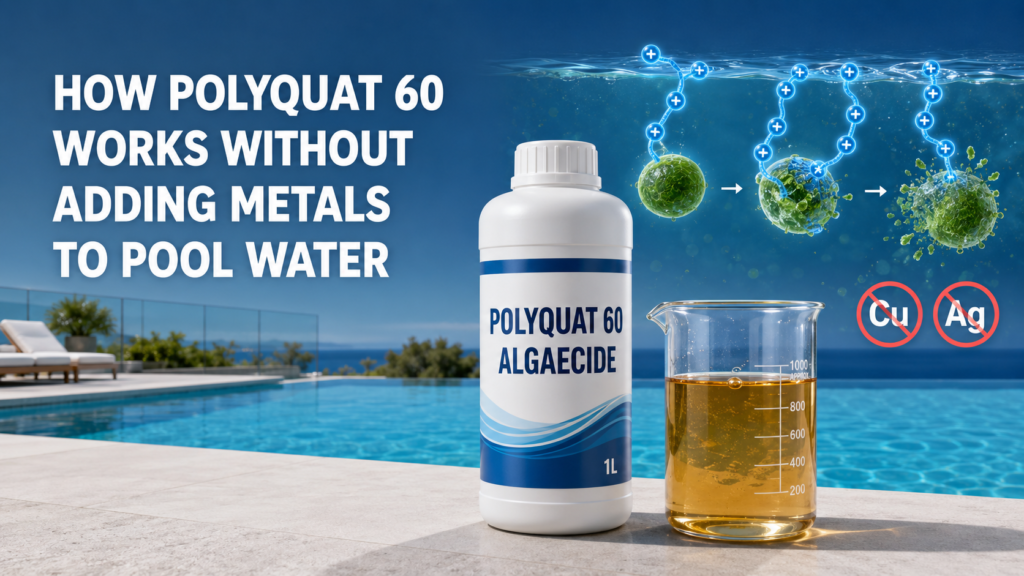
How Polyquat 60 Works Without Adding Metals to Pool Water?
Pool algae control often comes with a trade-off. A treatment may remove the algae, yet leave behind another problem—stained plaster, discolored water, or metal deposits that become harder to manage over time.
Polyquat 60 takes a different route.
Instead of using copper, silver, or another biologically active metal, Polyquat 60 relies on a positively charged organic polymer. This polymer interacts with negatively charged algae cells, interferes with their protective membranes, and limits their ability to survive and multiply.
No copper ions are needed. No silver ions are released. The algae-control effect comes from electrical charge and polymer chemistry.
That sounds straightforward, but what actually happens after Polyquat 60 enters the water? And why does avoiding metals matter so much in a swimming pool?
Let’s explain it without turning the pool into a chemistry lecture.
What Exactly Is Polyquat 60?
Polyquat 60 is the common pool-industry name for a concentrated polymeric quaternary ammonium algaecide. Many commercial products in this category use Polixetonium Chloride, also known as Polyquaternium-42, as their active ingredient.
Its chemical identification is commonly given as:
- Chemical name: Poly[oxyethylene(dimethyliminio)ethylene(dimethyliminio)ethylene dichloride]
- Common name: Polixetonium Chloride
- CAS number: 31512-74-0
- Chemical family: Polymeric quaternary ammonium compounds
- Typical commercial concentration: Approximately 60% active ingredient
The name itself provides a useful clue.
“Poly” refers to a polymer—a comparatively large molecule built from repeating units. “Quat” refers to quaternary ammonium groups, which carry a permanent positive charge. The number “60” generally indicates the approximate active concentration of the supplied raw material or concentrated product.
The important feature is not the name, though. It is the molecular charge.
Polyquat 60 contains multiple positively charged sites along a water-soluble polymer chain. These sites allow it to interact with algae without depending on copper or another metal as the active algae-control component.
For a broader introduction to the product, see Polyquat 60 Algaecide, including its typical properties and pool-care applications.
Why Are Metals Used in Some Pool Algaecides?
Copper has a long history in algae control. When a copper-based algaecide dissolves, it releases copper ions into the water. These ions interfere with several essential biological processes inside algae cells.
Copper may affect:
- Enzyme activity
- Photosynthesis
- Cell metabolism
- Protein function
- Algae reproduction
In a carefully managed system, copper can be effective. Its persistence in water may also provide an extended algae-control effect.
But persistence has another side.
Copper does not simply disappear when its algae-control job is finished. Depending on water chemistry, some of it may remain dissolved, bind to other substances, precipitate, or deposit on pool surfaces.
This is where the familiar problems begin.
Elevated metal levels or unfavorable pH conditions can contribute to:
- Blue, green, gray, or dark pool stains
- Discolored plaster and grout
- Deposits around fittings and steps
- Green discoloration of light-colored hair
- Water tinting after oxidation
- More complicated stain-removal treatments
Official public-pool guidance also recognizes that heavy metals such as copper, iron, manganese, and silver can contribute to staining and water discoloration under certain conditions. That does not mean every copper treatment will stain a pool, but it does mean that metal concentration and water balance must be watched carefully.
Polyquat 60 avoids this particular route because its active mechanism is based on a charged organic polymer—not a dissolved metal ion.
So, How Does Polyquat 60 Work Without Metals?
The short answer is electrostatic attraction followed by disruption of normal cell function.
Most algae cell surfaces develop an overall negative electrical character under typical pool-water conditions. Polyquat 60 is strongly cationic, meaning positively charged.
Opposite charges attract.
When Polyquat 60 is dispersed through the pool, its positively charged polymer chains are drawn toward negatively charged sites on algae cells. The polymer then attaches to the cell surface at multiple points.
Think of it less like one hook catching a fish and more like a strip of hook-and-loop fastener touching a fabric surface. A polymer chain can form several points of contact. This multipoint attachment helps it remain associated with the biological surface.
Once attached, Polyquat 60 can disturb the membrane processes that algae need to stay alive.
The overall sequence looks something like this:
- The concentrated liquid is diluted into the circulating pool water.
- Water-soluble polymer chains disperse through the pool.
- Positive sites on the polymer encounter negatively charged algae surfaces.
- The polymer adsorbs onto the cells.
- Cell-membrane organization and permeability are disturbed.
- Nutrient exchange and other normal functions become less efficient.
- Algae growth slows, and affected cells may lose viability.
- Filtration and physical cleaning help remove suspended or weakened material.
None of these steps requires copper, silver, or another metal.
The polymer’s electrical charge does the initial targeting. Its interaction with the cell envelope produces the biological effect.
The Algae Cell Membrane Is the Main Target
An algae cell membrane is not merely a thin wrapper. It is a working boundary that separates the inside of the cell from the surrounding water.
It helps the cell:
- Maintain internal chemical balance
- Control the movement of ions
- Absorb nutrients
- Remove waste
- Preserve energy-related gradients
- Support growth and reproduction
Polyquat 60 can interfere with this boundary after attaching to the cell surface. The membrane may become less organized or more permeable, making it difficult for the cell to control what moves in and out.
Imagine a swimming pool with dozens of uncontrolled leaks. The pool might still exist, but maintaining the correct water level would become nearly impossible. An algae cell faces a comparable problem when its membrane can no longer regulate exchange properly.
This is why Polyquat 60 can control algae without behaving like an oxidizer or metal poison. It attacks a physical and electrochemical weakness of the cell.
The process is also why uniform distribution matters. An EPA-registered label for a product containing this polymer chemistry specifically notes that even distribution through the pool water is necessary for maximum effectiveness. Product directions and concentrations vary, so the applicable label must always govern actual use.
Does Polyquat 60 Kill Algae or Only Prevent It?
It can serve both purposes, but prevention is usually where Polyquat 60 feels most at home.
When algae cells are exposed to an adequate concentration, the polymer can damage them and reduce their viability. However, a severe established bloom creates a much larger treatment burden than a few early cells trying to gain a foothold.
A green pool may contain:
- A high algae population
- Dead and living organic matter
- Poor circulation zones
- High chlorine demand
- Debris on the floor
- Algae attached beneath ladders or inside fittings
Adding one chemical and walking away is unlikely to solve all of that.
For visible algae, a complete recovery program may include brushing, filtration, debris removal, sanitizer correction, pH adjustment, and an algaecide used according to its approved label. Polyquat 60 can support the treatment, but it cannot physically remove piles of dead cells or repair inadequate circulation.
Routine maintenance is different. A smaller number of algae cells is easier to control before they develop into a visible colony. Regular preventive treatment can interfere with early growth, especially during warm weather, heavy use, storms, or short interruptions in normal sanitizer control.
That is the quiet strength of Polyquat 60. It helps stop a small problem from becoming a weekend-consuming mess.
Non-Metal Does Not Mean Non-Chemical
The phrase “metal-free algaecide” sometimes creates the wrong impression.
Polyquat 60 is still an active chemical treatment. It should be measured, handled, stored, and dosed according to the product label and safety documentation. Pouring in more than recommended will not automatically create better water.
Its non-metal character simply describes the source of its algae-control activity.
A Polyquat 60 formulation does not need copper or silver as the active algaecidal ingredient. Instead, it uses a synthetic cationic polymer.
This distinction matters because it avoids adding a persistent metal load, but it does not remove the need for:
- Proper dosage
- Adequate circulation
- Correct pH
- Routine sanitizer testing
- Filtration
- Brushing
- Safe chemical handling
Chemistry still needs management—even when no metal is involved.
“Adds No Metal” and “Removes Metal” Are Not the Same
Here is a particularly important point: Polyquat 60 does not add metals, but it should not be described as a metal remover.
If source water already contains copper or iron, Polyquat 60 will not automatically eliminate those metals. The same applies if copper entered the water through previous algaecide use, corroding equipment, heater components, mineral systems, or certain fill-water sources.
Existing metal problems may require separate actions, such as:
- Testing the fill water and pool water
- Correcting aggressive water conditions
- Checking metal equipment for corrosion
- Using an appropriate sequestrant
- Applying a specialized stain treatment
- Partially replacing water where practical
- Consulting a pool professional for severe staining
In other words, switching to Polyquat 60 can stop the algaecide program from adding more copper, but it cannot rewind the pool’s history overnight.
That distinction protects buyers from unrealistic expectations and makes technical product descriptions more credible.
Why Avoiding Added Metals Can Protect Pool Appearance
A clear pool depends on more than freedom from algae. Surface color, water tone, and visual brightness all affect how clean the pool appears.
This is especially important for:
- White plaster pools
- Light-colored grout
- Decorative tile
- Fiberglass finishes
- Hotel and resort pools
- Public aquatic facilities
- High-end residential pools
A small stain that might be tolerated in a utility water tank becomes painfully obvious on a white pool step. Guests notice. Homeowners notice too—usually just after the cleaning work is finished.
Since Polyquat 60 does not depend on copper ions, it does not increase the pool’s copper concentration when the formulation contains no added copper. This removes one potential contributor to metal-related staining.
That does not make every stain impossible. Iron in fill water, manganese, organic debris, scale, corrosion products, and existing copper can still cause discoloration. Yet avoiding an additional metal source gives the operator one less variable to chase.
And in pool care, fewer troublesome variables can feel like a small luxury.
Why Polyquat 60 Usually Does Not Turn Hair Green
Chlorine often gets blamed for green hair, but copper is commonly involved in the actual discoloration.
Copper dissolved in pool water can deposit on hair, especially hair that is:
- Light-colored
- Bleached
- Chemically treated
- Porous
- Frequently exposed to pool water
Oxidized copper compounds may then give the hair a greenish tint.
A genuinely copper-free Polyquat 60 algaecide does not introduce the copper responsible for this effect. Therefore, it does not create copper-related green hair through its active ingredient.
Still, using Polyquat 60 cannot guarantee that hair will never discolor. The pool may already contain copper from another source. That is why testing remains useful when green hair, turquoise stains, or unexpected water color appears.
Is Polyquat 60 a Non-Oxidizing Algaecide?
Yes. Polyquat 60 is generally classified as a non-oxidizing algaecide.
Oxidizing chemicals attack contaminants by transferring electrons and breaking down susceptible molecules. Chlorine is the most familiar pool example. It sanitizes water and oxidizes many organic contaminants.
Polyquat 60 follows another mechanism. It adsorbs onto biological surfaces and interferes with cell-membrane function.
This difference explains why Polyquat 60 should not be treated as a substitute for chlorine.
Chlorine’s job includes controlling harmful microorganisms and oxidizing swimmer waste. Polyquat 60 has a more specialized supporting role: algae control.
A sensible maintenance program may therefore use:
- Chlorine or another approved sanitizer for sanitation
- Polyquat 60 for supplementary algae prevention
- Filtration for suspended-particle removal
- Brushing for attached growth
- Balanced pH and alkalinity for stable treatment conditions
They are members of the same maintenance team, but they do not have the same job description.
How Polyquat 60 and Chlorine Work Together
When used according to product directions, Polyquat 60 is commonly incorporated into chlorine-maintained pools.
Chlorine acts quickly against many microorganisms and oxidizable contaminants. Polyquat 60 adds a second algae-control mechanism based on cationic polymer interaction.
This can be useful when algae pressure rises because of:
- Hot weather
- Strong sunlight
- Heavy swimmer loads
- Rain and windblown debris
- Temporary circulation problems
- Low-flow corners
- Seasonal opening or closing
- A brief drop in sanitizer level
However, compatibility should never be interpreted as permission to mix concentrated chemicals together.
Add each product separately and follow its label. Maintain circulation so the algaecide spreads through the water. If shock treatment is part of the maintenance procedure, follow the timing instructions supplied by the product manufacturers.
The difference between “compatible in pool water” and “safe to mix as concentrates” is enormous. Pool operators should never guess.
Why the Polymer Structure Also Helps Reduce Foaming
Metal-free performance is not Polyquat 60’s only practical advantage. It is also known for non-foaming or very low-foaming behavior when correctly formulated and dosed.
Conventional small-molecule quaternary ammonium algaecides may behave more like surfactants. Under agitation from return jets, waterfalls, fountains, or spa features, some can produce visible foam.
Polyquat 60 uses a larger polymeric structure and generally shows much lower foaming tendency.
This matters in pools where appearance is part of the experience. A foam-covered resort pool may be chemically treatable, but try explaining that to a guest standing beside it with a towel. It simply looks wrong.
To compare these two mechanisms more closely, read Copper Algaecide vs Polyquat 60: Understanding the Difference.
Can Polyquat 60 Help With Water Clarity?
Polyquat 60 is primarily selected for algae control, but its cationic polymer structure may also affect negatively charged suspended material.
Small particles in pool water can remain dispersed because their surface charges help keep them apart. A cationic polymer can interact with some of these particles, reducing charge repulsion and encouraging them to associate into larger groups.
Larger particles may be easier for the filtration system to capture.
This does not mean Polyquat 60 should be treated as a universal clarifier. Formulation, molecular structure, dosage, particle type, and pool conditions all influence the result. Too much cationic polymer can even reduce performance rather than improve it.
When water clarity is the primary problem, a purpose-designed <u>Polymer Pool Clarifier</u> may provide a more targeted solution.
The algaecide and clarifier can involve related polymer concepts, but their recommended functions and formulations are not automatically interchangeable.
What Can Reduce Polyquat 60 Performance?
The chemistry may be effective, yet the pool environment still decides how well it performs.
Several factors deserve attention.
Poor circulation
Polyquat 60 cannot interact efficiently with algae if the treatment remains concentrated in one area. Run the circulation system as directed and brush low-flow areas such as steps, corners, behind ladders, and around fittings.
Heavy organic contamination
Leaves, pollen, soil, and an established algae mass increase the workload placed on the entire treatment program. Remove physical debris instead of expecting chemicals to do everything.
Incorrect dosage
Underdosing may leave too little active polymer to control the algae population. Overdosing wastes product and may create unwanted interactions with other charged materials.
Neglected sanitizer
Polyquat 60 does not replace an approved primary sanitizer. Letting chlorine fall out of its recommended range can create broader microbiological risks, even if algae remains less visible.
Poor filtration
Damaged filters, short operating times, clogged media, and inadequate turnover allow suspended material to remain in the water.
Severe established algae
A thick bloom or firmly attached growth often needs brushing, sanitizer correction, filtration, and debris removal in addition to algaecide treatment.
Unchecked label differences
“Polyquat 60” is a product category, not one universal label. Active concentration, approved uses, dosage, and timing can differ by market and formulation.
When Does a Non-Metal Algaecide Make the Most Sense?
Polyquat 60 is particularly attractive when the maintenance goal includes both algae prevention and protection of visual appearance.
It may suit:
- Residential pools receiving routine preventive treatment
- Pools with light-colored plaster or decorative finishes
- Facilities concerned about copper accumulation
- Saltwater pools that still need supplementary algae protection
- Commercial pools where foaming would be unacceptable
- Seasonal opening and winter-closing programs
- Private-label formulations positioned around non-copper algae control
- Pool service companies seeking a polymer-based maintenance product
A non-metal algaecide is not automatically the correct answer for every pool. Treatment selection should reflect the algae condition, existing metal concentration, sanitizer system, local regulations, surface type, and product label.
Still, when operators want to avoid adding copper while maintaining supplementary algae control, Polyquat 60 offers a well-established chemical route.
The Bottom Line
Polyquat 60 works without adding metals because it does not need metal ions to attack algae.
Its water-soluble polymer chains contain positively charged quaternary ammonium sites. These sites are attracted to negatively charged algae surfaces. After attachment, the polymer interferes with the cell membrane, disrupts normal exchange processes, and limits the cell’s ability to survive and reproduce.
That mechanism provides several practical benefits:
- No copper added by the active ingredient
- No copper accumulation from repeated algaecide dosing
- No additional copper-related staining pressure
- No copper-related green hair effect from the product
- Low-foaming performance
- Useful preventive algae control
- Compatibility with many chlorine-based maintenance programs when used correctly
The careful wording matters: Polyquat 60 avoids adding metals, but it does not remove metals already present. It controls algae, but it does not replace sanitation, filtration, water balance, or physical cleaning.
Used as part of a complete maintenance program, it offers something pool owners value more than dramatic chemical promises—a practical way to manage algae without trading green water for metal stains.
Frequently Asked Questions
1. Does Polyquat 60 contain copper or silver?
A genuine metal-free Polyquat 60 formulation uses a polymeric quaternary ammonium compound rather than copper or silver as its active algaecide. Buyers should still check the ingredient statement, technical data sheet, and product label because finished formulations can differ.
2. How does Polyquat 60 kill algae without copper?
Its positively charged polymer chains attach to negatively charged algae surfaces. This interaction disrupts cell-membrane function, interferes with nutrient exchange, and reduces the algae cells’ ability to grow and survive.
3. Can Polyquat 60 remove copper already present in pool water?
No. Polyquat 60 avoids adding new copper, but it is not a copper-removal chemical. Existing copper may require water testing, corrosion correction, sequestration, stain treatment, or partial water replacement.
4. Can a metal-free Polyquat 60 algaecide replace chlorine?
No. Polyquat 60 provides supplementary algae control, while chlorine or another approved sanitizer controls a broader range of microorganisms and oxidizes contaminants. Both products must be used according to their respective labels.
5. Is Polyquat 60 suitable for pools with metal-staining concerns?
It is often considered when operators want to avoid adding copper through the algaecide program. However, the pool should still be tested for metals already entering through fill water, corroding equipment, previous treatments, or mineral-based systems.