
GET IN TOUCH
Ask For Sample?
How Pool Chemicals Keep Water Clear and Healthy?
A swimming pool can look simple from the deck: clear blue water, sunlight dancing across the surface, maybe a few leaves waiting for the skimmer. But chemically, that water is anything but simple.
Every swimmer brings in sweat, skin oils, cosmetics, and tiny amounts of organic matter. Wind carries dust and pollen into the water. Rain changes the pool’s chemistry. Warm temperatures can encourage algae and microorganisms to grow. Even the pool surfaces, pipes, filters, and circulation system influence what happens in the water.
That is why keeping a pool clear and healthy takes more than adding chlorine once in a while.
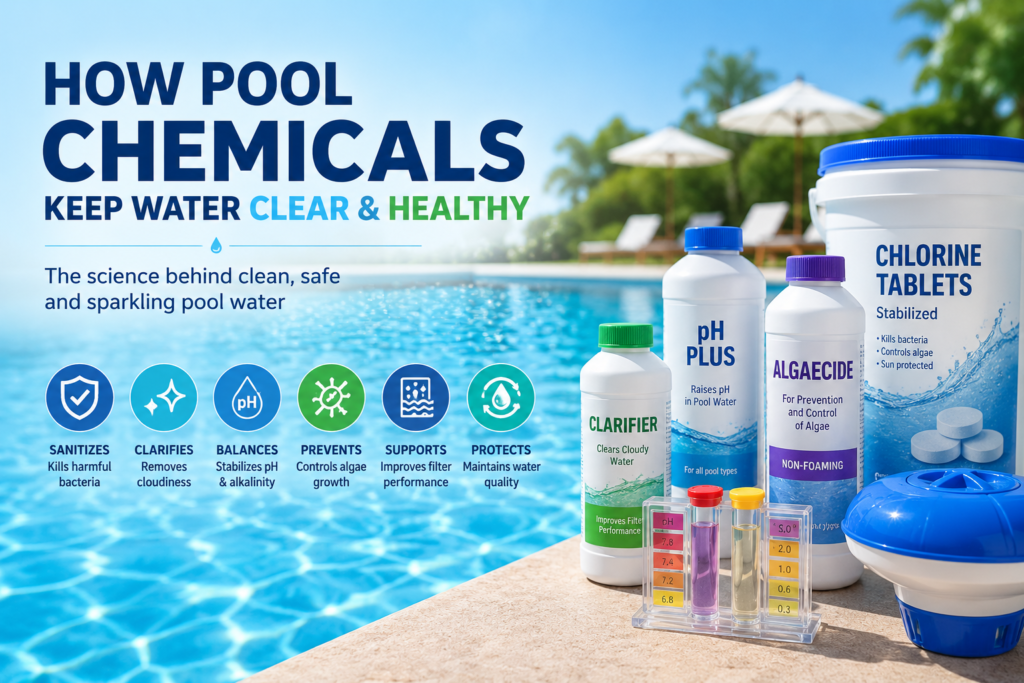
Modern pool care relies on several types of chemicals working together. Sanitizers control harmful microorganisms. Oxidizers deal with contaminants. Algaecides help prevent algae. Clarifiers improve filtration. pH and alkalinity products keep the water chemically balanced.
Think of it less like one powerful chemical doing everything and more like a small maintenance crew. Each member has a different job.
So, how exactly do pool chemicals keep water clear and healthy? Let’s break it down.
Clear Water and Healthy Water Aren’t Quite the Same Thing
Here’s an important distinction.
Water that looks clear isn’t automatically microbiologically safe, and water that has been properly sanitized can still develop appearance problems if its chemistry or filtration isn’t well managed.
That’s because pool water quality has several dimensions.
A well-maintained swimming pool generally needs:
- effective microbial control
- proper sanitizer levels
- balanced pH and alkalinity
- good circulation and filtration
- control of algae growth
- removal of suspended particles
- management of organic contamination
Miss one part and problems can begin to appear.
For example, inadequate sanitizer residual may allow microbial activity to increase. Poor filtration can leave fine particles suspended in the water. An unsuitable pH can reduce chlorine performance. Algae may find favorable conditions in poorly circulated areas.
And anyone who has opened a neglected pool after a hot spell knows how quickly things can go sideways.
Pool chemicals therefore aren’t simply there to make water “blue.” They help maintain a controlled aquatic environment in which sanitation, water balance, filtration, and algae prevention support one another.
Chlorine Does the Heavy Lifting
For many swimming pools, chlorine remains the primary sanitizer.
When chlorine-containing products are introduced into water, they produce active chlorine species, including hypochlorous acid. Hypochlorous acid plays an important role in controlling bacteria and other microorganisms.
In simple terms, chlorine attacks cellular components and interferes with biological processes that microorganisms need to survive.
It also helps oxidize some organic contaminants introduced by swimmers and the surrounding environment.
That’s a big job.
But chlorine performance depends strongly on water conditions, especially pH. As pH changes, the balance between hypochlorous acid and hypochlorite ion also changes. This is one reason pool operators pay such close attention to pH instead of simply adding more sanitizer whenever something looks wrong.
There is another catch.
Chlorine isn’t a magic shield against every water-quality problem.
Heavy swimmer loads, intense sunlight, organic contamination, poor circulation, inadequate filtration, or badly balanced water can all make pool management more difficult. Algae may also gain a foothold in areas where sanitizer exposure isn’t sufficient.
That brings us to the next member of the pool-care team.
Algaecides Give Algae Fewer Chances to Take Hold
Algae can turn an attractive pool into a maintenance headache surprisingly quickly.
Spores and other biological material can enter pools through wind, rain, dust, equipment, and surrounding vegetation. Under favorable conditions—warm water, sunlight, nutrients, and insufficient sanitizer control—algae can begin growing on surfaces or in the water.
Once established, the problem becomes harder to manage.
This is why algaecides are commonly used as supporting chemicals rather than replacements for normal sanitation.
Different pool algaecides work in different ways.
Some products are based on metals such as copper. Others use quaternary ammonium compounds, while another important category uses polymeric quaternary ammonium compounds.
Polymeric quats, often shortened to polyquats, are especially interesting because their positively charged polymer chains can interact with negatively charged biological surfaces.
The chemistry sounds rather technical, but the basic idea isn’t.
Imagine many positively charged sites distributed along a long molecular chain. Those sites can interact with algae cells and interfere with normal cellular function. The polymeric structure also gives these products properties that differ from smaller conventional quaternary ammonium compounds.
One widely recognized example in swimming-pool maintenance is Polyquat 60, a concentrated polymeric algaecide commonly associated with preventive algae-control programs.
For pool chemical formulators and private-label brands, understanding Polyquat 60 Algaecide can be useful when developing non-metal algae-control products, particularly where low foaming is an important formulation consideration.
Why Non-Foaming Algae Control Matters
Foam sounds like a cosmetic issue until you’re standing beside a pool covered in bubbles that aren’t supposed to be there.
Some traditional quaternary ammonium algaecides can produce noticeable foaming, especially when water is strongly agitated. Waterfalls, jets, return lines, spas, and other high-circulation environments can make the problem more obvious.
Polymeric quaternary ammonium compounds behave differently.
Certain polyquat formulations are valued in pool care partly because they provide algae-control activity without the same tendency toward persistent foam associated with some conventional quat products.
That characteristic becomes particularly useful in:
- swimming pools with vigorous circulation
- water features
- spas and connected systems
- commercial pools
- private-label low-foam formulations
There’s a practical lesson here: selecting a pool chemical isn’t only about whether the active ingredient performs its main function.
Its behavior inside the complete pool system matters too.
A product can control algae effectively and still create an undesirable user experience if it causes excessive foam, staining, cloudiness, or compatibility problems.
Good formulation is always a balancing act.
Oxidizers Deal With What Swimmers Leave Behind
Let’s talk about something nobody particularly enjoys thinking about.
Pools collect organic contamination.
Sweat, body oils, sunscreen, cosmetics, environmental debris, and other materials continuously enter the water. As these substances accumulate and react with pool chemistry, they can contribute to water-quality problems.
Oxidation helps break down certain contaminants.
Chlorine itself performs part of this function. Pool maintenance programs may also use additional oxidation or shock-treatment strategies depending on the sanitizer system and water conditions.
This is why “shock” treatment is commonly discussed in pool maintenance.
The goal isn’t simply to pour an unusually large amount of chemical into the water. Proper treatment is based on restoring water quality by addressing accumulated contaminants and maintaining effective sanitation.
The exact approach depends on the pool system, sanitizer chemistry, water balance, and product instructions.
More chemical isn’t automatically better.
That’s worth repeating.
More chemical isn’t automatically better.
Accurate testing and controlled dosing usually beat guesswork.
pH Is the Quiet Number Running the Show
If chlorine is the obvious star of pool chemistry, pH is the person backstage controlling the lights.
pH describes how acidic or basic the water is.
For many conventional chlorinated swimming pools, operators commonly aim for a moderately neutral-to-slightly-basic range, often around pH 7.2–7.8 depending on the system and applicable guidance.
Why does such a small numerical range matter?
Because pH affects several things at once.
It influences chlorine chemistry, swimmer comfort, scale formation, corrosion tendencies, and the overall behavior of pool water.
When pH becomes too low, water can become more corrosive toward certain materials and equipment.
When pH climbs too high, scale formation and cloudy-water problems may become more likely, and chlorine’s sanitizing efficiency can be affected.
This is why pool operators use pH increasers or reducers rather than treating pH as an occasional afterthought.
A clear pool depends on balance, not brute force.
Total Alkalinity Helps Keep pH From Bouncing Around
If you’ve ever adjusted pool pH only to see it shift again shortly afterward, total alkalinity may be part of the story.
Alkalinity acts as a buffer.
In practical terms, it helps water resist sudden changes in pH. Without sufficient buffering capacity, pH can become unstable and harder to manage.
Products such as sodium bicarbonate are commonly used to increase total alkalinity when required.
But here’s where pool chemistry gets slightly more interesting: pH and alkalinity are related, yet they aren’t identical.
Changing one can affect the other.
That means pool treatment should follow a logical sequence based on testing rather than treating every parameter independently.
You wouldn’t tune a guitar by randomly tightening every string. Pool water isn’t much different.
Calcium Hardness Protects the Physical Side of the Pool
Water chemistry doesn’t only affect microorganisms. It affects the pool itself.
Calcium hardness measures the concentration of dissolved calcium ions in the water.
If calcium hardness becomes excessively high, scale may develop on surfaces and equipment under favorable conditions. If it is too low—particularly in certain plaster, concrete, or cementitious pool environments—the water may become more aggressive toward calcium-containing surfaces.
Pool operators therefore consider calcium hardness together with pH, alkalinity, temperature, and other factors.
This is also why professional pool management often considers overall water balance rather than looking at isolated test numbers.
One parameter rarely tells the whole story.
Clarifiers Help the Filter Catch What Your Eyes Can See
Sometimes pool water isn’t green. It isn’t obviously dirty either.
It’s simply… hazy.
You can see the bottom, but not with that crisp, almost glass-like clarity people expect from a well-maintained pool.
Very small suspended particles may be responsible.
Some particles are so fine that filtration systems don’t capture them efficiently. Pool clarifiers are designed to help address this problem.
Many clarifying products contain polymers that encourage small suspended particles to associate into larger structures that can be captured more effectively by filtration.
It’s a little like trying to pick up flour scattered across a countertop versus collecting it into a small pile first.
Same material. Much easier to remove.
This is why clarifiers and filtration work together. A clarifier doesn’t magically make unwanted material disappear; it helps prepare certain suspended matter for more effective physical removal.
For a closer look at this chemistry, Polymer Pool Clarifier formulations show how polymer-based water treatment concepts can be adapted specifically for swimming-pool clarity.
Filtration Still Matters—A Lot
Chemicals get much of the attention in pool care, but filtration deserves equal respect.
A pool filter physically removes particles from circulating water. Depending on the system, the pool may use sand, cartridge, diatomaceous earth, or another filtration technology.
Chemicals can make filtration more effective, but they cannot replace adequate circulation and filtration.
Consider what happens when circulation is poor.
Some areas receive less treated water. Debris accumulates. Chemical distribution becomes uneven. Algae can gain an advantage in corners, steps, ladders, behind fixtures, and other low-flow zones.
This explains why brushing is still such a useful maintenance step.
It physically disturbs developing deposits and exposes surfaces to circulating treated water.
Not exactly glamorous work—but effective.
Stabilizers Help Outdoor Chlorine Survive Sunlight
Outdoor pools face another challenge: ultraviolet radiation.
Sunlight can rapidly degrade free chlorine.
Cyanuric acid, often called chlorine stabilizer or conditioner, is commonly used in outdoor chlorinated pools to reduce the rate at which chlorine is lost through UV exposure.
That can help maintain a more persistent sanitizer residual.
But, once again, balance matters.
Excessive cyanuric acid can change the relationship between measured free chlorine and sanitizing effectiveness. Pool operators therefore need to consider stabilizer concentration when determining appropriate chlorine management.
This is a recurring theme in pool chemistry.
One chemical solves a problem, but its concentration still needs to be controlled.
Preventive Chemistry Is Usually Easier Than Rescue Chemistry
Picture two pools.
Pool A is tested regularly. pH is adjusted when necessary. Sanitizer residual is maintained. The filter runs properly. Walls and steps are brushed. Algaecide is used where appropriate as part of the maintenance program.
Pool B gets attention only when the water changes color.
Which one requires more chemicals, labor, and frustration over the course of a swimming season?
Usually Pool B.
Preventive pool maintenance is generally easier because problems are addressed before they become severe.
Algae is a good example.
A preventive algaecide program can provide an additional layer of control when conditions favor algae growth. This can be particularly valuable during hot weather, periods of heavy pool use, seasonal opening and closing, or situations where maintaining stable sanitizer conditions becomes more difficult.
For seasonal treatment programs, Winter Algaecide formulations may also be used to help manage algae risks while pools remain closed for extended periods.
Prevention isn’t about throwing every available chemical into the water. Quite the opposite.
It’s about using the right treatment, at an appropriate level, for a clearly defined purpose.
Why Pool Professionals Don’t Depend on One Chemical?
It is tempting to think of pool treatment as a chlorine problem.
Keep enough chlorine in the water and everything else will sort itself out, right?
Not quite.
A reliable maintenance program usually combines chemistry with physical treatment.
Sanitizer controls microorganisms. Oxidation helps manage contaminants. Algaecides support algae prevention. pH and alkalinity adjustment stabilize the chemical environment. Clarifiers can assist filtration. Circulation distributes treatment throughout the pool. Filtration physically removes unwanted material.
Each process supports the others.
This integrated approach becomes even more important in commercial pools, hotels, resorts, water parks, public facilities, and other high-bather-load environments.
More people mean more contaminants entering the water—and less room for sloppy chemistry.
How Pool Chemical Formulators Think About Product Selection?
For a homeowner, the question might be simple: “What should I add to my pool?”
For formulators, distributors, and private-label pool chemical brands, the question is broader.
They need to consider active concentration, compatibility, storage stability, packaging, water conditions, dosing strategy, foaming behavior, regulatory requirements, and how the finished product fits into a complete maintenance program.
Take an algaecide as an example.
A formulator may ask:
Does it contain metal?
Will it foam?
Can it be incorporated into a maintenance product?
How concentrated is the supplied raw material?
How does it behave across the expected pH range?
Is it suitable for the intended market and regulatory framework?
Those questions matter because the raw material is only one piece of the finished product.
For businesses developing polymer-based pool treatment products, understanding the underlying chemistry of Polixetonium Chloride and polymeric quaternary ammonium compounds can help explain why certain cationic polymers are used for algae-control applications.
Testing Comes Before Treatment
There’s one habit that separates controlled pool care from chemical guesswork:
Test first.
Before adjusting water chemistry, operators should know what the water actually needs.
Depending on the pool and treatment program, routine testing may include free chlorine, combined chlorine, pH, total alkalinity, calcium hardness, and cyanuric acid. Commercial facilities may require additional monitoring according to local regulations.
Testing prevents the classic maintenance mistake of treating symptoms without understanding the cause.
Cloudy water?
It could involve filtration, pH, sanitizer conditions, suspended particles, calcium balance, or several factors working together.
Green water?
Algae is an obvious possibility, but treatment still requires checking sanitizer levels, circulation, filtration, and overall chemistry.
Chemical treatment becomes much more predictable when it’s guided by measurements.
Clear Water Is Really a System
Perhaps the easiest way to understand pool chemicals is to stop thinking about them as individual bottles.
A swimming pool is a treatment system.
Water enters circulation. Chemicals control biological and chemical conditions. The filter removes particles. Pumps keep water moving. Operators test the results and make adjustments.
When those pieces work together, maintaining clear water becomes much easier.
When one piece fails, another often has to work harder.
Poor circulation can make algae control more difficult. Unbalanced pH can interfere with sanitizer performance. Excessive organic contamination increases treatment demand. Weak filtration can leave properly treated water looking cloudy.
That’s why good pool maintenance sometimes feels less like cleaning and more like managing a tiny water-treatment plant.
Because, technically speaking, that’s pretty close to what it is.
The Bottom Line
Pool chemicals keep water clear and healthy by performing several different jobs rather than relying on one “all-purpose” treatment.
Sanitizers control potentially harmful microorganisms. Oxidizers help deal with contaminants. Algaecides provide additional protection against algae. pH and alkalinity products create a more stable chemical environment. Clarifiers support filtration, while hardness and stabilizer management help maintain suitable water conditions.
But chemicals work best when paired with proper circulation, filtration, brushing, testing, and sensible dosing.
That’s the key.
The goal isn’t to put more chemicals into a swimming pool. It’s to maintain the right chemistry at the right time.
When that balance is achieved, the result is exactly what swimmers expect: clear, inviting water that is properly maintained for healthy recreational use.
FAQ
1. What chemicals are needed to keep swimming pool water clear?
Most pool maintenance programs use a sanitizer such as chlorine, chemicals for pH and alkalinity control, and products for other needs such as algae prevention or water clarification. The exact treatment depends on pool type, water chemistry, sanitizer system, and operating conditions.
2. Why can a swimming pool turn green even when chlorine is present?
Measurable chlorine doesn’t always mean algae growth is fully controlled. Poor circulation, unsuitable pH, high contaminant loads, sunlight, warm temperatures, or insufficient effective sanitizer levels can contribute to algae problems.
3. What does algaecide do in swimming pool water?
Pool algaecides help prevent or control algae growth. They are generally used alongside proper sanitation, filtration, circulation, and water balancing rather than as replacements for chlorine or another primary sanitizer.
4. What is the purpose of Polyquat 60 in pool maintenance?
Polyquat 60 is a polymeric quaternary ammonium algaecide used in swimming-pool algae-control programs. It is particularly associated with non-metal and low-foaming algae-control formulations.
5. How do pool clarifiers make cloudy water clearer?
Pool clarifiers help very small suspended particles associate into larger structures that a filtration system can capture more effectively. They work with the filter rather than replacing filtration, so circulation and proper filter maintenance remain essential.