
GET IN TOUCH
Ask For Sample?
Common Causes of Pool Algae Problems
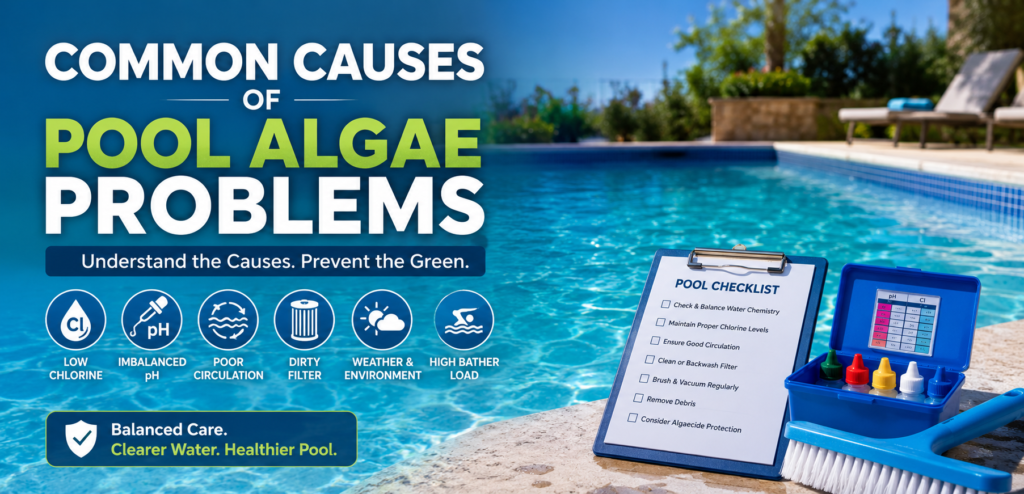
A swimming pool can look perfect on Monday and slightly suspicious by Wednesday. The water loses a little sparkle. The steps feel slick. A faint green tint appears near a corner where the circulation is weak.
Then, seemingly overnight, you have algae.
It is tempting to blame the algae itself. After all, that is what you can see. But visible algae is usually the result of another problem somewhere in the pool maintenance system.
Maybe chlorine dropped too low during a hot weekend. Perhaps the filter has been running for fewer hours than usual. Heavy rain may have changed the water chemistry. Or circulation simply isn’t reaching one stubborn corner.
Often, several small problems happen at once.
Understanding these causes matters because killing existing algae is only half the job. If the conditions that encouraged algae remain, the green visitor may come right back.
First, Why Does Pool Algae Appear So Quickly?
Algae are simple organisms, but don’t let that simplicity fool you. Given water, light, nutrients, and favorable conditions, algae can establish themselves surprisingly fast.
Algae spores can enter an outdoor pool through wind, rainwater, dust, contaminated equipment, swimsuits, leaves, soil, and other environmental sources. Keeping every single spore out of a swimming pool isn’t realistic.
That’s why pool maintenance focuses less on creating a perfectly sterile outdoor environment and more on keeping conditions unfavorable for algae growth.
A well-maintained sanitizer residual, suitable water chemistry, good circulation, effective filtration, and routine physical cleaning work together.
Think of pool algae control as a chain. One weak link may not immediately cause trouble. Two or three weak links? That’s when the water can start changing fast.
So what usually goes wrong?
1. Low Chlorine Levels Give Algae an Opening
This is probably the first thing most pool owners think about—and for good reason.
Free chlorine provides the primary sanitizing action in many swimming pools. When the available chlorine concentration falls too low, microorganisms and algae have a much easier opportunity to establish themselves.
The tricky part is that chlorine doesn’t stay at one concentration forever.
It is constantly being consumed.
Sunlight can reduce available chlorine. Swimmers introduce organic contaminants. Leaves, pollen, insects, dirt, sunscreen, sweat, and other materials also add to chlorine demand.
A pool that had an acceptable chlorine reading yesterday may not necessarily have the same reading today.
This becomes especially important during periods of heavy pool use.
Imagine a backyard pool during a hot summer weekend. Several people swim throughout the afternoon. Sunscreen enters the water. The sun is intense. A few leaves fall into the pool. The circulation system shuts down that evening.
That’s quite a workload for the sanitizer.
If chlorine isn’t checked and replenished as needed, algae may find the opening they were waiting for.
2. High pH Can Make Chlorine Less Effective
Having chlorine in the water doesn’t automatically mean that chlorine is working under ideal conditions.
Water chemistry matters.
For pools using chlorine-based sanitization, pH influences the balance between different chlorine species in the water. As pH rises, the proportion of the more active hypochlorous acid form decreases.
In plain English?
The chlorine may become less effective even though a test still shows chlorine in the pool.
This is one reason pool professionals pay attention to pH rather than simply adding more sanitizer whenever something looks wrong.
Pool water chemistry is connected. Change one parameter and another part of the system may respond.
A consistently high pH can therefore contribute to conditions where algae control becomes harder.
On the other hand, aggressively pushing pH downward isn’t the answer either. Very low pH can create its own problems, including swimmer discomfort and potential effects on pool surfaces and equipment.
The goal is stable, appropriate water chemistry—not chemical whiplash.
3. Poor Water Circulation Creates Algae Hot Spots
Have you ever noticed algae appearing first on steps, behind ladders, near corners, around lights, or along certain sections of the pool wall?
That pattern tells you something.
The problem may not be the entire pool. It may be water movement.
Sanitizer needs to reach the places where algae are trying to grow. If circulation is weak in a particular area, sanitizer distribution may be less effective there.
These areas can become little algae shelters.
Common trouble spots include:
- Pool steps and benches
- Corners
- Behind ladders
- Around lights and fittings
- Areas beneath or near pool accessories
- Sections far from return jets
- Crevices in rough or textured surfaces
You can have acceptable water chemistry at the testing point and still experience localized algae growth elsewhere.
That’s a detail worth remembering.
Testing tells you what is happening in the sample you collected. Circulation determines how well those conditions are reproduced throughout the pool.
4. An Underperforming Filter Lets Problems Build
The circulation pump moves the water. The filter removes suspended material.
They work as a team.
When filtration performance falls, fine debris and suspended contaminants can remain in the water longer than they should. That doesn’t necessarily create algae by itself, but it can make overall water management more difficult.
A poorly maintained filter may struggle because it is dirty, overloaded, incorrectly sized, damaged, or simply not operated long enough.
Pool owners sometimes respond to cloudy or green water by adding more chemicals while ignoring the filtration system.
That’s a bit like spraying air freshener in a kitchen while leaving yesterday’s rubbish on the floor. You’re dealing with the symptom rather than the source.
Chemical treatment and physical removal need to support each other.
After an algae treatment, this becomes particularly important. Dead or damaged algae and other fine particles still need to be removed from the water.
If the filter cannot handle that material efficiently, the pool may remain cloudy even after algae have been controlled.
5. The Pump Isn’t Running Long Enough
A perfectly good pump cannot circulate water while it is switched off.
Sounds obvious, right?
Yet insufficient circulation time is a surprisingly common contributor to pool problems.
The necessary operating schedule depends on factors such as pool volume, pump capacity, hydraulic design, weather, swimmer load, and filtration conditions. There isn’t one magic number that works for every pool.
During hot weather or periods of frequent use, the circulation demand may increase.
If pump operating time remains unchanged while the pool’s actual workload rises, water quality can gradually deteriorate.
This is particularly noticeable in larger pools or systems with weak circulation patterns.
So when algae keeps returning, don’t look only at the chemical shelf.
Look at the equipment timer too.
6. Hot Weather Can Accelerate the Problem
Warm, sunny weather is exactly when people want to use their pools most.
Unfortunately, it can also make pool maintenance more demanding.
Higher temperatures can support faster biological activity, while strong sunlight increases chlorine loss in outdoor pools that rely on chlorine sanitization.
Then comes the human factor.
Hot weather means more swimmers.
More swimmers mean more sweat, sunscreen, body oils, dirt, and other organic material entering the water. That increases the burden on the sanitizer and filtration system.
The result is a rather unfair combination:
More favorable conditions for algae at exactly the same time the pool is experiencing greater sanitizer demand.
This helps explain why a maintenance routine that worked beautifully in spring may struggle during the hottest part of summer.
Seasonal conditions change. Pool care sometimes needs to change with them.
7. Heavy Rain Can Throw Pool Conditions Off Balance
A summer storm can change more than the water level.
Rainwater may carry dust, soil, pollen, leaves, and other contaminants into an outdoor swimming pool. Runoff can create an even larger contamination problem if landscaping or surrounding surfaces drain toward the pool.
Heavy rainfall may also dilute pool chemicals and alter water chemistry.
And then, after the storm, the sun comes back out.
Warm weather plus newly introduced contaminants plus reduced sanitizer concentration can create a rather convenient environment for algae.
This is why checking the pool after major weather events makes sense.
The water may look fine immediately after the rain. Problems sometimes become visible later.
8. Leaves, Pollen, Dust, and Organic Debris Feed the Problem
Outdoor pools are basically giant collectors.
Wind doesn’t care that you cleaned the water yesterday.
Leaves land on the surface. Pollen drifts in. Dust settles. Insects appear. Tiny particles of soil can enter from the surrounding deck or garden.
As this material accumulates and breaks down, it increases the organic load on the water and can increase sanitizer demand.
Some debris also settles into corners or along the floor, exactly where circulation may already be weaker.
This creates a double problem.
The sanitizer has more work to do, while the algae-friendly area may receive less circulation.
Regular skimming, vacuuming, and cleaning therefore aren’t cosmetic chores. They are part of algae prevention.
Clear water isn’t merely prettier. It is often easier to maintain.
9. Swimmers Bring More Into the Pool Than You Think
Nobody likes thinking too hard about this one.
But swimmers are a major source of contaminants.
Sweat, body oils, cosmetics, hair products, sunscreen, dirt, and tiny amounts of organic material all enter the pool during normal swimming.
A heavily used pool therefore behaves differently from a pool that has been sitting quietly for several days.
This is particularly relevant for:
- Hotels
- Resorts
- Apartment pools
- Community swimming pools
- Fitness centers
- Water parks
- Busy residential pools
Higher bather loads generally mean greater sanitizer demand and a heavier filtration workload.
That doesn’t mean swimmers directly “cause” algae. Rather, heavy use changes the water conditions and can make algae control more challenging if maintenance doesn’t keep pace.
10. Poor Brushing Allows Algae to Establish on Surfaces
Chemistry gets most of the attention in pool maintenance.
The pool brush deserves more respect.
Algae often begin growing on surfaces rather than floating freely through the water. Rough plaster, grout lines, steps, corners, ladders, and other irregular surfaces provide places where algae can become established.
Once a film begins forming, simply circulating treated water past it may not always be enough.
Brushing physically disturbs deposits and exposes the affected surface to the sanitizer.
This is particularly useful in areas where water movement is weak.
There’s an important lesson here: pool algae control isn’t purely chemical.
Mechanical cleaning matters.
A balanced treatment program combines chemistry, circulation, filtration, and physical maintenance rather than expecting one chemical to do everything.
11. Phosphates and Other Nutrients Can Support Algae Growth
Phosphates receive plenty of attention in the pool industry, sometimes to the point where they become the villain in every green-pool story.
The reality is more nuanced.
Phosphorus is a nutrient that algae can use. Phosphates may enter pools through environmental contamination, source water, organic debris, landscaping materials, and other routes.
So yes, nutrient availability can contribute to algae growth.
But the presence of phosphates doesn’t automatically mean a pool will turn green.
If sanitizer levels, circulation, filtration, and overall water chemistry are properly maintained, algae may still remain controlled.
This distinction matters because focusing exclusively on phosphate concentration can distract from more fundamental maintenance problems.
If a pool repeatedly develops algae, look at the whole system rather than searching for one dramatic test result to blame.
12. High Cyanuric Acid Can Complicate Chlorine Management
Cyanuric acid, often shortened to CYA, helps protect chlorine from rapid degradation by sunlight in outdoor pools.
Useful? Absolutely.
But more isn’t always better.
As CYA concentration increases, chlorine becomes less active, which means the relationship between free chlorine and CYA becomes important for effective sanitation and algae prevention.
A pool owner may look at a chlorine reading and think everything is fine while overlooking the stabilizer level.
This is another example of why isolated test numbers can be misleading.
Pool chemistry works as a system.
When algae keeps appearing despite measurable chlorine, reviewing CYA and the broader chemistry can reveal what a single chlorine reading misses.
13. Incorrect Chemical Dosing Creates Gaps in Protection
Pool treatment is sometimes approached like cooking without measuring cups:
“A little of this. Maybe some of that. Looks about right.”
That can become expensive quickly.
Chemical dosage should consider pool volume, product concentration, water conditions, treatment purpose, and the manufacturer’s instructions.
Under-dosing may provide insufficient control.
Over-dosing doesn’t necessarily solve the problem faster and can introduce other water-quality, compatibility, safety, or cost concerns.
Accurate pool volume is especially important.
If you think you have a 30,000-liter pool when the real volume is closer to 45,000 liters, every treatment calculation starts from the wrong number.
Before blaming the chemical, check the math.
14. Algae Can Return When Treatment Stops Too Early
Green water starts clearing, so the job is finished.
Not quite.
Visible improvement doesn’t always mean every affected surface has been adequately cleaned or that all suspended material has been removed.
If treatment is stopped while algae remain in low-circulation areas, behind fittings, or inside difficult-to-clean sections, the problem can return.
That is why follow-up maintenance matters.
After an algae episode, pool operators may need to continue monitoring sanitizer, brush affected surfaces, clean or service the filter as appropriate, remove debris, and confirm that normal water chemistry has been restored.
The pool should not merely look recovered.
The conditions that allowed algae to develop should also be corrected.
15. Equipment Problems Can Quietly Encourage Algae
Sometimes chemistry gets blamed for what is actually an equipment issue.
A partially blocked skimmer, clogged filter, weak pump, damaged return fitting, closed valve, dirty cartridge, or poorly positioned return jet can reduce water movement without immediately causing an obvious mechanical failure.
The equipment still runs.
You hear the pump.
Water still comes from the returns.
Everything seems normal.
Yet circulation may have dropped enough to create areas where algae can establish.
When recurring algae always appear in the same location, that pattern is particularly useful. It may point toward a hydraulic or circulation problem rather than a pool-wide chemical failure.
16. Contaminated Pool Equipment Can Reintroduce Algae
Here’s one people occasionally miss.
Brushes, vacuum heads, hoses, robotic cleaners, floats, toys, and other equipment move between water and storage areas. Equipment transferred from another pool can potentially carry contaminants with it.
The same issue can apply to swimwear or equipment used in natural bodies of water before entering the pool.
This doesn’t mean every float needs laboratory-style sterilization.
It simply means that repeated algae problems should be investigated beyond the water itself.
Sometimes the source is sitting beside the pool.
17. Poor Winterization Can Lead to an Ugly Spring Surprise
Seasonal pools face another challenge: long periods with reduced circulation and little routine maintenance.
During winterization, operators usually want to minimize the conditions that encourage algae growth while the pool is closed.
If the water enters the off-season with significant contamination, poor chemistry, or inadequate treatment, algae may develop while nobody is watching.
Then spring arrives.
The cover comes off.
And—well, green isn’t exactly the color anyone was hoping for.
Proper closing procedures can make reopening much easier. Depending on the pool system and climate, this may include balancing the water, cleaning the pool, removing debris, following suitable sanitizer procedures, and using an appropriate winter treatment where applicable.
18. Why Algae Sometimes Appears Even When Chlorine Is Present
This question frustrates pool owners more than almost any other:
“My pool has chlorine. Why do I still have algae?”
Because a chlorine reading is only one piece of information.
Consider everything we’ve just covered.
The pool might have:
- Inadequate free chlorine relative to actual demand
- High pH
- High CYA
- Weak circulation
- Dead zones
- Heavy organic contamination
- Poor filtration
- Warm water
- High swimmer load
- Inadequate brushing
- Incorrect treatment calculations
So the more useful question isn’t simply, “Is there chlorine?”
It is:
“Is the entire pool maintenance system creating conditions that consistently suppress algae?”
That’s a much better diagnostic question.
So Where Do Algaecides Fit?
Algaecides can provide another layer of algae control, but they should generally be considered part of a broader maintenance program rather than a substitute for sanitation, circulation, filtration, and cleaning.
Different algaecide chemistries behave differently.
Some traditional formulations may be associated with foaming under certain conditions. Copper-based products can be effective against algae, but metal content can also raise concerns about staining or discoloration if water chemistry isn’t properly managed.
Polymeric quaternary ammonium algaecides—commonly referred to as Polyquat 60 in the pool industry—are widely used where a non-foaming, non-metal approach is desired.
These products are commonly incorporated into preventive algae-control programs and may also be used in seasonal pool maintenance according to the finished product label and local regulatory requirements.
Still, adding an algaecide while ignoring poor circulation or inadequate sanitizer is rather like putting a new lock on a door while leaving the window open.
It may help, but it doesn’t fix the whole problem.
A Better Way to Think About Pool Algae Prevention
Instead of asking which single chemical prevents algae, think in layers.
Layer one: sanitation.
Maintain an appropriate sanitizer residual for the pool system and conditions.
Layer two: balanced water chemistry.
Monitor parameters such as pH and stabilizer levels rather than looking at chlorine alone.
Layer three: circulation.
Make sure treated water reaches the entire pool, including steps, corners, and other difficult areas.
Layer four: filtration.
Keep the filtration system operating effectively and service it when required.
Layer five: physical cleaning.
Brush, skim, and vacuum. Remove the material that chemicals and filters shouldn’t have to handle alone.
Layer six: supplementary algae control.
Where suitable, an appropriate algaecide can add another layer of protection, particularly during challenging weather, seasonal closing, or periods when algae pressure is high.
No single layer needs to carry the entire workload.
That’s the point.
Recurring Algae Usually Means Something Is Being Missed
A one-time algae outbreak can happen after a storm, equipment failure, unusually heavy swimmer load, or a lapse in chemical maintenance.
Repeated outbreaks are different.
If algae returns again and again—especially in the same location—there is probably a recurring condition behind it.
Look for patterns.
Does it appear after rain?
After weekends with heavy swimming?
Only during the hottest weeks?
Always behind the ladder?
Every time the filter pressure changes?
Soon after chlorine drops?
Those patterns can tell you far more than simply knowing that the water turned green.
Good pool maintenance is partly chemistry and partly detective work.
And yes, sometimes the pool leaves clues everywhere.
The Bottom Line: Algae Is Usually a Symptom, Not the Whole Problem
Pool algae rarely appear because of one mysterious event.
More often, the problem develops when several conditions overlap: sanitizer becomes less effective, circulation weakens, contaminants accumulate, temperatures rise, filtration struggles, or cleaning is delayed.
That is why lasting algae control requires more than pouring another treatment into the water.
Start with the basics.
Check sanitizer. Review pH and other relevant water parameters. Inspect circulation. Examine the filter. Remove debris. Brush problem areas. Think about recent weather and swimmer load.
Then consider whether a supplementary algaecide belongs in the maintenance program.
Once you begin looking at the pool as a connected system, algae problems become much easier to understand—and usually much easier to prevent.
Frequently Asked Questions About Pool Algae Problems
1. What is the most common cause of algae in a swimming pool?
Low or insufficiently effective sanitizer is one of the most common causes of swimming pool algae. However, poor circulation, filtration problems, high pH, heavy swimmer load, warm weather, and organic contamination can contribute at the same time.
2. Why does my pool keep getting algae even though chlorine is present?
A measurable chlorine level does not necessarily guarantee effective algae control. High pH, elevated cyanuric acid, high chlorine demand, weak circulation, poor filtration, or algae growing in low-flow areas may still allow a problem to develop.
3. Why does algae keep growing on the same pool wall or steps?
Repeated algae growth in one location often suggests poor circulation, inadequate brushing, or a surface where deposits can accumulate. Check nearby return jets, ladders, lights, steps, corners, and other areas where water movement may be limited.
4. Can hot weather cause algae problems in swimming pools?
Hot weather can increase algae pressure indirectly and make pool maintenance more demanding. Strong sunlight can increase chlorine loss, warmer conditions may favor biological activity, and pools usually experience heavier swimmer loads during hot periods.
5. Can Polyquat 60 help prevent recurring pool algae?
Polyquat 60 is a polymeric quaternary ammonium algaecide commonly used as part of algae-control and pool maintenance programs. Its non-foaming and non-metal characteristics make it useful for certain formulations, but it should complement proper sanitation, circulation, filtration, and physical cleaning rather than replace them.