GET IN TOUCH
Ask For Sample?
Why Long-Chain Cationic Polymers Provide Better Surface Protection
When people think about protecting industrial surfaces, pipelines, tanks, membranes, or water system equipment, they often focus on one question: Which chemical kills microorganisms fastest?
But is fast action always enough?
In many real-world systems, the bigger challenge is not simply eliminating bacteria or algae at one specific moment. The real challenge is keeping surfaces protected over time — especially when water keeps flowing, temperatures change, organic matter accumulates, and microorganisms constantly try to attach and grow.
This is where long-chain cationic polymers become increasingly important.
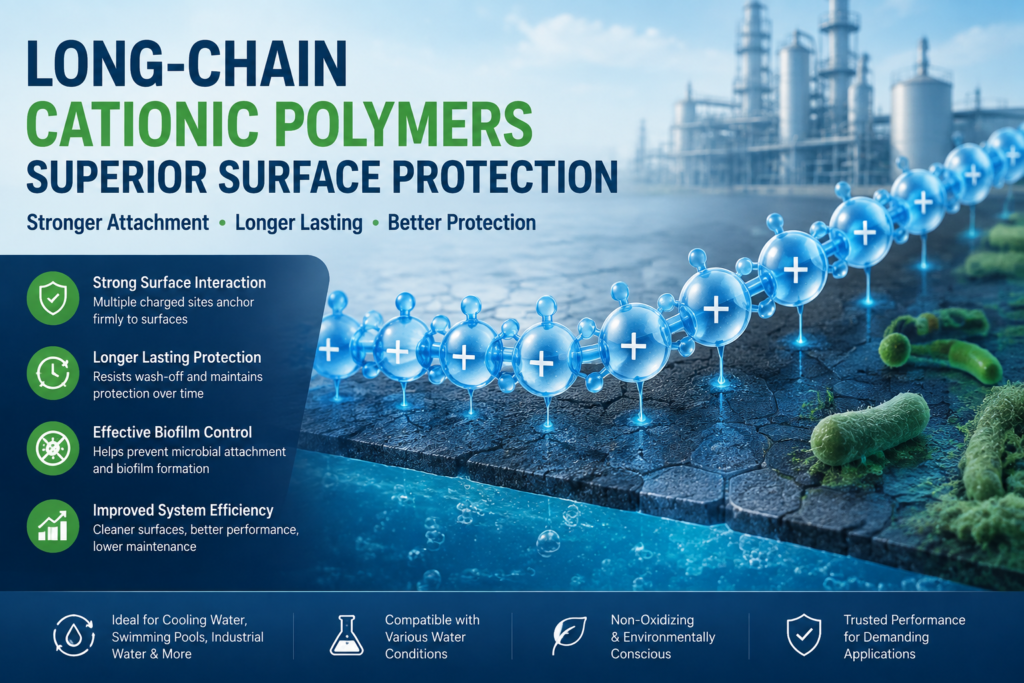
Unlike small molecular biocides that mainly work by reacting with microbial cells in the surrounding water, long-chain cationic polymers can create a protective interaction layer on surfaces. Their extended molecular structure allows them to remain attached longer, improve surface coverage, and provide more persistent control.
So, why does chain length make such a big difference?
Let’s take a closer look.
1. What Are Long-Chain Cationic Polymers?
Cationic polymers are polymers containing positively charged functional groups, usually quaternary ammonium groups. The word “cationic” simply means the molecule carries a positive charge.
This positive charge is the key to their behavior.
Many industrial surfaces, microbial cells, and suspended particles carry negative charges. Because opposite charges attract, cationic polymers can interact strongly with these surfaces.
Common examples of cationic polymers include:
- PolyDADMAC (Polydiallyldimethylammonium chloride)
- Polyamines
- Poly(2-hydroxypropyldimethylammonium chloride)
- Polixetonium Chloride (Polyquaternium-42)
To better understand how these materials differ in structure, charge characteristics, and industrial applications, it is helpful to first look at the classification and naming system behind polyquaternary ammonium compounds. Different polymer structures can lead to different performance profiles in water treatment, microbial control, and surface interaction.Although these materials have different structures and applications, they share a common feature: multiple positive charges distributed along a polymer chain.
A small molecule may have one or two active groups.
A polymer chain may contain hundreds or thousands of repeating charged units.
That difference changes everything.
Imagine trying to hold a heavy curtain with a single hook versus using a long rail with many hooks. Which one stays in place better? The answer is obvious.
The same principle applies at the molecular level.
2. Why Molecular Chain Length Matters for Surface Protection?
The length of a polymer chain affects several important properties:
- Surface adsorption
- Contact time
- Film formation
- Microbial attachment resistance
- Protection durability
A longer polymer chain can interact with a larger surface area because more charged sites are available.
When a long-chain cationic polymer reaches a surface, part of the chain may attach while other sections extend outward into the surrounding environment.
This creates what scientists often describe as a polymer layer or protective film.
The polymer is no longer just floating in water.
It becomes part of the surface environment.
This is especially valuable in systems where continuous protection is needed, such as:
- Cooling water circuits
- Industrial process water
- Swimming pool water systems
- Metalworking fluids
- Oilfield water systems
You know what happens when a pipe stays wet for a long time — biofilm formation becomes almost inevitable if conditions are right. A protective polymer layer can help make that surface less favorable for unwanted microbial growth.
3. How Cationic Polymers Attach to Surfaces
The interaction between cationic polymers and surfaces usually involves several mechanisms.
Electrostatic Attraction
Many surfaces naturally carry negative charges.
Examples include:
- Metal oxide surfaces
- Mineral particles
- Organic deposits
- Microbial cell walls
The positively charged polymer chain is attracted to these negatively charged areas.
This first interaction allows the polymer to approach and attach to the surface.
Multiple Attachment Points
Here is where long chains show their advantage.
A short molecule may attach at only one or two points.
A long polymer chain can attach at multiple points along its structure.
This creates stronger physical retention.
Think about Velcro.
One tiny piece of Velcro has limited holding power. A large Velcro strip can hold much more because thousands of small connections work together.
A polymer chain works in a similar way.
Polymer Bridging
Long-chain polymers can also extend across nearby particles or surface areas.
This ability is called polymer bridging.
Although polymer bridging is commonly discussed in water clarification and flocculation, the same molecular characteristic contributes to surface interaction and protective layer formation.
4. The Role of Charge Density and Polymer Architecture
Chain length alone does not determine performance.
A long polymer with poor charge distribution may not perform as expected.
Surface protection depends on a combination of factors:
- Molecular weight
- Charge density
- Polymer structure
- Functional groups
- Solubility
- Compatibility with the application environment
For example, two cationic polymers may have similar chemical compositions but different molecular architectures.
One may form a stronger surface-associated layer.
Another may remain mostly dissolved in water.
This is why professional formulators do not simply ask:
“Is the polymer long enough?”
They ask:
“How does the polymer behave in this specific system?”
Water chemistry matters.
pH, hardness, dissolved solids, organic contamination, and temperature can all influence polymer performance.
5. Why Long-Chain Polymers Create More Durable Protective Layers
The biggest advantage of long-chain cationic polymers is persistence.
A protective layer created by a polymer can remain effective longer because the molecule has more interaction points.
This can provide several benefits.
Longer Surface Residence Time
Small molecules are often quickly consumed, diluted, or removed by water movement.
Long-chain polymers tend to remain associated with surfaces for longer periods.
This does not mean they never leave the surface. All chemicals eventually change or move through a system.
However, their larger structure gives them a greater ability to maintain surface interaction.
Improved Biofilm Control
Biofilms are not just floating microorganisms.
They are communities attached to surfaces and surrounded by protective substances produced by microbes.
Once biofilms establish themselves, they become much harder to control.
Long-chain cationic polymers can help by interfering with microbial attachment and reducing the ability of microorganisms to form stable colonies.
More Uniform Coverage
A polymer chain can spread across a surface rather than acting only at isolated points.
This creates more consistent protection.
A simple analogy:
Spraying a wall with scattered drops of paint leaves exposed areas.
Applying a smooth coating provides much better coverage.
6. Applications of Long-Chain Cationic Polymers in Industrial Systems
Long-chain cationic polymers are widely used because many industrial environments need continuous protection.
Cooling Water Systems
Cooling towers and heat exchangers are perfect environments for microbial growth.
Warm temperatures, circulating water, and nutrients create ideal conditions for:
- Algae
- Bacteria
- Slime-forming microorganisms
Cationic polymers such as Polyquaternium compounds are often used as non-oxidizing microbial control agents.
Their ability to interact with surfaces helps reduce biological deposits that affect heat transfer efficiency.
Swimming Pools
Pool operators often look for algaecides that provide lasting protection without excessive foaming or metal staining.
Polymeric quaternary ammonium compounds, such as Polyquat-based products, are popular because they combine:
- Non-oxidizing action
- Low irritation potential compared with some alternatives
- Compatibility with chlorine systems
- Long-lasting algae control
Metalworking Fluids
Metalworking fluids can become contaminated by bacteria and fungi during operation.
A polymer-based antimicrobial approach can help maintain fluid quality and reduce unpleasant odors caused by microbial activity.
Oilfield and Industrial Water Systems
Produced water, injection water, and process water systems often require chemicals that can withstand challenging conditions.
Long-chain cationic polymers may contribute to microbial control and surface protection in these environments.
7. Long-Chain Cationic Polymers vs Traditional Small-Molecule Biocides
Does this mean polymers are always better than traditional biocides?
Not necessarily.
Different chemicals solve different problems.
Small-molecule biocides often have advantages:
- Fast microbial kill
- Strong initial activity
- Easy dosing control
However, they may have limitations:
- Shorter residence time
- Rapid consumption
- Less surface interaction
Long-chain cationic polymers provide different advantages:
| Property | Small-Molecule Biocides | Long-Chain Cationic Polymers |
|---|---|---|
| Initial reaction speed | Often faster | Moderate |
| Surface interaction | Limited | Stronger |
| Film formation | Limited | Better |
| Persistence | Depends on chemistry | Often longer |
| Biofilm prevention | Variable | Strong potential |
In practice, many industrial systems use combinations of different technologies.
The goal is not simply the strongest chemical.
The goal is the right balance between immediate control and long-term protection.
8. How to Select the Right Cationic Polymer for Surface Protection
Choosing a polymer requires understanding the application.
Important factors include:
1. Target Problem
Are you controlling:
- Algae?
- Bacteria?
- Biofilm?
- Suspended solids?
- Surface deposits?
Different polymers have different strengths.
2. Water Conditions
Consider:
- pH range
- Temperature
- Hardness
- Organic loading
- Flow conditions
A polymer performing well in a swimming pool may not behave the same way in an industrial cooling system.
3. Molecular Characteristics
Important technical parameters include:
- Active content
- Molecular weight
- Charge density
- Viscosity
- Compatibility with other chemicals
For example, Polixetonium Chloride (Polyquaternium-42) is known for its polymeric quaternary ammonium structure, making it suitable for applications requiring persistent algae control and surface interaction.
9. Future Trends in Polymer-Based Surface Protection
As industries focus more on efficiency, sustainability, and reduced chemical consumption, polymer-based technologies are gaining attention.
Why?
Because preventing problems is often easier than fixing them later.
A heat exchanger covered with biological deposits does not simply look dirty. It loses efficiency.
A pipeline with biofilm does not just contain microorganisms. It creates maintenance problems.
A swimming pool with recurring algae does not just require more chemicals. It affects customer experience.
Long-chain cationic polymers represent a shift from “kill after growth” toward “prevent attachment and maintain cleaner surfaces.”
That change in thinking is becoming increasingly important.
Frequently Asked Questions (FAQ)
1. Why do long-chain cationic polymers provide better surface protection than traditional biocides?
Long-chain cationic polymers provide better surface protection because their extended molecular structure allows stronger attachment to surfaces, longer residence time, and more uniform protective coverage.
2. How does polymer chain length affect antimicrobial performance?
A longer polymer chain provides more charged sites for interaction with microbial cells and surfaces, which can improve persistence and surface protection.
3. Are cationic polymers suitable for cooling water systems?
Yes. Many cationic polymers are used in cooling water treatment because they can help control algae, bacteria, and biofilm formation while providing longer-lasting effects.
4. What is the difference between PolyDADMAC and Polyquaternium compounds?
PolyDADMAC is mainly used as a coagulant and flocculant, while some Polyquaternium compounds are designed for antimicrobial applications due to their quaternary ammonium polymer structure.
5. Why is Polixetonium Chloride considered a long-lasting polymeric algaecide?
Polixetonium Chloride contains a polymeric quaternary ammonium structure that allows strong interaction with microbial cells and surfaces, making it suitable for long-term algae control applications.