GET IN TOUCH
Ask For Sample?
The Difference Between Polymeric Quats and Traditional Quaternary Ammonium Compounds
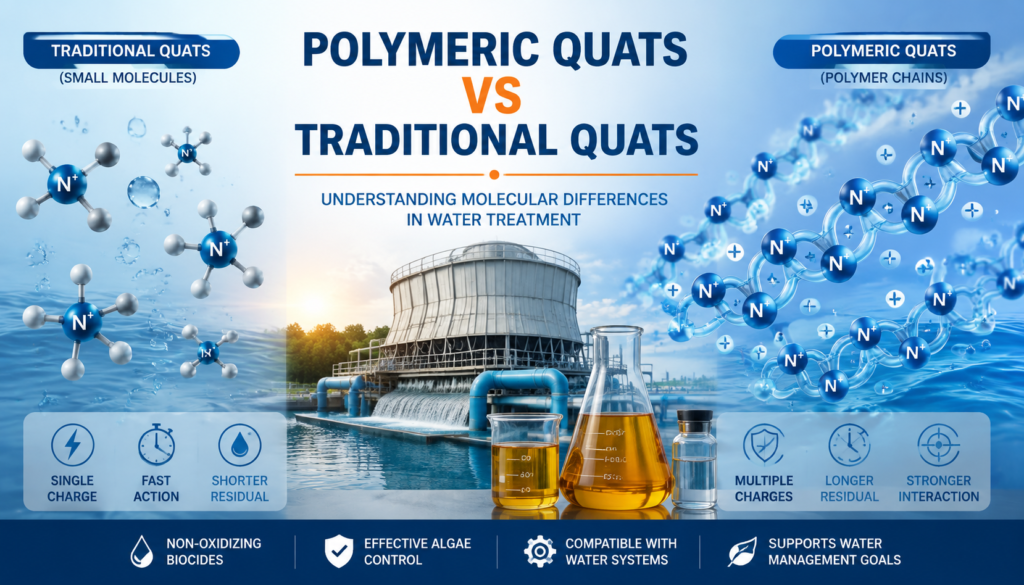
When people talk about quaternary ammonium compounds, they often use the word “quat” as if every product in this family works in exactly the same way.
But is that really true?
A small molecule disinfectant and a polymer-based cationic biocide may both belong to the quaternary ammonium family, yet their structures, behaviors, and practical applications can be surprisingly different.
For water treatment professionals, pool chemical manufacturers, and industrial formulators, understanding this difference is more than a chemistry lesson. It directly affects product performance, dosage efficiency, operating costs, and long-term system protection.
A traditional quat and a polymeric quat may share the same positively charged nitrogen chemistry, but one behaves like a single key opening one lock, while the other works more like a key ring carrying multiple keys at the same time.
So, what exactly separates polymeric quats from traditional quaternary ammonium compounds?
Let’s take a closer look.
What Are Quaternary Ammonium Compounds?
Quaternary ammonium compounds, commonly called quats, are a large family of cationic compounds containing a nitrogen atom bonded to four organic groups.
The general structure gives these materials a permanent positive charge.
This positive charge is the foundation of their antimicrobial activity.
Because microbial cell membranes usually contain negatively charged components, positively charged quats can be attracted to the surface of microorganisms. Once attached, they may disturb the membrane structure, causing leakage of cellular components and eventually microbial inactivation.
This basic mechanism has made quaternary ammonium compounds widely used in:
- Water treatment
- Swimming pool chemicals
- Surface disinfectants
- Industrial preservatives
- Metalworking fluids
- Oilfield chemicals
- Personal care formulations
However, “quat” does not describe only one type of chemistry.
The family includes both:
- Traditional low molecular weight quaternary ammonium compounds
- Polymeric quaternary ammonium compounds (polymeric quats)
And the difference between them starts with their molecular structure.
Understanding Traditional Quaternary Ammonium Compounds
Traditional quaternary ammonium compounds are usually small molecules, also known as monomeric quats.
Common examples include:
- Benzalkonium chloride (BAC)
- Didecyldimethylammonium chloride (DDAC)
- Alkyl dimethyl benzyl ammonium chloride
These compounds typically contain one quaternary ammonium group within a relatively small molecular framework.
Think of them as individual workers.
Each molecule travels through the system independently, attaches to microorganisms, performs its function, and eventually becomes diluted, neutralized, or removed.
This simple structure provides several advantages:
1. Fast antimicrobial action
Because traditional quats are small molecules, they can move easily through water systems and quickly interact with microbial surfaces.
This makes them valuable for applications requiring rapid microbial reduction.
2. Good surface activity
Many traditional quats also behave as surfactants because their molecules contain both hydrophilic and hydrophobic parts.
This allows them to interact with:
- Organic materials
- Cell membranes
- Surface contaminants
3. Established industrial use
Traditional quats have been used for decades and remain important ingredients in many formulations.
However, they also have limitations.
Because each molecule acts independently, their residual effect can sometimes be shorter, especially in systems with:
- High organic loading
- Continuous water replacement
- Strong microbial growth pressure
This is where polymeric quats become interesting.
What Makes Polymeric Quats Different?
Polymeric quats are quaternary ammonium compounds built into a polymer chain structure.
Instead of having one positively charged functional group per small molecule, polymeric quats contain many repeating charged units connected along a larger molecular backbone.
Some examples include:
- Polixetonium Chloride (Polyquaternium-42)
- PolyDADMAC (Polydiallyldimethylammonium chloride)
- Poly(2-hydroxypropyldimethylammonium chloride)
You can imagine the difference like this:
A traditional quat is like a single soldier.
A polymeric quat is like a team connected together in one long chain.
The individual positive charges are distributed along the polymer structure, creating different behavior in water systems.
This unique structure influences:
- Surface interaction
- Charge density
- Adsorption ability
- Retention time
- Microbial control performance
For industrial users, these differences can become very meaningful.
Molecular Structure: The Real Reason Behind the Difference
Chemistry often comes down to structure.
Two compounds may contain similar functional groups but behave completely differently because of their molecular arrangement.
Traditional quats usually have:
Small molecular size + limited positive charges
Polymeric quats usually have:
Large molecular structure + multiple positive charges along the chain
This creates several important differences.
1. Multiple positive charges
A polymeric quat molecule can carry many cationic sites.
When it encounters negatively charged surfaces, including microbial cells or suspended particles, multiple interaction points may occur.
This is different from a traditional quat molecule, which generally interacts through a smaller number of charged sites.
2. Larger molecular size
The larger polymer structure can influence how the material remains in a treatment system.
Instead of behaving only as a freely moving molecule, polymeric quats may interact with:
- Suspended solids
- Organic deposits
- Microbial biofilms
- Surface materials
This characteristic is particularly valuable in industrial water applications.
3. Different surface behavior
The polymer chain allows multiple contact points.
A simple comparison:
A small molecule may touch a surface with one hand.
A polymer chain may touch the same surface with many points along its length.
This does not automatically mean polymeric quats are always stronger in every situation. Chemistry is rarely that simple.
The advantage comes from how the molecule behaves under specific operating conditions.
Performance Comparison Between Polymeric Quats and Traditional Quats
When selecting a quaternary ammonium compound for a water treatment formulation, the question is usually not simply, “Which chemical is stronger?”
The better question is:
Which chemical structure fits the job?
A fast-acting disinfectant, a long-term algae control product, and a cooling water preservative may all require different characteristics.
Let’s compare the two categories from a practical perspective.
| Feature | Traditional Quaternary Ammonium Compounds | Polymeric Quaternary Ammonium Compounds |
|---|---|---|
| Molecular structure | Small molecules | Large polymer chains |
| Charge distribution | Usually one main cationic center | Multiple positive charges along polymer chain |
| Molecular weight | Lower | Higher |
| Surface interaction | Limited contact points | Multiple interaction points |
| Residual behavior | Often shorter persistence | Usually longer-lasting presence in treatment systems |
| Main strength | Rapid microbial interaction | Extended control and multifunctional performance |
| Common examples | BAC, DDAC | Polixetonium Chloride, PolyDADMAC |
| Typical applications | Disinfection, sanitation | Cooling water, algae control, clarification, specialty formulations |
The table tells an important story.
Polymeric quats are not simply “stronger versions” of traditional quats. Their advantage comes from their molecular design.
The larger polymer structure changes how the chemical moves, attaches, and remains active within a system.
Why Polymeric Quats Often Provide Longer-Lasting Protection
One of the biggest reasons industrial users consider polymeric quats is their ability to provide more persistent control.
But why?
The answer goes back to their polymer structure.
Imagine adding a handful of small stones into a flowing river.
The stones move quickly and are carried away easily.
Now imagine adding a long rope with many contact points. It behaves differently. It can interact with surfaces, catch onto certain materials, and remain in place longer.
Polymeric quats are not literally ropes, of course, but the comparison helps explain their behavior.
Because polymer chains contain multiple charged groups, they may interact more strongly with:
- Microbial surfaces
- Organic matter
- Suspended particles
- System surfaces
This can help maintain treatment activity between dosing cycles.
For industrial water systems, this characteristic can be valuable because many real-world systems are not simple laboratory environments.
Cooling towers, for example, face constantly changing conditions:
- Sunlight exposure
- Temperature fluctuations
- Organic contamination
- Dust and airborne particles
- Continuous water circulation
A chemical that disappears too quickly may require frequent adjustment.
A polymeric quat can provide a different approach by combining microbial control with longer-lasting system presence.
Polymeric Quats in Cooling Water Treatment
Cooling water systems are among the most demanding environments for biocides.
The water is warm, continuously circulated, and often exposed to nutrients that support microbial growth.
Algae, bacteria, and biofilm-forming organisms can create several problems:
- Reduced heat transfer efficiency
- Increased cleaning frequency
- Sludge formation
- Equipment maintenance issues
This is why non-oxidizing biocides are widely used in cooling water programs.
Polymeric quats have become an important category in this field.
For example, Polixetonium Chloride, also known as Polyquaternium-42, is a polymeric quaternary ammonium compound used in applications such as:
- Industrial algae control
- Cooling tower water treatment
- Swimming pool algaecides
- Specialty antimicrobial formulations
You can learn more about its basic chemistry and identity here:
What Is Polixetonium Chloride? A Complete Beginner’s Guide
The reason Polixetonium Chloride attracts attention is not only its antimicrobial chemistry but also its polymer structure.
The molecule contains repeating cationic units, allowing it to behave differently from conventional low molecular weight quats.
Polymeric Quats and Traditional Quats in Pool Chemical Applications
Swimming pool treatment provides another interesting comparison.
Many pool owners are familiar with traditional chlorine-based systems.
However, chlorine is not the only tool available.
Non-oxidizing algaecides based on polymeric quats are commonly used as complementary products, especially for algae prevention and maintenance.
Compared with traditional quats, polymeric quats may offer advantages such as:
- Lower foaming tendency in properly formulated products
- Compatibility with chlorine and bromine systems
- Long-lasting algae control
- Reduced risk of metal staining compared with copper-based algaecides
For example, Polyquat 60 algaecides are widely recognized in the swimming pool industry.
These products typically use polymeric quaternary ammonium chemistry to control algae while maintaining compatibility with pool water conditions.
For readers interested in the chemistry behind Polyquaternium-42 and its relationship with Polixetonium Chloride, this article provides more details:
Is Polyquaternium-42 the Same as Polixetonium Chloride?
Are Polymeric Quats More Effective Against Microorganisms?
This is one of the most common questions.
The answer is: it depends on the microorganism, formulation, concentration, and application environment.
A polymeric quat is not automatically superior in every antimicrobial test.
Traditional quats can perform extremely well in many applications, especially where rapid contact action is needed.
However, polymeric quats may provide additional benefits when the goal is:
- Longer residual activity
- Surface interaction
- Biofilm management
- Algae prevention
- Continuous water treatment
The difference is similar to comparing a quick cleaning spray with a long-lasting protective coating.
Both have value, but they solve different problems.
Polymeric Quats vs Traditional Quats: Which One Should You Choose?
Choosing between these two categories depends on your application.
There is no universal winner.
A formulation developer should consider:
Choose traditional quats when:
- Fast microbial reduction is the priority
- The system requires a well-established disinfectant
- Short contact time is important
- Cost sensitivity is a major factor
Consider polymeric quats when:
- Longer-lasting control is needed
- The application involves continuous water circulation
- Algae prevention is important
- Surface interaction provides additional benefits
- A non-oxidizing treatment approach is preferred
For example:
A surface disinfectant used for short contact may rely on traditional quaternary ammonium compounds.
A cooling tower algae control program may benefit more from polymeric quat chemistry.
The right choice depends on the entire treatment system.
The Growing Role of Polymeric Quaternary Ammonium Compounds
The demand for polymeric quats continues to grow because many industries are looking for more efficient water management solutions.
Several trends are supporting this development:
1. Increasing focus on water efficiency
Industries are trying to recycle and reuse more water.
However, higher water reuse often means higher microbial control challenges.
More concentrated systems need smarter treatment strategies.
2. Demand for non-oxidizing biocides
Oxidizing chemicals such as chlorine are effective, but they can create challenges related to:
- Corrosion
- Compatibility
- By-product formation
Non-oxidizing biocides provide another tool for treatment designers.
3. More specialized formulations
Modern water treatment is moving away from one-size-fits-all chemicals.
Different industries need different solutions.
A cooling tower, swimming pool, metalworking fluid, and oilfield system all have different requirements.
This creates opportunities for specialty polymeric chemistries.
Understanding the Future of Polymeric Quats
The future of quaternary ammonium chemistry is not about replacing traditional quats completely.
Both technologies have important roles.
Traditional quats remain valuable because they are proven, effective, and widely available.
Polymeric quats bring additional possibilities because their molecular structure allows different performance characteristics.
The key is understanding the chemistry behind the product.
A buyer who only looks at the product name may miss the most important factor:
The structure determines the behavior.
Whether you are selecting a biocide for cooling water, developing a pool chemical, or evaluating a new formulation, understanding the difference between traditional quats and polymeric quats helps you make better decisions.
Frequently Asked Questions
1. Are polymeric quats the same as traditional quaternary ammonium compounds?
No. Both belong to the quaternary ammonium family, but polymeric quats contain repeating charged units connected in a polymer chain, while traditional quats are usually smaller molecules with simpler structures.
2. What is the main advantage of polymeric quats in water treatment?
The main advantage of polymeric quats is their polymer structure, which can provide stronger surface interaction and longer-lasting performance in applications such as cooling water treatment and algae control.
3. Is Polixetonium Chloride a polymeric quat?
Yes. Polixetonium Chloride is a polymeric quaternary ammonium compound and is also known as Polyquaternium-42. It is commonly used in specialty applications including algae control and industrial water treatment.
For more information about its chemical name, CAS number, and synonyms, see:
Polyquaternium-42 CAS Number, Chemical Name, and Synonyms Explained
4. Can polymeric quats replace chlorine-based water treatment chemicals?
Not always. Polymeric quats and chlorine work through different mechanisms and are often used for different purposes. In many systems, polymeric quats are used as part of a broader water treatment program rather than a complete replacement.
5. Why are polymeric quats used in cooling tower algae control?
Polymeric quats are used in cooling tower algae control because their cationic polymer structure can provide effective interaction with microbial contaminants and support longer-lasting non-oxidizing treatment programs.