
GET IN TOUCH
Ask For Sample?
Why Algae Control Is Critical for Cooling Tower Maintenance?
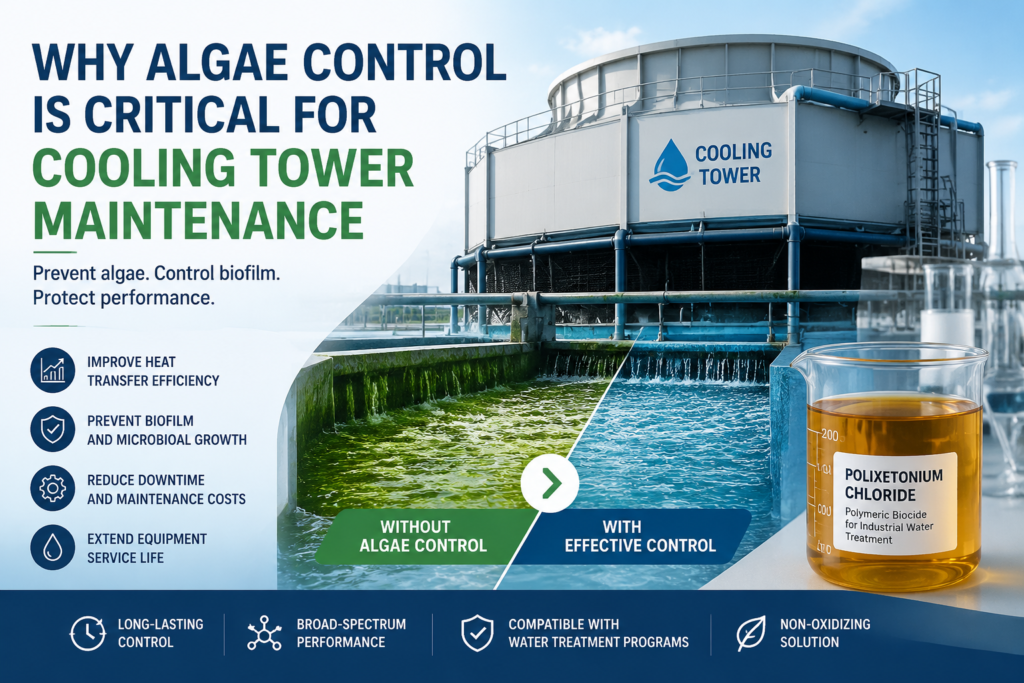
Cooling towers are often described as the “lungs” of industrial cooling systems. They remove excess heat, help maintain process stability, and keep equipment operating efficiently. But behind the visible water circulation, there is another story happening quietly.
Warm temperatures. Constant water movement. Exposure to sunlight. Nutrients carried by makeup water and airborne contaminants.
Sounds like the perfect environment for algae growth, doesn’t it?
For many industrial facilities, algae may seem like a small cosmetic issue at first. A little green color on a cooling tower basin or some slippery deposits on surfaces may not look like a serious problem. However, algae growth is rarely just an appearance issue. Left unmanaged, it can become the starting point for larger operational challenges, including biofilm formation, reduced heat transfer efficiency, increased cleaning frequency, and higher maintenance costs.
That is why algae control is not simply an optional chemical treatment step. It is an important part of a complete cooling tower maintenance program.
Cooling Towers and the Hidden Challenge of Algae Growth
A cooling tower works by bringing water and air into contact to remove heat through evaporation. This design makes cooling towers highly efficient, but it also creates conditions where microorganisms can survive.
Think about a garden pond. When sunlight, water, and nutrients come together, algae naturally appears. A cooling tower is not a pond, of course, but some environmental factors are surprisingly similar.
Cooling towers often provide:
- Warm circulating water
- Continuous moisture
- Exposure to sunlight in open systems
- Nutrients from dust, air particles, and organic matter
- Large surface areas for microorganisms to attach
Over time, algae can begin developing on:
- Cooling tower basins
- Fill materials
- Drift eliminators
- Distribution decks
- Pipe surfaces
- Water storage areas
At the beginning, algae growth may only appear as a thin layer. But as the population increases, the problem becomes more complicated.
The key point is simple: algae rarely stays alone.
Where algae grows, other microorganisms often find a place to survive.
Why Algae Naturally Develops Inside Cooling Water Systems
You may wonder: why do some cooling towers experience serious algae problems while others remain relatively clean?
The answer usually comes down to several environmental factors working together.
1. Sunlight Exposure
Open cooling towers receive direct sunlight, especially during summer months. Algae uses photosynthesis to produce energy, meaning light availability directly supports growth.
A cooling tower located outdoors in a sunny industrial area can become a much better environment for algae compared with a closed system.
2. Nutrient Availability
Algae requires nutrients to grow. These nutrients may come from:
- Airborne dust
- Organic debris
- Process contamination
- Makeup water
- Corrosion products
Even small amounts of nutrients can support microbial activity over time.
3. Water Temperature
Many industrial cooling systems operate at temperatures that are comfortable for microbial growth.
Warm water does not only help algae. It also supports bacteria and other microorganisms that contribute to biological fouling.
4. Poor Circulation Areas
Cooling towers are designed for water movement, but some areas naturally have lower flow rates.
These stagnant zones can become “safe zones” for algae attachment and growth.
A little corner that receives less movement may eventually become the place where a much bigger problem begins.
How Algae Affects Cooling Tower Performance and Operation
Algae problems are often underestimated because the first signs seem harmless.
A green film here. A slippery surface there.
But industrial cooling systems are sensitive. Small biological changes can create noticeable performance problems.
Reduced Heat Transfer Efficiency
Cooling towers depend on efficient heat exchange between water and air.
When algae accumulates on fill materials or heat exchange surfaces, it can create a physical barrier. This reduces the contact area between water and air.
The result?
The cooling tower may need to work harder to achieve the same cooling effect.
This can increase:
- Fan operation time
- Energy consumption
- Operating costs
A small biological layer can become an expensive efficiency problem.
Increased Cleaning and Maintenance Requirements
Without proper algae control, operators may need to perform more frequent cleaning.
Manual removal of algae deposits can require:
- Equipment shutdowns
- Labor hours
- Additional water usage
- Chemical cleaning procedures
For large industrial facilities, repeated cleaning is not just inconvenient. It directly affects operating budgets.
Increased Risk of Biofilm Formation
Algae is not always the main problem. Often, it acts as a foundation for more complex microbial communities.
Microorganisms can attach to algae deposits and create biofilms.
A biofilm is a protective layer formed when microorganisms attach to surfaces and surround themselves with extracellular polymeric substances (EPS).
Simply explained, biofilm is like a “microbial shelter.”
Once formed, microorganisms inside biofilms become harder to remove because the protective matrix reduces the effectiveness of many treatments.
This is why controlling algae early is much easier than trying to remove mature biological deposits later.
The Connection Between Algae, Biofilm, and Microbial Growth
Cooling water management is not only about killing individual microorganisms. It is about controlling the entire biological environment.
Algae can contribute to microbial problems in several ways:
Providing Nutrients
When algae grows and eventually dies, it releases organic materials that other microorganisms can use as food.
Creating Attachment Surfaces
Smooth surfaces are not always easy for microorganisms to colonize. However, algae deposits create rough biological layers where bacteria can attach.
Protecting Microorganisms
Mixed microbial communities can develop inside biological deposits, making chemical treatment more challenging.
This relationship explains why algae control should be considered a foundation of cooling tower hygiene.
Why Preventive Algae Control Matters in Cooling Tower Maintenance
Many operators only react after visible algae appears.
But waiting until algae becomes obvious is usually not the most efficient approach.
Preventive control offers several advantages:
Better System Reliability
A cooling tower is expected to operate continuously. Unexpected biological fouling can reduce performance at the worst possible time.
Regular algae management helps maintain stable operation.
Lower Maintenance Costs
Preventing biological buildup usually requires less effort than removing heavy deposits.
It is similar to cleaning a kitchen regularly instead of waiting until grease completely covers every surface.
Improved Water Treatment Efficiency
When algae and biofilm are controlled, other water treatment chemicals can perform more effectively.
A cleaner system allows better interaction between treatment chemicals and the water environment.
Common Approaches for Managing Algae in Cooling Towers
Cooling tower operators typically use a combination of mechanical, operational, and chemical methods.
Mechanical Cleaning
Physical cleaning remains an important part of maintenance.
Common practices include:
- Removing visible deposits
- Cleaning basins
- Inspecting fill materials
- Removing accumulated debris
However, mechanical cleaning alone cannot prevent algae from returning.
Oxidizing Biocides
Oxidizing chemicals, such as chlorine-based treatments, are widely used in water treatment.
They work by creating strong oxidative conditions that damage microbial cells.
Advantages include:
- Fast microbial control
- Broad application history
However, operators must carefully manage:
- Corrosion risks
- Chemical demand
- pH effects
- Organic interactions
Non-Oxidizing Biocides
Non-oxidizing biocides provide another approach, especially when long-lasting biological control is desired.
These products work through different mechanisms and are often selected based on:
- Water chemistry
- System design
- Microbial challenges
- Regulatory requirements
Among these materials, polymeric quaternary ammonium compounds have gained attention in certain industrial applications.
How to Choose the Right Algaecide for Industrial Cooling Systems
Choosing an algaecide is not simply about selecting the strongest chemical.
The right product depends on the actual cooling system.
Important factors include:
Water Chemistry
Consider:
- pH range
- Hardness
- Organic load
- Conductivity
- Existing treatment chemicals
A product that performs well in one cooling tower may not behave the same way in another.
Biological Challenge
Different systems may face different problems:
- Green algae
- Cyanobacteria
- Biofilm formation
- Mixed microbial growth
Understanding the biological challenge helps determine the suitable treatment strategy.
Compatibility With Other Chemicals
Industrial water treatment usually involves multiple products.
The selected algaecide should work alongside:
- Corrosion inhibitors
- Scale inhibitors
- Dispersants
- Other biocides
Chemical compatibility is a key part of successful treatment.
Why Polymeric Non-Oxidizing Biocides Are Receiving More Attention
Polymeric quaternary ammonium compounds represent an interesting category of non-oxidizing biocides.
One example is Polixetonium Chloride (Polyquaternium-42, CAS No. 31512-74-0), a cationic polymer used in industrial and specialty water treatment applications.
Compared with traditional small-molecule quaternary ammonium compounds, polymeric structures can offer different performance characteristics.
These materials are often valued for:
- Long-lasting biological control
- Low foaming characteristics
- Compatibility with various water treatment systems
- Broad application possibilities
For industrial users, the attraction is not only microbial control itself. It is also about maintaining system cleanliness with fewer operational interruptions.
You can learn more about its chemistry and characteristics through our article:
Understanding the Chemical Structure of Polixetonium Chloride
For buyers evaluating industrial biocides, understanding product specifications is equally important. Active content, viscosity, pH, and application concentration all influence product selection.
More details can be found in:
Technical Properties of Polixetonium Chloride
Practical Tips for Better Algae Control in Cooling Towers
A successful algae control program requires consistency.
Here are several practical recommendations:
- Inspect cooling tower basins regularly
- Monitor water quality changes
- Remove organic debris quickly
- Avoid unnecessary nutrient buildup
- Maintain proper circulation
- Use appropriate biocide programs
- Record treatment performance over time
A common mistake is changing chemicals frequently without understanding the root cause.
Sometimes the problem is not the chemical itself. It may be poor circulation, excessive nutrients, or insufficient monitoring.
Final Thoughts: Keeping Cooling Towers Clean Starts with Prevention
Algae control is a small part of cooling tower maintenance, but its impact can be much larger than many people expect.
A cooling tower is a carefully balanced biological and chemical environment. When algae begins growing, it can create conditions that encourage biofilm formation, reduce efficiency, and increase maintenance demands.
The smartest approach is not waiting for a visible problem.
It is building algae control into regular cooling tower management.
After all, preventing a biological problem is usually easier, cheaper, and more reliable than fixing one after it has already spread.
Frequently Asked Questions
1. What causes algae growth in cooling towers?
Algae growth in cooling towers is mainly caused by sunlight exposure, warm water temperatures, nutrients, and moisture. Outdoor cooling towers provide many conditions that support algae development.
2. Why is algae control important for cooling tower efficiency?
Algae control helps prevent biological deposits that reduce heat transfer efficiency, increase cleaning requirements, and contribute to biofilm formation.
3. How often should cooling towers receive algae treatment?
Treatment frequency depends on system conditions, water chemistry, climate, and biological activity. Many industrial facilities use continuous monitoring and scheduled biocide programs.
4. What type of algaecide is suitable for industrial cooling water systems?
Suitable algaecides depend on the cooling system design and water conditions. Non-oxidizing polymeric biocides, including certain polyquaternary compounds, are used in some industrial applications requiring long-lasting biological control.
5. Can polymeric biocides help control algae in cooling towers?
Yes. Certain polymeric biocides, such as Polixetonium Chloride, are designed for industrial microbial control applications and may help manage algae-related problems when used as part of a complete water treatment program.