GET IN TOUCH
Ask For Sample?
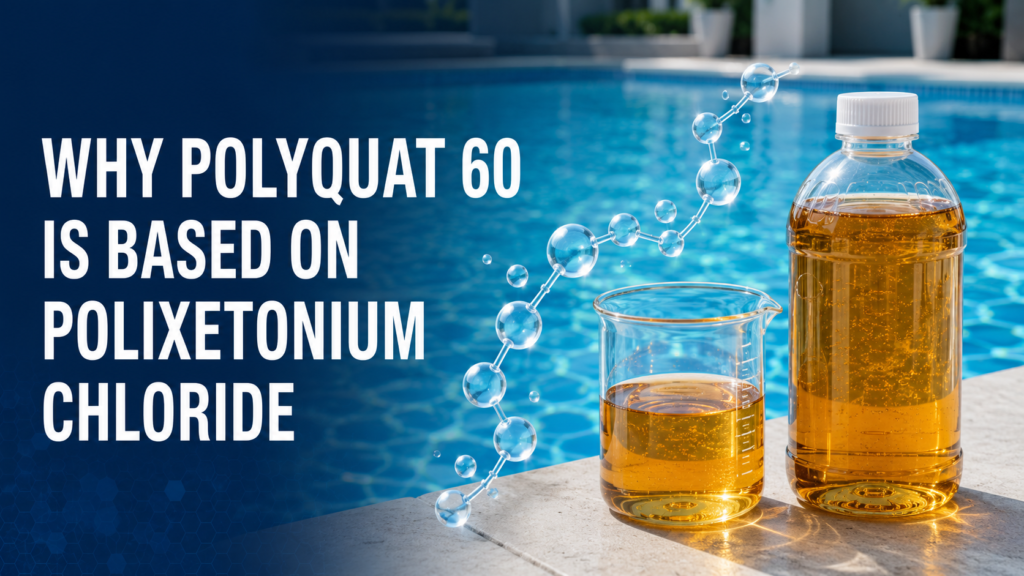
Why Polyquat 60 Is Based on Polixetonium Chloride?
Pool chemical names can be surprisingly confusing. A product may have a chemical name, a CAS number, an industry nickname, a concentration grade, and a private-label brand name—all referring to the same bottle.
Polyquat 60 is a good example.
People often ask whether Polyquat 60 and Polixetonium Chloride are two different chemicals. Usually, they are not. In the pool chemical industry, “Polyquat 60” commonly describes a concentrated polymeric algaecide whose active ingredient is Polixetonium Chloride.
The word “polyquat” refers to the polymeric quaternary ammonium structure. The number “60” normally refers to the concentration of the supplied product, often around 60% active ingredient or solids, depending on the supplier’s specification and test method.
That short explanation sounds simple. The chemistry behind it, however, explains why this ingredient became such a widely recognized option for non-metal, low-foaming pool algae control.
What Does “Polyquat 60” Actually Mean?
“Polyquat 60” is more of an industry description than a complete chemical identity.
The name has two parts:
- “Polyquat” indicates a polymer containing repeating quaternary ammonium groups.
- “60” indicates that the commercial concentrate is supplied at approximately 60% strength.
The active polymer is commonly identified as Polixetonium Chloride. Its widely used CAS number is 31512-74-0, and its EC number is 608-627-7. The U.S. Environmental Protection Agency also lists the substance under pesticide chemical code 069183.
Its formal chemical description is often written as:
Poly[oxyethylene(dimethyliminio)ethylene(dimethyliminio)ethylene dichloride]
That is quite a mouthful. No pool technician wants to repeat it while standing beside a pump room, so “Polyquat 60” became a much more practical commercial term.
Still, buyers should not rely on that name alone. Different markets and suppliers sometimes use shortened names inconsistently. A technical data sheet, safety data sheet, certificate of analysis, and CAS number provide a much clearer picture of what is actually being supplied.
So, Is Polyquat 60 the Same as Polixetonium Chloride?
In common pool-industry usage, Polyquat 60 is a concentrated product based on Polixetonium Chloride.
The relationship can be expressed like this:
| Term | What It Usually Describes |
|---|---|
| Polixetonium Chloride | The chemical identity of the active polymer |
| Polyquat | The polymeric quaternary ammonium chemical family |
| Polyquat 60 | A commercial concentrate containing roughly 60% of the polymer |
| CAS 31512-74-0 | A widely recognized identifier for Polixetonium Chloride |
| PC code 069183 | The EPA pesticide chemical code associated with this active ingredient |
This distinction matters.
Polixetonium Chloride identifies the substance. Polyquat 60 describes how that substance is commonly supplied and marketed for formulation or pool treatment.
Think of it like orange juice concentrate. “Orange juice” tells you what the material is; “60% concentrate” tells you something about the form in which it is sold. The concentration does not create a new chemical identity.
There is one important caution, though. “Polyquat 60” is not always applied with perfect consistency across every market. A buyer should confirm the chemical name, CAS number, active ingredient declaration, and analytical method before assuming that two products with similar labels are equivalent.
Why Is Polixetonium Chloride Used as the Active Ingredient?
The short answer is that its molecular structure fits the job.
Polixetonium Chloride is a water-soluble cationic polymer. “Cationic” means that the polymer carries positive electrical charges along its chain.
Many algae cells and suspended particles in pool water have surfaces that behave as negatively charged sites. The positively charged polymer is attracted to those surfaces. This interaction allows the active ingredient to adsorb onto algae and interfere with normal cell-surface and membrane functions.
That gives Polixetonium Chloride two useful characteristics:
- It can help suppress or control algae growth.
- Its polymeric charge can encourage very small suspended material to gather into larger groups that filtration may remove more easily.
The second effect helps explain why some pool owners notice improved water clarity when using a polyquat algaecide correctly. It does not mean every Polyquat 60 product should be treated as a dedicated clarifier. Formulation, dosage, circulation, filtration, and overall water balance still determine the result.
Chemistry rarely works alone in a swimming pool. It works as part of a system.
The Polymer Chain Makes a Real Difference
Traditional quaternary ammonium algaecides—often called monomeric quats—contain relatively small positively charged molecules. These products can control algae, but they may also interact strongly at the air-water interface.
That surface activity can produce foam, especially in pools with water features, return jets, swim jets, or heavy circulation. Anyone who has watched a spa suddenly turn into a bubble bath knows how quickly this becomes annoying.
Polixetonium Chloride is different because its cationic groups are incorporated into a larger polymer chain.
This polymeric structure changes how the material behaves in water. Compared with many conventional monomeric quats, a properly formulated Polixetonium Chloride algaecide is generally associated with:
- Much lower foaming
- Better suitability for highly circulated pools
- Longer-lasting algae-control support
- Reduced risk of the dramatic sudsing seen with some traditional quats
- Useful interaction with suspended particles
- Compatibility with many normal pool-maintenance programs when used correctly
This is the real meaning behind the “poly” in polyquat. It is not a decorative marketing prefix. It points to the repeating molecular structure that influences the product’s performance.
Why Not Use an Ordinary Quat at a Higher Dose?
It sounds logical: if a regular quat works, why not simply add more?
Because more of the wrong behavior is still the wrong behavior.
Raising the dose of a conventional foaming quat can increase surface activity and make foam more noticeable. It may also create unnecessary chemical demand or lead to treatment outside the product label.
Polixetonium Chloride offers formulators another route. Instead of relying on a higher dose of small surfactant-like molecules, it uses a charged polymer that behaves differently in pool water.
That does not make every polyquat application automatically perfect. Overdosing any pool chemical can create problems, and concentrated products should never be poured casually. The product label, pool volume, algae condition, sanitizer level, and filtration status must all be considered.
Still, for maintenance programs where low foam and non-metal algae control matter, the polymeric approach has a clear practical appeal.
Why Is the Commercial Concentration Usually Around 60%?
The “60” in Polyquat 60 is not a measure of molecular weight, algae-killing percentage, or expected reduction in sanitizer use. It generally refers to the concentration of the commercial product.
Why did approximately 60% become common?
A concentrated aqueous grade offers a useful compromise between several factors:
- Active ingredient per kilogram
- Transportation cost
- Pumpability
- Filling performance
- Dilution convenience
- Storage stability
- Downstream formulation flexibility
Shipping excess water is expensive. A higher-concentration raw material can reduce freight and packaging requirements per unit of active polymer. This is especially valuable for manufacturers producing private-label pool algaecides in several retail strengths.
Yet concentration cannot be increased without limits. As polymer concentration rises, viscosity can rise as well. A product that is too thick may become difficult to pump, meter, transfer, or dilute—particularly in a cold warehouse.
A 60% grade often provides a practical middle ground. It contains a substantial amount of functional polymer while remaining manageable in normal manufacturing operations.
That is why the 60% concentrate has become so familiar. It is not an arbitrary number printed on the bottle; it reflects a balance between chemistry, logistics, and processing.
“Active Content” and “Solids” Need Careful Attention
Here is where purchasing becomes a little more technical.
One supplier may describe a product as “60% active.” Another may report “60% solids.” Those statements can sound identical, but they are not automatically interchangeable.
Total solids measure the material left after volatile components—mainly water—are removed under a defined test. Active content is intended to describe the portion considered to be the functional active ingredient. Depending on the product composition and analytical method, the values may differ.
Before calculating formulation cost, buyers should ask:
- Is the reported percentage active ingredient or total solids?
- Which analytical method is used?
- Is the test method stated on the specification?
- What is the guaranteed range?
- Does the certificate of analysis report the same parameter?
- Are salts, residual monomers, or other nonvolatile components included in the solids result?
This is not paperwork for the sake of paperwork. If one concentrate contains a true 60% active level while another merely reports 60% total solids, their cost per kilogram of functional ingredient may not be equal.
A low quotation can become surprisingly expensive once concentration and formulation yield are calculated correctly.
Why Polixetonium Chloride Fits Non-Metal Algaecide Formulas
Copper compounds have long been used for algae control. They can be effective, but copper introduces a metal into the water. If water chemistry is poorly controlled, dissolved copper may contribute to discoloration, deposits, or blue-green staining on some pool surfaces and fittings.
Polixetonium Chloride does not rely on copper, silver, or another algaecidal metal. Its performance comes from its cationic polymer structure.
That gives Polyquat 60 an important position in non-metal pool treatment programs. It is often considered when formulators want to reduce concerns connected with:
- Metal accumulation
- Pool-surface staining
- Discoloration linked to dissolved copper
- Compatibility with certain stain-sensitive finishes
- Consumer preference for metal-free algae-control products
“Metal-free” should not be interpreted as “risk-free.” Concentrated Polixetonium Chloride still requires proper handling, labeling, storage, dosage control, and regulatory review. It is also not safe to release carelessly into natural water. Many antimicrobial active ingredients can be harmful to aquatic organisms outside their intended treatment system.
The benefit is more specific: the algaecidal action does not depend on adding a metal ion to the pool.
Does Polyquat 60 Replace Chlorine?
No. Polyquat 60 normally supports a pool sanitation program; it does not replace the primary sanitizer.
Chlorine or another approved sanitizer performs the central disinfection role. It controls a broad range of microorganisms and helps oxidize contaminants introduced by swimmers, rain, leaves, cosmetics, and the surrounding environment.
Polixetonium Chloride is mainly used to help prevent or control algae. The two chemicals have different jobs.
A sensible treatment program may therefore combine:
- Correct sanitizer residual
- Balanced pH and alkalinity
- Adequate circulation
- Effective filtration
- Regular brushing and cleaning
- A properly dosed Polyquat 60 algaecide when appropriate
It is rather like caring for a garden. Watering alone does not solve weeds, and weed control does not replace watering. Each part of the program addresses a different problem.
Concentrated Polyquat 60 and concentrated chlorine products should not be mixed together in a container or dosing line unless a validated formulation and process specifically permit it. Pool products should be added separately according to their labels.
Why Low Foaming Matters More Than It Sounds
Foam is not merely a cosmetic inconvenience.
In a commercial pool, fountain, spa, or water feature, persistent foam can make the water look contaminated even when microbial measurements are acceptable. Guests do not see molecular structures or laboratory reports. They see bubbles gathering at the edge and wonder whether the pool is clean.
Foam may also interfere with water-level sensors, overflow systems, skimmers, and visual inspection. In packaging terms, a foaming raw material can slow blending and filling because trapped air affects volume accuracy.
The low-foaming character associated with Polixetonium Chloride is therefore useful at several stages:
- Raw-material handling
- Product blending
- Retail bottle filling
- Application around the pool
- Operation of water features and high-flow systems
- Maintenance of a clean visual appearance
This is one reason professional pool chemical formulators distinguish polymeric quats from cheaper monomeric alternatives. The two groups may both contain quaternary ammonium chemistry, but their real-world behavior can be quite different.
Why Polyquat 60 May Help Water Look Clearer
Polixetonium Chloride carries multiple positive charges along its polymer chain. Besides interacting with algae, these charges may interact with negatively charged suspended particles.
When very fine particles remain separate, they can pass through a filter or stay suspended long enough to make the pool look dull. A charged polymer can reduce the forces keeping some particles apart, allowing them to form larger clusters.
Those clusters may be easier for the filter to capture.
This is a supporting effect rather than a reason to ignore filtration. A dirty filter, weak pump, short circulation time, or severe water imbalance cannot be rescued by pouring in more algaecide.
In fact, adding more product than the label recommends can work against good pool care. Accurate dosing remains essential.
For formulas designed mainly around particle removal, a dedicated Polymer Pool Clarifier may offer more predictable clarification performance. Polyquat 60 should first be evaluated as an algaecidal active ingredient, with any clarification benefit treated as a useful secondary property.
Is Every Polixetonium Chloride Product Suitable for a Finished Pool Algaecide?
Not necessarily.
Matching the chemical name and CAS number is only the first step. Product quality and regulatory suitability also depend on manufacturing controls, impurity profiles, concentration, pH, viscosity, stability, documentation, and the laws of the destination market.
A raw-material buyer should evaluate at least the following:
Chemical Identity
Confirm the full chemical name, CAS number, and any applicable regulatory identifiers. Polixetonium Chloride is commonly associated with CAS 31512-74-0, but documentation should be reviewed as a complete set.
Concentration
Check whether “60%” means active content, total solids, or another defined measurement. Ask for the test method and guaranteed specification range.
Appearance
A commercial Polixetonium Chloride concentrate may be supplied as an amber, transparent, viscous liquid. Significant haze, sediment, phase separation, or unexpected particles deserve investigation.
Color alone does not prove quality, but a sudden change from the approved standard may signal a raw-material or process variation.
Viscosity
Viscosity affects pumping, mixing, dilution, and bottle filling. The measurement temperature and test method should be stated because polymers can show noticeable changes under different conditions.
pH
A controlled pH range helps support storage stability and downstream formula consistency. Buyers should confirm whether pH is measured directly or at a specified dilution.
Batch Consistency
One excellent sample does not prove routine production quality. Recent certificates of analysis, retained-sample data, and multiple batch results provide a better view.
Regulatory Status
A chemical being commercially available does not automatically make every intended use legal. Pool algaecides may be regulated as pesticides or biocidal products, depending on the country.
In the United States, for example, the EPA identifies the active chemical under PC code 069183, while individual end-use products and labels have their own registration requirements. Buyers and formulators should confirm what applies to their raw material, manufacturing activity, claims, packaging, and destination market.
Polixetonium Chloride Versus Other “Polyquat” Materials
“Polyquat” is a broad descriptive term. It can refer to more than one cationic polymer, and not every polymeric quaternary ammonium compound is chemically identical to Polixetonium Chloride.
This matters because two cationic polymers may differ in:
- Monomer composition
- Charge density
- Molecular-weight distribution
- Viscosity
- Chloride content
- Algaecidal performance
- Clarification behavior
- Toxicological profile
- Regulatory registration
- Compatibility with other formulation ingredients
A supplier may use “polyquat” informally because the product belongs to the general chemical family. That does not prove it is the active ingredient recognized in a specific registered algaecide.
The CAS number and full chemical description should settle the question—not the nickname.
Buyers should be especially cautious when a quotation lists several CAS numbers as if they were automatically interchangeable. CAS identifiers can reflect different substances, naming conventions, or compositions. Any discrepancy should be explained before sampling, formulation, or regulatory submission begins.
Why Formulators Start with the Concentrated Raw Material
A 60% Polixetonium Chloride concentrate gives manufacturers room to create different finished-product strengths.
The concentrate may be diluted and incorporated into formulas intended for:
- Routine algae prevention
- Seasonal pool opening
- Pool closing and winter treatment
- High-bather-load maintenance
- Private-label retail products
- Commercial pool service programs
The finished product does not necessarily contain 60% active ingredient. “Polyquat 60” can refer to the concentrated raw material or, in some markets, a high-strength finished algaecide. Lower-strength retail products may be formulated from the same core chemistry.
This is why formulators calculate every batch on an active basis. If a raw material contains 60% active polymer, adding 100 kilograms contributes approximately 60 kilograms of active ingredient before allowing for analytical tolerance and manufacturing variation.
The formula must then account for the desired finished strength, batch size, density, processing losses, and regulatory label declaration.
The Main Reason Comes Back to Structure
Why is Polyquat 60 based on Polixetonium Chloride?
Because Polixetonium Chloride supplies the combination that the product name promises:
- A polymeric structure
- Multiple quaternary ammonium sites
- Positive charge in water
- Algae-control activity
- Low-foaming behavior compared with many conventional quats
- Non-metal performance
- A form that can be supplied efficiently as an aqueous concentrate
The name “Polyquat 60” is therefore a compact commercial description of both chemistry and concentration.
It tells formulators that they are dealing with a polymeric quat, not a simple monomeric quat. It also tells them that the material is supplied at a relatively high concentration—although the precise meaning of that concentration must still be confirmed.
Simple name, quite a lot going on underneath.
Choosing the Right Polyquat 60 Raw Material
A reliable purchase should begin with documents, but it should not end there.
Request a current technical data sheet, safety data sheet, certificate of analysis, specification, sample, and information about the analytical methods. Then test the sample in the intended formulation.
Useful checks may include:
- Appearance under normal and cold-storage conditions
- Active content or solids
- pH
- Density
- Viscosity
- Dilution behavior
- Compatibility with formula ingredients
- Foaming tendency
- Heat and freeze-thaw stability
- Packaging compatibility
- Performance in representative pool water
For private-label products, the finished formulation should also be evaluated in the actual HDPE bottle, cap, induction seal, label, and shipping carton. A formula may look stable in a laboratory beaker yet behave differently after months in a warehouse.
That is the unglamorous side of good formulation—and, honestly, the side that prevents expensive surprises.
Conclusion
Polyquat 60 is based on Polixetonium Chloride because this cationic polymer provides the chemical structure needed for effective, non-metal, low-foaming algae control.
Polixetonium Chloride is the active chemical identity. “Polyquat” describes its polymeric quaternary ammonium nature, while “60” normally refers to the concentration of the commercial product.
The terms are closely connected, but they are not interchangeable in every technical context. A product name cannot replace a full specification.
For buyers and pool chemical manufacturers, the safest approach is straightforward: verify the chemical name, CAS number, concentration basis, test method, batch data, and regulatory status. Once those points are clear, Polyquat 60 becomes much easier to understand—and much easier to formulate correctly.
Frequently Asked Questions
1. Is Polyquat 60 another name for Polixetonium Chloride?
Polyquat 60 commonly refers to a concentrated algaecide or raw material based on Polixetonium Chloride. Polixetonium Chloride is the chemical identity, while Polyquat 60 is an industry description that also indicates an approximately 60% concentration.
2. What is the CAS number for Polixetonium Chloride used in Polyquat 60?
Polixetonium Chloride is commonly identified by CAS number 31512-74-0. Buyers should confirm this number against the technical data sheet, safety data sheet, certificate of analysis, and applicable regulatory records.
3. Does the “60” in Polyquat 60 mean it kills 60% of algae?
No. The number normally refers to the concentration of the commercial product, not the percentage of algae controlled. Suppliers should clarify whether their specification reports active ingredient, total solids, or another measurement.
4. Is Polixetonium Chloride Polyquat 60 compatible with chlorine?
It is commonly used as part of chlorine-maintained pool programs when applied according to an approved product label. Concentrated Polyquat 60 should not be directly mixed with concentrated chlorine or other oxidizers. Each product should be added separately using the stated procedure.
5. Why choose a Polixetonium Chloride algaecide instead of a copper algaecide?
A Polixetonium Chloride algaecide controls algae without depending on copper or another metal. This can reduce concerns about metal accumulation and blue-green surface staining. Product selection should still consider the pool condition, water chemistry, local regulations, and label directions.