
GET IN TOUCH
Ask For Sample?
When Should You Add Polymer Pool Clarifier?
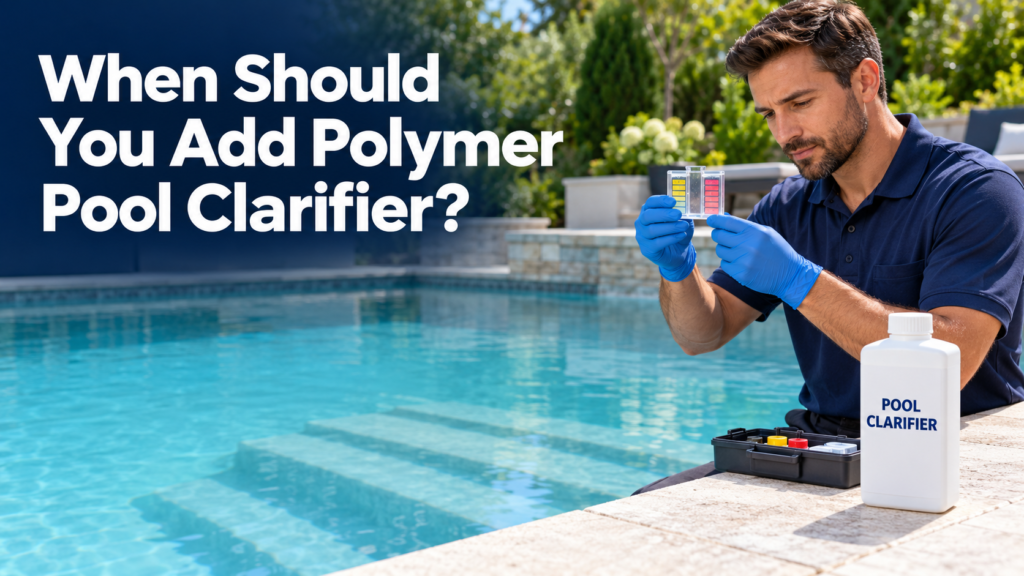
Add polymer pool clarifier when fine suspended particles leave the water dull or hazy after you have checked water chemistry, controlled any algae, and confirmed that the filter and circulation system work properly. Common opportunities include lingering haze after heavy swimming, windblown dust, seasonal opening, or successful algae treatment. Follow the specific product label for dose, chemical spacing, filter compatibility, and repeat treatment.
The water looked lovely yesterday. Today, the steps seem less sharp, and a soft haze hangs over the deep end. You check the pump. It is running. You check the water. Nothing obvious jumps out.
Should you add clarifier now?
Perhaps. But cloudy water is a symptom with several possible causes. A bottle of clarifier can help with one part of the problem: fine particles that are hard to filter. The best time to use it depends on whether those particles are the main reason your pool has lost its sparkle.
Let’s work through the signs, the timing, and a few situations where waiting is the smarter move.
First, Know What You’re Asking the Clarifier to Do
A polymer pool clarifier helps small suspended particles form groups that the filter can capture more readily. Think of crumbs on a table. One tiny crumb can escape your cloth; a small pile is easier to collect.
The comparison is simple, but it explains the job well. Clarifier conditions the particles. Filtration removes them.
For positively charged polymers, interactions with particle surfaces can reduce the forces that keep fine matter apart. The exact process depends on the polymer and the water. You do not need to master the chemistry to use a finished product correctly, but you do need to understand the division of work.
A clarifier does not replace sanitizer, remove every dissolved contaminant, or repair a damaged filter. If circulation is weak, the treated particles may never reach the filter at a useful rate.
That is why good timing starts with a check, rather than a calendar reminder.
Add It When a Fine Haze Remains After the Basics Are Right
Persistent, mild haze is one of the clearest reasons to consider polymer clarification.
You have removed visible debris. Your water tests are within the targets for your pool and treatment program. There is no clear sign of active algae. Return flow is normal, and the filter is in serviceable condition. Yet the water still looks flat.
At this point, fine suspended matter may be the missing piece.
Look for a gradual loss of detail: tile lines appear softer, steps look less crisp, or the water lacks its usual brightness. These observations can guide your inspection, though appearance alone cannot identify the cause.
If ordinary filtration is already making steady progress, you may not need clarifier. Give the system the chance to do its job. If improvement stalls and fine particles remain the likely cause, a measured, label-directed treatment becomes a reasonable next step.
The aim is to solve a defined problem, not to add another chemical because the pool looks slightly different in afternoon light.
After a Busy Swimming Day, Test Before You Treat
A crowded pool works hard. Swimmers bring small amounts of dirt, skin debris, sunscreen, and other material into the water. Some of that load may contribute to haze; some affects sanitizer demand or requires a different response.
So, after a pool party, the first question is not “How much clarifier?” It is “What changed?”
Check sanitizer and pH, empty baskets, remove visible debris, and inspect circulation. CDC guidance calls for more frequent disinfectant and pH checks when a pool is in heavy use. Clear-looking water alone cannot confirm that these conditions are suitable.
Once those checks are complete, consider clarifier if a fine haze remains and the product is suitable for your system.
For a hotel or club, a quiet period after closing may be convenient. Staff can measure the dose, keep records, and monitor filter pressure without working around swimmers. For a home pool, an evening after guests leave may serve the same purpose.
The useful feature is the uninterrupted treatment window. The clock itself does not make the polymer work better.
After Rain or Wind, Clear the Big Mess First
Storms can leave a pool full of leaves, dust, soil, and other debris. Wind alone can deliver a surprisingly fine layer of material that a skimmer cannot collect.
Start with what you can remove mechanically. Skim leaves, empty baskets, and vacuum settled dirt using the method suited to your equipment. Then test the water and check the filter.
If a light suspended haze remains after this cleanup, polymer clarifier may help filtration catch the smaller material.
Rain is not an automatic reason to dose. A clean pool after a short shower may need no clarification at all. Meanwhile, a pool affected by floodwater, sewage, or substantial contaminated runoff needs a proper contamination response. A clarity treatment cannot establish that such water is safe.
Treat the condition you find. Weather tells you where to look; it does not decide the treatment for you.
After Algae Treatment, Wait Until the Algae Is Controlled
An algae outbreak can leave a frustrating second problem. The green growth appears to be gone, but cloudy residue remains.
That is a situation where a filter-compatible clarifier may help, once the algae treatment has done its job and its instructions permit the next chemical addition.
Brush affected surfaces, remove settled residue, maintain the required treatment conditions, and keep the filter working. If fine debris remains suspended, clarification can support its removal.
Do not judge success only by a change from green water to pale blue water. Continued growth, slippery surfaces, or unexplained sanitizer demand deserve further investigation.
And do not assume that a polymer clarifier and a polyquat algaecide are interchangeable. They may both involve polymer chemistry, but their intended functions and directions differ.
The practical sequence is straightforward: control the algae, remove the debris, then address remaining fine haze if needed. Putting clarifier ahead of effective algae control can leave you chasing the same cloudiness again tomorrow.
During Pool Opening, Give the System a Proper Start
Opening a pool often reveals more than one problem. There may be leaves on the floor, a dirty filter, low sanitizer, and a pale cloud of suspended matter.
Clarifier can have a place in the opening process, but it belongs after the initial checks and cleanup.
Restore the water level and circulation. Remove debris. Inspect the filtration equipment. Test the water, correct relevant imbalances, and treat algae if present. Then reassess the haze.
If the remaining issue is fine suspended debris, a suitable clarifier may help finish the cleanup. If the water is already clearing at a useful pace, let filtration continue.
The same reasoning applies to a newly filled pool. Cloudiness after filling can relate to source-water chemistry, mineral precipitation, construction residue, or equipment issues. A new fill does not automatically call for polymer treatment.
A little patience here can save a great deal of chemical guesswork.
When Should You Hold Off?
Sometimes the right time to add clarifier is later. Sometimes it is never.
Pause when the pump has poor flow, the filter needs service, or water seems to bypass the filter medium. A clarifier depends on physical removal, so equipment faults need attention first.
Also pause when water chemistry points to a continuing source of haze. For example, conditions that cause calcium carbonate to precipitate can keep producing fresh suspended material. Addressing that cause matters more than repeatedly trying to collect the result.
Other reasons to wait include active algae, an unknown recent chemical addition, a previous clarifier overdose, or a product label that excludes your filter type.
If the deep-end drain cannot be seen clearly, keep swimmers out while the cause is investigated and corrected. CDC guidance tells swimmers to check that the drain at the bottom of the deep end is visible. Restoring visibility is essential, but it does not replace water testing or reopening requirements.
The distinction matters: a pool can look better before it is ready for use.
Before or After Shock? Use the Treatment Instructions
There is no single waiting period that fits every shock product, clarifier, and pool.
“Shock” may refer to different chemicals and treatment goals. Clarifier formulations also differ. A universal instruction to wait a fixed number of hours can ignore important product requirements.
If sanitizer treatment is needed to control algae or respond to contamination, complete that process according to the applicable instructions. Allow required circulation and chemical spacing, check the water, and confirm that conditions permit clarification.
Never mix concentrated clarifier with chlorine, acid, algaecide, or other pool chemicals in a container. Add each product separately as directed. CDC pool-safety guidance emphasizes reading labels and using appropriate protective equipment when handling chemicals. C
If the labels do not explain the sequence clearly, ask the supplier about the exact products involved. Provide their names, concentrations, current water readings, and filter type.
That information is far more useful than asking, “Can I add it after shock?” without saying what was added.
Is Morning, Afternoon, or Evening Best?
For most pool operators, practical conditions matter more than the time of day.
Choose a period when the circulation and filtration system can operate as required by the label, someone can measure the treatment accurately, and the pool can meet any restrictions on use.
Evening often works well because swimming has stopped and there is time to observe the system before the next busy period. Morning can work just as well if it provides the same conditions.
Check the filter pressure before treatment so you have a useful reference. Make sure baskets are clear and return flow is normal. Plan enough operating time for treated particles to reach the filter.
Avoid adding a filter-assisted clarifier just before a scheduled pump shutdown. You would be preparing particles for collection while switching off the system that collects them.
Also distinguish a clarifier from a settling flocculant. Some flocculant treatments involve a specific circulation period, settling, and vacuuming procedure. Follow the actual product instructions rather than transferring a routine from one category to another.
Should You Add Polymer Clarifier Every Week?
A weekly treatment can fit some product labels and maintenance programs. It is not a requirement for every pool.
Some pools remain clear with sound water chemistry, regular cleaning, and effective filtration. Others face recurring dust, pollen, or heavy use that may justify a label-approved maintenance dose.
The sensible approach is to track the need. Does haze return under similar conditions? Does the treatment produce a useful improvement? Does the filter remain manageable? Are you using the smallest label-directed amount that meets the purpose?
If the pool stays clear without regular dosing, avoid adding clarifier simply because a week has passed.
For service companies, records make this judgment easier. Log water readings, product dose, filter pressure, swimming load, and the clarity observed before and after treatment.
Over time, a pattern may emerge. One property struggles during pollen season; another loses clarity after weekend crowds. Those patterns support better timing than treating every pool on the route identically.
Dose Carefully, Then Let the Filter Earn Its Keep
Correct timing cannot compensate for an incorrect dose.
Use the finished product label and a reliable pool-volume estimate. Check whether the instructions express the dose as liquid product, product mass, or active polymer concentration. These are different quantities.
For example, a product containing 10% active polymer does not make “1 ppm of product” equivalent to “1 ppm of active polymer.” If technical guidance does not state the basis clearly, get clarification before calculating an addition.
Use a dedicated measuring tool. Follow any instructions for dilution and distribution, and confirm compatibility with your filter. Products grouped under the name “pool clarifier” can have different application requirements.
After dosing, maintain the prescribed circulation and filtration. Watch pressure and flow as the filter collects material. Service the filter according to its manufacturer’s guidance; avoid choosing a cleaning schedule without considering its actual condition.
The dose helps prepare the particles. The filter still needs time and capacity to remove them.
Don’t Add a Second Dose Just Because You’re Impatient
You add the measured amount, look at the water an hour later, and see little change. The temptation is obvious: perhaps another splash will help.
Resist that guess.
Clarification depends on particle conditions, circulation, filter performance, and formulation. There is no honest clearing-time promise that covers all pools.
Use the product’s stated assessment and repeat-treatment intervals. Compare the water from the same location under similar light, and note whether floor details become easier to see.
If improvement is slow, check flow, filter condition, dose calculation, and the possibility of continued contamination or an unresolved chemical problem. Excess polymer can sometimes impair particle aggregation or increase filter burden, so repeated additions can complicate the diagnosis.
If you suspect an overdose, stop adding product and seek product-specific recovery advice. Avoid improvising another chemical treatment to cancel out the first.
More is not a reliable shortcut. Better information usually is.
A Clear Plan for Pool Professionals and Buyers
Commercial pool operators need timing that fits the whole treatment program: water testing, cleaning, chemical additions, filtration, and reopening checks.
A planned treatment window helps staff measure accurately and observe the result. Public pools must also follow the applicable local operating and water-quality requirements. An attractive appearance cannot replace those checks.
For distributors and private-label buyers, clear instructions are part of product quality. Ask suppliers to state the dose basis, suitable filter types, circulation needs, chemical spacing, repeat interval, and relevant handling precautions.
Eautrix’s Polymer Pool Clarifier is listed as a PolyDADMAC-based formulation with 10% active ingredient. Its product page also describes formulation adjustment and private-label services. For a specific market or treatment program, confirm the finished formulation and its directions before setting customer dosing advice.
The most useful rule remains simple: add polymer clarifier when the remaining problem is fine suspended matter and your pool is ready to remove it. Check first, measure carefully, and judge the result before treating again.
Frequently Asked Questions
1. Can I add polymer pool clarifier when chlorine levels are normal?
Yes, if fine suspended particles are causing haze and the product instructions permit use under your water conditions. Normal chlorine readings do not rule out a filter problem, mineral precipitation, or another cause of cloudiness. Check those possibilities first.
2. How long should I wait to add pool clarifier after shock treatment?
Follow the directions for both products. There is no universal waiting period. Complete the required sanitizer treatment, meet chemical-spacing requirements, and confirm suitable water conditions before adding clarifier.
3. Should I add pool clarifier before or after backwashing?
If a backwashable filter needs cleaning, restore proper flow before treatment, then follow the clarifier label. After treatment, monitor pressure and clean when the filter manufacturer’s guidance calls for it. Cartridge filters require their own cleaning method.
4. Can I add polymer pool clarifier to a saltwater pool?
Use it only if the product is suitable for saltwater pools and your filtration system. A salt chlorine generator does not replace particle removal. Check chemistry and circulation, then follow the label dose and application directions.
5. When can swimmers return after pool clarifier is added?
Follow the product’s re-entry instructions and confirm appropriate sanitizer, pH, and clear visibility. Public pools must meet local reopening requirements. Do not allow swimming if the deep-end drain cannot be seen clearly, even if the clarifier’s stated waiting period has passed.