
GET IN TOUCH
Ask For Sample?
How to Evaluate Polymer Pool Clarifier Quality Before Purchase?
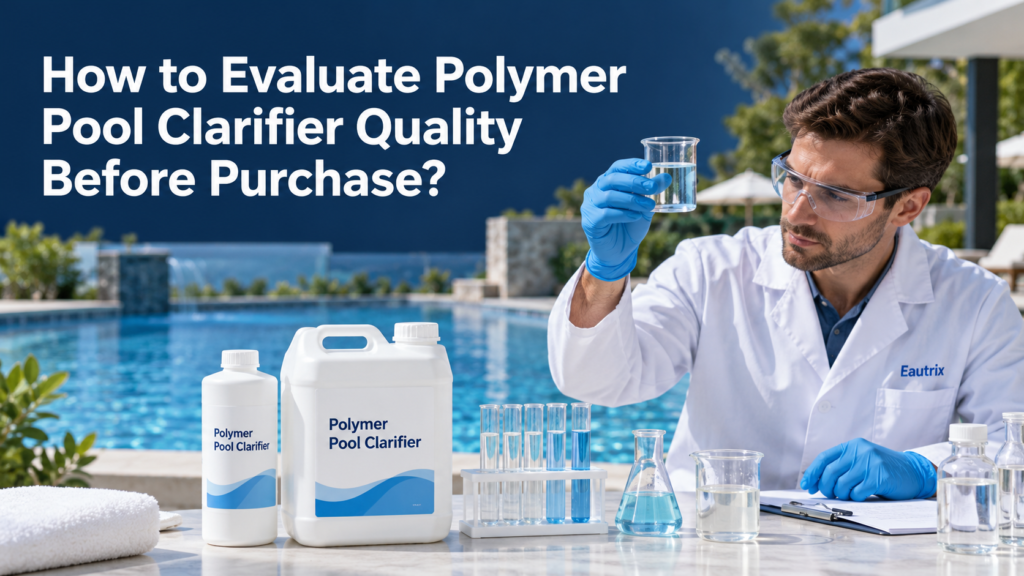
A polymer pool clarifier can look great in a sample bottle. The liquid is clear, the blue shade looks fresh, and the label promises sparkling water.
But will the next shipment perform the same way? Will it work with your customers’ filters? And does the quoted concentration mean what you think it means?
For pool chemical distributors, private label brands, and professional service companies, these questions matter more than appearance alone. A weak product can lead to repeat treatments and complaints. An inconsistent product creates a different problem: customers never quite know how much to use.
The most reliable way to evaluate polymer pool clarifier quality is to combine document review, sample inspection, controlled performance testing, and batch verification. Each step answers a different question. Together, they give you a sound basis for a purchase.
Let’s walk through what to check—and what can mislead you.
Start With What “Good Quality” Means for Your Market
Before comparing samples, define the job the product needs to do.
A clarifier sold to homeowners in small bottles faces different demands from one supplied to commercial pool maintenance teams. Homeowners may value simple measuring instructions. Service companies may care more about treatment cost, predictable results, and how often filters need cleaning.
Write down your intended use:
- Routine water polishing or occasional cloudy-water treatment.
- Residential pools, commercial pools, or both.
- Sand, cartridge, or diatomaceous earth (DE) filtration.
- Clear or blue product appearance.
- Ready-to-use retail formulation or concentrate for further blending.
- Expected transport and storage conditions.
This brief helps you ask better questions. “Is your clarifier good?” invites a sales pitch. “Can you provide filtration trial data for this formulation at its proposed label dose?” invites evidence.
There’s another point worth settling early: a clarifier supports particle removal. It does not replace proper sanitation, water balance, or a working filtration system. Clear-looking water alone does not prove that a pool is safe to use.
Know Which Polymer You’re Buying
“Polymer pool clarifier” describes a product category, not one fixed formula.
Products may use different polymer chemistries, grades, concentrations, and additives. Even when two products contain the same named polymer, their treatment behavior may differ.
For a PolyDADMAC-based clarifier, ask the supplier to identify the polymer as poly(diallyldimethylammonium chloride), CAS No. 26062-79-3. Then go a step further: confirm which grade is used and whether that grade remains consistent between orders.
The polymer name is the starting point. It is not a full specification.
For buyers assessing the raw material behind a finished formulation, the PolyDADMAC product page provides background on the polymer family.
A supplier may reasonably protect detailed manufacturing know-how. Still, you need enough information to establish product identity, assess suitability, and prepare accurate documents.
If the supplier cannot clearly explain what the product is, pause before discussing container quantities.
Ask What “10%” Actually Means
Two quotations may both say “10% polymer pool clarifier.” That does not automatically make them equivalent.
Ask whether the stated percentage refers to:
- Active polymer by weight.
- Total nonvolatile solids.
- The amount of a commercial polymer solution added during blending.
- Another defined measurement.
These are different things.
For example, adding 10% of a polymer raw material that itself contains 40% active polymer gives a nominal active polymer contribution of 4% by weight. It does not produce a finished formulation containing 10% active polymer.
That simple distinction can change the value of a quotation quite a lot.
Also, total solids testing may include non-polymer material. A solids result should not be treated as a polymer-specific assay unless the method and formulation justify that interpretation.
Ask the supplier to state the concentration basis and test method in writing. Where exact active polymer measurement is difficult, discuss which validated analytical checks and production controls support the declared content.
A percentage without a clear definition is a weak basis for purchasing.
Review the Documents as a Set
Request the technical data sheet (TDS), safety data sheet (SDS), product specification, and a recent certificate of analysis (COA).
Each document has a separate purpose.
| Document | What it should help you assess |
|---|---|
| Product specification | Agreed quality limits and relevant test methods |
| TDS | Product characteristics, application guidance, and storage conditions |
| SDS | Hazards, handling, storage, and other safety information |
| Batch COA | Results for an identified production batch |
| Label draft | Instructions and claims intended for the customer |
Check that the product name or code connects these documents. Different internal names can be workable, but the relationship should be clear.
Look for unexplained differences in concentration, appearance, storage conditions, or product identity. These may be simple editing errors. They may also show that document control needs attention.
An SDS is not proof of treatment performance. A TDS is not a batch test report. And a COA does not prove that a product suits every pool filter.
You need the full picture.
Read the COA Beyond the Word “Pass”
A useful COA links test results to a specific batch.
It should identify the product, batch number, and relevant dates. For measurable properties, actual values are generally more informative than a page filled with “Pass.”
Not every test requires a numerical result. Appearance, for example, may be assessed against a written description. But if pH, density, or viscosity are part of the release specification, ask to see the measured results.
The method matters too.
A viscosity result without a test temperature and instrument conditions may be hard to compare with your own measurement. A pH value is unclear if one party tests the product directly and another tests a diluted solution.
Agree on these details before the first order. Otherwise, two laboratories can produce different numbers without either one having made an obvious mistake.
For repeat supply, ask for COAs from several recent batches. You are looking for a consistent process, not one attractive result.
Inspect the Sample—but Keep Appearance in Perspective
Start with the unopened container.
Check the seal, batch identification, signs of leakage, and whether the sample matches the requested formulation. Photograph it before testing.
Then examine the liquid under consistent lighting against a plain background. Look for unexpected particles, sediment, separation, or a major difference from the supplier’s stated appearance.
A clear formulation and a blue formulation can both be acceptable. Blue color is a formulation feature; it is not a measure of polymer strength.
Likewise, a darker blue product is not automatically more concentrated. A small change in dye level can create a large visual difference.
For private label orders, approve a reference color sample and define an acceptable range. This helps keep the shelf appearance consistent without confusing color control with treatment performance.
Avoid directly sniffing unknown chemical samples. Follow the SDS and use appropriate handling precautions during inspection.
Don’t Let Thickness Make the Decision
A thick liquid can feel more substantial. It is easy to assume that thicker means stronger.
That shortcut can lead you astray.
Viscosity depends on polymer grade, concentration, temperature, and formulation. A thinner clarifier may perform well at its intended dose. A thicker product may simply be harder to pour or measure.
Treat viscosity as an agreed quality characteristic, not a universal ranking of effectiveness.
Ask:
- At what temperature was viscosity measured?
- Which instrument, spindle, and speed were used?
- What range is acceptable for this formulation?
- Does the product pour cleanly from the intended package?
- Can users measure the recommended dose without difficulty?
This last question deserves attention. A technically effective formula can still cause frustration if it drips down the bottle or is awkward to dose in cool weather.
Quality has to survive contact with everyday use.
Run a Controlled Sample Comparison
A controlled test is far more useful than adding a splash of each product to two random jars.
Use the same source water, sample volume, mixing conditions, temperature, and observation schedule for every candidate. Include an untreated control.
A practical screening plan might contain:
| Test sample | Purpose |
|---|---|
| Untreated water | Shows what changes without clarifier |
| Current approved product | Provides a known reference, if available |
| Candidate at proposed dose | Tests the intended use level |
| Candidate at a lower dose | Helps identify the lower end of useful performance |
| Candidate at a higher dose | Explores dose sensitivity under controlled conditions |
Use supplier-supported doses and record the basis clearly. “One milliliter per jar” means little unless the jar volume and product concentration are also known.
General coagulation testing guidance emphasizes consistent test conditions and measured outcomes. However, a pool clarifier screening test needs to reflect the intended application; a drinking-water settling procedure should not simply be copied and treated as proof of pool performance.
If the required dose is too small to measure accurately, have a competent laboratory prepare a suitable working dilution. Confirm that dilution is appropriate for the product and account for it in every calculation.
Measure Clarity Instead of Relying Only on Photos
Photographs are useful records. They are weak substitutes for consistent measurements.
Lighting, reflections, camera settings, and background color can make the same water look quite different. Blue dye adds another visual distraction.
Where practical, use a calibrated turbidity meter and a documented sampling procedure. Turbidity measures light scattering associated with suspended material and can help compare treatment results.
Handle samples consistently. Bubbles, dirty sample cells, and differences in sample timing can affect the reading. EPA Method 180.1 also identifies interference from dissolved color and fine air bubbles, which is relevant when comparing dyed formulations.
Record the starting water condition and the result at agreed times. Repeat the test to see whether the outcome holds.
There is no single reduction percentage that proves every pool clarifier is suitable. Set acceptance criteria around your application and test method. A clear, repeatable comparison is more useful than an impressive number with no context.
Big Flocs Aren’t the Whole Story
Watching particles gather into visible clumps can be satisfying. Something is happening—you can see it.
But the biggest clump is not always the best result for a pool filtration system.
A jar test may show aggregation or settling. It does not fully reproduce circulation, filter capture, flow resistance, or filter cleaning.
This distinction matters when comparing a filtration aid with a product intended to settle material for vacuuming to waste. They may require different operating procedures.
Ask the supplier how the clarifier is meant to work in practice:
- Should the filtration system keep running?
- Is settling part of the intended treatment?
- Is vacuuming to waste required?
- Which filter types have been evaluated?
- What observations support the recommended procedure?
A dramatic jar demonstration can help screen a product. It should not be the only evidence behind a commercial purchase.
Confirm Performance Through the Intended Filter
After laboratory screening, move to a controlled filtration trial.
Use a representative system and follow the product directions. If possible, compare trials with similar starting conditions rather than treating unrelated pools as a direct comparison.
Record water clarity, dose, circulation time, filter pressure, cleaning frequency, and any unusual deposits or persistent foam.
A product that clears water while creating an unacceptable cleaning burden may be a poor fit for your customers. Equally, a pressure increase can reflect particle capture, so it needs to be interpreted alongside flow, clarity, and cleaning results.
Avoid blanket claims such as “works with all filters” unless there is evidence covering that claim.
Sand, cartridge, and DE filters differ. Confirm suitability for each filter type you intend to mention on the label, including any equipment manufacturer restrictions.
The buyer’s question is straightforward: will this product help customers get clearer water with a manageable maintenance routine?
Test the Water Conditions Your Customers Actually Face
One successful trial does not establish performance everywhere.
Your customers may use different source water, operate at different temperatures, or treat pools with different particle loads. A useful evaluation includes representative conditions from the intended market.
Record factors such as:
- pH and water temperature.
- Total alkalinity and calcium hardness.
- Sanitizer conditions.
- Starting turbidity.
- Recent chemical treatments.
- Filter condition and circulation.
You do not need to test every possible combination. Start with common conditions, then investigate the ones most likely to cause trouble.
Also, confirm that the cloudiness is a suitable target for the product. Fine suspended dirt is different from an ongoing algae problem or mineral precipitation caused by water imbalance.
A clarifier cannot compensate for every cause of cloudy water. Understanding the starting problem makes the trial fairer—and the eventual label more useful.
Check the Useful Dose Range
A product may perform well at one carefully chosen dose yet become less effective when the dose changes slightly.
That matters in retail use. Pool volume estimates are not always exact, and measuring caps are not laboratory pipettes.
Under controlled conditions, evaluate doses around the proposed use level. Look for a practical range that gives consistent results.
Depending on the formulation and water, excessive polymer dosing can worsen clarity or cause unwanted filter effects. More is not automatically better.
A higher-dose screening test can help identify sensitivity, but it should not become advice to exceed the label dose in an operating pool.
Ask the supplier for troubleshooting guidance as well. If a customer reports poor results, what should be checked first? What evidence would distinguish an unsuitable dose from a filtration problem?
A supplier who can explain these limits gives you something valuable: support you can pass on to your customers.
Evaluate Storage Stability in the Final Package
A fresh sample proves little about how the product will look and perform after months in storage.
Request stability information for the exact formulation you plan to buy, including its color and packaging. Review the claimed shelf life, storage limits, and supporting records.
For your own checks, retain samples and assess them at planned intervals. Depending on the agreed specification, monitor appearance, pH, viscosity, leakage, and treatment performance.
Use storage conditions that reflect the expected supply route. A shaded warehouse and a hot delivery vehicle are very different environments.
Accelerated testing can help reveal potential problems. It does not automatically establish a shelf life unless the method and interpretation are justified.
Custom dye, a new bottle resin, or a revised closure can create questions that were not covered by earlier testing. Confirm whether the available evidence applies to your finished product.
Treat Packaging as Part of Product Quality
A sound formulation in a leaking bottle is still a failed delivery.
Test the actual package you intend to sell. A laboratory sample bottle cannot demonstrate how a 5L jerrycan or 25L container will behave in transport.
Check cap fit, seal integrity, pouring, handle strength, label adhesion, and carton performance. Confirm that the container material suits the formulation.
For retail packs, assess whether the measuring device can deliver the label dose clearly. For larger containers, check whether pouring or transfer is practical for the intended user.
Also distinguish net mass from net volume. A container described as “5L” does not, by itself, establish the product’s net weight.
These details may seem small beside polymer chemistry. They are often the details customers notice first.
Make Sure the Order Matches the Approved Sample
Sample approval should lead to a written purchasing specification.
Record the product code, formulation version, concentration basis, appearance range, test methods, packaging, and agreed acceptance criteria.
Then link the shipment to that approval through batch records and a batch-specific COA. For a new supplier or a large order, consider representative pre-shipment sampling or independent inspection with a defined scope.
Ask how samples are selected from a batch. A single bottle chosen without a sampling plan may give limited assurance about the full shipment.
Retain sealed samples from the approved evaluation and each delivery under suitable storage conditions. Keep batch numbers and dates attached.
This creates a useful reference if a later order behaves differently. Instead of relying on memory—“the old one seemed better”—you have material to compare.
Compare Treatment Cost, Then Make the Buying Decision
Price per kilogram is easy to compare. It is not the whole cost.
For illustration, suppose Product A costs $1.20/kg and needs 0.20kg for a defined treatment. Its chemical cost is $0.24. Product B costs $1.60/kg and needs 0.12kg for the same accepted result. Its chemical cost is about $0.19.
These are hypothetical figures, not market quotations. They show why dose and result must sit beside price.
Add freight, packaging, filter cleaning, repeat visits, and potential complaints where relevant. A small saving at purchase can disappear during use.
Before approving an order, make sure you can answer five questions:
- Is the product clearly identified and specified?
- Has it met agreed performance criteria in representative tests?
- Does it suit the intended filters and use instructions?
- Are stability and packaging supported by relevant evidence?
- Can the supplier show that the shipment matches the approved formulation?
Eautrix lists a 10% PolyDADMAC-based clarifier with original or blue appearance, concentration customization, and private label packaging. Buyers can review the Polymer Pool Clarifier product details and request samples and technical information for their evaluation.
The goal is a product you can order again with confidence. Clear specifications, repeatable trials, and traceable batches make that confidence easier to earn.
Frequently Asked Questions
1. How can I test polymer pool clarifier quality before placing a bulk order?
Review the specification, SDS, and batch COA first. Then inspect a representative sample, run controlled dose comparisons, and confirm performance through the intended pool filter. Link the approved results to a written purchase specification.
2. Does a thicker polymer pool clarifier work better?
Not necessarily. Viscosity depends on polymer grade, concentration, temperature, and formulation. Compare thickness against the agreed specification, then judge effectiveness through treatment and filtration tests.
3. Is blue polymer pool clarifier stronger than clear clarifier?
Blue color does not prove higher strength. Compare the defined polymer concentration, formulation, dose, and measured treatment results. Color consistency is a separate quality check for private label products.
4. What should a polymer pool clarifier COA include?
It should identify the product and batch, show agreed test results, and connect them to specification limits. Relevant methods and conditions should be available, especially for concentration, pH, density, and viscosity measurements.
5. Can a jar test confirm pool clarifier compatibility with cartridge filters?
A jar test can screen clarification behavior, but it cannot establish cartridge filter compatibility on its own. Follow it with a representative filtration trial that checks clarity, flow, pressure, and cleaning requirements.