
GET IN TOUCH
Ask For Sample?
How to Build a Pool Maintenance Program with Polyquat 60?
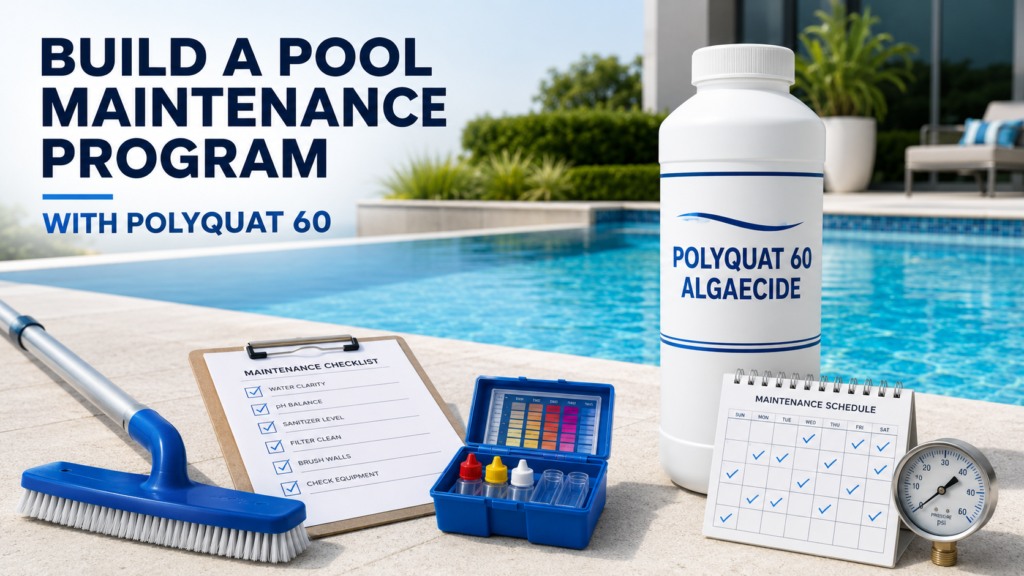
A clear pool rarely stays clear by accident. Behind the bright blue water is a routine built around testing, circulation, filtration, sanitation, brushing, and timely chemical treatment.
Polyquat 60 can strengthen that routine. It is a non-metallic, non-foaming algaecide commonly used to prevent algae growth, support seasonal pool care, and reduce the chance of algae returning after treatment. Yet it should not be treated as a substitute for chlorine, balanced water, or a working filtration system.
The real question, then, is not simply, “How much Polyquat 60 should I add?”
A better question is: “How can I build Polyquat 60 into a complete pool maintenance program?”
That small change in thinking matters. Instead of reacting every time the water becomes dull or a wall turns green, you create a repeatable system that catches problems early.
Start with the Right Role for Polyquat 60
Polyquat 60 is generally based on polixetonium chloride, a cationic polymer used for algae control. “Cationic” means that the polymer carries positive electrical charges in water.
Many algae cells and suspended particles have negatively charged surfaces. The positively charged polymer can interact with those surfaces, disturb normal cellular functions, and help bring fine material together so that the filtration system can remove it more effectively.
That sounds impressive—and it is useful chemistry—but Polyquat 60 still has a defined role.
It is mainly an algaecide and algae-prevention aid. It is not the pool’s primary disinfectant. It does not replace chlorine or bromine, and it should not be expected to manage every contaminant introduced by swimmers.
Chlorine remains responsible for controlling many disease-causing microorganisms and oxidizing swimmer waste. The US Centers for Disease Control and Prevention recommends maintaining at least 1 ppm free chlorine in residential pools, or at least 2 ppm when cyanuric acid or stabilized chlorine is used. The CDC also recommends a pH between 7.0 and 7.8. Local codes and product directions may set different or more restrictive requirements, especially for public pools.
Think of the maintenance program as a team:
- The sanitizer controls germs and oxidizes contaminants.
- The filter removes suspended material.
- Circulation distributes chemicals and reduces stagnant areas.
- Brushing breaks up deposits and exposes hidden growth.
- Balanced water protects surfaces, equipment, and swimmer comfort.
- Polyquat 60 adds another layer of algae control.
If one member of this team stops working, adding more algaecide will not always solve the underlying problem.
Record the Pool Before You Write the Program
A useful maintenance program begins with basic pool information. Otherwise, every treatment becomes a rough guess.
Create a pool profile containing:
- Pool volume
- Pool type and surface material
- Indoor or outdoor location
- Sanitizer system
- Filter type and size
- Pump flow rate
- Normal circulation time
- Presence of a heater, spa, water feature, or automatic cover
- Typical number of swimmers
- Local climate and seasonal temperatures
- Known algae history
- Polyquat 60 product concentration and label directions
Pool volume is particularly important because most chemical doses are based on the amount of water being treated.
For a rectangular pool:
Because one cubic metre equals 1,000 litres:
For an irregular pool, divide it into smaller shapes, calculate each section, and then combine the results. A small measurement error is normal, but a large one can lead to repeated overfeeding or underfeeding.
Do not assume that every bottle carrying the words “Polyquat 60” has identical directions. Raw material concentration, finished formulation, density, regional registration, and intended use can differ. Always use the application rate on the specific product label or the supplier’s confirmed technical instructions.
For more information about the polymer commonly associated with Polyquat 60, see Polixetonium Chloride.
Establish the Water Conditions Polyquat 60 Will Support
Polyquat 60 performs more reliably when the rest of the pool is already under control. A maintenance program should therefore define operating ranges rather than relying on how the water looks.
Clear water can still be chemically unbalanced. On the other hand, slightly cloudy water may reflect filtration trouble rather than active algae growth.
At minimum, monitor:
- Free chlorine or bromine
- Combined chlorine, where relevant
- pH
- Total alkalinity
- Calcium hardness
- Cyanuric acid in stabilized outdoor pools
- Water temperature
- Clarity
- Filter pressure
- Visible algae or slippery surfaces
For residential pools, the CDC recommends checking chlorine and pH at least twice a day, with more frequent testing during heavy use. Public facilities may require much more frequent testing and formal records. The CDC advises public pool operators to test disinfectant and pH before opening and every two to four hours while the facility is operating.
A commercial maintenance company may use these requirements to create a detailed service schedule. A homeowner will probably use a simpler version. The principle remains the same: measure first, treat second.
Build the Program Around Five Maintenance Layers
A practical Polyquat 60 program can be divided into five layers:
- Start-up or pool-opening treatment
- Routine preventive treatment
- Event-based treatment
- Corrective algae treatment
- Seasonal closing or winter treatment
Each layer has a different purpose. Mixing them together is one reason pool chemical programs become confusing.
Layer One: Prepare the Pool Before the First Dose
Polyquat 60 should normally be introduced into a functioning pool—not a neglected vessel filled with leaves, sediment, and stagnant water.
Before the first seasonal treatment:
- Remove the cover and clear away debris.
- Empty skimmer and pump baskets.
- Inspect the pump, filter, valves, and return fittings.
- Restore the correct water level.
- Start circulation and confirm that water moves through all returns.
- Brush the walls, floor, steps, corners, and ladders.
- Vacuum settled debris.
- Test the water.
- Correct major pH and sanitizer problems.
- Clean or backwash the filter when necessary.
Once the water has been physically cleaned and circulation is stable, add Polyquat 60 according to the label’s opening or initial dose.
Distribute the product around the pool perimeter while the circulation system is running, unless the label tells you otherwise. Pay attention to steps, shallow ledges, corners, and areas behind ladders. These are common low-flow zones where algae gets a comfortable head start.
Allow the pump to run long enough to distribute the treatment throughout the pool. The required period depends on pool size, hydraulic design, product directions, and existing water condition.
Never pour concentrated algaecide into a skimmer unless the product manufacturer specifically permits it. A concentrated chemical passing through pumps, heaters, or dosing equipment may create compatibility problems.
Layer Two: Create a Weekly Preventive Routine
The weekly routine is the heart of the program. It is far less dramatic than treating a green pool—and that is precisely the point.
A typical weekly service visit can follow this order:
- Inspect the water and pool surfaces.
- Remove leaves and floating debris.
- Empty baskets.
- Test free chlorine, pH, and other scheduled parameters.
- Correct the sanitizer level.
- Adjust pH and alkalinity when required.
- Brush algae-prone surfaces.
- Vacuum or run the pool cleaner.
- Inspect filter pressure and circulation.
- Add the label-directed maintenance dose of Polyquat 60.
- Record the treatment and observations.
Why add Polyquat 60 after checking the main water conditions? Because an algaecide should support a stable system. It should not hide low chlorine, poor circulation, or a clogged filter.
Keep the pump running during and after application so the product can disperse. Do not pour the full dose into one corner. Slow, even distribution around the perimeter is usually more sensible, provided it follows the product directions.
Weekly dosing is common, but it is not universal. Some products specify another interval. Always calculate the amount from the actual pool volume and the maintenance rate on the label.
A simple dose formula is:
For example, if a label gives a rate per 10,000 litres, divide the pool volume by 10,000 and multiply the result by the stated product quantity. The formula is simple. The difficult part is resisting the urge to add an extra splash “just to be safe.”
More chemical does not automatically create more protection.
Layer Three: Add Event-Based Decision Rules
A fixed weekly calendar is useful, but pools do not live on calendars alone. Weather, swimmers, dust, leaves, and equipment failures change the chemical demand.
Your program should include decision rules for unusual events.
After Heavy Rain
Rain can dilute chemicals, carry organic debris into the water, change pH, and increase the sanitizer demand. Surface runoff can make matters worse if landscaping soil or dirty deck water enters the pool.
After heavy rain:
- Remove visible debris.
- Check the water level.
- Restore circulation.
- Test free chlorine and pH.
- Inspect clarity and pool surfaces.
- Correct the sanitizer level.
- Brush low-flow areas.
- Add Polyquat 60 only when the normal schedule, measured condition, and product directions support it.
Avoid treating every shower as an emergency. A short rain event may require no extra algaecide. Measurement should drive the response.
After Heavy Swimmer Use
A crowded afternoon introduces sweat, body oils, cosmetics, dirt, and other contaminants. These materials increase chlorine demand and may reduce water clarity.
After a party or busy operating day:
- Remove debris.
- Test and restore the sanitizer.
- Check pH.
- Extend circulation if necessary.
- Clean baskets and inspect the filter.
- Brush and vacuum.
- Follow the product label when deciding whether an additional algaecide treatment is appropriate.
Polyquat 60 does not “replace” sanitizer consumed by swimmers. Adding algaecide while leaving free chlorine below its required level would address the wrong part of the problem.
During Hot Weather
Warm water can support faster algae growth, while strong sunlight can increase chlorine loss in outdoor pools. Higher temperatures may also bring more swimmers, so several pressures arrive at once.
During hot periods:
- Test more frequently.
- Check shaded corners and steps.
- Confirm that circulation time matches the increased demand.
- Maintain the prescribed sanitizer residual.
- Keep the Polyquat 60 schedule consistent.
- Avoid allowing the pool to drift from clear to slightly dull before taking action.
That faint loss of sparkle may appear harmless. Sometimes it is the first warning that the filter, sanitizer, or circulation system is falling behind.
After an Equipment Failure
A stopped pump changes the treatment plan. Chemicals cannot distribute evenly when circulation is absent, and stagnant areas may become algae shelters.
If the pump or filter fails:
- Limit pool use as required.
- Repair the equipment.
- Remove debris manually.
- Test the water.
- Restore circulation before normal chemical application.
- Inspect surfaces and hidden areas.
- Apply corrective treatment only after identifying the actual condition.
Pouring extra Polyquat 60 into poorly circulating water is rarely a sound rescue plan.
Coordinate Polyquat 60 with Chlorine Treatments
Polyquat 60 and chlorine can be used within the same maintenance program, but timing matters.
Chlorine is an oxidizing sanitizer. Polyquat 60 is a polymeric algaecide. High chlorine concentrations may gradually consume or weaken polymer-based products. As a result, adding Polyquat 60 immediately before a high-dose chlorine treatment may waste some of the algaecide.
When a pool requires shock treatment:
- Calculate and apply the chlorine treatment according to its label.
- Run the circulation system.
- Brush and clean the pool.
- Allow the chlorine level to return to the acceptable operating range.
- Recheck pH and water condition.
- Add Polyquat 60 at the label-directed rate when appropriate.
Do not mix chlorine and Polyquat 60 together in a bucket, measuring container, feeder, or storage area. Add each chemical separately.
This applies to other pool chemicals as well. Concentrated products that are safe after dispersion in thousands of litres of water may react dangerously when mixed directly.
Know When Prevention Has Become Correction
Polyquat 60 works particularly well as part of a preventive routine. A severe algae outbreak, however, may require a broader corrective procedure.
Watch for:
- Green, yellow, brown, or dark patches
- Slippery walls or steps
- Rapid chlorine loss
- Persistent cloudiness
- Deposits returning soon after brushing
- Algae around fittings, ladders, lights, and grout lines
- Weak flow from return fittings
- Filter pressure changes
When visible algae is established, first identify the cause. Was the sanitizer low? Did the pump stop? Is the filter dirty? Is cyanuric acid affecting the chlorine program? Are dead zones present?
Then use a structured response:
- Restrict swimming if the water is unsafe or the floor cannot be seen clearly.
- Test the full water chemistry.
- Correct pH as the treatment instructions require.
- Brush affected surfaces thoroughly.
- Apply the prescribed sanitizer treatment.
- Run circulation and filtration.
- Vacuum or remove dead algae.
- Clean or backwash the filter as required.
- Retest the water.
- Add Polyquat 60 at the indicated stage and dose.
- Investigate the original maintenance failure.
A recurring outbreak is not simply “strong algae.” It is usually evidence that the operating program has a gap.
Include Filtration and Brushing in the Chemical Plan
Chemical dosing often receives all the attention because it is easy to measure. Filtration and brushing can seem ordinary. Still, they decide whether the treatment reaches the places where algae survives.
Brush:
- Steps and benches
- Corners
- Tile lines
- Behind ladders
- Around lights and return fittings
- Under removable fittings
- Shaded walls
- Rough or porous surfaces
Select a brush suitable for the pool finish. A tool appropriate for concrete may damage vinyl or another softer surface.
Check the filter pressure against the clean starting pressure. A rising reading may indicate trapped debris and restricted flow. A very low or unstable reading may point to suction trouble, a pump problem, or another hydraulic fault.
Fine suspended matter may sometimes require a dedicated clarifier program rather than additional algaecide. A Polymer Pool Clarifier can support particle removal when the product is suitable for the filter and water conditions. However, algaecides and clarifiers should not be treated as interchangeable products.
Create a Monthly System Review
Weekly service keeps the pool operating. A monthly review helps you catch slow changes.
Once a month, inspect:
- Total chemical consumption
- Frequency of low sanitizer readings
- pH movement
- Cyanuric acid trends
- Filter pressure history
- Pump operating hours
- Areas requiring repeated brushing
- Weather and swimmer load
- Polyquat 60 dose accuracy
- Signs of overdosing or underdosing
- Product inventory and storage condition
Compare chemical use with earlier months. If Polyquat 60 consumption rises while algae control becomes worse, adding more product may not be the answer.
Perhaps the pool volume was recorded incorrectly. Perhaps the sanitizer is repeatedly falling too low. Maybe the pump schedule changed. Or perhaps the filter needs cleaning.
This monthly pause turns a collection of chemical tasks into an actual management program.
Build a Separate Plan for Winter Closing
A winter pool faces a different set of conditions. The cover may block routine inspection, leaves may introduce nutrients, and sanitizer levels may fall during a long closed period.
For seasonal closing:
- Wait until the water temperature is suitable for closing in your climate.
- Clean the pool thoroughly.
- Remove leaves and organic matter.
- Balance the water.
- Treat the sanitizer as required.
- Clean the filter.
- Prepare plumbing and equipment for local freezing conditions.
- Add the label-directed closing dose of Polyquat 60.
- Distribute it with the circulation system running.
- Install and secure the winter cover.
Do not close a dirty or actively green pool and expect Polyquat 60 to quietly repair it beneath the cover. That is rather like sweeping dust under a rug and hoping it disappears by spring.
Where long-term algae prevention is needed, a dedicated Winter Algaecide formulation may be considered according to its label, climate suitability, and compatibility with the closing program.
The pool should also be checked during the closed season when access and weather allow. Look for cover failure, excessive water accumulation, debris entry, unusual water colour, or signs that the closing treatment is no longer holding.
Keep a Simple Maintenance Record
Records do not need to be complicated. A paper sheet, spreadsheet, or pool service app can work.
Include these fields:
| Date | Free Chlorine | pH | Water Temperature | Clarity | Filter Pressure | Polyquat 60 Dose | Other Treatment | Notes |
|---|---|---|---|---|---|---|---|---|
| Service visit | Test result | Test result | Reading | Clear, dull, or cloudy | Reading | Measured amount | Chemical and dose | Rain, swimmers, algae, repairs |
For commercial pools, include staff initials, opening and closing readings, corrective actions, incident notes, and any information required by the local health authority.
Records answer valuable questions:
- Does algae appear after the same type of weather?
- Does sanitizer fall every weekend?
- Is one technician feeding more product than another?
- Does filter pressure rise unusually quickly?
- Is the algaecide program reducing corrective treatments?
Without records, each outbreak feels like a surprise. With records, patterns become visible.
Watch for Common Program Mistakes
The most frequent problems are usually ordinary ones.
Adding Polyquat 60 without measuring the pool volume can produce chronic dosing errors.
Using it as a chlorine substitute leaves the pool without adequate primary disinfection.
Adding it immediately before a high chlorine treatment may reduce its useful life.
Ignoring circulation allows algae to persist in protected areas.
Skipping brushing leaves attached growth and biofilm on surfaces.
Treating cloudiness as proof of algae can lead to unnecessary chemical additions.
Pouring in extra product “for insurance” may increase cost and filter loading without fixing the cause.
Mixing concentrated chemicals can cause dangerous reactions.
Failing to record treatments makes it difficult to tell whether the program is working.
And perhaps the biggest mistake? Waiting for green water before calling the program unsuccessful. Early warnings—dull water, slippery steps, repeated low chlorine, or growth in one corner—deserve attention.
Turn the Program into a Repeatable Checklist
A workable program should be clear enough that different trained operators can follow it consistently.
Every Service Visit
- Inspect water, surfaces, equipment, and circulation.
- Remove debris.
- Test sanitizer and pH.
- Correct water chemistry.
- Brush and vacuum.
- Check filter pressure.
- Add Polyquat 60 when scheduled.
- Record results and treatments.
After Rain or Heavy Use
- Retest sanitizer and pH.
- Remove extra debris.
- Inspect clarity and surfaces.
- Extend circulation when needed.
- Apply event-based treatment only when justified.
Monthly
- Review treatment records.
- Verify pool volume and dosing calculations.
- Inspect problem areas.
- Check equipment performance.
- Review product stock and storage.
At Opening and Closing
- Complete physical cleaning.
- Restore or prepare equipment.
- Balance the water.
- Follow the seasonal sanitizer procedure.
- Apply the label-directed Polyquat 60 treatment.
- Document the pool’s starting or closing condition.
A good checklist removes uncertainty while leaving room for professional judgement. Pools differ, weather changes, and swimmer use never follows a perfectly tidy schedule.
The Strongest Program Uses Polyquat 60 as Support, Not a Shortcut
Polyquat 60 can be a valuable part of residential, commercial, hotel, and service-company pool care. Its non-metallic and generally low-foam character makes it attractive for preventive algae control, especially where operators want to avoid adding copper-based ingredients.
Its value rises when it is connected to the rest of the maintenance system.
Measure the pool. Test the water. Maintain the sanitizer. Keep water moving. Brush the hidden areas. Clean the filter. Adjust the plan after rain, heat, and heavy use. Then apply Polyquat 60 at the correct dose and stage.
That routine may sound less exciting than rescuing a swamp-green pool. Frankly, that is a good thing. A successful maintenance program is usually quiet, predictable, and almost boring—and the water stays beautifully clear.
Frequently Asked Questions
Can Polyquat 60 replace chlorine in a pool maintenance program?
No. Polyquat 60 is primarily used for algae control, while chlorine is the main sanitizer and oxidizer in most pool programs. Maintain the required chlorine residual even when Polyquat 60 is used regularly.
How often should Polyquat 60 be added to a swimming pool?
Many products use a regular maintenance interval, often weekly, but application rates and schedules vary. Follow the directions for the specific formulation and calculate the dose from the pool’s actual water volume.
Should Polyquat 60 be added before or after pool shock?
It is commonly added after shock treatment, once chlorine has returned to the acceptable operating range. Very high chlorine levels may consume the polymer and reduce the value of the Polyquat 60 treatment. Follow both product labels.
Can Polyquat 60 clear an already green swimming pool?
It may support an algae treatment, but a green pool usually requires testing, brushing, sanitizer correction, continuous circulation, filtration, and removal of dead algae. The equipment or chemistry failure that allowed the outbreak should also be corrected.
Is Polyquat 60 suitable for winter pool closing?
A properly labelled Polyquat 60 product can be used in many winter closing programs because it helps suppress algae during periods of reduced maintenance. Clean and balance the pool first, follow the closing dose on the label, and distribute the product before the circulation system is shut down.