
GET IN TOUCH
Ask For Sample?
How Do Pool Service Companies Apply Polyquat 60?
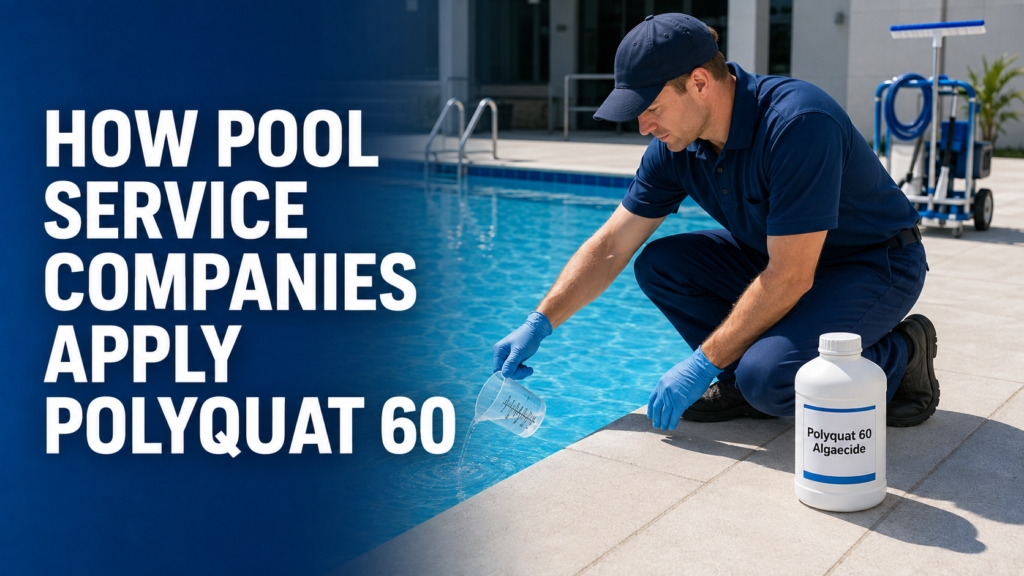
Pool service companies rarely rely on a single chemical to keep water clear. They work with a treatment system: balanced water, steady circulation, effective filtration, proper sanitation, routine brushing, and—when conditions call for it—a reliable algaecide.
Polyquat 60 often fits into that system as a preventive, non-metallic algaecide. Professionals may use it during routine maintenance, after algae treatment, before a pool is left unattended, or as part of seasonal closing. It is especially useful when technicians want ongoing algae control without adding copper or creating the foam associated with some conventional quaternary ammonium algaecides.
The actual application, however, involves more than pouring a measured amount around the pool. Timing, water balance, circulation, algae condition, sanitizer level, and the product label all matter.
What Is Polyquat 60?
Polyquat 60 is a common name for a concentrated polymeric quaternary ammonium algaecide. Many commercial products contain approximately 60% active polymer, although the precise formulation and label directions can vary by manufacturer and market.
Unlike copper-based algaecides, Polyquat 60 does not depend on metal ions to control algae. This is a practical advantage for swimming pools with light-colored plaster, vinyl liners, decorative tile, or other surfaces where staining is a serious concern.
It is also generally described as non-foaming under normal pool-use conditions. That feature matters more than it may sound. Foam can become highly visible in spas, water features, vanishing-edge pools, and commercial facilities with strong water movement. Nobody wants a hotel pool to look like someone added laundry detergent.
The polymer carries cationic, or positively charged, groups. These groups interact with negatively charged sites on algae cells and interfere with normal cell function. Its polymeric character also distinguishes it from simpler quaternary ammonium compounds, which are more likely to produce persistent foam when overdosed.
Polyquat 60 is not a replacement for chlorine, bromine, or another approved primary sanitizer. Pool service companies use it as an additional algae-control measure—not as the entire sanitation program.
Why Do Pool Service Companies Use Polyquat 60?
For a homeowner, a small patch of green algae is frustrating. For a service company, it can be much more than that. It may lead to an emergency visit, extra chemical costs, an unhappy customer, or questions about whether the pool was serviced correctly.
That is why prevention matters.
Service companies often include Polyquat 60 in maintenance plans because it can provide several practical benefits:
- It helps prevent green, yellow, and other common forms of pool algae.
- It does not add copper or other staining metals to the water.
- It normally produces little or no foam when used correctly.
- It can be used in chlorine- and bromine-treated pools when permitted by the product label.
- It is suitable for many residential and commercial pool finishes.
- It can support algae control when a pool will be unattended.
- It is useful during pool closing and winterization.
- It can provide a backup layer when circulation or sanitizer conditions temporarily become less stable.
That last point deserves a little explanation. A preventive algaecide should never be used to hide poor maintenance. Still, real pools do not operate under laboratory conditions. A storm may bring debris into the water. A pump may stop overnight. Heavy swimmer use may reduce the free chlorine level faster than expected. Hot weather can also accelerate both algae growth and sanitizer loss.
Polyquat 60 gives technicians another layer of protection while the main treatment system continues to do the heavy lifting.
For customers who want a concentrated, metal-free product, an appropriately formulated Polyquat 60 Algaecide can be incorporated into a planned maintenance or seasonal algae-control program.
Professionals Inspect the Pool Before Adding Anything
Experienced technicians do not begin with the chemical bottle. They begin with the pool.
Before applying Polyquat 60, a service professional will normally inspect the water, equipment, surfaces, and recent operating history. A five-minute inspection can prevent a treatment from being wasted.
The technician may check:
- Water clarity and visible algae
- Free and combined chlorine
- pH
- Total alkalinity
- Cyanuric acid in outdoor chlorine pools
- Water temperature
- Filter pressure
- Pump and circulation performance
- Skimmer and pump baskets
- Recent rainfall or heavy swimmer use
- Pool surface condition
- Signs of scale, metals, or organic contamination
Why does this matter? Because an algaecide performs best when the rest of the pool is functioning properly. If the water is barely circulating or the filter is blocked, adding more chemicals will not solve the underlying problem.
A technician also needs to decide whether the pool requires preventive maintenance or corrective algae treatment. Those are two different jobs.
Clear water with no visible algae usually calls for a maintenance application. Cloudy green water, slippery steps, or algae growing in corners requires cleaning, sanitizer correction, filtration, and possibly shock treatment before Polyquat 60 is used as a follow-up product.
How Polyquat 60 Is Applied During Routine Pool Service
For a standard preventive application, pool service companies follow a controlled sequence. The exact dose must come from the registered product label because concentrations and approved use rates are not identical across all formulations.
Step 1: Confirm the Pool Volume
Chemical dosing starts with pool volume. A surprisingly large number of treatment problems begin with an inaccurate estimate.
For a rectangular pool, volume can be estimated from length, width, and average depth. Irregular pools may require separate calculations for different sections. Commercial technicians often keep verified pool volumes in customer records so they do not have to estimate them during every visit.
This figure should include connected spas or balance tanks when they share the same circulation and treatment system.
Step 2: Test and Adjust the Water
The technician checks whether pH and sanitizer levels fall within the pool’s operating targets and applicable local requirements.
Extremely unbalanced water can reduce treatment efficiency and create unrelated problems. A high pH, for example, can weaken the effectiveness of chlorine. Low sanitizer may allow algae to grow faster than the maintenance algaecide can control it.
Professionals therefore correct major water-balance problems before treating the pool.
Step 3: Clean the Circulation System
Skimmer baskets, pump baskets, and obvious debris are removed. The filter pressure is checked, and the filter is cleaned or backwashed when necessary.
Good circulation carries Polyquat 60 throughout the pool. It also helps move suspended material toward the filter. Adding a product to stagnant water and hoping it somehow reaches every corner is, frankly, not much of a strategy.
Step 4: Measure the Product Carefully
The technician measures the amount specified on the product label for the verified pool volume and the intended application.
Professional service vehicles often carry graduated measuring containers dedicated to specific chemical types. This reduces dosing errors and helps avoid accidental contamination between incompatible products.
Polyquat 60 should not be mixed with chlorine, acid, or other concentrated pool chemicals in the same container. Even when two products can be used in the same pool program, their concentrates should remain separate.
Step 5: Add It with the Pump Running
Pool service companies usually apply Polyquat 60 while the circulation system is operating. The measured product is distributed slowly around the pool perimeter or added according to the product label.
Technicians pay extra attention to areas with weaker circulation, such as:
- Steps and benches
- Ladders
- Corners
- Behind pool fittings
- Shallow tanning ledges
- Attached spas
- Areas near water features
- The far end of long commercial pools
Some product labels may allow pre-dilution in a clean container of pool water. Others may instruct the operator to apply the product directly. The label takes priority.
Step 6: Brush the Pool
Brushing is not glamorous, but it is one of the most useful parts of algae prevention.
A technician brushes walls, steps, corners, and other areas where water movement is limited. This disrupts early biofilm and exposes microscopic algae growth before it becomes an established colony.
Polyquat 60 works better as part of this physical-and-chemical approach. Chemicals reach the organisms, brushing removes protected growth, and filtration carries loose material out of the water.
Step 7: Keep the Water Circulating
After application, the pump remains on for the circulation period specified by the label or the service company’s operating procedure.
The goal is even distribution. Turning the pump off immediately can leave parts of the pool inadequately treated, especially in large or irregularly shaped systems.
Step 8: Record the Treatment
Commercial service companies usually document the date, dose, pool volume, test results, visible water condition, and technician’s name. Some also record the product lot number for large facilities.
These records help the company identify patterns. If a pool repeatedly develops algae despite correct applications, the problem may be poor circulation, inadequate sanitizer, a damaged filter, inaccurate pool volume, or hidden organic contamination.
How Do Service Companies Use Polyquat 60 When Algae Is Already Visible?
Visible algae changes the treatment plan.
Polyquat 60 may help control algae, but pouring it into a severely green pool without cleaning or correcting the sanitizer is unlikely to produce a fast, professional result. Service companies generally treat the entire algae problem rather than expecting one product to perform every task.
The technician first identifies the likely severity and location of the growth. Light algae dust on a wall is different from opaque green water. The latter usually indicates a larger sanitation and filtration failure.
A typical corrective process may include:
- Removing leaves and other debris.
- Brushing algae from walls, floors, steps, and fittings.
- Testing pH and sanitizer.
- Adjusting the water as required.
- Applying an approved shock or sanitizer treatment.
- Running the circulation and filtration system.
- Cleaning or backwashing the filter as pressure rises.
- Vacuuming settled material.
- Applying Polyquat 60 at the label-approved time and dose.
- Retesting the pool before returning it to normal service.
A professional may use Polyquat 60 during the later stage of this process to help control surviving organisms and reduce the risk of regrowth.
This distinction is important: shock treatment provides rapid oxidation, while Polyquat 60 supplies non-oxidizing algae control. The two methods perform different roles.
Should Polyquat 60 Be Added Before or After Pool Shock?
There is no universal sequence that applies to every branded formulation, every sanitizer level, and every pool condition. The product label should always decide the final procedure.
That said, service companies commonly avoid adding Polyquat 60 at the same moment as a heavy chlorine shock. Very high oxidizer concentrations can attack organic polymeric ingredients and reduce the amount available for algae control.
A practical professional sequence is often:
- Balance the water.
- Brush and clean the pool.
- Apply the required shock treatment.
- Circulate and filter the water.
- Allow the sanitizer to return to the range stated on the algaecide label.
- Add Polyquat 60 as the follow-up preventive treatment.
This staged approach lets the shock treatment oxidize heavy contamination first. Polyquat 60 can then help prevent the remaining algae from gaining ground again.
Technicians should never combine the two concentrated products in a bucket, feeder, or dosing container. Chemical compatibility in diluted pool water does not mean concentrated chemicals are safe to mix.
Applying Polyquat 60 in Commercial Swimming Pools
Commercial pools present a different operating environment from quiet backyard pools. They may have high bather loads, longer operating hours, larger filtration systems, splash pads, therapy sections, or water features that complicate circulation.
A service company working on a hotel, school, fitness center, or community pool usually coordinates Polyquat 60 application with the facility’s operating schedule.
The technician may plan treatment:
- After the pool closes for the day
- During a scheduled maintenance period
- After heavy-use weekends
- Before a holiday shutdown
- Following major rainfall
- After an algae cleanup
- Before periods of unusually hot weather
The application must also comply with the product label, health-code requirements, facility procedures, and any required pool closure or re-entry period.
Commercial operators should not assume that adding an algaecide allows them to maintain less sanitizer. Required disinfectant residuals must still be maintained. Polyquat 60 supports the program; it does not replace regulatory sanitation.
Large pools may also require staged distribution or circulation checks to ensure that the product reaches remote sections. Technicians sometimes observe return flow, inspect surge tanks, and confirm that valves are correctly positioned before dosing.
How Polyquat 60 Fits into Weekly Maintenance
Not every service company applies Polyquat 60 every week. Frequency depends on the product label, climate, pool history, service plan, and operating conditions.
A low-use residential pool with stable chemistry may require less frequent application than a warm commercial pool exposed to heavy swimmer traffic. Meanwhile, a pool with a repeated algae history may need closer inspection even when an algaecide is being used.
During weekly visits, a technician may:
- Inspect for early algae growth
- Test sanitizer and pH
- Remove debris
- Empty baskets
- Brush low-circulation areas
- Check filter pressure
- Add a label-approved maintenance dose when due
- Record all work completed
Regular small applications are generally intended to maintain protection. They should not be confused with the larger initial or corrective doses listed on some product labels.
Overdosing does not automatically create better protection. It increases chemical cost, may interfere with treatment performance, and can place an unnecessary organic load on the sanitizer system.
Using Polyquat 60 Before a Pool Is Left Unattended
Service companies may apply Polyquat 60 before a homeowner travels or when a property will be vacant for a period. It can provide additional algae protection when routine observation will be limited.
Before applying it, the technician normally:
- Cleans the pool thoroughly
- Balances the water
- Confirms adequate sanitizer
- Cleans the filter
- Checks the pump timer
- Verifies that the water level is correct
- Applies the label-approved dose
- Runs the circulation system
This does not make the pool maintenance-free. The circulation system must continue to operate, and sanitizer still needs to be maintained. If the property will be vacant for an extended period, scheduled service visits remain the safer approach.
How Service Companies Use It During Pool Closing
Polyquat 60 is widely associated with seasonal pool closing because algae can still develop beneath a cover, particularly when the water remains warm.
A pool that looks crystal clear in autumn can become a green surprise by spring. Few pool owners enjoy that particular reveal.
During closing, technicians typically clean and balance the pool, lower or manage the water level as required, winterize the equipment, and add approved closing chemicals. Polyquat 60 may be included as the non-metallic algaecide component.
Timing matters. Closing a pool too early, while the water is still warm, can give algae a long period to grow. Service companies often coordinate closing with falling water temperature, local climate, and the property owner’s schedule.
For seasonal programs that require broader protection during extended shutdowns, a purpose-designed <u>Winter Algaecide</u> may be more suitable than relying on a standard maintenance dose alone. The selected product should match the closing procedure, cover type, sanitizer program, and local winter conditions.
The technician distributes the product thoroughly and allows it to circulate before completing the shutdown. The exact order depends on the system and label directions.
Can Polyquat 60 Also Help Water Clarity?
Polyquat 60 is a cationic polymer, so it may interact with some suspended particles. Under certain conditions, this can support particle agglomeration and filtration.
Still, pool service companies should not treat every cloudy-water problem as an algae problem.
Cloudiness may be caused by:
- Fine debris
- Dead algae
- High calcium hardness
- Poor filtration
- High pH
- Inadequate sanitizer
- Excess organic contamination
- Air entering the circulation system
- A damaged or undersized filter
When fine suspended particles are the primary concern, a dedicated Polymer Water Clarifier may provide more predictable clarification. Technicians first identify the cause, then select the right treatment. Otherwise, they may keep adding chemicals while the actual problem sits inside the filter.
Common Polyquat 60 Application Mistakes
Even a well-formulated algaecide can disappoint when it is used incorrectly. Professional companies train technicians to avoid several recurring mistakes.
Treating It as a Chlorine Replacement
Polyquat 60 controls algae, but it is not the main disinfectant for swimmer protection. Sanitizer residuals must still be maintained.
Applying It Without Testing the Water
If chlorine is depleted or pH is poorly controlled, algae may grow despite the algaecide. Testing reveals the wider problem.
Adding It to a Green Pool and Walking Away
Established algae usually requires brushing, sanitation, filtration, and vacuuming. One chemical addition is rarely the full answer.
Dosing by Guesswork
The correct dose depends on product strength, label instructions, pool volume, and treatment purpose. “About half a bottle” is not a professional measurement.
Applying It with Poor Circulation
A blocked filter or failed pump prevents even distribution. The equipment should be checked before treatment.
Mixing Concentrated Chemicals
Polyquat 60 should not be mixed directly with concentrated chlorine, acid, or other pool chemicals. Products should be added separately and exactly as directed.
Adding It During Extreme Chlorine Levels
A heavy shock dose may reduce the polymer’s persistence. Service companies commonly separate the treatments and follow label timing.
Using More Than the Label Allows
Polyquat 60 is often called non-foaming, but that does not make unlimited dosing sensible. Excess product can increase cost, complicate water treatment, and waste sanitizer.
Application Safety and Chemical Handling
Pool chemicals deserve careful handling, even when a product is considered straightforward to use.
Technicians should review the current product label and Safety Data Sheet before application. Appropriate gloves, eye protection, and work clothing may be required. Containers should remain closed, upright, correctly labeled, and protected from extreme storage conditions.
A measuring tool used for Polyquat 60 should not be returned to another chemical container. Likewise, unused diluted material should not be poured back into the original package unless the manufacturer specifically permits it.
If a spill occurs, the service company should follow its written spill procedure and the instructions in the Safety Data Sheet. Local disposal requirements also apply.
Recordkeeping Turns Routine Dosing into Professional Service
One quiet difference between casual pool care and professional pool management is documentation.
A well-kept service record may include:
- Date and time of visit
- Pool volume
- Water temperature
- Free and combined chlorine
- pH and total alkalinity
- Cyanuric acid where applicable
- Filter pressure
- Product name and concentration
- Quantity applied
- Reason for application
- Visible algae or clarity condition
- Corrective work completed
- Technician identification
Over time, these records reveal useful trends. Perhaps algae appears after every holiday weekend. Maybe one return jet has weak flow. Perhaps sanitizer falls whenever the weather turns hot.
Polyquat 60 becomes more effective when its use is based on these patterns rather than a rigid habit.
A Reliable Application Is a Process, Not a Pour
Pool service companies apply Polyquat 60 most successfully when they treat it as one part of a complete maintenance system.
They confirm the pool volume, test the water, restore circulation, measure the correct dose, distribute it evenly, brush vulnerable areas, and document the result. When visible algae is present, they combine it with physical cleaning, sanitizer treatment, filtration, and follow-up care.
That may sound less dramatic than finding a miracle chemical, but it works. Clear pool water is usually the result of many small, correct actions performed at the right time.
Polyquat 60 adds a useful layer of algae protection—especially when a service company wants a non-metallic, low-foaming option. Yet the essentials remain unchanged: balanced water, adequate sanitizer, sound equipment, and regular attention.
Frequently Asked Questions
How often do pool service companies apply Polyquat 60?
Application frequency depends on the product label, pool conditions, climate, sanitizer program, and algae history. Some pools receive periodic maintenance doses, while others use Polyquat 60 mainly after algae treatment or during seasonal closing.
Can Polyquat 60 be added directly to pool water?
Many products are distributed directly around the pool while the pump is running, but application instructions vary. Technicians should follow the specific label to determine whether direct addition or pre-dilution is required.
Can a pool service company use Polyquat 60 with chlorine?
Polyquat 60 can generally be incorporated into a chlorine-treated pool program when allowed by the label. It should not be mixed directly with concentrated chlorine, and technicians often separate its application from heavy shock treatment.
Does Polyquat 60 remove an existing green algae bloom?
It can help control algae, but a severe bloom normally requires brushing, sanitizer correction, filtration, filter cleaning, and vacuuming. Polyquat 60 is often most valuable as a follow-up treatment that helps prevent algae regrowth.
Why do professionals choose Polyquat 60 instead of a copper algaecide?
Pool professionals may choose Polyquat 60 because it provides algae control without adding copper, reducing concerns about metal-related surface staining or discolored hair. It also normally produces little or no foam when applied at the correct rate.