
GET IN TOUCH
Ask For Sample?
How Pool pH Affects Clarifier Performance?
You’ve checked the filter. You’ve added the right amount of clarifier. Yet the pool still has that dull, hazy look.
Could pH be part of the problem?
Yes—but the reason is more subtle than “high pH stops clarifier from working.”
Pool pH affects the water in several ways. It can change the surface charge of some suspended particles, influence mineral deposits, and alter how chlorine behaves. These changes can affect the results you see after adding a clarifier, even when the clarifier itself remains active.
For PolyDADMAC-based pool clarifiers, there’s an important distinction: the polymer retains its positive charge across a broad pH range, but the pool still needs balanced water chemistry and effective filtration.
That’s why pH belongs near the top of your checklist when cloudy water refuses to clear.
Let’s look at what pH actually changes, what it doesn’t, and how to give your clarifier a fair chance to do its job.
First, What Is pH Telling You?
pH tells you how acidic or basic the water is.
A pH of 7 is neutral. Below 7, water is acidic. Above 7, it’s basic. Swimming pools normally operate slightly above neutral, within the range required by local rules, the treatment program, and equipment guidance.
The CDC recommends a pool pH range of 7.0–7.8. Many pool care programs use a narrower working target within that range, such as 7.2–7.6. However, a pool’s normal operating target should not be confused with a clarifier’s tested performance range.
That difference matters.
A clarifier supplier may report that a polymer works across a wide pH range. This tells you something about the chemical’s treatment capability. It doesn’t mean every pH value within that range is suitable for swimmers, pool surfaces, or the rest of the treatment system.
Think of it like a pump that can run under many conditions. The pump may still turn, but the whole system needs the right conditions to work well.
Your clarifier is one part of that system.
What Does a Polymer Pool Clarifier Actually Do?
Some of the particles that make pool water cloudy are too small for the filter to capture well on their own.
Fine dust, organic debris, and other suspended material can stay dispersed in the water. Many of these particles carry a negative surface charge. Since like charges repel, the particles tend to resist coming together.
A cationic polymer carries positive charges. When it interacts with suitable particles, it can reduce that repulsion and help form aggregates that are easier to filter.
PolyDADMAC—short for poly(diallyldimethylammonium chloride)—is one such polymer. Research describes its use in coagulating negatively charged particles and dissolved organic matter in water treatment.
The basic process is straightforward:
- The clarifier disperses through the pool.
- It interacts with suitable suspended material.
- Small particles form more filterable groups.
- The circulating water carries those groups to the filter.
- Filter cleaning removes the captured material from the system.
Notice the final steps.
A clarifier helps prepare particles for removal. The filter still has to remove them.
If flow is poor, the filter is damaged, or new cloudiness keeps forming, adding clarifier may produce disappointing results.
Does High pH Remove PolyDADMAC’s Positive Charge?
Within normal pool operating conditions, that’s the wrong explanation for poor performance.
PolyDADMAC contains quaternary ammonium groups. These groups carry a permanent positive charge. Unlike some polymers with pH-sensitive amine groups, PolyDADMAC doesn’t rely on low pH to become positively charged.
Published research identifies this permanent charge as a reason for its cationic behavior across a wide pH range.
So, a pool moving from pH 7.3 to 7.8 does not simply switch off the polymer’s charge.
But here’s the catch: the particles and water around that polymer may behave differently as pH changes.
Some particle surfaces gain or lose charge. Organic material can change its degree of ionization. Calcium carbonate may become more likely to leave solution under unfavorable water balance conditions.
In other words, the polymer can remain positively charged while the treatment task changes.
That’s why these two statements can both be true:
PolyDADMAC has a permanent positive charge.
pH can still influence the result of PolyDADMAC treatment.
They describe different parts of the same process.
pH Changes the Particles, Too
It’s easy to focus on the product in the bottle. Yet much of the action happens on the particles already in the pool.
Some suspended materials have surface groups that respond to pH. Their charge can become more or less negative as pH changes. That can alter how much cationic polymer is needed to bring them together.
Natural organic matter adds another layer of complexity. Research on PolyDADMAC and humic acid shows that pH, calcium, and polymer dose can all influence their interactions. These findings help explain the chemistry, though they should not be treated as a universal dosing rule for swimming pools.
What does this mean in practice?
Two pools with the same pH may respond differently to the same clarifier dose.
One may contain mainly windblown dust. Another may have fine mineral particles, decaying leaves, and residues from earlier treatments. Their treatment needs won’t necessarily match.
Likewise, changing pH does not guarantee that a fixed dose becomes more effective.
The useful question is broader: What is causing the haze, and are the conditions suitable for removing it?
When High pH Creates More Cloudiness?
High pH can cause trouble without directly disabling the clarifier.
One important example is calcium carbonate precipitation.
Calcium is normally present in dissolved form in pool water. Whether it stays dissolved depends on several factors, including pH, calcium hardness, alkalinity, temperature, and dissolved solids.
When water becomes sufficiently oversaturated with calcium carbonate, fine mineral particles can form. The result may be a pale, milky haze. Scale can also develop on surfaces or equipment.
High pH can push the water toward this condition, especially when other factors already favor precipitation. Pool water balance guidance links unfavorable saturation conditions with carbonate clouding and scale.
Here’s why that matters for clarification.
You may be trying to filter out particles while the water is still creating new ones.
It’s a bit like sweeping a floor while dust keeps falling from above. Your sweeping technique may be fine. The source needs attention, too.
A suitable clarifier may help capture some suspended mineral material. However, it does not correct the underlying saturation imbalance.
If that imbalance remains, the water may stay cloudy or become cloudy again soon after treatment.
High pH Can Also Complicate Chlorine Control?
Cloudy water isn’t always a mineral problem.
Algae, organic contamination, and an inadequate sanitation program can also contribute. In those cases, pH matters partly because it affects chlorine chemistry.
As pH rises, the balance between hypochlorous acid and hypochlorite shifts. Hypochlorous acid is the more effective disinfecting form. Cyanuric acid also affects chlorine behavior, so simple pH charts should not be used as a complete guide for stabilized pools.
The practical point is that pH and sanitizer control need to be assessed together. The CDC identifies disinfectant control and pH as key defenses against germs in pool water.
A clarifier cannot replace that work.
If algae are actively growing, grouping fine particles for filtration won’t resolve the cause. The pool needs an appropriate sanitation response first.
Once the contamination is controlled, clarification may help remove remaining fine debris when the product directions support that use.
Clear water and properly treated water should go together. Appearance alone cannot confirm sanitation.
What About Low pH?
Low pH deserves attention, too, though it does not automatically mean a PolyDADMAC clarifier has lost activity.
The polymer’s permanent charge remains the key distinction.
Still, water below the pool’s required operating range can create other concerns. Depending on the overall chemistry and pool materials, it may increase the risk of corrosion or damage to certain surfaces.
Low pH can also change how some suspended materials interact with a cationic polymer.
Should you deliberately lower pH below the normal pool range to improve clarification?
No.
There is no sound general rule that “the lower the pH, the better the clarifier works.” The right treatment conditions depend on the formulation and the material being removed.
Correct out-of-range pH according to the pool’s treatment program. Then assess whether suspended particles still need clarification.
Chasing clearer water by creating a different water balance problem is a poor trade.
pH and Total Alkalinity Aren’t the Same Thing
These two readings are often discussed together, which can make them seem interchangeable.
They aren’t.
pH describes the water’s current acid–base condition. Total alkalinity describes its capacity to resist certain pH changes.
A pool can have an acceptable pH reading and still have an alkalinity issue that makes control difficult.
If alkalinity is too low for the system, pH may change sharply after chemical additions. High carbonate alkalinity can contribute to upward pH drift as carbon dioxide escapes from the water.
The pattern matters as much as the single reading.
Imagine that a technician adjusts pH, adds clarifier, and leaves. By the next visit, pH has risen again and the water looks dull. The clarifier may be blamed, even though an ongoing water balance issue is driving the change.
Keeping a short record of pH and alkalinity helps reveal this pattern.
Don’t keep correcting the same number without asking why it keeps moving.
Which Checks Matter Before You Add Clarifier?
A pH test is useful, but it should be part of a wider check.
| Check | Why it matters |
|---|---|
| pH | Affects water balance, sanitation chemistry, and some particle interactions |
| Total alkalinity | Helps explain pH stability and recurring drift |
| Calcium hardness | Helps assess the possibility of mineral clouding |
| Water temperature | Influences calcium carbonate saturation |
| Sanitizer level | Helps identify whether sanitation needs attention |
| Cyanuric acid, where used | Provides context for chlorine management |
| Filter pressure and flow | Shows whether particle removal may be restricted |
| Recent chemical additions | May explain sudden haze or an unexpected pH change |
You don’t need to treat every cloudy pool as a laboratory puzzle. But you do need enough information to avoid treating the wrong cause.
A useful first question is: Did the cloudiness appear before or after the latest chemical addition?
That small detail can change the whole approach.
A Better Sequence: Test, Correct, Then Clarify
For routine treatment with a filter-aid polymer clarifier, a sensible sequence starts with diagnosis.
First, test the water.
Use a suitable kit or meter, follow its instructions, and collect the sample from a representative location. Avoid testing right beside a return immediately after chemical dosing.
Next, address the cause of the cloudiness.
If sanitation is inadequate, resolve that issue. If mineral imbalance is suspected, assess the full water balance. If circulation is weak, inspect the equipment.
Then correct pH when needed.
Use the relevant product directions and a suitable dose calculation. Pool volume and alkalinity both affect adjustment needs.
Allow mixing and retest.
Don’t assume that an estimated dose produced the intended result.
Finally, add clarifier if fine suspended particles remain.
Follow the clarifier label for dose, application method, filter suitability, and treatment intervals.
This sequence gives you useful information at each stage. Sometimes the water improves after correcting the underlying condition, reducing the need for further treatment.
Can You Add pH Adjuster and Clarifier Together?
Both products may belong in the same maintenance program. That does not mean they should be mixed together or added at the same point at the same time.
Never combine concentrated pool chemicals in a bottle, bucket, or dosing container. The CDC specifically warns against mixing different pool chemicals.
For separate additions, follow each product’s instructions. Allow the required circulation and separation between treatments.
There is no universal waiting period that fits every pool and every product.
A small residential pool and a large commercial pool may have very different circulation patterns. Application methods also vary.
The useful check is whether the adjustment has mixed through the water and produced a reliable, stable reading—not whether an arbitrary number of minutes has passed.
This also makes troubleshooting easier. If several treatments are added close together, it becomes harder to know which one caused the next change.
Don’t Use More Clarifier to Compensate for Poor pH Control
When water stays cloudy, another dose can feel like the quickest fix.
Pause before reaching for the bottle.
Too much cationic polymer can reduce treatment performance for some particle systems. Excess polymer may leave particle surfaces overly positive or otherwise interfere with the conditions needed for useful aggregation.
That does not mean every overdose behaves the same way. It means the dose–response relationship is not always “more product, more clarity.”
Before repeating a dose, check:
- Whether the first dose matched the actual pool volume
- Whether the label requires a waiting interval
- Whether pH has changed
- Whether new mineral haze may be forming
- Whether the filter needs cleaning
- Whether flow is reaching all parts of the pool
Also confirm what the dose refers to.
A volume of finished clarifier is not the same thing as an active-polymer concentration. Products with different concentrations cannot be exchanged dose for dose.
The Filter Still Has the Last Word
Balanced pH helps support the treatment process. It doesn’t remove particles by itself.
For a filter-aid clarifier, circulation must carry treated material to the filter, and the filter must retain it.
A clogged cartridge, a damaged element, a valve problem, or poor flow can limit the result. Dead spots in the pool can leave treated particles hanging around far from the intake.
As the filter captures material, its condition may change. Monitor pressure and flow, and clean or backwash according to the filter manufacturer’s guidance.
Don’t assume that every clarifier is suitable for every filter type. Check the product instructions, especially for cartridge and diatomaceous earth systems.
The process has two linked jobs: make the particles easier to catch, then catch them.
Both need to work.
Three Cloudy Pools, Three Different Explanations
Consider these illustrative situations.
A milky pool with high pH and high calcium hardness
Mineral precipitation is a possible cause. Assess saturation balance before treating the haze as ordinary dust. Correcting the condition that creates the particles may matter more than another clarifier dose.
A dull pool with stable pH after a windy day
Fine dust may be the main issue. If sanitation and filtration are satisfactory, a suitable polymer clarifier may help the filter capture the remaining material.
A cloudy pool with acceptable pH but poor sanitizer control
The pH reading does not rule out an algae or sanitation problem. Address the contamination first, then assess the need for clarification.
None of these descriptions proves a diagnosis. They show why pH is useful context rather than a complete answer.
The same cloudy appearance can come from different causes.
What Pool Service Teams Should Record?
For service companies, a few clear notes can prevent repeat visits and guesswork.
Record the starting water readings, the likely cause of haze, the product and dose used, and the filter condition. On the next check, note whether pH remained stable and whether clarity improved.
Look for repeat patterns.
Does the pool become hazy after refill water is added? After a particular chemical treatment? During warmer weather? After heavy use?
Those details help distinguish a one-off particle load from a continuing chemistry or equipment issue.
They also improve customer communication.
Rather than saying, “The clarifier didn’t work,” you can explain that the water continued to form mineral haze, or that restricted flow delayed particle removal.
That’s a more useful diagnosis—and a better basis for the next action.
Choosing a Clarifier With Clear Technical Guidance
A product’s ability to work across a broad pH range is helpful. It should still come with clear instructions for actual pool use.
Ask about the polymer type, active concentration, dose basis, filter suitability, and any tested pH limits.
Eautrix’s Polymer Pool Clarifier is based on PolyDADMAC technology. For a specific maintenance program or private-label formulation, request application guidance that matches the finished product and the intended pool conditions.
Avoid treating a raw polymer’s broad chemical tolerance as proof of a finished formulation’s performance under every condition.
The most useful guidance tells you how to apply the product, what to monitor, and when the cloudiness needs a different response.
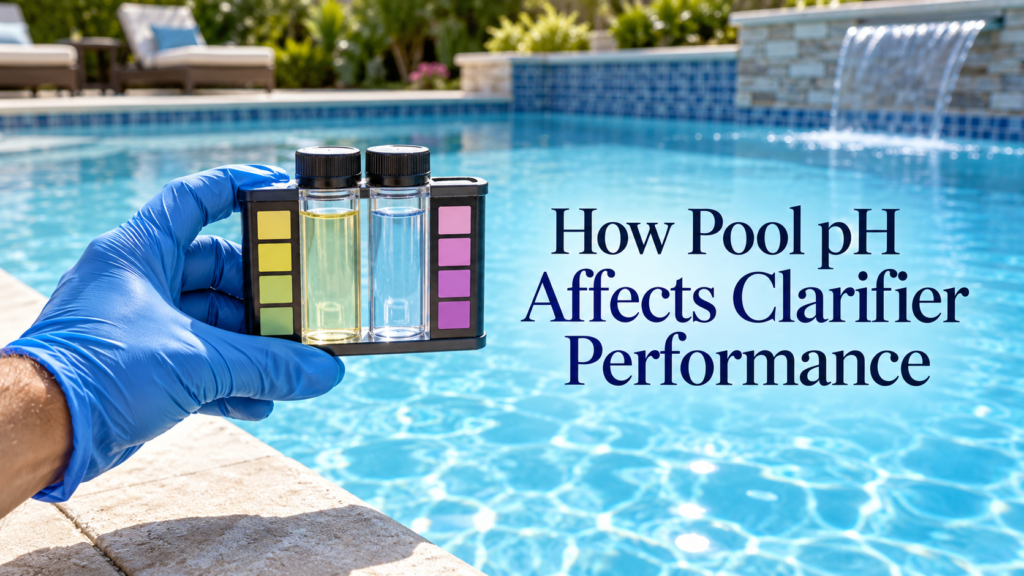
Hero image alt text: Gloved pool technician holding a water test comparator beside a clear swimming pool, with the headline “How Pool pH Affects Clarifier Performance.”
FAQ
1. What is the best pool pH for using a polymer clarifier?
Keep pH within the pool’s required operating range and follow the clarifier label. There is no universal pH value that gives every polymer clarifier its best result. The product formulation and the cause of cloudiness both matter.
2. Will a PolyDADMAC pool clarifier work at pH 7.8?
PolyDADMAC retains its positive charge at pH 7.8. However, actual clarification depends on dose, particle type, mineral balance, and filtration. Check the finished product’s instructions rather than assuming pH alone determines performance.
3. Should I lower pool pH before adding clarifier to cloudy water?
Correct pH if it is outside the required range. If it is already suitable, don’t lower it simply to make clarifier work faster. Check sanitation, calcium balance, and filter performance before choosing the next treatment.
4. Why is my pool still cloudy after pH adjustment and clarifier?
Possible causes include ongoing mineral precipitation, algae, poor circulation, filter faults, or an unsuitable clarifier dose. Retest the water and inspect the filtration system before adding more product.
5. Can pool clarifier be used instead of a pH reducer?
No. A clarifier helps make suitable suspended particles easier to remove. A pH reducer changes the water’s acid–base condition. Use each product for its intended purpose and follow its label directions.