
GET IN TOUCH
Ask For Sample?
How Does Polyquat Algaecide Work in Swimming Pools?
A swimming pool can look clean one day and turn cloudy or green the next. It’s frustrating, especially when you’ve checked the chlorine level, cleaned the filter, and kept the pump running.
So, what’s missing?
Sometimes, the answer is better algae prevention. That’s where Polyquat algaecide comes in.
Polyquat algaecide is a non-oxidizing, polymer-based pool treatment that helps control algae growth. Unlike chlorine, which serves as the main sanitizer, Polyquat works through contact between its positively charged polymer chains and negatively charged sites on algae cells.
One of its biggest advantages is that it can help prevent algae without adding copper or creating the heavy foam associated with some other algaecide formulas.
But how does Polyquat actually work? Can it kill existing algae? And why do pool professionals often use it alongside chlorine rather than as a replacement?
Let’s look at the chemistry, the benefits, and the practical ways to use it.
What Is Polyquat Algaecide?
Polyquat algaecide is a type of polymeric quaternary ammonium compound used to control algae in swimming pools.
The word Polyquat comes from two parts:
- Poly: A polymer made of repeating chemical units.
- Quat: Short for quaternary ammonium, a chemical group that carries a permanent positive charge.
Put them together, and you get a positively charged polymer that can interact with algae cells in pool water.
A common commercial product is Polyquat 60 Algaecide, which contains approximately 60% active polymer.
The active ingredient is commonly identified as:
| Property | Description |
|---|---|
| Chemical name | Polixetonium Chloride |
| Alternative designation | Polyquaternium-42 |
| CAS number | 31512-74-0 |
| Chemical family | Polymeric quaternary ammonium compound |
| Typical commercial concentration | 60% active ingredient |
| Appearance | Clear amber, viscous liquid |
| Treatment type | Non-oxidizing algaecide |
| Main purpose | Algae control and prevention |
The 60% concentration refers to the active ingredient content of the product. It doesn’t mean that 60% of the swimming pool water should contain Polyquat.
In fact, Polyquat is used at much lower concentrations once diluted into the pool.
Because product formulations and approved directions can differ, pool owners should always follow the label of the specific algaecide they purchase.
How Does Polyquat Algaecide Actually Kill Algae?
The chemistry sounds complex, but the basic idea is quite simple.
Algae cells have outer surfaces that often carry a negative electrical charge. Polyquat molecules carry multiple positive charges along their polymer chains.
Opposite charges attract.
That attraction helps Polyquat interact with the algae cell surface, where it can interfere with normal cell function.
Here’s how the process works.
Conceptual illustration: positively charged Polyquat groups are attracted to negatively charged sites on an algae cell surface. Not to molecular scale.
Step 1: Polyquat Is Dispersed Throughout the Pool Water
When Polyquat algaecide is added to a swimming pool according to its label, it disperses through the circulating water.
Good circulation matters. It helps distribute the treatment and reduces the chance that some parts of the pool receive too little product.
Areas with poor circulation, such as steps, corners, and behind ladders, can remain vulnerable to algae growth.
That’s why adding algaecide is only one part of a sound pool maintenance program.
Step 2: Positively Charged Polymers Attach to Algae Cells
Many algae cell surfaces contain negatively charged groups.
Polyquat molecules contain multiple positively charged sites. These sites can attract and bind to negatively charged regions on the algae surface.
Think of it like static electricity attracting small bits of paper. The interaction isn’t identical, but the comparison helps explain why the polymer tends to associate with algae cells.
This electrostatic attraction is a key part of Polyquat’s mode of action.
Step 3: Polyquat Disrupts Normal Cell Function
Once Polyquat associates with the algae cell surface, it can interfere with membrane function and other essential cell processes.
Cell membranes act like security gates. They control what enters and leaves a cell.
When those membranes are disturbed, the algae may lose its ability to maintain normal internal conditions.
Depending on the algae species, concentration, contact time, and pool conditions, this interference can inhibit growth or lead to cell death.
The important point is that Polyquat doesn’t need to oxidize algae in the same way chlorine does.
Its activity comes primarily from interactions between the cationic polymer and the biological cell surface.
Step 4: Algae Growth Is Suppressed
When Polyquat reaches susceptible algae at an effective concentration, it can slow growth and help prevent new colonies from becoming established.
This is especially useful in pools that face recurring algae problems.
However, Polyquat is not a magic shield. Sunlight, debris, poor filtration, low sanitizer levels, and inadequate circulation can still create conditions that favor algae growth.
Regular pool maintenance remains essential.
Step 5: Filtration Helps Remove Suspended Material
Polyquat is a cationic polymer, so it may also influence the way certain suspended particles interact in water.
Under suitable conditions, particle association may help filtration remove some material.
Still, Polyquat algaecide should not be treated as a direct replacement for a dedicated pool clarifier. Its main job is algae control, and any clarification effect depends on the formulation and water conditions.
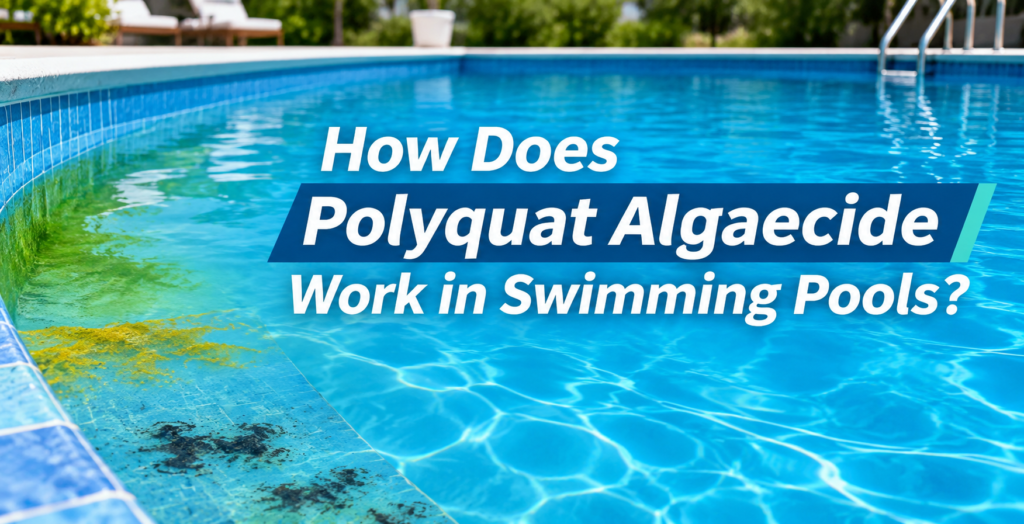
If a pool has persistent cloudy water, the owner should investigate filtration, water balance, and suspended contaminants rather than assuming more algaecide will solve the problem.Hero image alt text: How Polyquat algaecide works in swimming pools, showing green, yellow, and dark algae deposits along pool walls and steps, with clear blue water illustrating algae control.
Why Is Polyquat 60 Different From Traditional Pool Algaecides?
Not all algaecides work the same way. Some rely on copper ions, while others use smaller quaternary ammonium compounds.
Polyquat 60 belongs to a different category: polymeric quaternary ammonium algaecides.
That difference affects its performance, foaming behavior, and suitability for routine pool care.
1. Low-Foaming Performance
One of the most noticeable benefits of Polyquat 60 is its low-foaming behavior.
Some conventional quaternary ammonium algaecides can create foam when pool water is agitated.
You may notice this around return jets, waterfalls, or spa features.
Excessive foam can make a pool look poorly maintained, even when the water is otherwise clean.
Polyquat 60 is generally considered a low-foaming algaecide, making it useful for pools with active circulation and water features.
However, the finished formulation matters. Added surfactants or other ingredients can affect foam formation.
2. No Copper-Based Staining
Copper-based algaecides can control algae, but excess copper may contribute to stains on pool surfaces.
Copper can also cause discoloration of hair under certain conditions.
Polyquat 60 contains no copper as its active ingredient.
This makes it attractive for pool owners who want algae control without adding another source of dissolved metal.
Of course, a copper-free algaecide won’t remove copper that is already present in pool water.
3. Non-Oxidizing Algae Control
Chlorine is an oxidizing sanitizer. It attacks contaminants through chemical oxidation.
Polyquat uses a different mechanism.
Its positively charged polymer structure interacts with algae cells and disrupts their normal function.
This makes Polyquat useful as a supplementary treatment in chlorine-based pool maintenance programs.
The two products have different roles, and neither should be treated as an automatic replacement for the other.
4. Useful for Preventive Maintenance
Polyquat is often valued for preventive algae control.
When used according to label directions, it can help reduce the chance of algae becoming established.
That’s important because preventing algae is usually easier than treating a pool that has already turned green.
A prevention program can also help reduce the time spent brushing surfaces, vacuuming dead algae, and cleaning clogged filters.
Polyquat Algaecide vs. Chlorine: What’s the Difference?
This is one of the most common questions pool owners ask.
If chlorine already kills algae, why add Polyquat?
The answer comes down to their different jobs.
| Feature | Polyquat 60 Algaecide | Chlorine |
|---|---|---|
| Main function | Algae control | Primary pool sanitation and oxidation |
| Chemical action | Non-oxidizing cell-surface interaction | Oxidation |
| Controls algae | Yes, when properly applied | Yes, at effective concentrations |
| Controls pathogens | Not a substitute for approved sanitizers | Yes, when properly maintained |
| Removes organic contaminants through oxidation | No | Yes |
| Copper content | None in copper-free formulas | None in standard chlorine products |
| Routine use | Supplementary algae prevention | Essential sanitizer maintenance |
The key difference is that chlorine protects swimmers by maintaining sanitary water conditions, while Polyquat provides additional algae control.
A pool with a good Polyquat treatment but inadequate sanitizer levels is not necessarily safe for swimming.
Similarly, a properly chlorinated pool may not need routine algaecide treatment if water balance, circulation, and filtration are well maintained.
Polyquat is an extra tool, not a substitute for the basics.
Does Polyquat Work Against Green, Yellow, and Black Algae?
Different algae problems require different levels of treatment.
The response to Polyquat depends on the organism, the severity of growth, the product concentration, and the pool’s operating conditions.
Green Algae
Green algae is one of the most familiar pool problems.
It may appear as green water, slippery walls, or patches along pool surfaces.
Polyquat can help prevent and control susceptible green algae.
For an established green algae outbreak, pool owners may also need brushing, filtration, and an appropriate chlorine treatment.
Yellow or Mustard Algae
Yellow algae often appears as dusty yellow or brownish deposits on shaded surfaces.
It can return after cleaning, especially if contaminated equipment or hidden surfaces aren’t treated.
Polyquat may help with preventive control, but established mustard algae can require a more comprehensive treatment program.
Always check whether the product label specifically includes the algae being treated.
Black Algae
Black algae is especially troublesome in plaster and other porous pool surfaces.
It can form dark, persistent spots that resist ordinary treatment.
Physical brushing is often necessary to expose the growth to the sanitizer or algaecide.
Polyquat should not be assumed to eliminate established black algae on its own. Product-specific label claims and treatment directions matter.
How Long Does Polyquat Algaecide Take to Work?
There isn’t one universal answer.
The time needed depends on several factors, including:
- Algae species and growth stage
- Polyquat concentration and application rate
- Water temperature and pH
- Chlorine concentration
- Circulation and filtration
- Organic debris and other contaminants
For preventive treatment, the goal is to stop visible algae from developing in the first place.
For existing algae, results may take longer, and additional cleaning or sanitation may be necessary.
Don’t judge performance only by how quickly the water becomes clear.
Dead algae, dirt, and other suspended particles can remain in the pool after the algae has been controlled.
Filtration must remove that material.
How Should You Use Polyquat 60 Algaecide in a Swimming Pool?
The correct application rate depends on the product’s registered label, active ingredient concentration, and intended use.
A 60% Polyquat product cannot automatically be dosed using directions written for a 10% product.
Likewise, an initial treatment may differ from a maintenance treatment.
Here is a practical approach to using Polyquat safely and effectively.
Step 1: Test the Pool Water
Check free chlorine, pH, and other relevant water balance parameters. Correct poor sanitation or water balance before relying on algaecide.
Step 2: Brush and Clean the Pool
Remove debris and brush surfaces where algae may be growing. Cleaning exposes hidden deposits to treatment.
Step 3: Measure the Correct Dose
Calculate pool volume and follow the exact product label. Wear the protective equipment specified in the safety instructions.
Step 4: Distribute the Treatment
Add the product only as directed, with the circulation system operating when required. Never mix concentrated pool chemicals together.
Step 5: Monitor and Maintain
Continue filtration, test the water, and clean the filter when needed. Follow the label’s swimming reentry instructions.
A common mistake is adding extra algaecide when the pool doesn’t clear immediately.
More chemical doesn’t always mean better results. Overdosing can increase cost, affect water appearance, and cause unwanted interactions with other pool treatment products.
Can Polyquat Algaecide Be Used With Chlorine?
Yes. Many Polyquat algaecides are designed for use in properly maintained chlorine pools.
However, compatibility doesn’t mean that concentrated chemicals should be mixed together.
Polyquat and chlorine products should be added separately, following their respective labels.
Very high chlorine concentrations, such as those present during some shock treatments, may also reduce the effective life of certain Polyquat formulations.
The correct timing depends on the product.
For this reason, avoid applying Polyquat at the same time as a concentrated chlorine treatment unless the labels specifically permit that procedure.
The same caution applies to other pool chemicals.
What Affects Polyquat Algaecide Performance?
Polyquat’s chemical structure is important, but actual performance depends on the water environment.
Pool Water pH
Polyquat contains permanently charged quaternary ammonium groups.
Unlike some chemicals whose electrical charge changes substantially with pH, these groups remain positively charged across ordinary swimming pool pH conditions.
That supports Polyquat’s usefulness over a range of pool water conditions.
However, pH still matters for the overall treatment program, especially chlorine performance and swimmer comfort.
For typical residential chlorine pools, pH is commonly maintained around 7.2–7.8, subject to applicable local requirements.
Water Temperature
Warm water can encourage algae growth.
Pools exposed to strong sunlight and high temperatures may need closer monitoring, especially during summer.
Polyquat can be used in various seasonal maintenance programs, but its actual performance and application frequency should follow product-specific directions.
Organic Contamination
Leaves, pollen, dust, sunscreen, and other organic materials can increase the burden on pool treatment systems.
They may also interfere with the effective distribution or availability of treatment chemicals.
Keeping the pool clean helps Polyquat perform its intended role.
Water Circulation
Poor circulation creates areas where algae can develop.
Even an effective algaecide cannot compensate fully for stagnant corners, blocked returns, or inadequate filtration.
Good hydraulic circulation helps distribute chemicals throughout the pool.
Product Concentration and Quality
Not every product marketed as Polyquat algaecide has the same active ingredient concentration.
Some are concentrated formulations, while others are diluted for retail or maintenance applications.
Differences in polymer content, viscosity, formulation stability, and manufacturing consistency can influence handling and performance.
For professional buyers, checking the technical specification and certificate of analysis is an important part of product evaluation.
Why Is Polyquat 60 Popular for Pool Opening and Winterizing?
Seasonal maintenance presents a special challenge.
During pool opening, algae may already be present after months of limited circulation or sanitation.
During winter closing, pool owners want to reduce the risk of algae growth while the pool is not being used.
Polyquat 60 is commonly considered for both situations because of its non-oxidizing, low-foaming, copper-free characteristics.
Pool Opening
At the start of the swimming season, Polyquat may be included in a broader maintenance program after the pool has been cleaned and water conditions corrected.
If algae is already present, it may require a separate cleanup treatment before normal maintenance begins.
Pool Winterizing
Winterizing programs aim to reduce problems during the months when the pool is closed.
A suitable Polyquat formulation may help control algae during this period.
However, the treatment should be selected according to local climate, pool type, expected closure period, and the product’s winterizing directions.
In regions with freezing winters, correct water level, equipment drainage, and freeze protection are just as important as chemical treatment.
Polyquat cannot protect pipes from freezing.
Is Polyquat Algaecide Safe for Swimming Pools?
Polyquat algaecides can be used safely when the product is authorized for swimming pool use and applied according to its label.
That does not mean the concentrated product is harmless.
Concentrated algaecide may irritate or damage eyes and skin, depending on its formulation and hazard classification.
Pool owners and service professionals should read the safety data sheet and label before handling it.
Important precautions include using suitable protective equipment, avoiding direct contact with concentrates, storing the product securely, and never mixing concentrated chemicals.
Swimming should resume only when the product label’s reentry conditions are met and the pool meets applicable water quality requirements.
Also, keep in mind that Polyquat is an algaecide, not a replacement for a registered swimming pool sanitizer.
Its ability to inhibit algae does not establish that it provides the pathogen control required for safe swimming.
What Should Pool Chemical Distributors Know About Polyquat 60?
For distributors and private label pool chemical brands, understanding the mechanism of Polyquat is only the beginning.
The finished product must also meet practical requirements for storage, packaging, labeling, and consistent performance.
A typical Polyquat 60 product is a clear amber, viscous liquid containing approximately 60% active polymer.
Its viscosity and appearance can help with routine quality checks, although neither is a substitute for analytical testing.
Professional buyers should evaluate several factors.
| Quality factor | Why it matters |
|---|---|
| Active ingredient concentration | Helps ensure consistent formulation strength |
| Appearance | Supports visual inspection and batch consistency |
| Viscosity | Affects pumping, filling, and handling |
| pH | Helps assess formulation consistency |
| Density | Useful for quality control and filling calculations |
| Stability | Important for storage and shelf life |
| Packaging compatibility | Helps prevent leaks and container problems |
| COA and SDS | Support quality review and safe handling |
For brands planning to sell in different markets, product registration and label compliance are especially important.
An algaecide may be regulated as a pesticide or biocidal product, depending on the country and intended claims.
For example, swimming pool algaecide claims in the United States generally fall under EPA pesticide regulation. European Union markets have separate biocidal product requirements.
A supplier’s technical specification alone does not establish permission to sell a finished algaecide in a particular country.
Private Label Polyquat 60 Algaecide
For distributors developing their own pool chemical range, packaging is another consideration.
Common supply formats include:
- 1L bottles for retail pool care
- 5L containers for professional service businesses
- 25L drums for commercial customers
- 200L drums for bulk distribution
- 1000L IBCs for industrial-scale supply
Different concentrations and packaging styles may be developed for specific markets, provided that product performance, stability, and local regulatory requirements are properly addressed.
At Eautrix, Polyquat 60 Algaecide is part of a broader range of cationic polymer products for pool and water treatment applications.
Product information is available at Eautrix Products.
Common Mistakes When Using Polyquat Algaecide
Even a well-formulated algaecide can disappoint when applied incorrectly.
One common mistake is using Polyquat as the only treatment for a severely contaminated pool. Heavy algae growth often requires physical cleaning, appropriate sanitizer treatment, and effective filtration.
Another is assuming that every Polyquat product has the same concentration. A 10% formulation and a 60% formulation require different dosing calculations.
Some pool owners also neglect circulation. Chemicals need to reach the areas where algae are present.
And then there’s the temptation to add several pool chemicals at once.
This can create unwanted chemical interactions and safety risks.
A more reliable approach is to follow a planned maintenance schedule, keep accurate water test records, and use each chemical for its intended purpose.
Is Polyquat Algaecide Worth Using?
For pools that struggle with recurring algae, Polyquat can be a useful addition to the maintenance program.
Its main strengths are its non-oxidizing algae control mechanism, low-foaming behavior, and copper-free formulation.
It can be especially attractive for preventive maintenance, seasonal pool care, and professional service programs.
But it’s important to keep expectations realistic.
A pool with good chlorine control, balanced water, effective filtration, and regular cleaning may not need routine algaecide treatment.
For a pool with recurring algae problems, a properly selected Polyquat product may provide an extra layer of protection.
The most effective strategy is to identify why algae is developing and address those conditions alongside any chemical treatment.
Final Thoughts: Prevention Is Easier Than Cleanup
Polyquat algaecide works by using positively charged polymer chains to interact with algae cells and interfere with their normal function.
That makes it different from chlorine and copper-based algaecides.
For pool owners, the appeal is straightforward: better algae prevention without the added copper or heavy foaming associated with some alternative treatments.
For pool professionals and distributors, Polyquat 60 offers a concentrated polymer-based ingredient that can support a range of pool care products.
Still, the fundamentals never change.
Clean water depends on effective sanitation, circulation, filtration, and balanced chemistry.
Polyquat works best as part of that complete maintenance program—not as a shortcut around it.
Frequently Asked Questions About Polyquat Algaecide
1. Does Polyquat 60 algaecide kill existing algae or only prevent new growth?
Polyquat 60 can inhibit or kill susceptible algae when used at an effective concentration. However, established algae outbreaks may also require brushing, chlorine treatment, and filtration. Always follow the product label for the specific treatment.
2. Can I use Polyquat algaecide in a saltwater swimming pool?
Many Polyquat products are suitable for saltwater pools because these pools typically generate chlorine through saltwater chlorination. Check the specific product label for compatibility and continue maintaining the correct sanitizer level.
3. How often should I add Polyquat 60 algaecide to my pool?
The application frequency depends on the product’s concentration, approved label, and treatment purpose. Some products provide separate initial and maintenance directions. Never assume that all Polyquat 60 formulations have the same dosing schedule.
4. Will Polyquat algaecide make cloudy pool water clear?
Polyquat may influence suspended particles under certain conditions, but its primary function is algae control. Cloudy water can result from poor filtration, unbalanced water chemistry, or fine suspended contaminants. A dedicated clarifier may be more suitable once the cause is identified.
5. Is Polyquat 60 better than copper algaecide for swimming pools?
Polyquat 60 is attractive when low foaming and avoiding added copper are priorities. Copper-based products may be effective against certain algae, but excess copper can contribute to staining. The better choice depends on the algae problem, pool surface, water chemistry, and approved product directions.