
GET IN TOUCH
Ask For Sample?
Top 3 Applications of Poly(2-hydroxypropyldimethylammonium chloride)
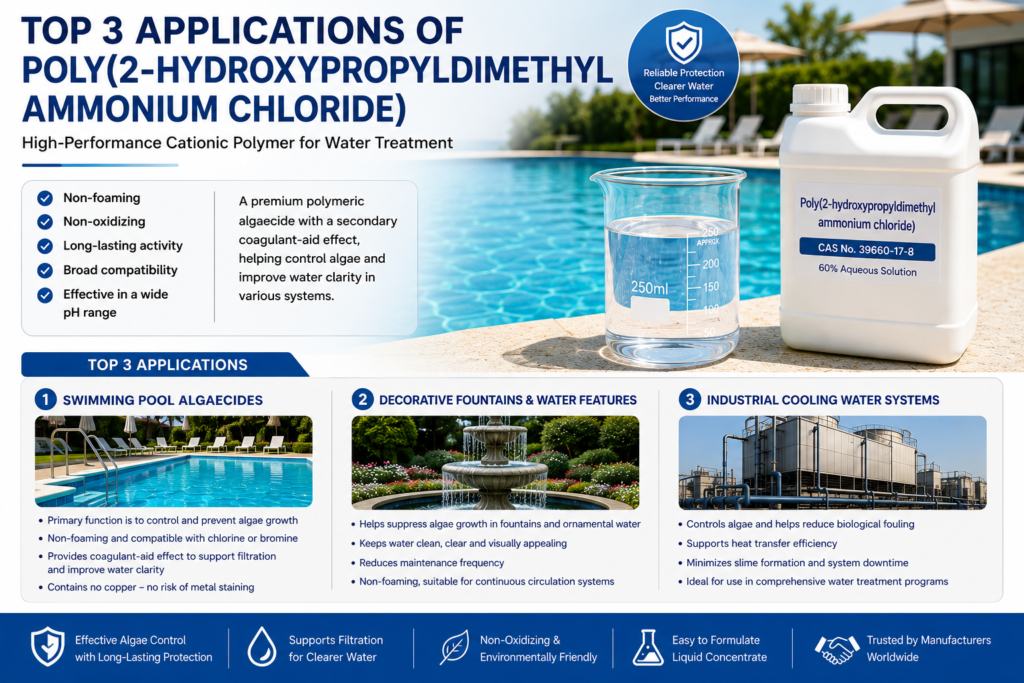
Poly(2-hydroxypropyldimethylammonium chloride) (CAS No. 39660-17-8) is a high-performance cationic quaternary ammonium polymer widely used in industrial water treatment. Thanks to its non-foaming, non-oxidizing, and long-lasting antimicrobial performance, it has become a preferred active ingredient in many commercial formulations.
Unlike traditional oxidizing biocides, this polymer works by interacting with the negatively charged surfaces of microorganisms. This unique mechanism provides effective algae control while maintaining excellent compatibility with many water treatment systems.
Here are the five most important applications of Poly(2-hydroxypropyldimethylammonium chloride).
1. Swimming Pool Algaecides
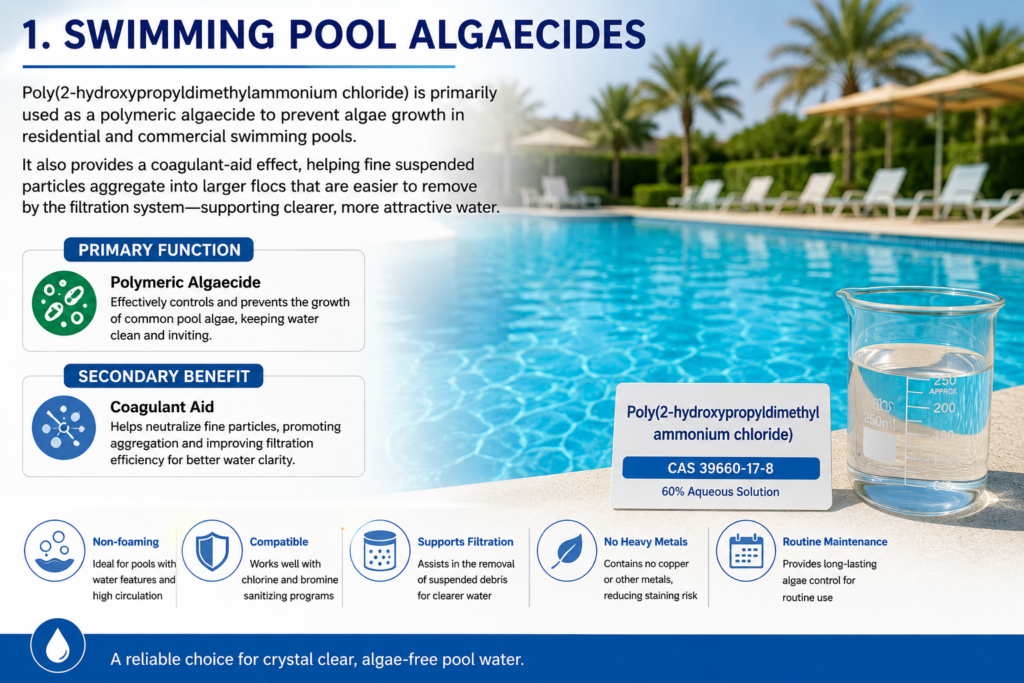
The primary application of Poly(2-hydroxypropyldimethylammonium chloride) is in residential and commercial swimming pools, where it is widely used as a non-foaming polymeric algaecide.
Its main function is to help prevent the growth of algae, keeping pool water cleaner and reducing the likelihood of green or cloudy water. Because the polymer remains dissolved in the water and is not rapidly consumed like oxidizing sanitizers, it can provide extended algae control when used as part of a regular pool maintenance program.
In addition to its algae control performance, the polymer’s cationic structure can also provide a coagulant-aid effect. It helps neutralize the negative charges on fine suspended particles, encouraging them to aggregate into larger particles that are more easily removed by the pool filtration system. While it is not intended to replace a dedicated pool clarifier, this secondary benefit can contribute to improved water clarity over time.
Key Benefits
- Effectively controls common swimming pool algae
- Non-foaming, making it ideal for pools with water features and high circulation
- Compatible with chlorine and bromine sanitizing programs
- Provides a secondary coagulant-aid effect to support filtration efficiency
- Helps maintain cleaner, clearer pool water during routine maintenance
- Contains no copper or other heavy metals, reducing the risk of metal staining
For these reasons, Poly(2-hydroxypropyldimethylammonium chloride) has become a popular active ingredient in premium polymeric algaecides for both residential and commercial pool applications.
2. Decorative Fountains and Water Features
Decorative fountains often experience algae growth due to continuous sunlight and nutrient exposure.
This polymer helps keep water cleaner while maintaining the visual appearance of fountains in:
- Hotels
- Shopping malls
- Public parks
- Resorts
- Commercial landscapes
Advantages
- Suppresses algae growth
- Reduces cleaning frequency
- Maintains water clarity
- Produces virtually no foam
3. Industrial Cooling Water Systems
Cooling towers and recirculating cooling water systems provide favorable environments for biological growth.
When algae and slime accumulate, they can reduce heat-transfer efficiency and increase maintenance costs.
Poly(2-hydroxypropyldimethylammonium chloride) is commonly incorporated into industrial water treatment programs to help:
- Control algal growth
- Reduce biological fouling
- Minimize slime formation
- Support long-term system cleanliness
It is typically used as part of a comprehensive microbiological control program rather than as the sole treatment.
Why These Three Applications Stand Out
Although Poly(2-hydroxypropyldimethylammonium chloride) has potential uses in several industries, these three applications account for most of its commercial demand because they benefit directly from its unique combination of properties:
- Non-foaming performance
- Long-lasting antimicrobial activity
- Non-oxidizing chemistry
- Excellent water solubility
- Broad formulation compatibility
- Easy handling as a liquid concentrate
These advantages make it especially valuable wherever continuous water circulation and reliable algae control are required.
Conclusion
Poly(2-hydroxypropyldimethylammonium chloride) has become one of the most versatile polymeric biocides available for water treatment. Whether it’s keeping swimming pools crystal clear, protecting cooling towers from biological fouling, preserving metalworking fluids, or serving as a key ingredient in industrial water treatment formulations, its proven performance continues to support a wide range of applications.
For formulators, distributors, and OEM manufacturers, choosing a high-quality grade with consistent active content and stable production quality is essential for achieving reliable long-term performance.
FAQs
1. What is the primary application of Poly(2-hydroxypropyldimethylammonium chloride)?
Its largest application is in polymeric swimming pool algaecides, where it provides long-lasting algae control with virtually no foaming.
2. Can it be used in industrial cooling water systems?
Yes. It is commonly incorporated into industrial cooling water treatment programs to help control algae and biological fouling as part of an integrated treatment strategy.
3. Does it replace chlorine in swimming pools?
No. It is generally used alongside chlorine or bromine as an algaecide rather than replacing primary disinfectants.
4. Why is it popular for OEM water treatment products?
Its stable liquid form, non-foaming characteristics, good compatibility with many formulations, and residual antimicrobial activity make it an excellent active ingredient for private-label and customized water treatment chemicals.