
GET IN TOUCH
Ask For Sample?
How Does Poly(2-hydroxypropyldimethylammonium Chloride) Work?
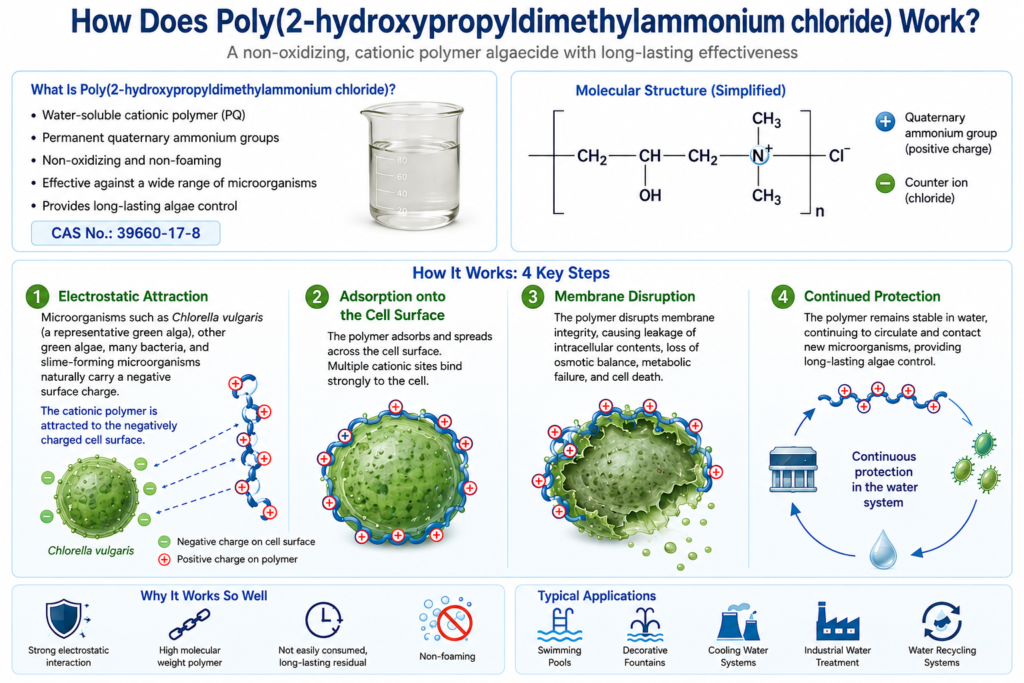
When people first hear about Poly(2-hydroxypropyldimethylammonium chloride), one question usually comes up:
How can one chemical prevent algae for weeks without behaving like chlorine or copper-based products?
The answer lies in its molecular structure rather than strong oxidation or metal toxicity.
Unlike traditional oxidizing biocides that rapidly attack microorganisms through chemical oxidation, Poly(2-hydroxypropyldimethylammonium chloride) works through a cationic polymer contact mechanism. Because the polymer molecules remain chemically stable in water, they continue protecting the system long after application.
Let’s explain exactly how it works.
What Is Poly(2-hydroxypropyldimethylammonium Chloride)?
Poly(2-hydroxypropyldimethylammonium chloride), sometimes abbreviated as PQ 60, is a water-soluble quaternary ammonium polymer.
Typical properties include:
- Colorless to light yellow clear liquid
- Around 60% active content
- Completely water soluble
- Non-oxidizing
- Non-foaming
- Compatible with most pool sanitizers
Its polymer backbone carries permanent positive charges (quaternary ammonium groups) distributed along the entire molecular chain.
Those positive charges are the key to its performance.
Understanding the Molecular Structure
Unlike small-molecule disinfectants, Poly(2-hydroxypropyldimethylammonium chloride) is a high-molecular-weight polymer.
Imagine a long flexible chain covered with hundreds—or even thousands—of tiny positive electrical charges.
That means one polymer molecule can interact with many microorganisms at the same time.
This gives it several advantages:
- Large contact area
- Strong adsorption to negatively charged cell surfaces
- Lower volatility
- Better persistence in water
- Reduced consumption compared with oxidizing chemicals
In simple terms, instead of acting like a chemical “bomb,” it behaves more like a microscopic net that continuously searches for algae cells.
How Does Poly(2-hydroxypropyldimethylammonium Chloride) Work?
Its mechanism can be divided into four major steps.
Step 1: Electrostatic Attraction
Most microorganisms naturally carry a negative surface charge.
These include:
- Chlorella vulgaris
- Other green algae
- Many bacteria
- Slime-forming microorganisms
Since Poly(2-hydroxypropyldimethylammonium chloride) carries permanent positive charges, the polymer is naturally attracted to microbial cell surfaces.
This electrostatic attraction occurs almost immediately after contact.
Step 2: Adsorption onto the Cell Surface
Once attracted, the polymer spreads across the cell membrane.
Because one polymer chain contains many charged sites, it can bind firmly rather than temporarily touching the organism.
The polymer effectively coats portions of the cell surface.
Step 3: Membrane Disruption
The microbial cell membrane controls:
- Nutrient transport
- Waste removal
- Water balance
- Energy production
After adsorption, the polymer interferes with membrane integrity.
This disruption causes:
- leakage of intracellular materials
- loss of osmotic balance
- failure of normal metabolism
- eventual cell death
Importantly, this is a physical membrane-disruption mechanism, not an oxidation reaction.
Step 4: Continued Protection
Here’s where Poly(2-hydroxypropyldimethylammonium chloride) differs from many traditional algaecides.
The polymer itself is not rapidly consumed during action.
Instead:
- polymer molecules remain dissolved in the water,
- continue circulating with the water,
- contact newly introduced microorganisms,
- and provide extended protection until gradually removed through dilution, filtration, splash-out, or normal water replacement.
This is why properly maintained pools often require dosing only every several days rather than daily.
Why Does It Provide Long-Lasting Algae Control?
Many people assume the product lasts longer because it sticks to algae forever.
That’s only part of the story.
The primary reason is actually that the polymer remains chemically stable in water.
Unlike chlorine:
- it is not rapidly consumed by sunlight,
- it is not immediately exhausted after attacking one organism,
- and it continues circulating throughout the water system.
Its long service life comes from persistent polymer molecules combined with repeated contact opportunities, rather than a one-time chemical reaction.
Of course, over time the concentration gradually decreases because of:
- water replacement
- backwashing
- splash-out
- adsorption onto suspended solids
- normal system losses
Eventually, replenishment becomes necessary.
Why Is It Non-Foaming?
One interesting feature is its non-foaming behavior.
Many conventional quaternary ammonium compounds produce excessive foam because they behave like surfactants.
Poly(2-hydroxypropyldimethylammonium chloride) behaves differently.
Its polymeric structure greatly reduces surface activity while maintaining strong cationic properties.
As a result, it delivers algae control without creating objectionable foam during circulation, waterfalls, fountains, or spa operation.
This characteristic makes it especially attractive for:
- swimming pools
- decorative fountains
- cooling water systems
- industrial recirculating water
Factors That Affect Performance
Although highly effective, several factors influence overall performance.
Polymer Concentration
Higher active concentration generally provides faster algae control and longer residual protection.
Maintaining the recommended dosage is essential.
Contact Time
Since the mechanism depends on physical interaction with microorganisms, adequate circulation improves performance.
Water Quality
Heavy organic contamination can reduce efficiency because suspended particles may adsorb part of the polymer.
Good filtration helps maximize activity.
Algae Population
Preventive treatment is always easier than eliminating an established bloom.
Routine maintenance dosing produces the best long-term results.
Typical Applications
Thanks to its unique working mechanism, Poly(2-hydroxypropyldimethylammonium chloride) is widely used in:
- Residential swimming pools
- Commercial pools
- Water parks
- Decorative fountains
- Cooling water systems
- Industrial water treatment
- Process water Reservoirs Water recycling systems
- Various water-based formulations requiring microbial control
Its broad compatibility also allows it to be used alongside many common water treatment programs.
Why This Mechanism Matters
Understanding the mechanism helps explain why Poly(2-hydroxypropyldimethylammonium chloride) has become popular in modern water treatment.
Instead of relying on strong oxidation or heavy metals, it controls microorganisms through electrostatic attraction and membrane disruption.
The polymer’s stable molecular structure allows it to remain active in water, providing prolonged algae control with no foaming and excellent compatibility with other treatment chemicals.
For pool operators and industrial users alike, that translates into fewer algae problems, more stable water quality, and simpler maintenance.
Frequently Asked Questions
1. Is Poly(2-hydroxypropyldimethylammonium chloride an oxidizing biocide?
No. It is a non-oxidizing cationic polymer biocide. It works by binding to negatively charged microbial cell surfaces and disrupting cell membrane function rather than oxidizing cellular components.
2. Why does Poly(2-hydroxypropyldimethylammonium chloride last longer than many traditional algaecides?
Its polymer molecules remain chemically stable and dissolved in the water after application. They continue contacting newly introduced microorganisms until their concentration gradually decreases through dilution, filtration, or water replacement.
3. Does Poly(2-hydroxypropyldimethylammonium chloride kill bacteria as well as algae?
Yes. Its membrane-disruption mechanism is active against many algae species and a broad range of microorganisms, although the spectrum depends on concentration, contact time, and application conditions.
4. Why doesn’t Poly(2-hydroxypropyldimethylammonium chloride create foam?
Unlike many low-molecular-weight quaternary ammonium compounds, its polymeric structure has much lower surface activity, allowing it to provide algae control without the excessive foaming commonly associated with surfactant-type quats.
5. Can Poly(2-hydroxypropyldimethylammonium chloride be used together with chlorine?
Yes. It is commonly used alongside chlorine or bromine in swimming pool water treatment programs. The polymer provides residual algae prevention while the oxidizing sanitizer controls pathogens and oxidizes organic contaminants.