
GET IN TOUCH
Ask For Sample?
What Is Poly(2-hydroxypropyldimethylammonium Chloride)? A Complete Beginner’s Guide
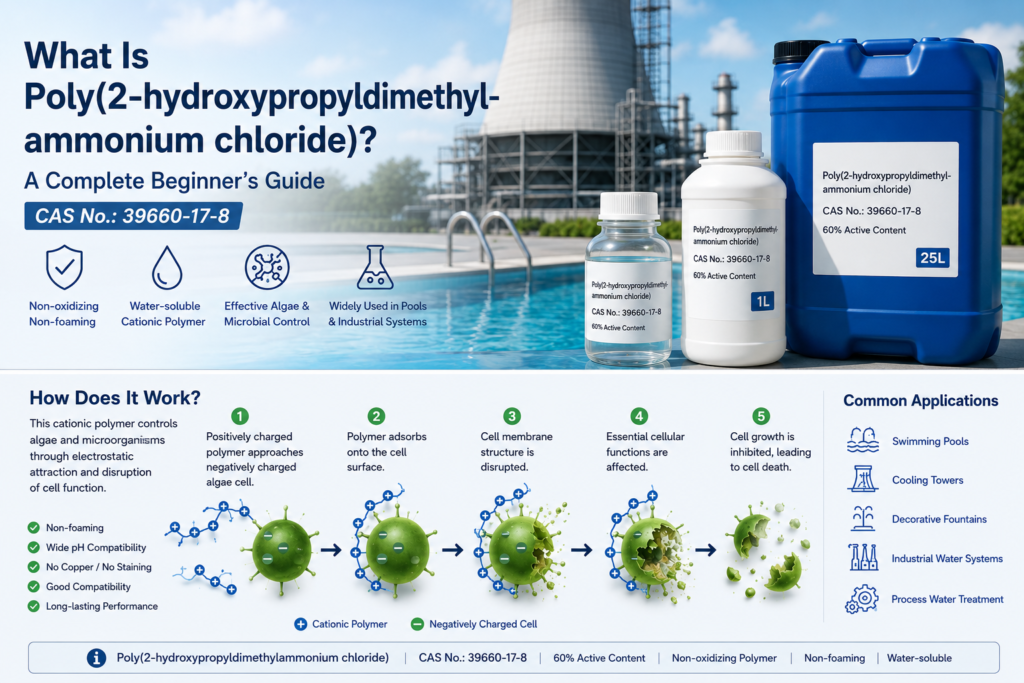
If you’ve been researching industrial biocides, pool algaecides, or water treatment polymers, you’ve probably come across the rather intimidating name Poly(2-hydroxypropyldimethylammonium chloride).
At first glance, it sounds like something only a chemist could pronounce. But here’s the interesting part—it has become one of the most widely used polymeric algaecides because it combines effective algae control with excellent compatibility in water treatment systems.
Unlike many traditional biocides, this polymer doesn’t rely on oxidation or heavy metals to do its job. Instead, it uses a unique cationic polymer structure that helps control algae while remaining gentle on equipment and water systems.
Let’s break it down in plain English.
What Is Poly(2-hydroxypropyldimethylammonium Chloride)?
Poly(2-hydroxypropyldimethylammonium chloride), with CAS No.39660-17-8, known as PQ 60 is a water-soluble cationic polymer made by polymerizing quaternary ammonium monomers.
Because every repeating unit contains a permanently charged quaternary ammonium group, the polymer carries a positive charge regardless of the water pH. This positive charge is the key to its performance.
It is commonly supplied as a clear colorless to light yellow liquid with an active content of approximately 60%, although diluted grades such as 10% are also available for specific applications.
Unlike oxidizing biocides such as chlorine or bromine, it belongs to the family of non-oxidizing polymeric biocides.
Typical product information includes:
| Property | Typical Value |
|---|---|
| Chemical Name | Poly(2-hydroxypropyldimethylammonium chloride) |
| CAS No. | 39660-17-8 |
| Appearance | Colorless to light yellow clear liquid |
| Active Content | About 60% |
| Solubility | Completely water soluble |
| Ionic Character | Cationic |
| Foaming | Non-foaming |
| Stability | Stable over a wide pH range |
H2: Other Names You May Encounter
Depending on the manufacturer or application, the same chemistry may appear under different names, including:
- Poly(2-hydroxypropyldimethylammonium chloride)
- N,N-Dimethyl-2-hydroxypropylammonium chloride polymer
- Polyquaternary ammonium polymer
- Polymeric quaternary ammonium compound
- PQ Polymer
- Poly EPI-type cationic polymer (in some industrial applications)
Knowing these alternative names can make product searches much easier.
H2: How Does It Work?
Here’s where things become surprisingly simple.
Algae, bacteria, and many microorganisms naturally carry negatively charged cell surfaces.
Poly(2-hydroxypropyldimethylammonium chloride) carries positive charges along its polymer chain.
When the polymer comes into contact with microorganisms:
- The positively charged polymer is attracted to the negatively charged cell surface.
- It adsorbs onto the cell membrane.
- The membrane structure becomes disrupted.
- Essential cellular functions are affected.
- Cell growth is inhibited, eventually leading to cell death.
Because the polymer contains many positively charged sites along a single molecule, one chain can interact with multiple locations on a microorganism’s surface, providing efficient contact.
An additional benefit is that this polymer can also help aggregate fine suspended particles, improving water clarity in some systems.
Why Is It Different from Traditional Algaecides?
Many conventional algaecides rely on:
- Copper ions
- Chlorine
- Bromine
These products certainly have their place, but they may also present challenges such as:
- Metal staining
- Equipment corrosion
- Strong odors
- Higher chemical consumption
- Reduced stability in some operating conditions
Poly(2-hydroxypropyldimethylammonium chloride) approaches algae control differently.
Instead of oxidation, it works through electrostatic interaction with microorganisms.
That means it generally offers:
- Non-foaming performance
- No copper staining
- Good compatibility with many water treatment programs
- Lower corrosion risk than oxidizing products
- Long-lasting activity
H2: Common Applications
One of the biggest strengths of this polymer is its versatility.
Swimming Pools
It is widely used in:
- Residential swimming pools
- Commercial pools
- Hotel pools
- Water parks
- Seasonal pool maintenance
Pool operators appreciate that it helps prevent algae without creating foam.
Industrial Cooling Water
Industrial cooling systems constantly circulate warm water—a perfect environment for algae and microbial growth.
The polymer helps maintain cleaner systems while reducing biological fouling.
Typical applications include:
- Cooling towers
- Heat exchangers
- Closed-loop cooling systems
Decorative Water Features
Clear water is essential for fountains and ornamental ponds.
This polymer helps suppress algae while maintaining water appearance.
Industrial Water Treatment
It may also be used in:
- Process water
- Recirculating water systems
- Certain industrial cleaning systems
The exact formulation depends on local regulations and system requirements.
Key Benefits
Users often choose Poly(2-hydroxypropyldimethylammonium chloride because it offers several practical advantages.
Non-foaming
Foam can interfere with pumps, filters, and circulation systems.
This polymer is naturally non-foaming, making it suitable for systems where excessive foam is undesirable.
Excellent Water Solubility
It dissolves readily without leaving visible residues.
Wide pH Compatibility
The polymer remains effective across a broad pH range, giving operators more flexibility.
Easy to Dose
Liquid formulations can be added manually or through automated dosing equipment.
Good Compatibility
It is often compatible with many commonly used pool and industrial water treatment chemicals, although compatibility should always be confirmed for individual formulations.
Long Service Life
Because it is a polymer rather than a rapidly consumed oxidizer, it may provide longer-lasting biological control under appropriate operating conditions.
How to Choose a High-Quality Product
Not all products on the market are exactly the same.
When comparing suppliers, pay attention to several important factors.
1. Check the Active Content Carefully
Many suppliers advertise 60% Active Content, but the term “active content” is not always used consistently across the industry.
Some products are labeled according to active ingredient, while others are marketed based on total solids content. These are not necessarily the same measurement.
A product labeled as 60% active ingredient may contain a higher actual concentration of the effective polymer than a product described simply as 60% solids, depending on the manufacturing process and analytical method.
For this reason, buyers should always ask suppliers to clarify:
- How the active content is measured
- Which test method is used
- Whether the reported value refers to active ingredient or total solids
Understanding this distinction helps ensure you are making a fair comparison between products rather than relying only on the percentage shown on the label.
2. Appearance
A quality product should typically be:
- Clear
- Free from visible particles
3. Viscosity
Viscosity is more than a physical property. It often reflects the polymer’s molecular weight, which can influence algae-control performance, product stability, and overall application characteristics.
4. Technical Documentation
Reliable suppliers should be able to provide:
- Technical Data Sheet (TDS)
- Safety Data Sheet (SDS)
- Certificate of Analysis (COA)
5. Manufacturing Consistency
Batch-to-batch consistency is essential, especially for customers using automated dosing systems or private-label products.
H2: Storage and Handling
Although relatively stable, good storage practices help maintain product quality.
Recommended conditions include:
- Store in tightly sealed containers.
- Protect from freezing.
- Avoid prolonged exposure to direct sunlight.
- Keep the storage area clean and dry.
- Follow local chemical handling regulations.
Always consult the supplier’s Safety Data Sheet before use.
Is It Safe to Use?
When handled according to the manufacturer’s instructions, Poly(2-hydroxypropyldimethylammonium chloride is widely used in industrial and pool water treatment applications.
As with any industrial chemical:
- Wear appropriate personal protective equipment (PPE).
- Avoid direct contact with eyes and skin.
- Prevent unnecessary environmental release.
- Follow local regulations regarding storage, transportation, and disposal.
The required precautions depend on the product concentration and the intended application.
H2: Final Thoughts
Poly(2-hydroxypropyldimethylammonium chloride may have a long chemical name, but its role in water treatment is quite straightforward.
It is a water-soluble cationic polymer that provides effective, non-foaming control of algae and other microorganisms through electrostatic interaction rather than oxidation. Its broad compatibility, ease of use, and stable performance have made it a popular choice for swimming pools, cooling water systems, and a variety of industrial water treatment applications.
When selecting a supplier, look beyond the headline concentration. Understanding how active content is defined and measured, along with reviewing technical documentation and manufacturing consistency, can help you choose a product that delivers reliable performance over the long term.
Frequently Asked Questions (FAQ)
1. What is Poly(2-hydroxypropyldimethylammonium chloride) used for?
It is mainly used as a polymeric algaecide and non-oxidizing biocide in swimming pools, cooling towers, industrial water systems, and decorative water features.
2. Is Poly(2-hydroxypropyldimethylammonium chloride the same as copper algaecide?
No. Copper algaecides rely on metal ions, while Poly(2-hydroxypropyldimethylammonium chloride is a cationic polymer that controls microorganisms through electrostatic interaction. It does not introduce copper into the water.
3. Does Poly(2-hydroxypropyldimethylammonium chloride produce foam?
High-quality formulations are typically non-foaming, making them suitable for applications where foam control is important.
4. How should I compare different Poly(2-hydroxypropyldimethylammonium chloride suppliers?
Compare active content measurement methods, product appearance, viscosity consistency, technical documentation (TDS, SDS, COA), quality control procedures, and batch-to-batch consistency rather than relying only on the concentration printed on the label.
5. Why is active content important when buying Poly(2-hydroxypropyldimethylammonium chloride?
Because active ingredient content and total solids content are not always the same measurement. Understanding how the supplier determines the reported value helps ensure you’re comparing products on an equivalent basis and selecting the grade that best fits your application.