
GET IN TOUCH
Ask For Sample?
How to Choose Polixetonium Chloride
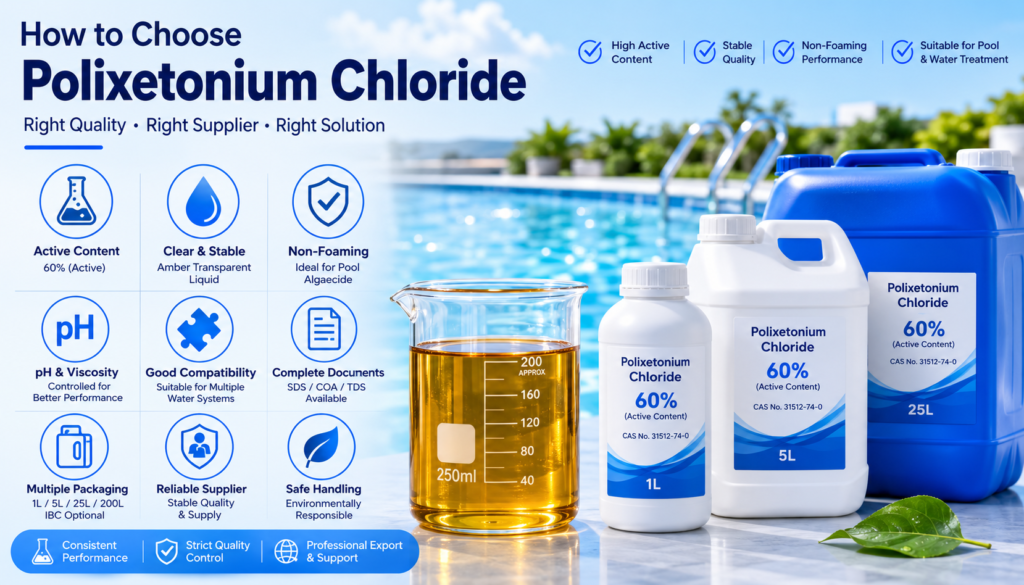
Choosing Polixetonium Chloride sounds easy at first. You ask for CAS No. 31512-74-0, check the price, compare two or three suppliers, and place the order.
Well… not quite.
If you’ve ever bought water treatment chemicals, pool algaecide raw materials, or industrial biocides, you already know the tiny details matter. A product can look right on paper but behave differently in real water systems. It may be too thin, too cloudy, poorly packed, unstable after storage, or simply not matched to your use case.
Polixetonium Chloride is commonly known as a cationic polymeric biocide and algaecide. Its chemical name is often listed as Poly[oxyethylene(dimethyliminio)ethylene(dimethyliminio)ethylene dichloride], and CAS No. 31512-74-0 is widely used for identification in SDS and product documents. Some SDS documents also describe it under synonyms such as Polyquaternium-42, Polixetonium Chloride, or WSCP.
So, how do you choose the right grade?
Let me explain.
First, What Are You Actually Buying?
Polixetonium Chloride is usually supplied as an aqueous liquid. In commercial pool and water treatment markets, 60% active formulations is common. Some pool algaecide SDS documents list 60% active Poly[oxyethylene(dimethyliminio)ethylene(dimethyliminio)ethylene dichloride] with CAS No. 31512-74-0.
That “60%” number matters. It affects dosage, cost per active ingredient, viscosity, labeling, shipping, and downstream formulation.
But here’s the catch: active content alone does not tell the whole story.
A good Polixetonium Chloride product should also have:
- Clear and consistent appearance
- Stable active content
- Suitable pH
- Controlled viscosity
- Good water solubility
- Low or non-foaming performance
- Reliable batch-to-batch quality
- Proper SDS, COA, and transport information
Sounds basic? It is. But basic things are where many sourcing mistakes hide.
Start with the Application, Not the Price
Before comparing offers, ask one simple question:
What will this Polixetonium Chloride be used for?
That question changes everything.
For swimming pool algaecide, buyers usually care about non-foaming behavior, clear appearance, compatibility with chlorine or bromine systems, and consumer-friendly dilution. Some retail algaecide products promote 60% algaecide formulas as non-foaming and compatible with chlorine and bromine.
For industrial water treatment, the focus may shift toward microbial control, dosage efficiency, environmental handling, and system compatibility.
For metalworking fluids, buyers may care about bacterial control in water-based cutting fluids, compatibility with amines, borates, phosphates, nitrates, and nonionic surfactant systems. Historic product literature for Polixetonium Chloride-type products has described use in preserving water-based synthetic metalworking fluids, while noting limits in systems with anionic surfactants.
See the difference?
Same chemical family. Different buying logic.
Check the Active Content Carefully
Most buyers begin with active content, and they should.
For a concentrated grade, Polixetonium Chloride 60% is often the target. If you are buying it as a raw material for pool algaecide blending, this concentration can help reduce freight cost per unit of active ingredient.
But don’t just read the number on the quotation.
Ask for:
- COA from recent batches
- Test method used for active content
- Typical active range, not only one perfect value
- Batch history if available
- Retest data after storage
A serious supplier should not hesitate here.
If a supplier says “about 60%” but cannot provide a COA, that’s a yellow flag. Maybe not a disaster, but definitely a pause-and-check moment.
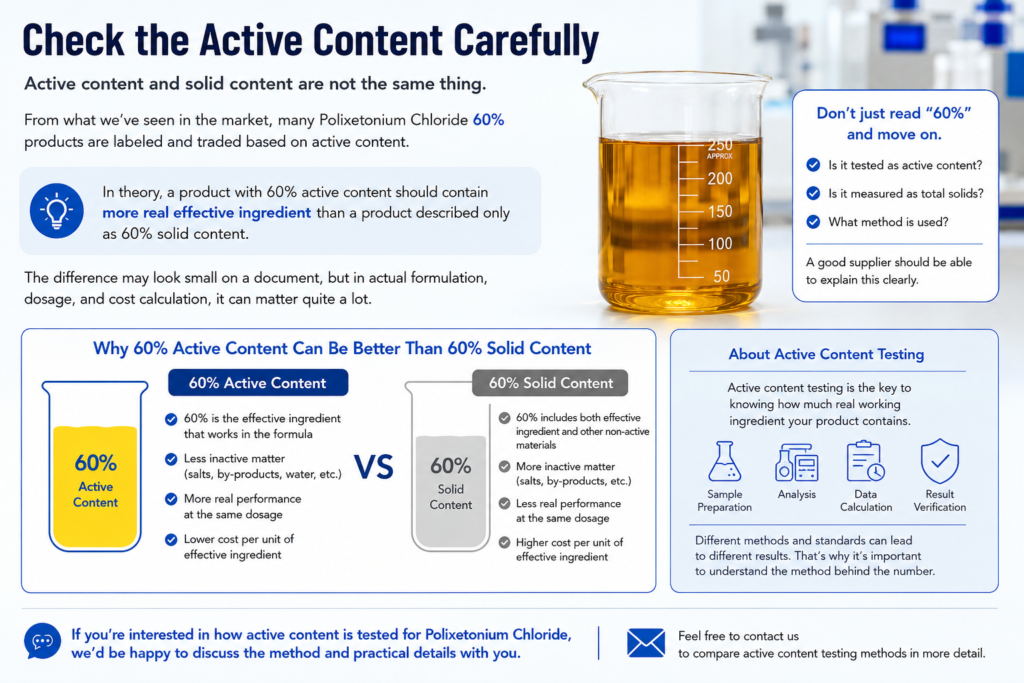
One more detail is worth slowing down for: “active content” and “solid content” are not always the same thing.
From what we’ve seen in the market, many Polixetonium Chloride 60% products are labeled and traded based on Solid Content. This is important because, in theory, a product with 60% active content should contain more real effective ingredient than a product described only as 60% solid content. The difference may look small on a document, but in actual formulation, dosage, and cost calculation, it can matter quite a lot.
So don’t just read “60%” and move on. Ask what the number really means. Is it tested as active content? Is it measured as total solids? What method is used? A good supplier should be able to explain this clearly, not dance around it.
If you’re interested in how active content is tested for Polixetonium Chloride, we’d be happy to discuss the method and practical details with you.
Appearance: Clear Liquid Is Not Just Cosmetic
For many buyers, appearance feels secondary. It shouldn’t.
Polixetonium Chloride is often expected to be a clear liquid. Depending on grade and production process, the color may range from amber to dark brown. Describing it as an amber, transparent, viscous liquid can be suitable when it matches your actual product specification.
Why does this matter?
Because cloudy liquid, sediment, floating particles, or obvious color drift may suggest poor filtration, contamination, unstable raw materials, or storage issues.
A little color difference between batches may be acceptable. A dramatic change is not.
Ask your supplier for real photos under natural light. Even better, ask for a sample before bulk purchase. A 100 ml or 500 ml sample can save you from a very expensive headache.
Viscosity: The Quiet Detail Buyers Forget
Viscosity is not just a lab number. It affects pumping, filling, dilution, and user experience.
If the product is too thin, buyers may suspect lower solids or different formulation. If it is too thick, filling lines may slow down, especially in winter. For private-label pool chemical filling, viscosity affects how the liquid pours into 1 L bottles, 5 L jerrycans, or 25 L drums.
You know that awkward moment when a liquid refuses to flow cleanly through a small filling nozzle? Nobody enjoys that.
So ask for a viscosity range, test temperature, and whether viscosity changes after long storage.
pH: Small Number, Big Clue
pH is another simple but useful quality signal.
Polixetonium Chloride products are usually supplied in water, and pH can affect compatibility with downstream formulas. A stable pH range also shows process control.
When comparing suppliers, don’t only ask “what is the pH?” Ask:
- Is this pH tested directly or as a diluted solution?
- What is the typical range?
- Does pH drift after 3–6 months?
- Can the supplier provide historical batch data?
Not every customer needs deep technical data. But if you are building a serious B2B supply chain, this kind of question separates casual sellers from real manufacturers.
Non-Foaming Performance: Very Important for Pool Use
For swimming pool applications, non-foaming performance is a major selling point.
Why?
Because pool owners hate foam. Foam makes water look cheap, dirty, and over-treated. Even when water is chemically safe, foam creates a bad impression. It’s like serving clean water in a dusty glass; technically fine, emotionally wrong.
That’s why many polyquat-style algaecides are promoted as non-foaming. For pool products, this benefit helps position Polixetonium Chloride against foaming quaternary ammonium compounds.
If your target customers are pool chemical brands, distributors, or private-label buyers, test foam behavior in real conditions. Don’t rely on a slogan.
A practical test can include:
- Dilution in tap water
- Shaking test
- Circulation test
- Compatibility test with chlorine
- Visual observation after 24 hours
Simple? Yes. Useful? Very.
Compatibility: Don’t Skip This Part
Polixetonium Chloride is cationic. That means it carries a positive charge in water.
This is part of why it works well in many water treatment systems. But it also means compatibility matters. Cationic polymers may not work well with strongly anionic ingredients. In some formulations, they can form haze, precipitate, or lose performance.
So before you blend it with other materials, test compatibility with:
- Surfactants
- Clarifiers
- Chelating agents
- Copper salts
- Dyes
- Fragrances
- Preservatives
- Other algaecide ingredients
- Chlorine or bromine treatment systems
For industrial applications, check compatibility with system chemistry, including corrosion inhibitors, dispersants, scale inhibitors, and process contaminants.
A jar test is cheap. A failed container shipment is not.
Regulatory Use: Know Your Market
Polixetonium Chloride has recognized use as an algaecide and antimicrobial active in certain regulated markets. A U.S. EPA draft document describes Polixetonium Chloride as used as an algaecide, bacteriostat, fungicide, microbiocide/microbiostat, and molluscicide.
That sounds powerful, right?
But it also means regulatory requirements may apply when selling finished biocidal or pesticidal products in certain countries.
For example, selling a finished pool algaecide in the U.S. may involve EPA registration requirements. Selling the same chemical as an industrial raw material to a qualified formulator may follow a different path.
So, don’t treat all markets the same.
Ask:
- Is the product sold as a raw material or finished algaecide?
- Which country will receive the product?
- Who is responsible for registration?
- Will the buyer repackage or relabel it?
- Are private-label claims allowed in that market?
This is where many small importers get surprised. The chemistry is only half the story. The label claim can be the bigger issue.
Packaging: Match It to the Buyer
Good packaging is not decoration. It protects quality and helps customers use the product smoothly.
Common packaging options may include:
- 1 L HDPE bottle for retail or sample use
- 5 L jerrycan for small commercial customers
- 25 L stackable jerrycan for distributors
- 200 L plastic drum for industrial buyers
- 1000 L IBC tote for bulk users
For Polixetonium Chloride, HDPE packaging is commonly preferred because it is practical, strong, and chemical-resistant for many aqueous formulations.
When choosing a supplier, check:
- Is the drum new or recycled?
- Is the cap sealed properly?
- Is pallet wrapping strong enough?
- Can the supplier support private labels?
- Can they provide small trial packaging?
- Are labels compliant with destination rules?
A beautiful formula in weak packaging is still a bad shipment.
Ask for a Sample, Then Test It Like a Buyer
A sample is not just for appearance. Treat it like a mini audit.
Test:
- Appearance
- Odor
- pH
- Viscosity
- Active content if possible
- Dilution clarity
- Foam behavior
- Storage stability
- Compatibility with your formula
- Performance in target water
If you are buying for pool use, test in real pool water when possible. If you are buying for industrial systems, test with actual process water. Lab-grade deionized water can hide problems that show up later in the field.
Water is messy. Real water is even messier.
Supplier Reliability: The Boring Part That Saves You
A good Polixetonium Chloride supplier should offer more than a price.
Look for:
- Stable production experience
- Clear product specification
- Fast document response
- Batch traceability
- Export experience
- Packaging flexibility
- Honest discussion about limitations
- Technical support for formulation questions
Be cautious if a supplier promises everything: any concentration, any label claim, any certification, any market, no problem.
In chemicals, “no problem” can sometimes mean “we haven’t checked.”
Common Mistakes When Choosing Polixetonium Chloride
Here are the mistakes buyers make again and again.
First, buying only by CAS number. CAS No. 31512-74-0 helps identify the substance, but it does not prove concentration, purity, stability, or application fit.
Second, ignoring actual active content. A 60% label needs verification.
Third, skipping compatibility tests. Cationic polymers can behave badly with some anionic systems.
Fourth, forgetting regulatory claims. Calling a product an algaecide, biocide, fungicide, or disinfectant may trigger local rules.
Fifth, accepting poor documents. SDS, COA, and TDS should be clear, current, and consistent.
Sixth, choosing the cheapest offer without checking packaging. Leakage, deformation, and label errors can destroy savings fast.
A Simple Buying Checklist
Before confirming a Polixetonium Chloride order, check these points:
- CAS No.: 31512-74-0
- Chemical name and synonyms match your target
- Active content confirmed by COA
- Appearance matches specification
- pH range is suitable
- Viscosity is controlled
- Product is water-soluble
- Foam behavior matches application
- SDS and transport details are available
- Sample has passed your test
- Packaging is suitable for your market
- Supplier can support repeat orders
- Regulatory responsibility is clear
Not fancy. Just practical.
So, What Makes a “Good” Polixetonium Chloride?
A good Polixetonium Chloride is not only high active content. It is the right balance of concentration, clarity, viscosity, stability, compatibility, documentation, and supply reliability.
For pool chemical buyers, the product should support clean, clear, non-foaming algaecide formulas.
For industrial water treatment buyers, it should be stable, consistent, and suitable for microbial control programs.
For private-label brands, it should come with reliable packaging options and clean documentation.
And for importers? It should arrive safely, match the COA, and perform the same way every time.
That’s the real test.
FAQ
1. What is Polixetonium Chloride used for?
Polixetonium Chloride is used in pool algaecide, water treatment, and some industrial microbial control applications. It is commonly associated with algae control, microbiostatic performance, and non-foaming pool treatment formulas.
2. How do I choose Polixetonium Chloride 60% liquid?
Choose Polixetonium Chloride 60% liquid by checking active content, appearance, pH, viscosity, foam behavior, SDS, COA, packaging, and compatibility with your final formula or water system.
3. Is Polixetonium Chloride non-foaming?
Polixetonium Chloride-based pool algaecides are often promoted as non-foaming. Still, buyers should test foam behavior in real water conditions before using it in finished pool products.
4. What documents should a Polixetonium Chloride supplier provide?
A reliable supplier should provide SDS, COA, TDS, packaging details, shelf-life information, and transport classification. For regulated markets, buyers may also need registration-related support.
5. Can Polixetonium Chloride be used for private-label pool algaecide?
Yes, it can be used as a raw material for private-label pool algaecide formulas, but the final product must meet local regulatory, labeling, packaging, and performance requirements in the target market.