
GET IN TOUCH
Ask For Sample?
Polixetonium Chloride vs Oxidizing Traditional Solutions: Which Water Treatment Option Delivers Better Long-Term Performance?
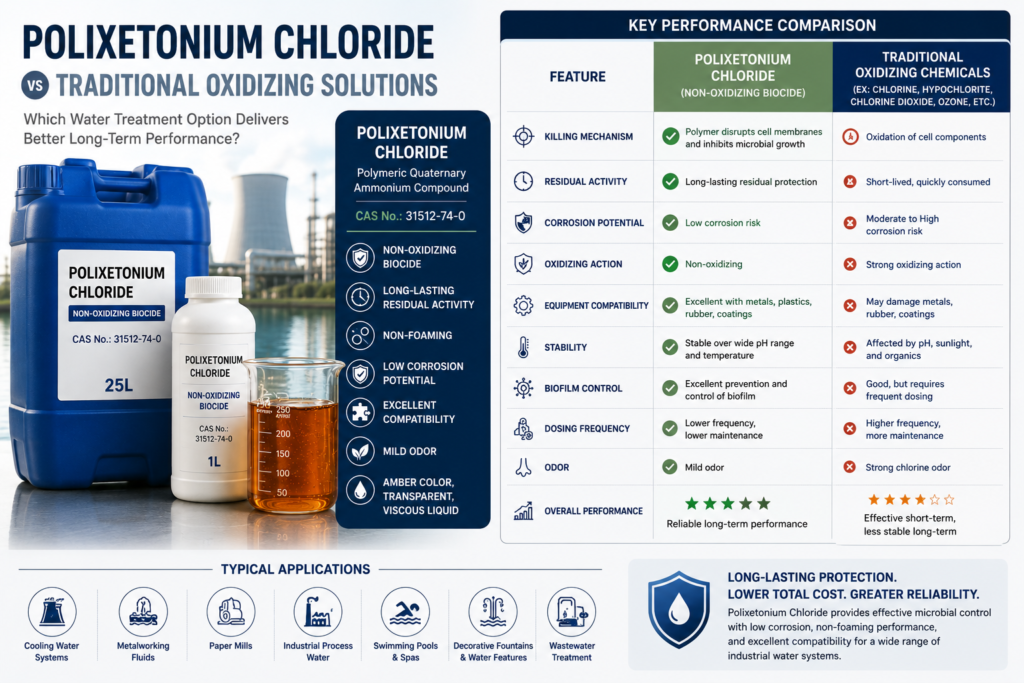
Water treatment has changed a lot over the past few decades. Facilities no longer focus only on killing algae or bacteria—they also care about operating costs, equipment protection, environmental impact, and system stability.
That raises an important question:
Should you continue using traditional biocides, or is Polixetonium Chloride the better choice?
The answer isn’t always black and white.
Traditional oxidizing chemicals still have their place. They work quickly and are often inexpensive. However, they also come with several drawbacks, including corrosion, short residual activity, strong odors, and higher maintenance requirements.
Polixetonium Chloride offers a different approach. As a non-oxidizing polymeric biocide, it provides long-lasting microbial control with low foaming and excellent material compatibility, making it increasingly popular in industrial water treatment and specialty applications.
Let’s compare both options in detail.
What Is Polixetonium Chloride?
Polixetonium Chloride is a polymeric quaternary ammonium compound widely used as a non-oxidizing biocide.
It controls:
- Algae
- Gram-positive bacteria
- Gram-negative bacteria
- Slime-forming microorganisms
- Some fungi
Unlike oxidizing disinfectants, it works primarily by disrupting microbial cell membranes through its positively charged polymer chains. Once attached to negatively charged microorganisms, the polymer damages the cell membrane, causing leakage of cellular contents and eventual cell death.
Because of this mechanism, Polixetonium Chloride provides effective microbial control without oxidation.
Typical applications include:
- Cooling water systems
- Decorative fountains
- Industrial process water
- Paper mills
- Metalworking fluids
- Swimming pools
- Wastewater treatment
What Are Traditional Water Treatment Solutions?
Traditional microbial control products generally fall into two categories.
Oxidizing Biocides
These include:
- Chlorine
- Bromine
- Sodium hypochlorite
- Calcium hypochlorite
- Chlorine dioxide
- Ozone
They destroy microorganisms through oxidation and usually provide very rapid disinfection.
Conventional Non-Oxidizing Biocides
Examples include:
- Isothiazolinones
- Glutaraldehyde
- DBNPA
- Bronopol
- THPS
These chemicals attack microbial proteins or metabolic processes.
Each product has strengths, but each also comes with limitations depending on the operating conditions.
Polixetonium Chloride belongs to a different subgroup of non-oxidizing biocides. As a polymeric quaternary ammonium compound, it offers long-lasting residual activity, low foaming, and excellent material compatibility, distinguishing it from many conventional non-oxidizing biocides.
Side-by-Side Comparison
| Feature | Polixetonium Chloride | Traditional Oxidizing Chemicals |
|---|---|---|
| Killing mechanism | Polymer membrane disruption | Oxidation |
| Residual protection | Long-lasting | Usually short |
| Corrosion | Low | Moderate to high |
| Odor | Mild | Often strong chlorine odor |
| Stability | Good over wide pH range | Sensitive to pH and sunlight |
| Equipment compatibility | Excellent | Can attack metals and rubber |
| Worker handling | Easier | Requires stronger safety precautions |
| Biofilm control | Good | Often limited without repeated dosing |
1. Longer Residual Protection
One of the biggest differences is how long the treatment continues working.
Traditional oxidizers react immediately.
That’s great for rapid disinfection—but they are also consumed quickly.
Once chlorine reacts with contaminants, very little active ingredient remains.
Polixetonium Chloride behaves differently.
Its polymer chains remain adsorbed on system surfaces and continue suppressing microbial growth after application.
That means:
- fewer dosing cycles
- more stable water quality
- reduced maintenance
For continuously operating systems, this longer residual activity can significantly improve efficiency.
2. Lower Corrosion Risk
Oxidizing chemicals don’t just attack microorganisms.
They also attack metals.
Over time they may contribute to:
- pitting corrosion
- heat exchanger damage
- pump wear
- seal degradation
- shortened equipment life
Polixetonium Chloride is non-oxidizing.
Because it doesn’t rely on oxidation, it is generally much gentler on:
- stainless steel
- plastics
- PVC
- fiberglass
- rubber components
This makes it attractive for facilities that want to extend equipment service life.
3. Better Biofilm Control
Anyone who has operated a cooling tower knows that biofilm can be incredibly stubborn.
Once microorganisms establish a protective slime layer, oxidizers often struggle to penetrate deeply.
Polixetonium Chloride helps prevent biofilm formation by interfering with microbial attachment and growth.
Instead of only killing free-floating bacteria, it also helps reduce the establishment of slime-producing microorganisms.
This leads to:
- cleaner surfaces
- better heat transfer
- lower energy consumption
- improved system efficiency
4. Excellent Compatibility
Industrial water systems often contain multiple treatment chemicals.
Compatibility becomes critical.
Polixetonium Chloride is commonly compatible with many treatment programs, including:
- scale inhibitors
- corrosion inhibitors
- dispersants
- antifoams
- various polymer-based additives
This flexibility allows treatment programs to be optimized without major formulation changes.
5. Non-Foaming Performance
Foam creates operational headaches.
Overflow.
Poor circulation.
Sensor interference.
Maintenance downtime.
Many traditional quaternary ammonium compounds generate significant foam.
Polixetonium Chloride is designed to provide non-foaming performance under typical use conditions, making it suitable for systems where foam control is important.
6. Reduced Odor
Anyone who has walked into a heavily chlorinated facility knows the smell immediately.
While chlorine odors are familiar, they can create uncomfortable working conditions.
Polixetonium Chloride has a much milder odor profile, improving operator comfort in enclosed environments.
7. More Stable Across Operating Conditions
Traditional oxidizers are affected by several environmental factors.
For example:
- sunlight
- organic contamination
- pH changes
- temperature
Their effectiveness can fluctuate significantly.
Polixetonium Chloride generally maintains stable antimicrobial performance across a broad operating pH range and is not consumed through oxidation reactions in the same way as chlorine-based products.
Why More Industrial Users Are Switching
You know what’s interesting?
Many facilities are no longer looking only at chemical purchase price.
Instead, they evaluate the total operating cost.
That includes:
- labor
- maintenance
- corrosion repair
- equipment replacement
- downtime
- chemical consumption
Although Polixetonium Chloride may have a higher upfront cost than some commodity oxidizing biocides, its longer residual activity, lower corrosion potential, and reduced maintenance can lower overall lifecycle costs in suitable applications.
That’s why it has gained acceptance in many industrial water treatment programs.
When Traditional Solutions Still Make Sense
This comparison doesn’t mean traditional products are obsolete.
Far from it.
Traditional oxidizing biocides remain an excellent choice when:
- rapid shock disinfection is required
- drinking water regulations specify approved oxidizing disinfectants
- very low initial chemical cost is the primary concern
- continuous residual protection is less important
Many facilities actually use both oxidizing and non-oxidizing biocides as part of an integrated treatment program to improve microbial control and help manage resistance.
Choosing the Right Solution for Your Application
The best treatment depends on your specific operating conditions.
Consider the following factors:
- Water chemistry
- System design
- Target microorganisms
- Required contact time
- Corrosion tolerance
- Environmental regulations
- Maintenance schedule
- Total operating cost
If your priority is long-term microbial control with minimal corrosion, non foaming, and reduced maintenance, Polixetonium Chloride may be a strong candidate.
If rapid oxidation is essential, traditional oxidizing biocides may still be the preferred option—or they may be used alongside a non-oxidizing product in a complementary treatment strategy.
Final Thoughts
There isn’t a single water treatment chemical that fits every application.
Traditional oxidizing chemicals are proven, widely available, and highly effective for rapid disinfection. Polixetonium Chloride, by contrast, offers a non-oxidizing approach that emphasizes residual microbial control, equipment compatibility, low foaming, and operational stability.
For many industrial systems, the most effective strategy is not choosing one over the other, but selecting—or combining—technologies based on system requirements, operating conditions, regulatory obligations, and long-term cost considerations.
FAQs
1. Is Polixetonium Chloride better than chlorine for every application?
No. Chlorine is highly effective for rapid disinfection and is required in many regulated drinking water and sanitation applications. Polixetonium Chloride is often preferred where long-lasting microbial control, low corrosion, and reduced foaming are priorities.
2. Can Polixetonium Chloride replace traditional oxidizing biocides?
In some industrial systems it can serve as the primary non-oxidizing biocide, but many treatment programs use it together with oxidizing biocides to achieve broader and more robust microbial control.
3. Does Polixetonium Chloride cause equipment corrosion?
Because it is a non-oxidizing polymeric biocide, it is generally less corrosive than chlorine-based oxidizing disinfectants when used as directed, making it suitable for systems containing metals, plastics, and elastomers.
4. Which industries commonly use Polixetonium Chloride?
It is widely used in industrial cooling water, metalworking fluids, paper manufacturing, decorative water features, swimming pools, and certain wastewater treatment applications where non-foaming, long-lasting microbial control is desired.
5. How do I choose between Polixetonium Chloride and traditional water treatment chemicals?
Evaluate the intended application, target microorganisms, required disinfection speed, equipment materials, water chemistry, regulatory requirements, and total lifecycle cost. Consulting a water treatment specialist and conducting on-site performance evaluations can help identify the most appropriate solution.