
GET IN TOUCH
Ask For Sample?
Common Problems Solved by Polixetonium Chloride
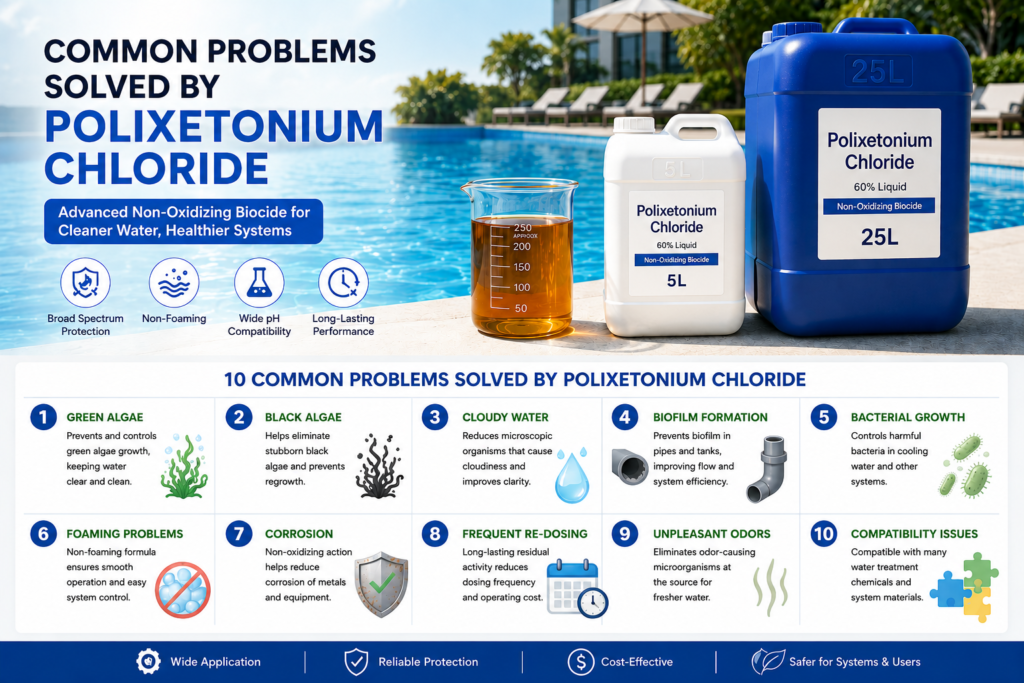
If you’ve ever dealt with algae-covered swimming pools, bacteria in industrial water systems, or unpleasant biofilm buildup, you already know one thing—these problems rarely disappear on their own.
Traditional oxidizing chemicals often solve one issue while creating another. They may increase corrosion, generate unpleasant odors, or lose effectiveness quickly. That’s exactly why many water treatment professionals have turned to Polixetonium Chloride, a polymeric quaternary ammonium compound known for broad-spectrum microbial control, long-lasting performance, and non-foaming characteristics.
So what kinds of real-world problems can it actually solve?
Let’s walk through the most common applications and why this polymer has become a trusted choice across swimming pools, cooling water systems, industrial processes, and specialty water treatment.
What Is Polixetonium Chloride?
Polixetonium Chloride is a polymeric cationic biocide designed to control algae, bacteria, fungi, and biofilm in aqueous systems.
Unlike oxidizing biocides such as chlorine or bromine, it works by interacting with microbial cell membranes. The positively charged polymer attaches to negatively charged microorganisms, disrupting their membrane integrity and eventually stopping their growth.
Because it remains stable over a wide pH range and produces virtually no foam, it is widely used in applications where water clarity, equipment protection, and operational stability are equally important.
Typical industries include:
- Swimming pool chemicals
- Industrial cooling water
- Decorative fountains
- Water recycling systems
- Metalworking fluids
- Industrial process water
You may find more details of Top 10 Applications of Polixetonium Chloride here.
1. Persistent Green Algae in Swimming Pools
This is probably the most familiar problem.
Even with regular chlorination, algae can appear after:
- Heavy rain
- High temperatures
- Increased swimmer load
- Poor circulation
- Inconsistent sanitizer levels
Green algae spread rapidly, turning clear water cloudy and slippery.
Polixetonium Chloride helps by preventing algae reproduction before visible blooms develop. Because it remains active longer than many conventional treatments, it provides continuous protection between maintenance cycles.
Benefits include:
- Clearer water
- Longer algae prevention
- Reduced chemical demand
- Better swimmer experience
2. Black Algae That Keeps Coming Back
Black algae are much harder to eliminate.
They develop protective layers that make ordinary sanitizers less effective. Pool owners often notice that black spots return shortly after cleaning.
Polixetonium Chloride penetrates microbial colonies more effectively than many traditional algaecides, making it an excellent component of a long-term algae management program.
Instead of simply treating symptoms, it helps reduce recurring infestations.
3. Cloudy Pool Water
Cloudy water isn’t always caused by suspended dirt.
Sometimes microscopic algae and bacterial growth create fine particles that reduce water clarity.
Since Polixetonium Chloride controls these microorganisms before they multiply, filtration systems can remove contaminants more efficiently.
The result is:
- Improved transparency
- Faster clarification
- Better filter performance
Many commercial pool operators appreciate this secondary benefit because appearance matters just as much as water chemistry.
4. Biofilm Formation Inside Pipes
Here’s something many people don’t see—but it causes expensive problems.
Biofilms form when bacteria attach to pipe walls and produce a protective layer.
Once established, biofilms can:
- Reduce heat transfer
- Restrict flow
- Protect harmful bacteria
- Increase maintenance costs
- Cause unpleasant odors
Polixetonium Chloride disrupts early-stage microbial attachment, helping prevent biofilm formation before it becomes difficult to remove.
For industrial facilities, prevention is usually much cheaper than mechanical cleaning.
5. Bacterial Growth in Cooling Water Systems
Cooling towers provide excellent conditions for microorganisms:
- Warm temperatures
- Continuous water circulation
- Nutrient availability
- Large surface areas
Unchecked bacterial growth can lower system efficiency and increase operating costs.
Because Polixetonium Chloride offers broad-spectrum antimicrobial activity while remaining non-oxidizing, it is commonly incorporated into industrial cooling water treatment programs.
Regular application helps maintain cleaner systems with fewer biological deposits.
6. Foaming Problems During Water Treatment
Foam may look harmless, but operationally it can become a headache.
Excessive foam can:
- Reduce pump efficiency
- Interfere with sensors
- Complicate chemical dosing
- Overflow treatment tanks
One major advantage of Polixetonium Chloride is its non-foaming nature.
Unlike certain surfactant-based biocides, it provides microbial control without generating excessive foam, making it suitable for automated industrial systems.
7. Corrosion Caused by Strong Oxidizing Chemicals
Many traditional disinfectants are highly oxidative.
While effective against microorganisms, they may also:
- Attack metal equipment
- Damage seals
- Shorten equipment lifespan
- Increase maintenance expenses
Polixetonium Chloride works through a different mechanism.
Since it is a non-oxidizing biocide, it delivers microbial control while generally being less aggressive toward many system materials when used appropriately.
This makes it particularly attractive for facilities seeking longer equipment service life.
8. Frequent Chemical Re-Dosing
Some water treatment chemicals disappear quickly after application.
That means:
- More labor
- Higher chemical consumption
- Increased operating costs
Polixetonium Chloride’s polymeric structure allows longer residual activity compared with many rapidly consumed oxidizing treatments.
For maintenance programs, this often translates into:
- Less frequent dosing
- More stable performance
- Lower operating costs
- Simplified maintenance schedules
9. Unpleasant Odors Caused by Microbial Growth
Musty smells often indicate active microbial contamination rather than poor ventilation.
Whether in decorative fountains, industrial tanks, or recycled water systems, bacteria can generate unpleasant odors as they multiply.
By reducing microbial populations, Polixetonium Chloride helps eliminate the source instead of simply masking the smell.
Cleaner water generally smells cleaner too.
10. Compatibility Challenges in Multi-Chemical Water Treatment Programs
Modern water treatment rarely relies on a single chemical.
Operators often combine:
- Scale inhibitors
- Corrosion inhibitors
- Flocculants
- Clarifiers
- pH adjusters
- Algaecides
Polixetonium Chloride is valued because it can be incorporated into many integrated treatment programs when compatibility has been properly evaluated.
Its flexibility makes formulation easier for manufacturers developing customized water treatment solutions.
Why Many Manufacturers Choose Polixetonium Chloride
There isn’t one perfect water treatment chemical for every situation.
However, Polixetonium Chloride offers an attractive balance of performance and practicality.
Key advantages include:
- Broad-spectrum antimicrobial activity
- Effective algae prevention
- Non-oxidizing action
- Non-foaming performance
- Wide pH compatibility
- Long residual activity
- Reduced maintenance frequency
- Suitable for various industrial and recreational water systems
These characteristics explain why it continues to gain popularity among formulators and distributors worldwide.
How to Select High-Quality Polixetonium Chloride
Not all products on the market perform equally.
When evaluating suppliers, consider:
- Stable active ingredient concentration
- Clear, uniform liquid appearance
- Consistent viscosity
- Reliable manufacturing quality control
- Batch-to-batch consistency
- Complete technical documentation
- Professional technical support
- Flexible packaging options for OEM or private label projects
Working with an experienced manufacturer can improve both product consistency and long-term supply reliability.
Final Thoughts
Microbial contamination causes far more than green water. It affects equipment efficiency, operating costs, maintenance frequency, water appearance, and even customer satisfaction.
Polixetonium Chloride addresses many of these challenges through a combination of broad-spectrum antimicrobial performance, long-lasting residual activity, and non-foaming operation. Whether you’re maintaining a commercial swimming pool, protecting an industrial cooling system, or developing a private-label water treatment product, it offers a dependable solution for keeping water cleaner and systems running more efficiently.
Rather than reacting after problems appear, many operators now use Polixetonium Chloride as part of a preventive maintenance strategy—and that shift often leads to lower costs and fewer surprises over time.
Frequently Asked Questions
1. What problems does Polixetonium Chloride solve in swimming pools?
It helps prevent green algae, black algae, cloudy water, bacterial growth, and biofilm formation while maintaining clear water with minimal foam.
2. Is Polixetonium Chloride a non-foaming algaecide?
Yes. One of its biggest advantages is its non-foaming performance, making it suitable for swimming pools, fountains, and industrial water systems.
3. Can Polixetonium Chloride replace chlorine?
No. It is typically used alongside chlorine or other sanitizers as a complementary non-oxidizing biocide to improve algae and microbial control.
4. Is Polixetonium Chloride suitable for industrial cooling water?
Yes. It is widely used to control bacteria, algae, and biofilm in cooling towers and circulating water systems while helping reduce biological fouling.
5. What should buyers look for when sourcing Polixetonium Chloride?
Choose suppliers that provide consistent active content, stable product quality, complete technical documentation, reliable packaging options, and responsive technical support.