
GET IN TOUCH
Ask For Sample?
Polyquat Algaecide vs Traditional Pool Algaecides: What’s the Difference?
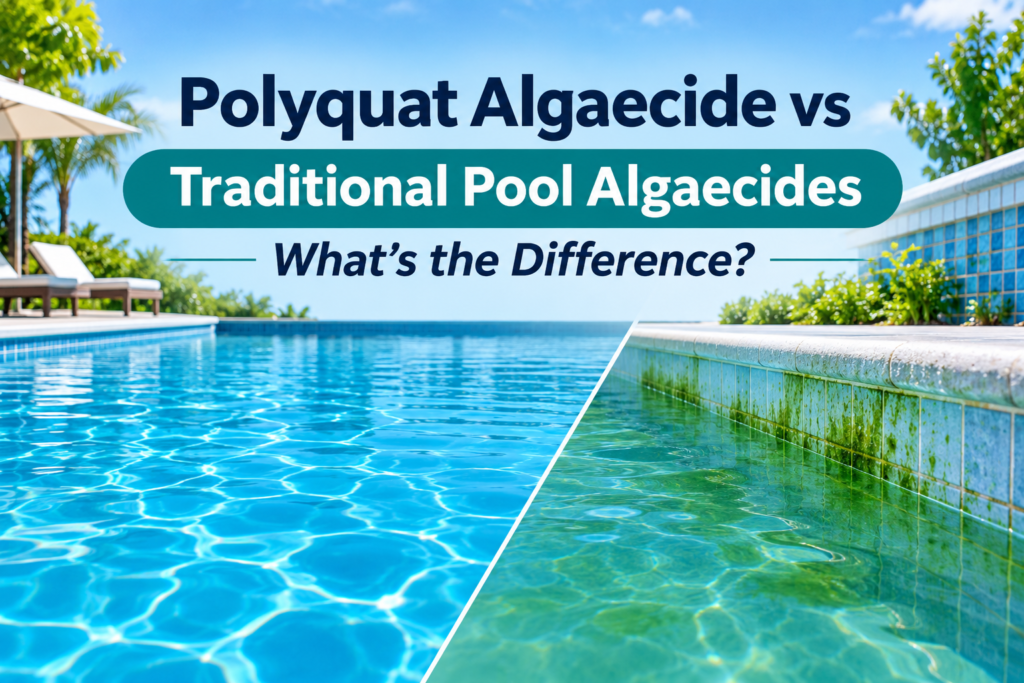
A clear, sparkling swimming pool looks inviting. But keeping it that way isn’t always easy. Algae can appear when chlorine levels drop, water circulation slows, or warm weather creates the right conditions for growth.
That’s why pool algaecides play an important role in pool maintenance.
Yet not all algaecides work the same way. Some contain copper compounds. Others use traditional quaternary ammonium chemicals, commonly called quats. Then there’s Polyquat Algaecide, a polymer-based solution known for its non-foaming performance and metal-free formulation.
So, what makes Polyquat different from traditional pool algaecides? Is it more effective? And is the higher purchase price worth it?
The answer depends on what your pool needs.
In this guide, we’ll compare Polyquat Algaecide with copper-based and traditional quat algaecides. We’ll look at how they work, their strengths and limits, and why pool service companies and chemical distributors often consider Polyquat 60 for premium pool care products.
What Is Polyquat Algaecide?
Polyquat Algaecide is a type of pool algae control product made from polymeric quaternary ammonium compounds.
That sounds a little technical, doesn’t it?
Here’s the simple version.
A polymer is a large molecule made from repeating chemical units. In Polyquat Algaecide, these units carry positive electrical charges that help the chemical interact with negatively charged surfaces on algae cells.
This interaction can damage the cells and interfere with their normal functions, helping control algae growth.
One widely used ingredient is Polixetonium Chloride (CAS No. 31512-74-0), also known as Polyquaternium-42 or Polyquat 60 in pool treatment applications.
A typical Polyquat 60 product contains approximately 60% active polymer.
Unlike copper-based algaecides, this formulation doesn’t rely on dissolved metal ions. And unlike traditional low-molecular-weight quats, Polyquat is designed to provide algae control without the foaming commonly associated with simple quaternary ammonium compounds.
According to the CDC’s Model Aquatic Health Code Annex, polymeric quats are recognized for their non-foaming and non-staining characteristics. cdc.gov+1
What makes Polyquat 60 different?
Its main characteristics include:
- Non-foaming performance: Suitable for pools with waterfalls, fountains, and other water features.
- Metal-free formulation: Does not add copper or other stain-forming metal ions.
- Non-oxidizing chemistry: Controls algae through a different mechanism from chlorine.
- Concentrated active ingredient: Commonly supplied as a 60% polymer formulation.
- Pool maintenance applications: Can support algae prevention, routine treatment, and seasonal pool care when used according to an approved label.
- Compatibility with chlorinated pools: Can be part of a chlorine-based maintenance program, although direct mixing with concentrated oxidizers must be avoided.
These features make Polyquat 60 attractive for pool owners who want algae control without extra concerns about foam or metal staining.
But how does it compare with the older alternatives?
What Are Traditional Pool Algaecides?
Before comparing performance, it’s worth understanding what the term traditional pool algaecides actually means.
There isn’t just one traditional formula.
Most conventional pool algaecides fall into two main groups: copper-based algaecides and simple quaternary ammonium algaecides.
Some products also combine multiple active ingredients.
Copper-based algaecides: Effective, but watch those stains
Copper-based algaecides use copper compounds to control algae growth.
Copper ions interfere with important biological processes inside algae cells. They can affect enzyme activity, cell membranes, and other functions needed for algae to survive.
These products have been used in swimming pools for many years.
One reason is simple: copper can be effective against several types of algae, including green and mustard algae.
Copper-based formulations also offer residual activity, meaning copper can remain in pool water after treatment.
However, that residual presence comes with a drawback.
When copper levels become excessive, or water chemistry isn’t well managed, copper may contribute to staining on pool surfaces.
You might notice greenish, blue, brown, or dark discoloration on plaster, tiles, or other surfaces. Copper can also contribute to hair discoloration under certain conditions.
Not every copper algaecide will cause staining. Proper dosing, water balance, and product formulation make a difference. Still, the possibility is something pool operators must consider.
Traditional quat algaecides: Affordable, but prone to foam
Traditional quat algaecides usually contain simple quaternary ammonium compounds.
Common examples include alkyl dimethyl benzyl ammonium chloride (ADBAC) and related compounds.
These chemicals act as cationic surfactants.
In plain English, they carry positive charges and can interact with algae cell membranes, helping disrupt cell function.
Traditional quats are often economical and can work well as supplemental algae-control products.
But there’s a catch.
Many simple quat formulations can produce foam, especially when too much product is added or the pool has strong water movement.
Imagine a hotel pool with decorative waterfalls. The maintenance team adds a conventional quat algaecide, and the next morning, foam appears around the water features.
The algae problem may be under control, but now the pool looks less appealing.
That’s one reason non-foaming polymeric algaecides have become a useful alternative.
Polyquat vs Traditional Algaecides: A Side-by-Side Comparison
The differences become clearer when you compare the main product characteristics.
| Feature | Polyquat 60 | Copper-Based | Traditional Quat |
|---|---|---|---|
| Active chemistry | Cationic polymer | Copper compounds | Simple quaternary ammonium |
| Foam formation | Non-foaming | Generally non-foaming | May foam |
| Metal staining risk | No added metal staining risk | Possible | No added metal staining risk |
| Algae prevention | Yes | Yes | Yes |
| Corrective algae treatment | Label-dependent | Label-dependent | Label-dependent |
| Residual action | Formulation-dependent | Copper may persist | Formulation-dependent |
| Typical purchase cost | Higher | Varies | Often lower |
| Water features | Well suited | Suitable with metal monitoring | Foam may be a concern |
| Winter pool care | Common application | Product-dependent | Product-dependent |
Comparison reflects typical chemistry characteristics, not guaranteed performance of every commercial product. Actual results depend on concentration, water conditions, approved claims, and dosing.
The most important point?
Polyquat’s main advantage isn’t that every dose kills algae faster. It’s that it combines algae-control performance with non-foaming, metal-free chemistry.
That combination can be valuable when pool appearance and maintenance consistency matter.
How Does Polyquat Algaecide Work Compared with Traditional Products?
The chemistry behind each algaecide helps explain its performance.
Let’s start with Polyquat.
Polyquat uses positively charged polymer chains
Polyquat 60 contains long polymer chains with positively charged groups.
Algae cell surfaces often carry negative charges. This creates an attraction between the polymer and the algae.
When the polymer interacts with the cell surface, it can disrupt membrane function and interfere with normal biological activity.
The polymeric structure also gives Polyquat different physical properties from simple quat surfactants.
Most notably, Polyquat 60 does not produce the persistent foam associated with conventional quat algaecides.
This matters because pool water is constantly moving. Pumps, return jets, fountains, and waterfalls all create turbulence.
A product that controls algae without creating foam can make pool maintenance much easier.
Copper-based algaecides rely on metal ions
Copper works through a different mechanism.
Dissolved copper ions interfere with proteins, enzymes, and cellular processes that algae need to survive.
The effect can be useful against established algae growth, although results depend on the algae species, available copper concentration, and pool water conditions.
Copper’s behavior is also affected by pH and other water chemistry factors.
When conditions change, dissolved copper can form compounds that may deposit on pool surfaces.
That’s why copper-based algaecides require careful control of water balance and metal levels.
Traditional quats act more like surfactants
Simple quaternary ammonium compounds interact with cell membranes, disrupting their structure.
Their surfactant properties also explain why they can create foam.
Think about how soap behaves when water is stirred. Not all surfactants produce the same amount of foam, but many encourage bubbles to form and persist.
Traditional quat algaecides can behave in a similar way.
Polyquat compounds have different molecular structures and surface activity, allowing them to control algae without the same foaming behavior.
Why Is Non-Foaming Performance So Important?
Foam might seem like a minor issue. After all, isn’t algae the real problem?
Not always.
For a private backyard pool, a little foam may be inconvenient. For a luxury resort or commercial swimming pool, it can become a visible maintenance problem.
Guests expect clean, inviting water.
Foam around pool edges, return jets, or decorative fountains can make the water look poorly maintained—even when sanitizer levels are acceptable.
Polyquat 60 offers a practical advantage in these situations.
Its non-foaming properties make it suitable for pools with strong circulation and water features.
Consider three common applications.
Hotel swimming pools: A hotel maintenance team needs to maintain water clarity and appearance without adding visible foam.
Water parks: Pools with slides, waterfalls, and high water movement can benefit from low-foaming algae-control products.
Residential pools with spas and fountains: Homeowners often want a simple maintenance program that doesn’t create extra cosmetic problems.
In each case, Polyquat can be a useful part of the treatment program.
Of course, non-foaming doesn’t mean a product can be added without limits. Correct dosing still matters.
Polyquat vs Copper Algaecide: Which Is Safer for Pool Surfaces?
One of Polyquat’s strongest selling points is its metal-free chemistry.
Copper-based algaecides introduce copper into pool water. If copper accumulates or water chemistry becomes unfavorable, staining can occur.
The risk may be more noticeable on certain pool finishes, including light-colored plaster.
Polyquat 60 doesn’t introduce copper, so it avoids the specific staining mechanism associated with copper deposition.
That doesn’t mean Polyquat can prevent every kind of pool stain.
Iron, manganese, calcium deposits, organic materials, and other contaminants can still cause discoloration.
However, removing copper from the algaecide formulation eliminates one potential source of metal-related problems.
For pool owners who have experienced copper staining before, that’s a meaningful difference.
It can also be important for pool service companies. A staining complaint may require extra visits, testing, and cleaning.
Using a metal-free algaecide helps reduce one category of avoidable maintenance risk.
Does Polyquat 60 Last Longer Than Traditional Algaecides?
This question deserves a careful answer.
Polyquat is often marketed as a long-lasting algae-control product. Its polymeric chemistry can make it useful for ongoing maintenance programs.
However, it isn’t accurate to claim that every Polyquat formulation lasts longer than every copper-based or conventional quat algaecide.
Several factors affect how long a treatment remains effective:
- Active ingredient concentration and applied dose
- Chlorine concentration and other oxidizing conditions
- Pool water temperature
- Organic contamination
- Filtration and water replacement
- Algae species and severity of growth
- Product formulation and approved application schedule
Copper-based algaecides may provide extended residual activity because copper can remain in the water.
Polyquat products may also provide ongoing algae control, but their effective treatment interval depends on the formulation and conditions.
A practical way to compare products is to examine the recommended maintenance schedule on each approved label.
For distributors, this is especially important.
A product with a higher active concentration may require a smaller volume per treatment, but the cost advantage must be calculated using the actual labeled dose.
The price per bottle tells only part of the story.
Is Polyquat More Effective Against Green, Yellow, and Black Algae?
Different algae problems require different treatment approaches.
Green algae is one of the most common problems in swimming pools. It can cause cloudy water, green discoloration, and slippery surfaces.
Yellow or mustard algae often appears as yellowish deposits on shaded pool surfaces.
Black algae is particularly troublesome because it can form persistent colonies on porous surfaces.
Polyquat 60 is used in products intended to control several types of pool algae. However, effectiveness against a particular algae type should be supported by the specific product’s approved claims and directions.
Here’s how the treatment approach may differ.
Green algae
For light algae growth or routine prevention, Polyquat can be a useful supplemental treatment.
But when a pool has a severe green algae bloom, restoring proper sanitizer levels, brushing surfaces, and maintaining filtration are essential.
Algaecide alone may not restore the pool.
Yellow or mustard algae
Mustard algae can return when contaminated equipment, poor circulation, or untreated surfaces allow it to persist.
Some copper-based algaecides are effective against mustard algae.
Polyquat products may also be suitable when their labels support that use.
The treatment program should address both the visible growth and the conditions allowing it to return.
Black algae
Black algae often requires physical brushing to disrupt protective surface layers and expose the growth to treatment chemicals.
Certain Polyquat 60 formulations are marketed for black algae control, but results depend on the product and treatment method.
A single chemical application is rarely a substitute for thorough cleaning and water management.
The CDC emphasizes that algaecide treatment should be paired with appropriate brushing and label-compliant application. cdc.gov+1
Can Polyquat Algaecide Replace Chlorine?
No. And this is one of the most important distinctions in pool care.
Polyquat Algaecide is designed to control algae. Chlorine-based sanitizers play a broader role in protecting pool water against harmful microorganisms.
Even if an algaecide helps keep water looking clear, that doesn’t mean the water is safe for swimming.
Clear water and properly sanitized water are not the same thing.
A pool can look beautiful while having inadequate disinfectant levels.
Polyquat should therefore be viewed as a supplemental algae-control product rather than a replacement for an approved sanitizer.
Can Polyquat be used with chlorine?
Yes, suitable Polyquat formulations can be used in properly managed chlorinated pools.
However, there is an important chemical distinction.
Polyquat is a non-oxidizing algaecide. Chlorine is an oxidizing sanitizer.
Strong oxidizing conditions can affect the polymer and may increase chlorine demand.
For this reason, concentrated Polyquat products should never be mixed directly with chlorine products or other pool chemicals.
Follow the registered product label for application timing, water circulation, and any restrictions involving shock treatment.
This approach helps maintain both algae control and sanitizer performance.
Why Is Polyquat 60 Popular for Winter Pool Closing?
Winter pool care is another application where Polyquat can offer value.
When a pool is closed for the season, water circulation may stop or become limited.
Debris, sunlight, and changing water conditions can create opportunities for algae growth.
In some regions, pools remain closed for several months.
A suitable winter algaecide helps support algae prevention during this period.
Polyquat 60 is commonly used in winter pool closing products because of its concentrated, non-foaming, and metal-free characteristics.
But winter protection isn’t guaranteed by a single chemical dose.
A successful closing program also depends on proper cleaning, balanced water, suitable sanitizer conditions, and a secure pool cover.
What about spring reopening?
Nobody enjoys removing a winter pool cover and finding green water underneath.
A well-maintained winter closing program may reduce the amount of cleanup needed when the pool reopens.
Polyquat-based winter algaecides can be part of that program.
For chemical distributors, winter algaecides also create a seasonal product opportunity.
The same underlying polymer chemistry may be used in different registered formulations for routine pool care and seasonal closing applications.
This makes Polyquat an interesting ingredient for brands developing a wider pool maintenance range.
Polyquat Algaecide vs Traditional Products: What About Cost?
Let’s talk about money.
Polyquat 60 often costs more per unit than conventional simple quat algaecides.
That can make traditional quats attractive for price-sensitive markets.
But comparing products by bottle price alone can be misleading.
A 60% active Polyquat formulation is not directly comparable with a 10% active conventional quat product.
Their chemistry, approved dosage, and performance characteristics differ.
For a fair comparison, buyers should consider:
- Cost per labeled treatment
- Number of treatments per container
- Maintenance frequency
- Potential foam-related service issues
- Metal staining risk
- Packaging and freight costs
- Customer expectations and market positioning
Imagine two pool care products.
One is inexpensive but can create foam if used incorrectly. The other costs more but is non-foaming and metal-free.
For a budget residential market, the first product may be acceptable.
For a premium resort pool, the second may provide better overall value.
Neither choice is automatically right for every customer.
The key is to compare the total treatment program, not just the chemical purchase price.
Why Pool Chemical Distributors Consider Polyquat 60?
For pool chemical distributors, product selection is about more than chemical performance.
It’s also about creating a product range that customers understand and trust.
Polyquat 60 offers several advantages for brands targeting professional pool maintenance and premium retail markets.
A clear product story
Customers don’t need a chemistry degree to understand the benefits of a non-foaming, metal-free algaecide.
These are practical features that address familiar pool maintenance concerns.
A distributor can explain the value without making exaggerated performance claims.
Flexible packaging opportunities
Polyquat 60 formulations can be supplied in different packaging formats to serve various markets.
1L BottlesRetail pool care
5L Jerry CansPool service companies
25L ContainersProfessional and bulk supply
Larger 200L drums and 1000L IBC containers can also support bulk supply requirements.
The packaging choice depends on the target customer, handling conditions, local regulations, and distribution model.
Private label development
For brands developing their own pool chemical lines, Polyquat 60 can serve as a core ingredient in a private label algaecide product.
Possible product categories include routine algae-control treatments and seasonal winter algaecides.
However, formulations, concentrations, labels, and marketing claims must meet the regulatory requirements of the destination market.
In the United States, products making algae-control claims generally require EPA pesticide registration. A raw ingredient’s identity or concentration does not automatically authorize the sale of a finished algaecide. npic.orst.edu+1
What Should Buyers Check Before Purchasing Polyquat 60?
For professional buyers, not all products labeled “Polyquat 60” should be treated as identical.
The first step is to confirm the actual active ingredient.
One commonly used ingredient is Polixetonium Chloride, CAS No. 31512-74-0.
A typical commercial grade is an amber, transparent, viscous liquid containing approximately 60% active material.
Important quality indicators may include active ingredient content, pH, density, viscosity, appearance, and batch consistency.
Buyers should request a technical data sheet, safety data sheet, and certificate of analysis.
They should also confirm the intended application and relevant registration status.
Is a 60% product always better than a diluted formulation?
Not necessarily.
A concentrated product may reduce the amount of packaging and water shipped per unit of active ingredient.
It can also provide flexibility for further formulation.
However, diluted products may be more convenient for retail customers who prefer smaller treatment quantities or simpler handling.
For private label buyers, concentration should reflect the target market and the approved product directions.
What about custom formulations?
Some manufacturers can offer different concentrations, packaging options, and appearance adjustments.
For example, a distributor may want a retail-ready formulation in a 1L bottle or a concentrated product for professional pool service companies.
Any changes to the formulation should be evaluated for stability, compatibility, safety, and regulatory requirements.
A change in color or concentration may also require review of the finished product registration.
How Eautrix Supports Polyquat 60 Buyers
For distributors and pool chemical brands interested in Polyquat-based products, Eautrix focuses on cationic polymer chemistry and specialty pool treatment solutions.
Its Eautrix Polyquat 60 product offering is based on Polixetonium Chloride (CAS No. 31512-74-0), commonly supplied as a concentrated amber liquid.
Potential supply arrangements include bulk polymer supply, different packaging formats, and private label formulation discussions.
For professional buyers, the most useful starting point is a clear technical specification and an understanding of the destination market’s regulatory requirements.
You can explore the Eautrix product range or contact info@eautrix.com to discuss product specifications, samples, packaging, and supply requirements.
Which Pool Algaecide Should You Choose?
There’s no single algaecide that’s perfect for every swimming pool.
Traditional quat algaecides remain useful where cost is a major concern and foam formation can be managed.
Copper-based products can provide effective algae control, but their use requires attention to metal levels and staining risks.
Polyquat 60 offers a different combination of benefits.
Its non-foaming, metal-free chemistry makes it particularly attractive for pools with water features, professional maintenance programs, and premium pool care products.
For distributors, it also provides a clear product identity that can support a differentiated pool chemical range.
Still, the right choice depends on the pool, water conditions, target customer, approved label, and overall treatment cost.
The best algaecide isn’t simply the strongest or most concentrated product. It’s the one that controls algae effectively while fitting the pool’s maintenance needs.
Frequently Asked Questions About Polyquat Algaecide
1. Is Polyquat 60 better than copper-based pool algaecide?
Polyquat 60 is often preferred when avoiding foam and copper-related staining is important. Copper-based algaecides can also be effective, particularly against certain algae types. The better choice depends on the pool surface, water chemistry, algae problem, and approved treatment directions.
2. Does Polyquat Algaecide cause foam in swimming pools?
Polyquat 60 is considered a non-foaming algaecide. Unlike traditional simple quat products, it does not normally create foam when applied according to its label. This makes it suitable for swimming pools with fountains, waterfalls, and strong water circulation.
3. Can Polyquat 60 Algaecide be used in chlorine pools?
Yes. Suitable Polyquat 60 products can be used as supplemental algae-control treatments in chlorinated pools. However, they should never be mixed directly with concentrated chlorine or other chemicals. Follow the approved label for treatment timing and application instructions.
4. Is Polyquat 60 suitable for winter pool closing?
Polyquat 60 is commonly used in winter pool algaecide formulations. Its non-foaming and metal-free properties make it useful for seasonal algae-control programs. Effective winter protection also requires proper pool cleaning, water balance, sanitizer management, and a suitable cover.
5. What should distributors look for in a Polyquat 60 Algaecide supplier?
Distributors should verify the active ingredient identity, concentration, product specifications, batch consistency, SDS, COA, and packaging options. Buyers developing private label products should also confirm formulation stability, labeling requirements, and pesticide registration obligations in their target markets.