
GET IN TOUCH
Ask For Sample?
Request a Quote for Private Label Polymer Pool Clarifier: A Complete Guide for Pool Brands and Distributors
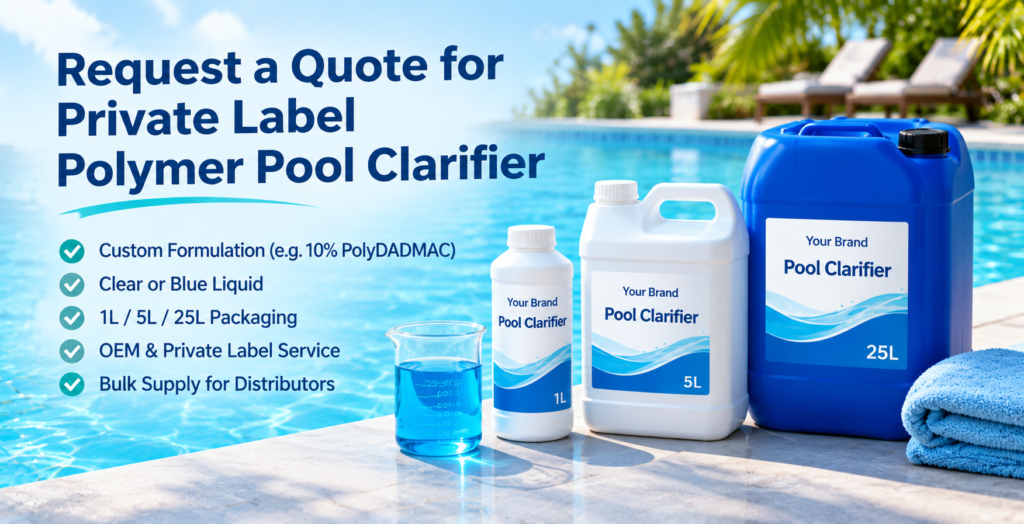
A great pool clarifier can make cloudy water look clear again. But for pool chemical brands and distributors, finding the right product is only half the job. You also need the right formula, packaging, label design, price, and supply partner.
That’s where a well-prepared quotation request makes all the difference.
If you’re planning to launch a private label polymer pool clarifier, you may have a few questions. How much will it cost? Can you customize the concentration? Which packaging size works for your market? And what details should you send to a manufacturer to get an accurate quote?
This guide walks you through the process, from choosing a PolyDADMAC-based formula to comparing quotations and preparing your first bulk order.
Whether you’re building a new pool care brand or adding a clarifier to an existing product range, you’ll learn how to request a quote that reflects your actual business needs.
Why Request a Custom Quote Instead of Buying a Standard Clarifier?
Not every pool market needs the same clarifier.
A retail brand selling 1L bottles to homeowners has different needs from a commercial pool service company buying 25L drums. A distributor serving tropical regions may also have different storage, packaging, and product positioning needs from one selling to seasonal pool markets.
That’s why a single price per liter rarely tells the full story.
When you request a custom quotation, you can discuss the details that affect both product performance and your business costs.
These may include:
- Polymer concentration and formulation requirements
- Clear or blue liquid appearance
- Bottle, jerrycan, or drum packaging
- Private label artwork and printing
- Expected order quantity
- Destination port and shipping terms
- Product testing and documentation requirements
A custom quote helps you compare the actual cost of getting a finished product into your market—not just the factory price of the liquid.
For example, two suppliers may offer the same price per kilogram. Yet one quotation may cover bulk liquid in industrial containers, while another includes filled retail bottles and custom labels.
Those are two very different offers.
The key is to define what you’re buying before comparing prices.
What Is a Private Label Polymer Pool Clarifier?
A private label polymer pool clarifier is a water treatment product manufactured for sale under another company’s brand.
Instead of building your own chemical production facility, you work with a manufacturer to develop or supply a suitable formula. The manufacturer can then fill the product into your preferred packaging and apply your brand label, subject to the agreed manufacturing services.
For pool chemical distributors, this model can reduce the work involved in launching a new product.
One common active ingredient is PolyDADMAC, short for polydiallyldimethylammonium chloride.
PolyDADMAC-based pool clarifier
CAS No. 26062-79-3
PolyDADMAC is a cationic polymer used in water treatment. Its positively charged polymer chains help bring certain fine suspended particles together, making them easier for a suitable pool filtration system to capture.
This process is known as coagulation and flocculation. In plain language, it helps tiny particles form larger groups that filters can remove more easily.
Pool water may look cloudy because of fine dust, organic debris, dead algae, or other suspended material. A properly formulated clarifier can help address some of these particles when used with suitable water chemistry and filtration.
However, a clarifier is not a disinfectant. It doesn’t replace chlorine, proper filtration, or routine pool maintenance.
Why PolyDADMAC appeals to private label brands
PolyDADMAC-based formulations offer several commercial advantages.
They can be supplied as liquid products, allowing convenient filling into retail and professional packaging. Formulations can also be developed with different polymer concentrations and appearances.
For example, Eautrix’s Polymer Pool Clarifier product concept includes a 10% PolyDADMAC formulation, with a clear or customized blue appearance.
The actual finished formula, dosing instructions, and filtration compatibility should be confirmed through product testing.
This gives brands room to build a product that fits their market rather than relying on a generic presentation.
What Information Should You Include in Your Quotation Request?
Here’s a simple rule: the more useful information you provide, the more relevant your quotation can be.
You don’t need to know every technical detail. A good manufacturer can help you work through the options.
Still, several details are worth preparing before sending your inquiry.
1. Your target market
Start with the country or region where you plan to sell the product.
This matters because local markets can have different expectations for packaging, language, labeling, and chemical regulations.
For example, a product intended for the European Union may face different regulatory obligations from one intended for Southeast Asia, the Middle East, or Africa.
Tell your supplier whether you’re selling to homeowners, pool maintenance professionals, commercial facilities, or distributors.
That information helps define the most suitable product format.
2. Preferred formula and concentration
If you already know your desired formula, include it.
You might request a 10% PolyDADMAC-based pool clarifier or ask the supplier to recommend a concentration for your intended application.
One important detail: 10% finished product concentration and 10% active polymer concentration are not always the same thing.
Ask the supplier to state clearly whether the percentage refers to active polymer, supplied raw material, or another formulation basis.
This prevents confusion when comparing quotations from different manufacturers.
3. Packaging size
Packaging affects much more than appearance. It also influences filling costs, shipping efficiency, storage, and customer convenience.
For many private label pool clarifier projects, 1L, 5L, and 25L containers are practical starting points.
4. Estimated order quantity
Tell the supplier how many bottles, cartons, or kilograms you expect to purchase.
If you’re testing a new market, explain that you’re considering a trial order followed by larger purchases.
You can also request separate prices for several order quantities.
This helps you understand how unit costs may change as your business grows.
5. Branding and label requirements
Do you already have a brand name and finished label artwork?
Or would you like the manufacturer to help prepare the packaging layout?
Mention your preferred label language, bottle color, label material, and any special printing requirements.
Keep in mind that the final label must comply with the laws of the destination market. A private label design should never omit required safety or product information.
6. Delivery destination and trade terms
Include your destination country, port, or delivery address.
You can request quotations under trade terms such as EXW, FOB, CIF, or other agreed Incoterms.
For international buyers, the shipping term can have a major effect on the total landed cost.
A clear request saves both sides time and avoids repeated email exchanges.
Choosing the Right Packaging for Your Private Label Clarifier
Packaging is one of the first things customers notice. It also plays a major role in the cost of your finished product.
A bottle that looks attractive on a retail shelf may not be the most practical choice for a professional pool service company.
So, which packaging size should you request?
1L Bottles — Retail and Homeowners
Suitable for pool shops, online retailers, and homeowners who want a convenient product for routine pool care. Private label printing can help create a recognizable retail identity.
5L Jerrycans — Pool Service Professionals
A practical choice for maintenance companies handling multiple swimming pools. Larger containers can reduce packaging use per liter compared with smaller bottles.
25L Containers — Commercial and Distributor Markets
Suitable for commercial users and distributors who need larger quantities. These containers may offer lower packaging costs per unit of liquid, although handling and storage requirements should be considered.
Larger industrial packaging, such as 200L drums or 1000L IBCs, may also be considered for bulk liquid supply, subject to the supplier’s filling capability and transport requirements.
When requesting your quotation, ask whether the supplier can provide several packaging options in the same shipment.
For example, you might want 1L bottles for retail stores and 5L containers for professional customers.
Combining formats could help you serve more than one market segment with a single product line. The feasibility and cost will depend on production quantities and packaging availability.
Clear or Blue Polymer Pool Clarifier: Does Color Affect Your Quote?
Color may seem like a small detail. But in pool care retail, appearance can influence how customers perceive a product.
Clear liquids can communicate simplicity and technical purity. Blue liquids often fit the visual identity of swimming pool maintenance products.
Neither appearance automatically means better performance.
For a PolyDADMAC-based clarifier, the color is a formulation and branding choice. The polymer’s concentration, quality, and compatibility with the finished formula matter far more than the shade.
What should you ask for?
If you’re developing a private label clarifier, request information about:
- Clear or blue liquid options
- Color consistency between production batches
- Dye compatibility with the polymer formula
- Appearance stability during storage
- Packaging compatibility and possible staining concerns
A suitable dye must be tested to ensure it doesn’t interfere with the product’s intended use or create unwanted effects in pool water.
If you’re unsure which appearance fits your brand, ask for samples of both versions.
That small comparison may save you from changing packaging or product presentation after launch.
How Does Polymer Concentration Affect Private Label Clarifier Pricing?
The concentration of active polymer is one of the main factors that can influence the cost of a clarifier formula.
A higher active concentration generally requires more polymer raw material per kilogram of finished product.
But here’s the catch: a more concentrated product isn’t automatically the better deal.
The right concentration depends on how the product will be used, the dose required, and the performance of the finished formulation.
Consider two hypothetical products:
| Product | Active polymer concentration | Active polymer in 1 kg |
|---|---|---|
| Formula A | 5% | 50 g |
| Formula B | 10% | 100 g |
Formula B contains twice as much active polymer per kilogram. That doesn’t prove it will deliver twice the clarification performance.
Polymer molecular weight, charge characteristics, water conditions, and the filtration system can all influence results.
This is why comparing products only by concentration can be misleading.
Ask for a clear technical specification
Before accepting a quotation, request the relevant specifications, which may include active polymer content, appearance, pH, viscosity, density, and storage stability.
The supplier should explain the testing methods used and identify which values are controlled product specifications.
For customized formulations, specifications may need to be agreed after sample testing.
A well-defined specification gives both parties a clearer basis for quality control and future orders.
What Determines the Price of a Private Label Polymer Pool Clarifier?
A finished private label clarifier involves several cost components.
Understanding them helps you evaluate quotations and avoid surprises after placing an order.
Illustrative quotation cost structure
These are cost categories, not actual Eautrix prices or fixed percentages.
Polymer and formulation
Active ingredient, water, additives, testing
Packaging and filling
Bottles, caps, cartons, labor
Private label preparation
Artwork handling, label materials, printing
Order and logistics
Quantity, palletizing, freight, trade terms
Raw material and formulation cost
The polymer ingredient is an important part of the cost.
Changes in polymer concentration, raw material prices, and special formulation requirements may affect the final quotation.
A standard formula may be less costly to prepare than a custom formula requiring additional laboratory work.
Packaging and filling cost
Retail bottles often require more packaging material and filling operations per liter than bulk containers.
Custom bottle shapes, printed cartons, induction seals, or special caps may increase costs.
Ask your supplier to specify which packaging components are included.
Label and artwork cost
A private label project may involve printed adhesive labels, direct container printing, or other decoration methods.
Printing methods can have different setup costs and minimum quantities.
For smaller trial orders, adhesive labels may offer more flexibility than fully customized packaging.
Order quantity
Larger orders may reduce the average cost of packaging, filling, and production setup.
However, the price reduction depends on the actual production process and the supplier’s purchasing conditions.
Rather than assuming a discount, request several quantity-based quotations.
Shipping and export costs
Freight, inland transportation, export documentation, and cargo handling can affect your landed cost.
Chemical transport classification must be assessed using the actual finished product, applicable regulations, and current transport documentation.
Don’t assume that all PolyDADMAC-based clarifiers have the same transport classification.
How to Request a Quote from Eautrix
A quotation request doesn’t need to be complicated.
At Eautrix, the starting point is to share your product requirements so that the proposed formula, packaging, and commercial terms can be discussed.
The following example shows how you can organize your inquiry.
Private Label Clarifier RFQ
Prepare a quotation request to send to Eautrix.Destination country or portPreferred formula10% PolyDADMAC-based formulaCustom concentrationPlease recommend a formulaLiquid appearanceBlueClearBothPreferred packaging1L bottles5L jerrycans25L containersMixed packaging / bulkEstimated order quantityOther requirements Copy quotation request
Copy your request and email it to info@eautrix.com. This form prepares text only; it does not submit your inquiry.
You can also visit Eautrix’s official website to learn more about the company and its chemical product range.
What Should a Professional Supplier Include in Its Quotation?
Once you’ve submitted your inquiry, the next step is reviewing the supplier’s offer.
A professional quotation should make it easy to understand exactly what is being supplied.
For a private label polymer pool clarifier, the offer should ideally include the following information.
| Quotation item | What to check |
|---|---|
| Product description | PolyDADMAC-based clarifier and agreed formulation |
| Concentration | Clearly defined active polymer content |
| Packaging | Container size, material, and carton quantity |
| Unit price | Price per kg, liter, bottle, or container |
| MOQ | Minimum quantity for the requested format |
| Private label | Label and artwork services included |
| Lead time | Estimated production and preparation period |
| Trade terms | Agreed Incoterm and named location |
| Payment terms | Deposit or payment schedule |
| Documentation | COA, SDS, and relevant export documents |
| Quotation validity | Period during which the offer remains valid |
Some buyers focus only on unit price.
That’s understandable. Price matters, especially when you’re competing in a crowded retail market.
But a quotation with unclear specifications or packaging details can create costly problems later.
A lower initial price may not mean a lower total cost.
Should You Request a Sample Before Placing a Bulk Order?
For a new private label product, sample testing is an important step.
It allows you to check the product before committing to a larger purchase.
A laboratory sample can help you evaluate basic characteristics such as appearance, viscosity, pH, and formulation stability.
Application testing can then help determine how the clarifier performs in representative pool water.
What should you test?
Start with the physical product.
Check whether the liquid is uniform, whether its appearance matches the agreed sample, and whether it remains stable under the intended storage conditions.
Then evaluate its performance.
For example, you can test how well the clarifier reduces turbidity in water containing fine suspended particles.
A useful comparison should include an untreated control and, where appropriate, a reference product.
Testing should also consider realistic water chemistry, including pH, hardness, sanitizer levels, and temperature.
Most importantly, test the finished formula at its intended use dose.
A concentrated product may look impressive in a bottle, but what matters is how it performs when properly diluted in pool water.
Don’t forget filtration compatibility
Polymer clarifiers work alongside filtration.
Different filter media and systems can respond differently to coagulated particles.
Sand, cartridge, and diatomaceous earth filters may have different operating needs.
Excessive polymer dosing can also cause unwanted effects, including filter loading or persistent cloudiness under some conditions.
That’s why the recommended dose and filtration instructions should be supported by testing.
For professional buyers, sample testing is more than a formality. It’s a practical way to reduce product complaints and support consistent performance after launch.
How to Compare Private Label Clarifier Quotations from Different Suppliers
Imagine receiving three quotations for what appears to be the same pool clarifier.
One supplier quotes per kilogram. Another quotes per liter. The third quotes per finished 1L bottle, including packaging and labels.
Which offer is the most competitive?
You can’t tell yet.
Before comparing prices, you need to put the quotations on a consistent basis.
Compare equivalent formulations
Start by checking the active polymer concentration.
A 5% active formulation and a 10% active formulation shouldn’t be compared only by the price of the finished liquid.
For a preliminary raw material comparison, you can calculate the cost per kilogram of active polymer:
\[ \text{Cost per kg of active polymer}=\frac{\text{Price per kg of product}}{\text{Active fraction}} \]
For example, suppose a hypothetical 10% active formula costs $1.20 per kilogram.
The calculated cost per kilogram of active polymer is:
\[ \$1.20 \div 0.10=\$12.00 \]
This calculation helps compare material content, but it doesn’t measure treatment efficiency. You still need performance testing to determine the cost per pool treatment.
Compare packaging and delivery terms
Make sure the quotations use the same packaging quantities, container specifications, and shipping terms.
A supplier quoting FOB Tianjin and another quoting CIF Jebel Ali are not offering the same delivery scope.
Ask for a clear breakdown whenever possible.
Consider product consistency
Consistency matters when customers expect the same results from every bottle.
A reliable supplier should be able to discuss batch testing, specifications, traceability, and procedures for handling quality complaints.
Ask how the manufacturer controls changes in raw materials, production methods, and finished product properties.
A supplier that can explain its quality control process may offer greater long-term value than one that provides only a low price.
Common Mistakes When Requesting a Private Label Pool Clarifier Quote
Most quotation problems begin with small misunderstandings.
Fortunately, they’re easy to avoid.
Mistake 1: Asking only for the lowest price. A short message such as “Please send your best price for pool clarifier” leaves too many details unanswered. Include your target concentration, packaging, quantity, and destination.
Mistake 2: Ignoring the concentration basis. Always confirm whether the stated percentage refers to active polymer or another ingredient measurement.
Mistake 3: Choosing packaging without checking logistics. A 1L bottle may be perfect for retail, but a large order of small bottles can involve different freight and handling costs from bulk liquid.
Mistake 4: Skipping sample testing. A product that looks similar to your current clarifier may not behave the same way in pool water.
Mistake 5: Overlooking local regulations. Chemical classification, labeling, product claims, and registration requirements can vary by market. Some jurisdictions may impose additional rules depending on how a pool chemical is marketed.
Mistake 6: Failing to agree on quality specifications. Without clear acceptance criteria, it becomes harder to resolve differences between batches or shipments.
A little preparation before placing your order can prevent a lot of work later.
Why Work with Eautrix for Your Private Label Polymer Pool Clarifier?
Choosing a chemical supply partner isn’t just about getting a product into a bottle.
It’s about finding a workable balance between technical requirements, branding, cost, and international supply.
Eautrix focuses on cationic polymers and specialty pool chemical products, including PolyDADMAC-based polymer pool clarifiers.
For buyers developing their own clarifier range, the main areas to discuss include:
- Formulation: A 10% PolyDADMAC-based clarifier concept and customized concentration requirements.
- Appearance: Clear or blue liquid options, subject to formulation testing.
- Packaging: Common private label formats such as 1L bottles, 5L jerrycans, and 25L containers.
- Branding: Customer-specific labels and packaging presentation.
- Bulk supply: Commercial quotations based on quantity, packaging, and delivery requirements.
- Technical communication: Discussion of product specifications, sample evaluation, and relevant documentation.
For distributors, this approach can help create a product that fits their existing pool maintenance range.
For new brands, it provides a starting point for developing a clarifier without investing in their own production equipment.
Actual manufacturing scope, minimum quantities, customization availability, and delivery schedules should be confirmed during the quotation process.
Ready to Request Your Private Label Polymer Pool Clarifier Quote?
Your private label clarifier project starts with a few practical decisions: the formula you want, the packaging your customers need, and the quantity you expect to purchase.
You don’t need every detail finalized before contacting a supplier.
Even an initial inquiry can help you understand the available options and identify which specifications need further discussion.
If you’re planning to introduce a PolyDADMAC-based pool clarifier to your market, Eautrix welcomes inquiries about custom formulations, private label packaging, and bulk supply.
Request Your Custom Quotation
Share your preferred concentration, packaging size, estimated quantity, and destination country.
info@eautrix.com
Product: Polymer Pool Clarifier — PolyDADMAC, CAS No. 26062-79-3 Copy Eautrix Email Address
A clear quotation request is the first step toward building a product that meets your customers’ needs and supports your brand’s growth.
Frequently Asked Questions About Private Label Polymer Pool Clarifier Quotes
1. What is the minimum order quantity for private label polymer pool clarifier?
The MOQ depends on the formula, packaging size, label requirements, and production arrangements. Standard packaging may offer more flexibility than custom-molded bottles. Contact Eautrix with your expected quantity to discuss the available options.
2. Can I request a custom blue 10% PolyDADMAC pool clarifier?
Yes, you can inquire about a blue 10% PolyDADMAC-based formulation. The active concentration, dye compatibility, stability, and final product specifications should be confirmed before commercial production.
3. Can I get a quotation for 1L, 5L, and 25L private label clarifier packaging?
Yes. You can request quotations for several packaging formats to compare costs and suitability for your market. State the quantity required for each format and whether you need custom labels or cartons.
4. What documents should I request when importing polymer pool clarifier from China?
Common documents include a Certificate of Analysis (COA), Safety Data Sheet (SDS), commercial invoice, packing list, and relevant shipping documents. Additional regulatory or transport documents may be required depending on the finished product and destination market.
5. How long does it take to receive a private label polymer pool clarifier quotation?
Quotation timing depends on how complete your requirements are. Standard formulations and packaging are generally simpler to evaluate than custom products requiring new testing or packaging development. Providing your target concentration, quantity, packaging, and destination can help the supplier prepare a more accurate offer.