
GET IN TOUCH
Ask For Sample?
Polymer Pool Clarifier OEM and Private Label Manufacturing Guide
A clear pool is easy to appreciate. Building a reliable pool clarifier brand takes a little more thought.
For distributors, pool chemical brands, and professional service suppliers, a private label clarifier can be a practical addition to an existing product line. It addresses a familiar customer concern—cloudy or dull-looking water—while giving the brand another opportunity to build repeat business.
But there’s more to sourcing a clarifier than choosing a bottle and adding a logo.
What should be in the formula? How can you compare samples? Which packaging size fits your customers? And what information should be settled before your first production run?
This guide walks through the key decisions, from product planning and sample testing to packaging, documentation, and shipment.
What Is a Polymer Pool Clarifier?
A polymer pool clarifier is a water treatment product designed to help improve water clarity. It works alongside the pool’s circulation and filtration system.
Many clarifiers contain water-soluble polymers. These polymers interact with fine suspended particles that can contribute to cloudy water. Under suitable conditions, the particles can come together into larger groups that are easier for the filtration system to capture.
Think of it like gathering scattered crumbs into a small pile. The crumbs were always there, but once they come together, they’re easier to remove.
Of course, a pool is more complex than a kitchen counter. The result depends on the product, the cause of the cloudiness, the filter, circulation, and the condition of the water.
For a closer look at the chemistry, read Why PolyDADMAC Is Suitable for Swimming Pool Water Clarification.
A clarifier has a specific job
A clarifier helps address suspended particles. It does not replace a disinfectant, correct all water balance problems, or repair a poorly maintained filter.
That distinction matters for your label and sales materials. If customers expect one bottle to solve every pool problem, disappointment may follow—even when the clarifier itself performs as intended.
Pool owners still need to maintain appropriate disinfectant levels and pH, while operators must keep filtration and circulation systems in good working order.
OEM vs. Private Label: What’s the Difference?
The terms OEM and private label are often used together in the pool chemical business. Their meaning can vary between suppliers, so it’s wise to confirm what each service includes.
Private label usually means a supplier provides an existing product that is packed and sold under your brand. You may be able to choose the label design, package size, and sometimes the product color.
OEM manufacturing often involves a broader level of customization. Depending on the supplier and order, this may include changes to the formula, concentration, appearance, packaging, or other product requirements.
Here’s a simple comparison:
| Consideration | Private label | OEM manufacturing |
|---|---|---|
| Formula | Often based on an existing formula | May be adjusted to an agreed specification |
| Brand | Your brand | Your brand |
| Packaging | Selected from available formats | May offer additional customization |
| Development work | Usually more limited | May require testing and approval |
| Minimum order | Depends on supplier and packaging | Often depends on the extent of customization |
| Time to launch | Can be shorter if materials are available | May be longer when development or testing is needed |
Neither route is automatically better. If you’re testing a new market, an established formula may help you start with fewer decisions. If you already understand your customers’ needs, a customized product may help you serve them more precisely.
Ask the supplier to explain its process in writing. The label “OEM” alone doesn’t tell you how much can be customized.
Who Should Consider a Private Label Pool Clarifier?
A polymer clarifier can fit several types of businesses, though each one may need a different product presentation.
Pool chemical distributors
Distributors may want to offer a clarifier under their own brand alongside chlorine products, pH adjusters, algaecides, and other pool care items.
A complete range can make purchasing easier for their customers. It can also help the distributor build recognition around its own brand.
Pool service companies
Professional service companies may prefer larger packs and clear dosing information. Their priorities often include consistent performance, easy handling, and dependable supply during the busy season.
For this audience, a practical 5 L or 25 L pack may be more useful than a small retail bottle.
Retail pool brands
Retail buyers often pay close attention to shelf appearance. Bottle shape, label design, product color, and simple directions all influence how easy a product is to understand.
A consumer standing in front of a shelf may give your label only a few seconds. Can they tell what the product does and how to use it?
Importers entering a new market
An importer may use private label manufacturing to launch a focused product line without building a production facility.
That said, the importer still needs to understand local requirements, product positioning, labeling, storage, and customer support. The manufacturer’s role is important, but the brand owner remains responsible for many market decisions.
Start With the Customer, Not the Container
Before requesting a quotation, define who will use the product and how it will be sold.
This sounds simple, but it shapes nearly every decision that follows.
A brand selling to homeowners may need a product with straightforward directions, a convenient bottle, and a label that explains the purpose in everyday language. A distributor serving commercial pool operators may place more emphasis on larger packaging, technical documents, and repeat-order consistency.
Consider these questions:
- Will the product be sold to residential pool owners, service professionals, or commercial facilities?
- Is it intended for routine maintenance, occasional clarification, or both?
- Which types of filtration systems are common in your target market?
- What package size do customers already buy?
- Will the product be sold through stores, online channels, or distributors?
- What language and regulatory information must appear on the label?
- What price range can your target customers accept?
A clear brief helps the supplier recommend a suitable starting point. It also makes quotations easier to compare.
For example, “Please quote pool clarifier” leaves many questions open. A more useful request might specify a PolyDADMAC-based liquid clarifier, preferred appearance, 1 L retail packaging, target market, estimated order quantity, and private label requirements.
Choosing a Polymer-Based Formula
One common material used in polymer pool clarifiers is PolyDADMAC, a water-soluble cationic polymer. “Cationic” means it carries positive charges, which can help it interact with certain negatively charged particles in water.
However, the polymer name alone does not describe the whole product.
Performance can be affected by factors such as the polymer grade, its characteristics, concentration, finished formulation, dosage, and the water being treated. Two products based on the same broad type of polymer may not behave identically.
Eautrix offers a Polymer Pool Clarifier based on cationic polymer technology, with OEM and private label support.
What does “10%” mean?
When a supplier offers a 10% polymer pool clarifier, ask exactly what the percentage represents.
For example:
- Is it the polymer content in the finished product?
- Is it based on the active content of the raw material?
- How is it measured or calculated?
- What tolerance applies to production batches?
- Will the same definition appear on the specification and certificate of analysis?
These questions help prevent misunderstandings. A number on a quotation is only useful when both parties understand what it measures.
Also, don’t assume that a higher percentage always means a better customer experience. Concentration affects dosing, cost, handling, and label instructions. The right choice depends on the intended use and the finished product’s tested performance.
Should Your Clarifier Be Clear or Blue?
Appearance is one of the most visible private label choices.
A clear or naturally colored product can communicate a simple, professional look. A blue clarifier may support a pool-care theme and stand out on a shelf. Both approaches can work.
The important point is that color is a branding choice; it is not proof of clarifying performance.
If you request a blue product, discuss:
- The desired shade and acceptable color range
- Whether the color is suitable for the formulation
- Stability during storage
- Packaging compatibility
- Whether the color affects label claims or local requirements
- How color consistency will be checked between batches
Ask to approve a physical sample where possible. Colors can look different on a computer screen, in a small sample bottle, and in a large container.
And remember: a little variation in lighting can make the same liquid look quite different. Agree on how the approved color will be assessed before production begins.
Choosing the Right Packaging Size
Your package should make sense for the person who will use it. A good-looking bottle helps, but ease of handling and transport matter just as much.
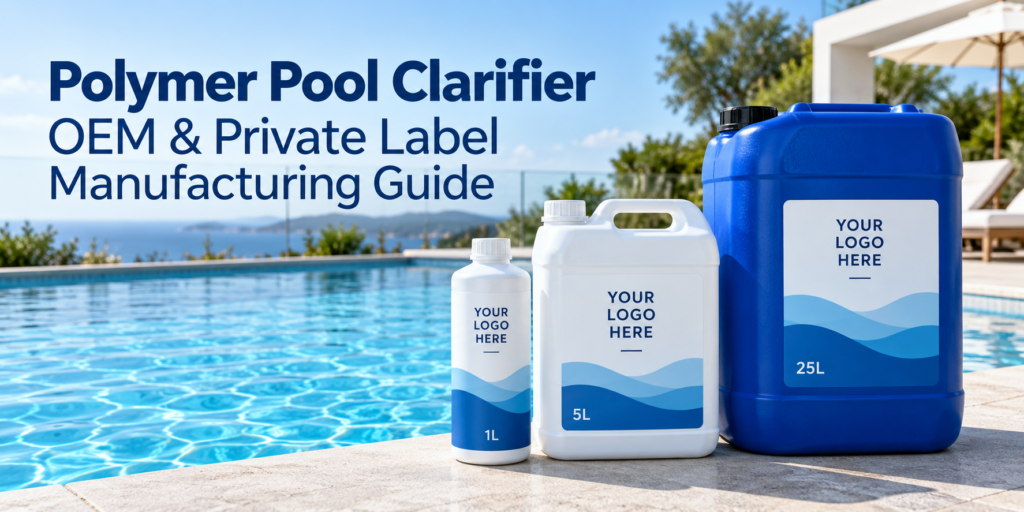
Eautrix offers polymer clarifier packaging options including 1 L, 5 L, and 25 L, subject to project requirements.
1 L: A practical retail format
A 1 L bottle can suit residential pool care customers and retail shelves. It’s relatively easy to carry and store, and it provides space for consumer-facing instructions.
For a retail product, review the cap, seal, label size, and bottle shape carefully. Can the customer pour the liquid without making a mess? Is the label readable when the bottle is wet? Does the package look consistent with the rest of your range?
These details may seem small, but they affect the experience every time the customer uses the product.
5 L: A useful middle ground
A 5 L container may appeal to pool service companies, commercial users with moderate demand, and distributors that want a larger format without moving to a heavy industrial pack.
It can also suit customers who prefer to buy less often but still want a manageable container.
Discuss the handle, cap, closure, and pouring method with your supplier. The package should work in real use, not just in a catalog photograph.
25 L: For higher-volume users
A 25 L container may be suitable for distributors, professional service businesses, and commercial users that consume more product.
Larger packs can reduce the number of individual containers handled per shipment, but they also raise practical questions. Who will move them? Will the customer need a dispensing pump? How will the containers be stored?
For every format, confirm the packaging material, fill quantity, closure, seal, carton or pallet arrangement, and any transport requirements with your supplier.
Label Design: Make It Clear, Useful, and Market-Ready
A private label does more than display your logo. It tells customers what they are buying and how to use it.
A strong label should be easy to read and appropriate for the destination market. Depending on the product and local requirements, it may need information such as:
- Product name and intended use
- Net contents
- Directions for use
- Applicable warnings and precautionary statements
- Storage instructions
- Batch or lot identification
- Manufacturer, importer, or responsible company details
- Required language and regulatory information
The final requirements depend on the product’s classification, claims, and market. Have the label reviewed by someone familiar with the applicable local rules before printing.
Be careful with performance claims
It’s tempting to make a label sound exciting. But claims should be supported by evidence and suitable for the market.
For example, “helps improve water clarity” describes a different function from “kills bacteria” or “prevents algae.” Claims related to disinfection or pest control may trigger additional requirements in some markets.
Don’t add such claims simply because they sound attractive. First confirm whether the finished product is intended, tested, and authorized for that use.
Directions should be understandable
If the recommended dose is difficult to interpret, even a good product can create a poor customer experience.
Check that the directions clearly explain:
- The pool volume to which the dose applies
- How to measure and add the product
- Any circulation or filtration instructions
- Whether the product is intended for routine use or a particular water condition
- Any relevant safety precautions
The exact directions should come from the finished product’s supported instructions and local requirements. Avoid copying another product’s dosage without testing and review.
Sample Testing: What Should You Check?
A sample is your chance to learn how the product behaves before committing to a larger order. It’s also a chance to see how the supplier responds to technical questions.
Start by checking the sample against the agreed brief:
- Appearance and color
- Odor, where relevant
- Ease of pouring and handling
- Packaging and closure
- Product documentation
- Performance under the conditions you want to serve
For performance testing, use a consistent method and record the conditions. A comparison is more useful when samples are tested at the same dose, in similar water, with the same equipment and observation period.
Where possible, record:
- The source and condition of the water.
- The apparent cause or type of cloudiness.
- Water test results relevant to the trial.
- Product dose and how it was added.
- Circulation and filtration conditions.
- Observations over time.
- Any filter maintenance needed after the trial.
If the product will be sold into different regions, consider whether the testing reflects the water and operating conditions your customers are likely to encounter.
A jar test may help with an initial comparison, but it does not automatically reproduce the conditions of a working pool and filter. Practical field testing can provide useful additional information.
Don’t judge by clarity alone
A sample that looks good quickly may still need further review. Consider whether the result is repeatable, whether the proposed dose is practical, and how the product behaves with the intended filtration system.
Also ask what happens if the product is overdosed. Your supplier may be able to explain the risks and provide guidance for label development. The final directions should be based on the specific formula.
Quality Control: What Should a Buyer Agree On?
A successful first sample is encouraging. Consistent production is what makes a brand dependable.
Before placing an order, agree on a written product specification and discuss how each batch will be checked. The exact tests depend on the formula, but the agreement may cover:
- Appearance
- Color range
- Polymer or active content, with a defined method
- pH and test conditions
- Other relevant physical properties
- Packaging and fill quantity
- Batch identification
- Acceptance criteria and handling of out-of-specification goods
Ask whether a certificate of analysis, or COA, will be provided for each batch. The COA should relate to the actual batch shipped and use the same definitions and units as the agreed specification.
For example, if pH is measured on a diluted sample, the dilution should be stated. Otherwise, two numbers may look different even when the products were tested under different conditions.
It’s also useful to agree on how long retain samples and production records are kept, and what information the supplier needs if a complaint arises.
No product is completely immune to complaints. What matters is whether you and the manufacturer can trace the batch, investigate the issue, and respond with useful evidence.
Documents to Request Before Shipment
The documents you need will depend on the destination, product classification, and sale arrangement. Discuss them early—especially if your customer must review them before placing an order.
Common documents may include:
- Product specification or technical data sheet
- Safety data sheet, or SDS
- Batch-specific certificate of analysis
- Commercial invoice
- Packing list
- Transport documents
- Certificate of origin, if required
- Other import or market-specific documents
Make sure the product identity is consistent across the relevant documents. A private trade name can be useful for branding, but it should not be used to hide information that must legally appear in safety, transport, customs, or regulatory documentation.
If the product needs classification or additional review for shipping, involve your logistics provider early. The correct requirements depend on the actual finished formulation and applicable transport rules.
How to Compare OEM Pool Clarifier Quotations?
Price matters. But a quotation is more useful when you understand what it includes.
A lower price per liter may reflect a different concentration, package, order quantity, service level, or delivery term. Compare the full offer before making a decision.
| Item | What to confirm |
|---|---|
| Product | Formula type, concentration definition, appearance, and specification |
| Packaging | Container size, material, cap, seal, label, carton, and pallet |
| Order quantity | Minimum order for the product and for each customized component |
| Price | Currency, unit, validity period, and what is included |
| Trade term | Agreed Incoterms® rule, named place, and version |
| Lead time | Starting point, production time, and expected shipping schedule |
| Documents | Which documents are included and when they will be available |
| Payment | Deposit, balance, and payment method |
| Quality | Batch testing, COA, retained samples, and complaint process |
A useful question is: What will this product cost me when it is ready to sell?
That may include product cost, packaging, artwork, freight, insurance where applicable, import charges, local handling, storage, and any required testing. Consider the cost per recommended treatment as well as the cost per bottle.
A concentrated product may have a higher purchase price but a different recommended dose. Compare products using their supported instructions and suitable test results, rather than relying on concentration alone.
Minimum Order Quantities: Why Do They Vary?
The minimum order quantity, or MOQ, may depend on more than the liquid itself.
Custom bottles, printed labels, cartons, caps, and color requirements can each have their own minimums. A supplier may be able to offer a smaller quantity of an existing formula, while a custom package or formula requires a larger commitment.
Ask for the MOQ in practical terms:
- How many liters are required?
- How many bottles or containers does that represent?
- Can different package sizes be included?
- Is there a separate minimum for each label design?
- Are unused printed materials stored for a future order?
- Does the MOQ change for repeat orders?
If your estimated first order is modest, say so. A supplier may be able to suggest an existing container or packaging arrangement that fits your launch.
Planning a Smooth First Production Run
Once you approve the sample and commercial terms, put the final details together in one clear document.
The approved product brief should identify:
- The finished product and specification
- Approved sample or reference
- Product appearance and color range
- Package size and components
- Label artwork and final text
- Order quantity
- Documents required
- Batch coding arrangements
- Delivery terms and production schedule
Ask for the final artwork and packaging layout to be approved before printing. Check spelling, net contents, contact details, instructions, and any required warnings carefully.
A photograph of a sample label can help, but it should not replace review of the final print file. Small text is easy to miss in a compressed image.
Before dispatch, you may also request photographs of the finished goods, labels, cartons, and pallet arrangement. Agree on this in advance so the supplier knows what you need and when.
How Eautrix Supports Private Label Pool Clarifier Projects?
Eautrix offers a polymer pool clarifier based on PolyDADMAC technology for pool chemical distributors, brands, and professional buyers. The product can be discussed for private label and OEM projects, including packaging and appearance requirements.
Available formats include 1 L, 5 L, and 25 L packaging. Clear or blue appearance may also be discussed according to the project. Specific formulation, packaging, order quantity, documentation, and lead time should be confirmed for each request.
To start a conversation, share your target market, intended customers, preferred packaging, estimated quantity, and any product or label requirements. The more clearly you describe your plans, the easier it is to identify a suitable product and quotation.
Learn more about the Eautrix Polymer Pool Clarifier and discuss your private label requirements with the Eautrix team.
Frequently Asked Questions
1. Can I sell a polymer pool clarifier under my own brand?
Yes. Private label manufacturing allows a product to be packed and sold under your brand, subject to the supplier’s available services and the requirements of your target market. Confirm the formula, packaging, label, and documentation before ordering.
2. What is the difference between an OEM pool clarifier and a private label pool clarifier?
Private label often uses an existing formula with your branding. OEM projects may involve further customization of the formula or packaging. The exact services vary, so ask the manufacturer what is included in its offer.
3. Can a 10% PolyDADMAC pool clarifier be customized for my market?
Customization may be possible, depending on the manufacturer, order quantity, technical feasibility, and local requirements. Confirm what “10%” means in the finished-product specification and test the proposed product for its intended use.
4. Which package size is suitable for a private label pool clarifier?
A 1 L bottle may suit retail customers, while 5 L and 25 L containers may suit professional users and distributors. The right size depends on customer demand, handling, storage, and your sales channel.
5. How long does private label pool clarifier manufacturing take?
Lead time depends on formula availability, order quantity, packaging, label approval, production scheduling, and shipping arrangements. Ask the manufacturer for a written schedule after the product and artwork have been confirmed.