
GET IN TOUCH
Ask For Sample?
What to Ask Before Buying Polymer Pool Clarifier in Bulk?
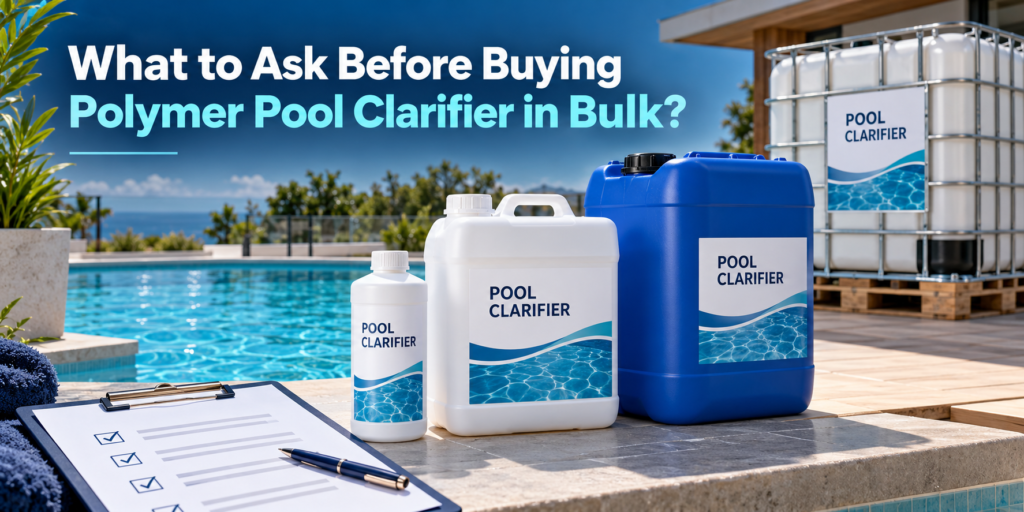
Buying polymer pool clarifier in bulk starts with a simple question: “What’s your price?”
That’s a fair place to begin. But it’s a poor place to stop.
Two suppliers may offer clear or blue liquids in similar containers, yet their products may differ in polymer content, treatment dose, handling needs, and batch consistency. Even the quotes can hide gaps. One price may include printed labels and pallets; another may cover only the liquid and basic containers.
For pool chemical distributors, private label brands, and professional service suppliers, these details affect far more than purchasing costs. They shape customer experience, stock planning, and the time your team spends answering complaints.
A sound bulk purchase needs a clear product specification, useful test results, and agreed supply terms. The questions below help you get there before you commit to a large order.
1. What Exactly Is the Product You’re Quoting?
“Polymer pool clarifier” describes a product category. It doesn’t tell you everything you need to know about the liquid inside the container.
Start by asking the supplier to identify the polymer chemistry and explain the product’s intended use.
Is it a finished pool care formulation? A concentrated product for professional dosing? Or a raw material meant for further blending?
Those are different purchases.
Request a technical data sheet, or TDS, that covers the product identity, key properties, application guidance, and storage conditions. Where relevant, ask for the chemical name and CAS number too.
A useful opening question is:
“Are you quoting a finished pool clarifier for direct use, or a concentrate that needs further formulation?”
This matters most when you plan to sell under your own brand. Your label directions must match the product you actually buy. A dose copied from an existing product may be unsuitable for a new formulation, even if both carry the same broad description.
Get the product definition right first. Price comparisons become much more useful after that.
2. What Does the Stated Polymer Percentage Mean?
A percentage can look precise while leaving plenty of room for confusion.
Suppose a supplier offers a “10% polymer clarifier.” Does that mean 10% active polymer by weight? Does it refer to total solids? Or does it mean the supplier added 10% of a polymer stock solution?
These figures are not interchangeable.
Ask the supplier to state:
- What the percentage measures.
- Whether it is expressed by weight or volume.
- The agreed specification range.
- The test method used to check it.
- Whether the result appears on each batch certificate.
For example, adding 10% of a stock solution that contains 40% polymer would contribute about 4% polymer to the finished blend by weight, assuming the blend percentages are also by weight. It would not make a 10% active-polymer product.
That small distinction can create a large pricing error.
Also, don’t assume that a higher polymer percentage guarantees better pool performance. Polymer properties and formulation design matter too. Concentration is one part of the buying decision; application testing helps complete the picture.
3. How Is the Clarifier Meant to Work in the Pool?
Ask the supplier to explain what happens after dosing.
For many polymer clarifiers, the aim is to help fine suspended particles form larger groups that the filtration system can remove. However, products sold under similar names may have different operating instructions.
Does the product work with the filter running? Does it require settling followed by vacuuming to waste? Is it designed for manual addition or controlled dosing?
You need a clear answer because these methods place different demands on the user.
Ask specifically:
“Will the user keep the circulation system running, stop it for settling, or follow another treatment sequence?”
Then check whether that sequence suits your market.
A pool service company may be comfortable with a detailed treatment procedure. A retail customer may need a simpler routine with clear measuring instructions.
The product and the instructions should work as a pair. A good formulation can still cause trouble when its label leaves users guessing.
4. Which Pool Systems Has It Been Tested In?
“Suitable for all pools” sounds reassuring. It also deserves a follow-up question.
Ask what evidence supports the claim and which conditions were covered. Relevant details may include filter type, water temperature, pH, sanitizer system, and the source of the cloudiness.
If your customers mainly use cartridge filters, ask about cartridge-filter applications. If they operate saltwater pools, ask whether the exact formulation has been assessed in those systems.
Useful questions include:
- Which filter types are covered by the application guidance?
- Are there restrictions from the filter manufacturer?
- Has the product been tested in chlorinated saltwater pools?
- What water conditions were used during testing?
- Which conditions call for a different treatment approach?
Keep the purpose of the product clear as well. Clarification supports water clarity; it does not replace sanitation, water testing, or proper filter maintenance. CDC guidance treats disinfectant control, pH, and filtration as core parts of pool care.
A supplier should help you define where the product fits, including its limits.
5. Can We Test a Representative Sample Before Ordering?
A bulk purchase should not depend on a photograph of sparkling water.
Ask for a sample of the exact grade you intend to buy, with its formulation reference or product code. Then agree how the bulk shipment will be matched to that approved sample.
A sample is most useful when it comes with supporting information:
- Batch number or sample reference.
- Technical data sheet.
- Safety data sheet.
- Suggested dose and treatment sequence.
- Relevant quality results.
You can begin with controlled small-scale trials, then assess the product in a representative pool system. A simple jar test may help compare particle aggregation or settling behavior, but it cannot fully reproduce circulation and filtration in a working pool.
Keep records. Note the water conditions, dose, mixing, filter operation, and observation times.
Where practical, include an untreated comparison under the same conditions. Otherwise, normal filtration may receive less credit than it deserves—or the clarifier may receive too much.
Eautrix also recommends sample evaluation before bulk purchases and small trial orders before a wider commitment.
6. What Is the Dose—and What Is It Based On?
Dose instructions need units, context, and a clear basis.
“Use 2 ppm” is incomplete if the supplier doesn’t say whether it means finished product or active polymer. Likewise, “add one cap” means little unless the cap volume and pool volume are defined.
Ask for instructions in units your customers can use, such as milliliters per cubic meter or fluid ounces per stated pool volume.
Clarify:
“Does this dose refer to the supplied liquid, or to its active polymer content?”
Also ask whether the supplier distinguishes between routine maintenance and treatment of visibly cloudy water.
Any claimed treatment time needs context too. What was the starting water condition? Which filter was used? How long did circulation run?
Be cautious about turning a successful trial into a universal promise. “Clear within a few hours” may describe one test; it does not prove the same result across all pools.
Your eventual label should use supported directions, with clear instructions on when users should reassess the water before adding more.
7. What Happens If Customers Add Too Much?
Bulk buyers need to think about everyday use, including mistakes.
A customer may misjudge pool volume, use the wrong measuring cup, or add a second dose before the first treatment has had time to work. Ask the supplier how the formulation behaves when dosing errors occur.
Excess polymer can interfere with clarification under some conditions, so “more is better” is a poor message for a product label.
Request practical guidance on:
- The recommended dose range.
- The minimum time before reassessment.
- Signs that another water problem needs attention.
- Steps to take after an accidental excess dose.
- Situations that require technical support.
The answer should relate to the exact product. Avoid relying on a generic troubleshooting sheet that covers several different formulations.
Clear dosing tools help too. A marked measuring cap or a simple volume chart may prevent more complaints than an extra paragraph of sales copy.
8. How Will You Keep Each Batch Consistent?
A good sample opens the door. Consistent production keeps the relationship going.
Ask for the finished-product specification before placing the order. It should define which properties are controlled, the acceptable ranges, and the test conditions.
Depending on the formulation, relevant checks may include appearance, polymer content, pH, density, and viscosity.
Not every test belongs on every specification. Ask why each parameter matters and how it is measured. For example, a viscosity result without a test temperature and method may be hard to compare.
Then ask about traceability:
“Can each container be traced to a production batch, and will we receive a batch-specific certificate of analysis?”
A certificate of analysis, or COA, should show useful release results for the supplied batch. A sheet that repeats only broad marketing claims offers little help.
Also agree how formulation changes will be handled. Changes to polymer grade, dye, or other ingredients may affect your approved product, even when the trade name stays the same.
9. Does Clear or Blue Appearance Change the Purchase?
Color can help a pool care line look consistent on the shelf. But it should have its own specification.
If you want a blue clarifier, approve the shade in the final container, not just in a small sample vial. Bottle color, label coverage, and liquid depth all affect how the product looks.
Ask whether the supplier has checked:
- Color stability during the stated shelf life.
- Performance of the dyed formulation.
- Compatibility with the chosen container.
- Variation between production batches.
- Any handling or staining concerns at concentrated strength.
A deeper blue does not prove greater treatment strength. Avoid building that suggestion into your packaging.
The commercial question is simple: can the supplier reproduce the appearance your customers will recognize, while maintaining the agreed product properties?
Approve a reference sample and retain it for future comparisons.
10. Which Packaging Format Fits How We Sell?
Bulk buying does not always mean selling in bulk containers.
You may purchase retail-ready bottles, larger jerrycans for service companies, or an IBC for local filling. Each route has a different cost structure.
Retail-ready supply can reduce your local filling work. Larger containers may suit professional users. An IBC may fit a business with suitable transfer equipment and filling controls.
Compare the full handling process, from delivery to the customer’s first dose.
For every pack size, confirm:
- Nominal container capacity.
- Actual net fill by weight or volume.
- Closure and seal type.
- Units per carton or pallet.
- Pallet dimensions and gross weight.
- Label and batch-code position.
Be especially careful with liters and kilograms. A container’s capacity does not establish its net fill weight; the product’s density must be considered.
Eautrix lists 1 L, 5 L, and 25 L packaging, along with IBC and custom supply formats, for its polymer pool clarifier. Buyers can review the Polymer Pool Clarifier product details and confirm the exact fill and pack arrangement for their order.
11. What Shelf Life Will Remain When the Goods Arrive?
A stated shelf life is only useful when you know when it starts.
Ask whether it runs from manufacture, filling, or another defined date. Then agree the minimum remaining shelf life at shipment or arrival.
This matters for seasonal pool markets. A product may spend weeks in transit, wait in a warehouse, and reach retail shelves after the strongest demand has passed.
Ask for written storage conditions, including temperature limits, protection from sunlight, and guidance following accidental freezing or excess heat.
If you plan to repackage the liquid, ask whether the original shelf-life evidence covers your chosen container and filling process. It may not.
A smaller order with healthy stock turnover can be better value than a large discount that leaves slow-moving inventory in storage.
Buy against a realistic sales plan, not just the most attractive price tier.
12. What Is Included in the Private Label Service?
“Private label available” can mean a printed sticker—or a much broader service.
Define the scope before artwork starts.
Ask who supplies the label layout, who checks the application directions, and who approves the final print file. Confirm the label material, adhesive, print quality, and resistance to normal handling.
Also check the details that often surface late:
- Artwork setup charges.
- Minimum label-print quantity.
- Carton design and printing.
- Barcode placement.
- Batch and date coding.
- Ownership of unused printed stock.
Request a filled, labeled pack for approval where practical. A flat PDF cannot show whether the label wrinkles around a handle recess or whether key text becomes hard to read on a curved bottle.
Finally, put approval stages in writing. Formula approval, packaging approval, and print approval are separate decisions, even when one supplier manages them all.
13. Which Documents Can You Supply for This Exact Product?
Ask for documents early enough to review them before production.
A useful starting set includes the TDS, SDS, sample COA, commercial invoice format, and packing-list format. Additional requirements depend on the shipment and destination.
The key word is exact.
Documents should match the purchased formulation, product reference, and supply arrangement. A generic safety sheet for a different concentration creates avoidable confusion.
For private label orders, ask how the supplier links your trade name to its internal product code. Clear traceability helps with repeat orders and technical questions.
Have your importer, broker, and freight provider review the necessary shipment details before dispatch. Agree who will resolve any document mismatch and how quickly corrections will be issued.
Good paperwork should support a smooth handover. It should not become a last-minute search through old email attachments.
14. What Is the Real Cost of the Order?
A low factory price can look less attractive once the full shipment is counted.
Compare quotes using the same product specification, packaging, quantity, currency, and delivery basis. Include the named place or port when discussing delivery terms.
Depending on the transaction, your cost review may need to cover inland transport, freight, insurance, destination handling, duties, local delivery, and filling costs.
Treatment economics deserve a separate look.
Imagine two hypothetical products:
| Item | Product A | Product B |
|---|---|---|
| Purchase price per kg | $1.10 | $1.40 |
| Validated product use per treatment | 0.20 kg | 0.12 kg |
| Product cost per treatment | $0.22 | $0.168 |
In this example, Product B costs more per kilogram but less per treatment.
The figures are illustrative, and such a comparison only works when both treatments achieve an acceptable result under comparable conditions.
Ask for the cost per saleable pack and the cost per effective treatment. Each tells you something different about your margin.
15. What Will Make a Repeat Order Predictable?
Your first shipment is one project. Repeat supply is the business.
Ask how long production takes after the formula, packaging, and payment requirements are complete. Separate liquid production time from printed-packaging lead time.
Then discuss the next order:
“What information will you retain so we can reorder the same product without starting again?”
A repeat-order record should identify the approved formulation, specification, color reference, container, label version, carton, and pallet arrangement.
Ask what happens during the busy season. Can the supplier reserve packaging? Can you place a forecast? How much notice is needed for a larger order?
Also agree the process for reporting a problem. Define the evidence required, the response contact, and the steps for investigating a disputed batch.
A clear process does not imply that trouble is expected. It gives both teams a practical way to respond if something goes wrong.
Put the Answers Into a Purchase Specification
After the discussions, bring the key answers together in one approved specification.
It should identify the product, quality limits, test methods, packaging, net fill, artwork reference, batch coding, shelf-life requirements, and required documents. Keep the commercial terms consistent with that specification.
For a new supplier, a sensible path is sample evaluation, a controlled trial order, and then a larger purchase based on the results.
There’s no prize for making the biggest first order.
The goal is to buy a clarifier your team can receive, sell, support, and reorder with confidence. A supplier who gives clear, documented answers makes that goal much easier to reach.
Frequently Asked Questions
1. What documents should I request before buying polymer pool clarifier in bulk?
Request the technical data sheet, safety data sheet, agreed product specification, and a sample certificate of analysis. Confirm which batch-specific documents will accompany the shipment and have the relevant parties review import and transport requirements.
2. Is a higher-concentration polymer pool clarifier always better value?
No. Compare the concentration basis, validated treatment dose, performance, and handling needs. A stronger product may reduce the quantity used, but concentration alone cannot establish treatment value.
3. Can I buy bulk polymer pool clarifier for local repackaging?
Yes, where the supplier offers a suitable bulk format. Confirm transfer and filling requirements, container compatibility, traceability, and whether the shelf-life evidence covers your repackaged product.
4. How should I evaluate a private label pool clarifier sample?
Test the exact proposed formulation under representative conditions. Record dose, water conditions, filter type, and treatment time. Assess the finished packaging separately, then agree how production batches will match the approved product.
5. What is the safest way to start with a new bulk pool clarifier supplier?
Begin with document review and representative sample testing, then place a manageable trial order. Increase volume after you have assessed product performance, packaging, delivery, and the supplier’s response to technical questions.