
GET IN TOUCH
Ask For Sample?
Polymer Pool Clarifier Buyer’s Guide for Distributors and Pool Brands
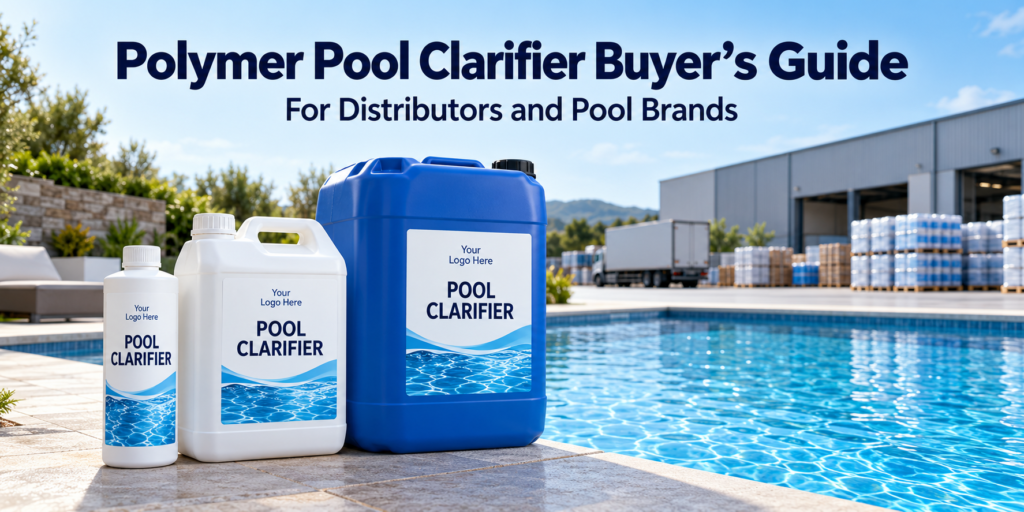
A pool clarifier looks like a simple product to buy. Choose a formula, approve a bottle, add your label, and place an order.
Then the questions begin.
Will it work with the filters your customers use? Is the dose clear enough for a homeowner to follow? Can the supplier match the approved sample six months later? And does that low price still look attractive once freight, packaging, and customer support enter the picture?
For distributors and pool brands, buying polymer pool clarifier means buying a product that must perform twice: first in the pool, then in your business.
The right choice should help customers manage fine suspended particles, fit your sales channel, and leave room for a healthy margin. It should also come with clear instructions and dependable supply.
This guide explains what to check before you commit—from polymer concentration and sample testing to private label packaging and repeat-order control.
Start With the Customer, Before You Start With the Quote
Before asking a supplier for its best price, describe who will use the product.
A homeowner with a small backyard pool has different needs from a service company that maintains dozens of pools each week. A commercial operator may need a product that fits an established treatment system. A local blender may want bulk material rather than finished bottles.
Those differences affect almost every buying decision.
| Customer group | Main buying concern | Product features to assess |
|---|---|---|
| Retail pool owners | Simple, dependable use | Clear dose chart, manageable bottle, readable directions |
| Pool service companies | Cost and convenience across many pools | Easy pouring, suitable pack size, consistent performance |
| Commercial pool operators | Fit with their operating system | Documented application limits, technical support, filtration compatibility |
| Regional distributors | Stock turnover and dealer acceptance | Pack range, dependable supply, transport efficiency |
| Private label brands | Brand control and repeatable quality | Agreed formula, artwork control, batch records |
| Local formulators | Reliable bulk supply | Defined specifications, handling guidance, blending support |
Write a short buying brief before you request samples.
Include your target market, typical pool types, common filters, preferred packaging, expected order volume, and intended product claims. If some details are unknown, say so.
A focused brief makes supplier replies easier to compare. It also reduces the chance of receiving a generic quotation for a product that does not fit your channel.
Know What Polymer Pool Clarifier Is Expected to Do
Polymer pool clarifier helps bring fine suspended particles together so they can be removed more readily through an appropriate filtration process.
Think of those particles as tiny scraps that are hard for a net to catch on their own. A suitable polymer treatment helps them form larger groups. The filter then has a better chance of capturing them.
That is the basic idea. Actual results depend on the formulation, dose, water conditions, mixing, and filter system.
A clarifier also has limits.
Cloudy water can result from poor circulation, inadequate filtration, algae, water imbalance, or other faults. PWTAG’s guidance stresses identifying the cause before choosing corrective action. A clarifier should therefore sit within a sound maintenance program, with clear instructions about when further investigation is needed.
For buyers, this has a direct commercial meaning: avoid building your brand around a promise to solve every cloudy-water problem.
A narrower, well-supported promise is easier to explain and easier to defend.
Clarifier or Settling Flocculant? Make the Use Method Clear
Pool chemical terms can become muddled.
Some products help filtration capture fine particles during circulation. Others are intended to form material that settles and must then be removed, often by vacuuming to waste.
Customers need to know which process your product requires.
Ask the supplier:
- Should circulation continue after dosing?
- Does the product depend on a particular filter type?
- Is settling part of the intended treatment?
- Must the pool have a vacuum-to-waste facility?
- What cleaning or backwashing steps follow treatment?
Do not rely on the word “clarifier” alone to answer these questions.
A homeowner who expects normal filtration may struggle with a treatment that requires a different removal method. The chemistry may be suitable, yet the buying experience still goes wrong.
Clear directions prevent that mismatch.
Ask What Is in the Formula—and What the Percentage Means
“Polymer-based” is a starting point, not a full specification.
Ask for the polymer identity, stated concentration, and the basis used to express that concentration. PolyDADMAC, for example, is one polymer used in pool clarifier formulations, but its name alone does not define the finished product’s performance.
A particularly useful question is:
Does the stated percentage refer to active polymer, total solids, or the amount of a supplied raw material added to the blend?
These figures can differ.
For example, adding 10% of a polymer solution to a blend does not necessarily create a finished product containing 10% active polymer. The raw material itself may contain water.
Ask the supplier to put the concentration basis in writing. Where relevant, request the test method too.
Also ask how changes in polymer grade are controlled. Products with the same general chemical identity can differ in properties that affect treatment behavior. A supplier should be able to explain which characteristics matter for its formulation and how it keeps them consistent.
You do not need every detail of a confidential manufacturing process. You do need enough information to define what you are buying.
Stronger Is Not Always the Better Commercial Choice
A concentrated product can look appealing. It may reduce the volume needed per treatment and suit professional users who measure doses carefully.
Yet a lower-dose product can be harder for some customers to use accurately.
Picture a homeowner treating a small pool with a large, unmarked cap. A small measuring error may become a large dosing error. A service technician with suitable measuring equipment faces a different situation.
The better choice depends on the user.
Consider:
- Typical pool volume.
- Measuring tools available.
- Required dose accuracy.
- Ease of pouring.
- Staff or customer training.
- Freight cost.
- Intended selling price.
Ask suppliers to explain why the proposed concentration suits your market.
“More concentrated” can be a useful feature. It becomes a benefit only when the customer can use it well.
Turn the Product Description Into a Written Specification
An attractive sample is not enough to control future supply.
Before approving a formula, agree on a written specification. It should define the characteristics used to accept or reject a batch.
Depending on the product, these may include:
| Item | What the buyer should clarify |
|---|---|
| Appearance | Accepted color, clarity, and visible condition |
| Polymer content or solids | Definition, range, and test method |
| pH | Test conditions and accepted range |
| Viscosity | Temperature, method, and accepted range |
| Density | Test temperature and reporting basis |
| Packaging fill | Whether quantity is controlled by mass or volume |
| Storage | Conditions supported by the supplier’s data |
| Shelf life | Evidence, packaging, and storage assumptions |
| Batch identification | Coding format and traceability |
Not every item needs a very narrow tolerance. Limits should reflect what matters for performance, handling, and customer expectations.
The purpose is simple: both sides should understand what “same product” means.
For a dyed formulation, an agreed color reference may help. For a product that must pass through a dosing system, viscosity may deserve closer attention.
Build the specification around the job the product has to do.
Compare Cost Per Treatment, Not Just Price Per Tonne
A low purchase price is easy to notice. A low treatment cost takes a little more work.
Start by comparing products under equivalent conditions and at doses supported by testing.
A useful calculation is:
Chemical cost per treatment = delivered cost per liter × liters used per treatment
For illustration only:
| Product | Delivered cost | Assumed dose per 100 m³ | Chemical cost per treatment |
|---|---|---|---|
| A | $1.40/L | 0.50 L | $0.70 |
| B | $1.80/L | 0.30 L | $0.54 |
Product B costs more per liter but less per treatment in this example.
These are invented figures for explaining the calculation, not market prices or dosing advice. They are meaningful only if testing shows that both treatments achieve the required result under comparable conditions.
Then look beyond the chemical cost.
Include bottles, caps, labels, cartons, freight, duties, warehousing, damaged stock, and local delivery. Consider the support burden too. A confusing label can consume time long after the order has been paid.
For a distributor, margin depends on the whole route from supplier to satisfied customer.
Test Samples With a Plan
A sample should answer a buying question.
“Does it look good?” is one question. “Does it perform reliably in the pool conditions we serve?” is the more useful one.
Begin with a documented screening test. Compare an untreated control with several doses under the same conditions. Keep water source, sample volume, mixing, temperature, and observation time consistent.
Where equipment is available, measure turbidity rather than relying only on photographs. Pictures can change with lighting, background, and camera settings.
A practical record should include:
- Product and sample batch number.
- Water source and initial condition.
- Dose and how it was calculated.
- Mixing method.
- Observation times.
- Measured or observed changes.
- Any deposits, foam, or other unexpected behavior.
A jar test can help screen products, but it cannot fully reproduce a working pool filter. Follow promising results with a controlled trial in a representative system.
The aim is to reduce uncertainty before placing a commercial order.
Include Filtration in the Trial
Clarifier performance and filtration belong in the same conversation.
A treatment may change the appearance of water in a test vessel without proving that it works well through the filter your customers use.
Ask for evidence relevant to sand, cartridge, or diatomaceous earth systems where those applications are proposed. Do not assume a broad compatibility claim covers every filter design and operating condition.
During a trial, record water clarity alongside filter behavior.
Watch for changes in flow, pressure, cleaning frequency, or handling. Follow the equipment manufacturer’s instructions and the product’s approved application guidance.
Also ask the supplier to define the limits of its claim. Does “compatible with cartridge filters” mean it has been tested in those systems? At which dose? Under what conditions?
A precise answer is worth more than a long list of check marks.
Make Dose Instructions Easy to Follow
Unclear units can spoil an otherwise sound product launch.
If a technical sheet uses parts per million, ask whether that figure refers to the finished product or active polymer. If the product is sold by volume but the technical dose is expressed by mass, confirm the density used for conversion.
For retail users, a practical volume-based instruction may be easier to follow, provided it is supported by the formulation and testing.
For example, a label might express an approved dose as a measured amount per stated pool volume. The exact amount must come from product-specific evidence.
A complete instruction set should explain:
- How to estimate pool volume.
- How to measure the dose.
- Where and how to add the product.
- Required circulation conditions.
- When to assess the result.
- Whether and when another dose is appropriate.
- What to check if cloudiness persists.
Keep concentrated chemical handling clear as well. Suitability within a pool treatment program does not establish that concentrated products can be mixed together.
Good instructions make the product easier to sell because staff can explain it with confidence.
Choose Packaging for the Way Customers Work
Packaging affects freight, shelf appeal, pouring, storage, and repeat sales.
A bottle that looks excellent in a design file may be awkward with wet hands. A large jerrycan may suit a service vehicle but feel cumbersome in a retail setting.
Consider the full use experience.
| Pack format | Potential channel fit | Checks before approval |
|---|---|---|
| 1L bottle | Retail and homeowner use | Grip, cap, measuring method, label space |
| 5L jerrycan | Service companies and frequent users | Handle strength, pouring control, closure |
| 25L jerrycan | Larger-volume users and distribution | Handling method, stacking, dispensing |
| Bulk container | Local filling or blending operations | Transfer equipment, traceability, storage |
These are starting points, not fixed rules.
Request filled packaging samples where practical. Assess leakage, label adhesion, carton strength, and pallet arrangements. Check that printed directions remain readable after normal handling.
Confirm net contents separately from container capacity. A container described as “1L” does not, by itself, establish a net mass of 1kg.
Small details matter here. A cap that drips can undo a lot of good branding.
Clear or Blue? Treat Color as a Brand Decision
Color can help a product stand out and make a range feel consistent.
It should not be treated as evidence of greater strength.
If you choose a blue formulation, ask the supplier how the dye behaves in the finished product and proposed packaging. Review color stability during storage, possible staining during spills, and consistency between batches.
Test the complete formulation, including the dye.
A clear product may suit a restrained technical range. A blue product may fit a familiar pool-care design. Either approach can work if the appearance is stable and the claims remain accurate.
The useful question is not “Which color looks strongest?”
It is “Which appearance fits our brand and holds up through storage and use?”
Buy Private Label Support as a Defined Service
“Private label available” can cover a wide range of services.
One supplier may only apply customer-provided labels. Another may coordinate artwork, packaging procurement, filling, carton printing, and export preparation.
Ask exactly what is included.
Agree who provides and approves:
- Label text and translations.
- Technical directions.
- Safety information.
- Barcode files.
- Batch and date coding.
- Container and closure specifications.
- Carton markings.
- Final print proofs.
Set a clear approval process. A revised label should not quietly replace the approved version, and a container substitution should not arrive as a surprise.
For your first launch, a limited pack range may make stock control easier. Add formats when customer demand supports them.
Brand consistency is easier to maintain when the underlying process is clear.
Review Documents Before Paying the Deposit
Documents are part of the product.
Request the current technical data sheet, safety data sheet, agreed specification, and an example certificate of analysis early in the buying process.
Each serves a different purpose.
The technical data sheet describes the product and its intended use. The safety data sheet addresses hazards and handling. A batch certificate of analysis reports the checks made against the relevant specification.
Confirm that document names and product identifiers are consistent. A private trade name should be linked to the correct formulation through the supplier’s records.
Requirements for sale, labeling, import, and transport depend on the product and destination. Review those points with qualified local support before approving commercial artwork or shipping arrangements. Claims involving disinfection or algae control deserve particular scrutiny because they may change how the product is regulated.
Ask for evidence behind approvals and certifications. A logo on a sales sheet is not enough to establish scope or validity.
Look for Repeat-Order Control
The first sample shows what a supplier can send once.
Your business depends on what it can send repeatedly.
Ask how the supplier controls incoming materials, records production, releases batches, and handles changes. Find out whether retained samples are kept and how a complaint can be traced back to production records.
A useful commercial agreement should address changes to the polymer source, formulation, dye, packaging, or test methods.
For larger purchases, consider independent checks selected for your risks. These might involve sampling, specified laboratory tests, fill quantity, or packaging inspection.
Be precise about inspection scope. A visual inspection cannot prove every chemical property, and a laboratory test cannot prove every pallet is packed correctly.
Choose checks that answer the questions most important to your order.
Plan the First Order Around Learning and Stock Turnover
The largest discount does not always produce the strongest launch.
A large opening order can tie up cash before you know which customers will reorder. Custom packaging may create separate minimum quantities, leaving unused bottles or labels if sales develop slowly.
Ask the supplier to break the timeline into stages:
- Formula and sample approval.
- Packaging and artwork approval.
- Material procurement.
- Production and filling.
- Testing and release.
- Shipment preparation.
Confirm which stage starts the quoted lead time.
Build your order quantity around a realistic sales period, storage conditions, and remaining shelf life on arrival. Seasonal markets need enough time for dealers to receive stock before demand rises.
An opening order should give you useful market feedback while leaving room to adjust.
Use One Buying Checklist Across Suppliers
Supplier comparisons become much easier when everyone answers the same questions.
Use a short scorecard covering:
| Buying area | Evidence to request |
|---|---|
| Product definition | Polymer identity, concentration basis, specification |
| Performance | Test method, conditions, results, application limits |
| Directions | Clear dose units and filtration instructions |
| Quality | Batch records, release checks, change control |
| Packaging | Approved components, fill basis, transport checks |
| Private label | Defined responsibilities and artwork approval |
| Commercial terms | Itemized quote, minimum quantities, lead time |
| Support | Technical contact and complaint process |
Weight the categories to suit your business. A retail brand may give extra weight to packaging and instructions. A professional distributor may place more emphasis on treatment cost and technical support.
Price still matters. It simply deserves to be assessed beside the evidence.
Put Your Shortlist Into Action
A sound purchase starts with a clear brief and ends with a repeatable product.
Define the customer. Agree on the formulation. Test it under relevant conditions. Confirm the package, documents, and commercial terms. Then keep the approved details together so the next order has a firm reference point.
For buyers assessing Eautrix, the Polymer Pool Clarifier product page describes a PolyDADMAC-based formulation with clear or blue appearance choices and private label support. Use those details as the basis for a specific sample and quotation request.
You can contact Eautrix with your target market, preferred pack sizes, expected volume, and testing needs.
The most useful supplier conversation begins with a practical question: Can we define, test, and consistently supply the product our customers need?
Frequently Asked Questions
1. What should distributors check before buying polymer pool clarifier in bulk?
Confirm the polymer identity, concentration basis, written specification, dose instructions, and intended filter applications. Test samples under relevant conditions, then review packaging, documents, delivered costs, and repeat-order controls.
2. Is a higher-concentration polymer pool clarifier always better for private label brands?
No. The right concentration depends on treatment performance, measuring accuracy, customer habits, packaging, and cost per treatment. A concentrated product needs directions and measuring arrangements that suit its users.
3. How can a pool brand compare two clarifier suppliers fairly?
Provide both suppliers with the same buying brief. Compare samples under equivalent conditions, use documented doses, and calculate delivered cost per successful treatment. Review quality controls and packaging alongside price.
4. Which packaging size is best for professional pool service companies?
A 5L jerrycan can be a useful starting point, while larger users may prefer 25L packs. The best size depends on consumption, vehicle storage, lifting requirements, pouring control, and dispensing equipment.
5. What should a private label pool clarifier sample request include?
Include your destination market, customer type, common filter systems, preferred concentration and color, packaging sizes, expected order volume, and trial plan. Request the technical data sheet, safety data sheet, and proposed specification with the sample.