
GET IN TOUCH
Ask For Sample?
Creating a Premium Private Label Pool Clarifier for Your Market
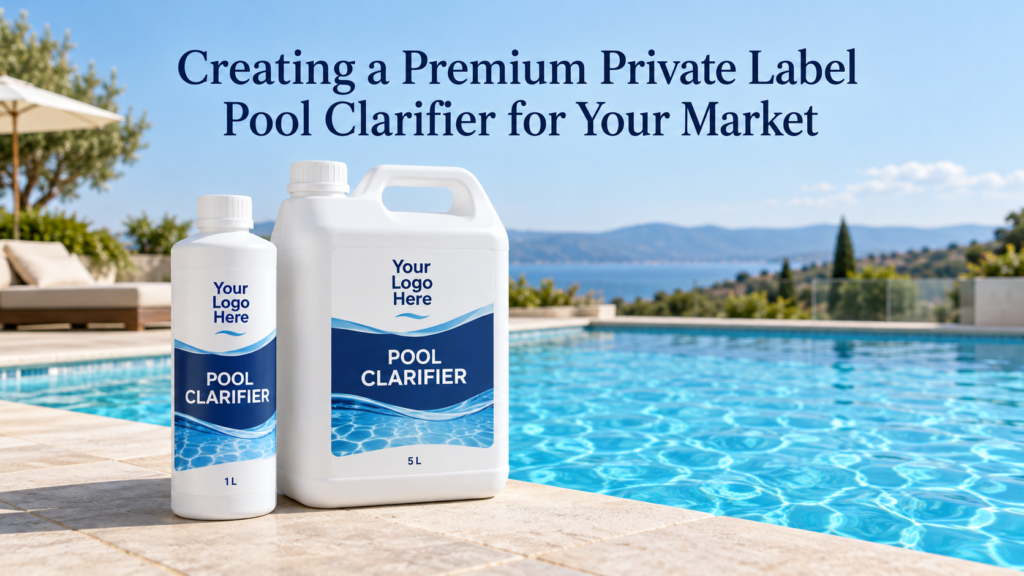
A pool clarifier can look impressive on a shelf. The bottle feels solid, the label looks sharp, and the color fits the brand. But the real test comes later—when someone measures a dose, adds it to a pool, and waits for the water to clear.
That’s where a premium product earns its place.
For pool chemical brands, importers, and distributors, creating a premium private label pool clarifier means bringing several parts together. The formula must suit the intended use. The pack must be easy to handle. The directions must make sense. And the next shipment should meet the same agreed standards as the first.
A new logo alone won’t achieve all that.
The good news? You don’t need to launch a huge range or make bold promises. A well-defined product, backed by sound testing and clear support, can give buyers a strong reason to choose your brand.
Let’s walk through how to build one for your market.
Start With the Customer Who Will Pour It
Before discussing polymer content, bottle shape, or label color, ask one simple question:
Who will use this clarifier, and what do they need from it?
A homeowner may want a small bottle with clear instructions. A pool service technician may care more about accurate dosing, easy transport, and treatment cost. A hotel maintenance team may need larger packs, written procedures, and a steady supply.
Those needs overlap, but they aren’t the same.
Even within one country, sales channels can shape the product. A clarifier sold through specialist pool shops may come with advice from trained staff. The same product sold online needs packaging and instructions that do more of the explaining.
Create a short customer brief before asking for samples. Include:
- The main user and sales channel.
- Typical pool sizes.
- Common filter types.
- The intended role of the product.
- Preferred pack sizes.
- Target retail or distributor price.
- The language and measurement units buyers use.
This brief gives your supplier something concrete to work toward. It also keeps the project focused when customization choices begin to multiply.
Give “Premium” a Meaning Buyers Can Understand
Premium is an easy word to print. It’s harder to prove.
For a private label pool clarifier, premium value might come from dependable performance, simpler dosing, a better pouring pack, or stronger technical support. It may also come from a combination of small details that make the product easier to trust.
Choose a few benefits you can support.
For example, your product brief might call for a clarifier that offers consistent appearance, clear treatment instructions, and packaging suited to regular service use. Those are useful goals because you can assess them.
“Perfect water every time” is much less useful. Pool conditions vary, and no label can remove that fact.
A strong product promise should answer three questions:
What does it help the customer do? Under which conditions? What must the customer do for it to work as intended?
That last part matters. A clarifier depends on the wider maintenance process. Honest guidance makes the product more credible and helps buyers set fair expectations.
Choose the Formula Around Its Job
A filter-aid pool clarifier is intended to help the filtration process remove fine suspended matter. It should have a clear place in the pool care routine, with directions developed for the finished formula.
That sounds straightforward, yet product development can lose focus here.
A brand may ask for a higher concentration because it sounds more premium. Another may request a darker blue because it looks stronger. Neither choice, by itself, proves better performance.
Start with the intended treatment task.
Will the product support routine water polishing? Will it target occasional haze caused by fine particles? Will service teams use it across a defined group of pools?
Then ask the manufacturer to explain why the proposed formula fits that task.
For example, Eautrix lists a pool clarifier based on 10% PolyDADMAC, with original or blue-dyed appearance and options for concentration adjustment and custom blending. These are starting points for a product discussion; the final specification still needs to match the proposed use and testing plan.
A premium brief should connect the formula to a real user need, rather than treat ingredient content as the whole story.
More Concentrated? Check the Whole Experience
A concentrated pool clarifier may suit professional buyers. It can reduce the amount of product handled per treatment when the formula and dose support that benefit.
But small doses can be harder to measure.
Picture a homeowner trying to pour a few milliliters from a wide-neck bottle. A slight slip may create a large dosing error. Now picture a trained technician using a suitable measuring tool. The same concentration may be much easier to manage.
That’s why concentration, dosing equipment, and instructions belong in one discussion.
Ask:
- Can the user measure the recommended dose with the supplied pack?
- Are the markings easy to read?
- Does the dose work neatly with local pool-volume units?
- Is any dilution required?
- Have the directions been checked with the finished product?
Also compare formulations on the same basis. A percentage may refer to active polymer, solids, or another defined measure. Confirm the test method and meaning before comparing two offers.
A higher number on a specification sheet should lead to questions, not an automatic buying decision.
Test for Your Market Before Making Broad Claims
Your market is more than a country name.
It includes water sources, maintenance habits, storage conditions, filter systems, and the way people buy and use pool chemicals. A product that performs well in one trial hasn’t yet answered every question about those conditions.
Build a test plan that reflects your intended customers.
Begin with agreed laboratory checks, then use controlled pool trials where appropriate. Record the starting water condition, dose, circulation schedule, filter type, and observations. Keep other treatment changes documented so the results can be interpreted.
Otherwise, you may see clearer water without knowing which part of the maintenance process caused it.
Useful trial records can include:
- Starting and final turbidity, where suitable equipment is available.
- Photographs taken under similar light and viewing conditions.
- The time between treatment and each observation.
- Filter pressure and cleaning needs.
- Any unwanted appearance or handling changes.
- Comments from the person who applied the product.
Photos help tell the story. Measurements help explain it.
Neither should be used to suggest that every customer will get the same result within the same time.
Make Compatibility a Test Question
“Works with all pool systems” sounds reassuring. It also covers a very wide range of conditions.
A premium product deserves more precise wording.
Ask which filter types and treatment programs have been assessed. Discuss the expected use alongside common pool chemicals, and distinguish between use in the same maintenance program and direct mixing of concentrates.
Those are separate questions.
The label should give clear application directions and any necessary restrictions for the finished formula. Avoid adding a broad compatibility claim simply because the base ingredient is familiar.
The same care applies to saltwater pools, automated dosing equipment, and commercial facilities. If one of those groups is central to your sales plan, make it part of development from the start.
A small, well-supported claim is more valuable than a sweeping claim that your support team struggles to explain.
Clear or Blue? Let Appearance Serve the Brand
Color can help give a private label pool clarifier a recognizable look.
A blue liquid may suit a range built around fresh water imagery. An original, undyed appearance may suit a brand that favors a simple technical presentation. Either approach can work.
The key is consistency.
The bottle, label, product name, and liquid should look like parts of the same range. If your algaecide, clarifier, and other treatments use similar packs, make sure customers can still tell them apart at a glance.
Color should support identification rather than carry the full burden.
For a dyed formula, include appearance in the development checks. Assess the chosen shade in the actual container, then review it after the agreed storage tests. Ask the formulator to evaluate dye suitability and any effect on the finished product.
A darker shade is a visual choice. It isn’t proof of greater clarifying power.
That distinction helps keep both marketing copy and customer expectations grounded.
Put the Package Through a Real Working Day
A premium pack should look good. It should also survive ordinary use.
Think about where it will go: a shop shelf, a delivery van, a damp equipment room, or a service technician’s kit. Then think about what happens when someone opens it with wet hands.
Is the grip secure? Does the product pour cleanly? Can the cap be closed without fuss? Can the label still be read after handling?
These details rarely lead a sales brochure, yet they can shape repeat orders.
Assess the complete pack, including the container, closure, liner or seal where used, label, and outer carton. Packaging suitability depends on the combination, not just the bottle material.
Ask for filled samples. Check them upright and in likely transport positions under an agreed test procedure. Review label adhesion, leakage, pack distortion, and the readability of batch codes.
An empty bottle sample can tell you how a pack looks. A filled sample tells you much more about how it works.
Choose Pack Sizes With a Clear Purpose
It’s tempting to launch several sizes so every buyer has a choice. Each extra size, though, adds stock, artwork, purchasing, and forecasting work.
Start with the sizes your main customers can justify.
| Pack format | Possible customer fit | Main development question |
|---|---|---|
| 1 L bottle | Retail buyers and smaller users | Can users measure and pour the dose easily? |
| 5 L jerrycan | Service firms and regular users | Is it practical to carry and dispense? |
| 25 L container | Larger maintenance operations | Is there a suitable handling and dosing method? |
| Bulk supply | Local filling or blending businesses | Who controls filling quality and traceability? |
These are planning examples, rather than fixed rules. The right pack also depends on the dose and expected rate of use.
For an initial launch, one well-chosen retail pack and one professional pack may be enough. Let actual demand guide further additions.
Simple ranges can be easier for distributors to stock and easier for sales staff to explain.
Write Directions That Leave Less Room for Guesswork
Clear instructions are part of product quality.
A customer shouldn’t have to work out whether a dose refers to the finished liquid or the active ingredient. Nor should they need to convert unfamiliar units while standing beside a pool.
Use the units your market understands, and define the treatment basis.
The finished label should make clear:
- How to determine the required quantity.
- How and where to apply it.
- What circulation or filtration steps to follow.
- When to assess the result.
- What to check before another treatment.
- Which storage and handling directions apply.
Any dose table must come from the approved formula and supporting work. Don’t copy a table from another product with a similar name.
Keep the main steps short. Put detail where readers can find it without burying the first action.
A useful review is to hand the draft to someone who hasn’t worked on the project. Ask them to explain the procedure back to you. Their questions may reveal gaps the development team no longer notices.
Turn Consistency Into a Written Agreement
A sample can win interest. Consistent shipments help retain it.
Before placing a commercial order, agree on a finished-product specification with defined limits and test methods. Decide which checks belong on each batch’s certificate of analysis and which are covered through other controls.
Depending on the formula, relevant checks may include appearance, color, polymer content or solids, pH, density, and viscosity.
Each test should have a purpose. Collecting figures without clear acceptance limits adds paperwork without much control.
Also discuss retained samples, batch identification, and change notification. If a raw material, dye, production step, or packaging component changes, what review is required before supply continues?
A signed reference sample can help with visual comparison. It should sit alongside the written specification.
This gives both sides a shared basis for accepting goods and investigating a complaint.
Check Shelf Life in the Finished Pack
Shelf life should reflect the product you plan to sell.
That includes the chosen formula, color, container, closure, and storage directions. A statement for a base formulation may need review when one of those parts changes.
Ask what evidence supports the proposed shelf life and which storage conditions it covers.
Relevant observations may include changes in appearance, separation, viscosity, color, packaging condition, and performance. The test program should be designed by the responsible technical team for the product and expected supply route.
Give them useful information. Will stock spend weeks in transit? Will distributors hold it through a quiet season? Are hot warehouses likely?
No one benefits from a storage instruction that buyers can’t realistically follow.
Planning around actual conditions helps reduce surprises after the product leaves the factory.
Price the Treatment, Then Price the Business
The cheapest bottle may not give the lowest treatment cost. The highest concentration may not give the best commercial return either.
Compare the amount needed for a defined treatment at its validated dose. Then add the rest of the business costs.
Those may include freight, packaging, local handling, testing, warehousing, distributor margins, damaged stock, and customer support.
A simple calculation can help:
Product cost per treatment = price per liter × liters used per treatment.
That figure is useful only when the compared products serve a similar purpose under comparable conditions.
Also consider ease of sale. A slightly more expensive product with clear directions and reliable supply may be easier for a distributor to support. That possibility should be tested through customer feedback and actual sales, rather than assumed.
Premium pricing needs a reason buyers can explain to their own customers.
Give Distributors More Than a Price List
Your distributor may understand the local market well and still need help explaining a new clarifier.
Prepare a small, practical sales pack. Include the technical data sheet, safety data sheet, product images, approved claims, and a short guide to common questions.
Keep the language consistent across the bottle, website, and sales material.
For instance, if the label describes support for filtration, an online listing shouldn’t promise to solve every cause of cloudy water. Conflicting messages create confusion before a customer even opens the pack.
Train sales staff to ask a few useful questions about pool volume, filtration, water condition, and recent treatments. These questions can help identify whether the product fits the situation.
Support should also cover what happens when results disappoint. A clear troubleshooting process gives the distributor a useful next step instead of another unsupported dose recommendation.
Launch With a Product You Can Learn From
A focused launch makes feedback easier to use.
Begin with a defined formula, a small pack range, approved artwork, and a limited group of suitable buyers. Track questions and complaints as carefully as repeat orders.
Did users understand the dose? Was the closure convenient? Did distributors need more product training? Were stock levels sufficient at the start of the season?
These observations can guide sensible improvements.
Avoid changing several elements at once unless there is a clear need. If the formula, label, pack, and directions all change together, it becomes harder to know which change helped.
Keep records of approved versions and use a controlled process for updates.
A premium product can improve over time. Buyers should still know what they are receiving with each order.
Bring a Clear Brief to Your Manufacturing Partner
A useful supplier conversation starts with your market, rather than a request for “the best clarifier.”
Share your intended users, product role, pack sizes, expected order volume, preferred appearance, and target launch window. Ask for a proposal that separates standard options from development work.
Eautrix’s Polymer Pool Clarifier page lists private label support, custom labels, packaging choices, and formulation services. A project discussion can use those options to define a sample and approval plan for your brand.
The most useful outcome is a clear agreement: what will be supplied, how it will be assessed, which claims are supported, and what must be approved before production.
That’s how a premium private label pool clarifier becomes more than an attractive bottle. It becomes a product your team can sell with confidence and your customers can use with clear expectations.
Frequently Asked Questions
1. What makes a private label pool clarifier premium?
A premium private label pool clarifier combines validated performance, consistent batch quality, practical packaging, and clear directions. Its value should be supported by the finished product and customer experience.
2. Is a higher polymer concentration always better for a premium pool clarifier?
No. The right concentration depends on the formula, intended dose, measuring method, and user. Compare treatment results and cost per treatment, rather than concentration alone.
3. Can I choose a custom blue color for my private label pool clarifier?
A manufacturer may offer custom color development. The chosen dye and shade should be assessed in the finished formula and packaging. Blue color alone doesn’t demonstrate better performance.
4. What should I test before launching a private label pool clarifier?
Assess clarification performance, dosing instructions, intended filter compatibility, storage stability, and packaging integrity. Use conditions that reflect your target customers and keep clear trial records.
5. Which packaging size should I choose for a new pool clarifier brand?
Choose a size that fits your main user’s dosing and handling needs. A 1 L bottle may suit retail sales, while larger packs may suit service firms. Confirm demand before expanding the range.